
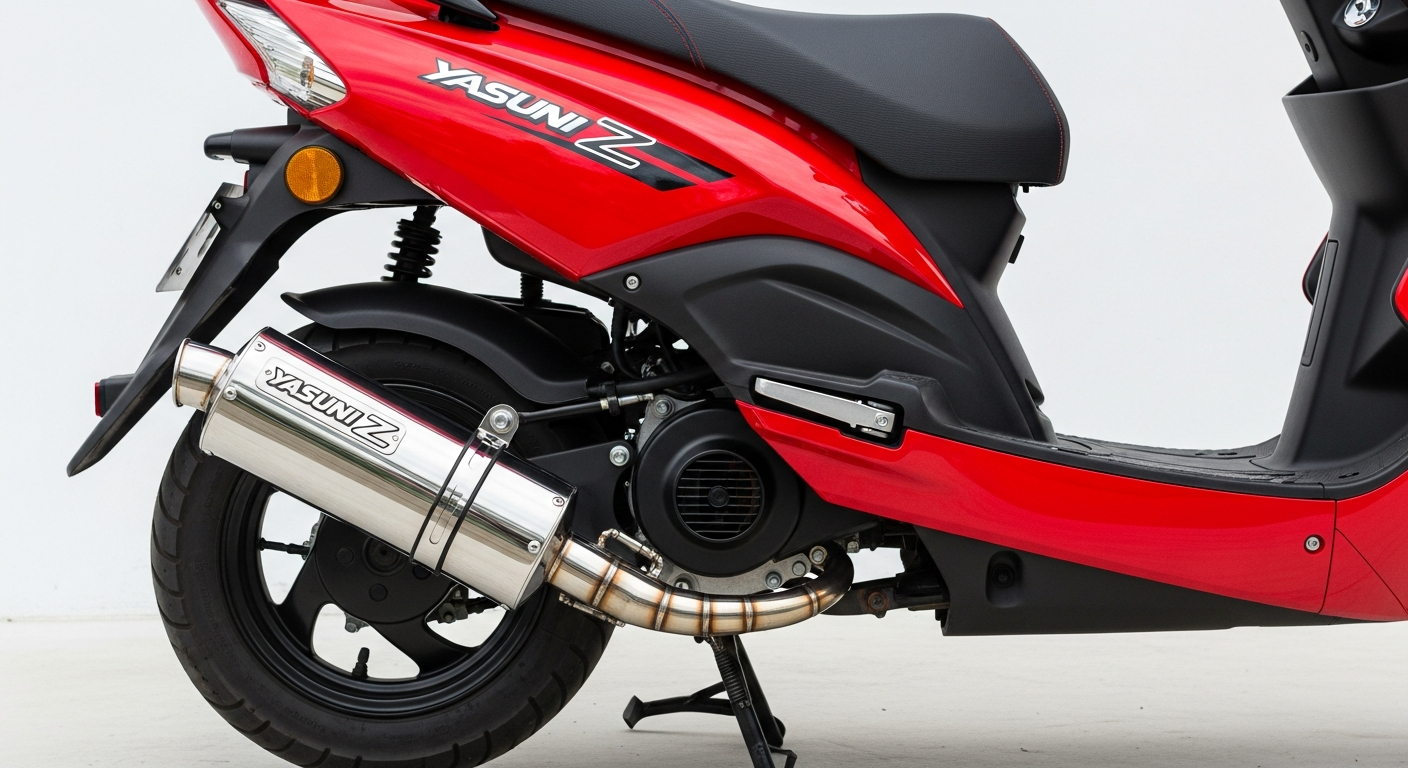
Discover how the Yasuni Z exhaust pipe transforms 50cc motorcycle performance. Learn about specifications, installation requirements, and whether this €150-€250 upgrade is right for your moped or scooter.
Fifty-cubic-centimeter motorcycles might seem limited on power, but riders who've installed a Yasuni Z exhaust pipe know better. The performance jump is real, tangible, and immediate—transforming sluggish acceleration into snappy responsiveness that catches even experienced riders off guard. The Yasuni Z represents a sweet spot in the 50cc tuning world, manufactured with hand-welded steel expansion chambers and lightweight aluminum silencers.
Your 50cc doesn't have to stay stock. Performance upgrades exist specifically for riders willing to unlock what their engine can actually deliver. La Bécanerie, a leading French specialist in two-wheeler parts, has built their reputation on products like the Yasuni Z—the kind of equipment that separates serious enthusiasts from casual commuters. This exhaust system has become a best-seller for good reason: it works, it looks sharp, and it transforms how your bike responds.
Check the Yasuni Z availability at La Bécanerie to see which variant matches your motorcycle.
Engineering Behind the Yasuni Z Expansion Chamber Design
Hand-welded Steel Construction and Gas Flow Dynamics
The Yasuni Z starts with materials, not shortcuts. Each expansion chamber undergoes hand-welding, a process that ensures durability and creates the precise internal geometry required for optimal gas flow. This isn't mass-production stamping—it's precision work that affects how exhaust gases move through the system.
The expansion chamber technology operates on a principle that many 50cc riders never consider: scavenging efficiency. When your piston moves downward, it creates a pressure wave in the exhaust. A properly designed expansion chamber uses this wave to help pull more fresh mixture into the cylinder, increasing the effective compression and power output. The Yasuni Z's chamber diameter, length, and cone angle relationships were engineered specifically to maximize this effect across the RPM range your 50cc engine actually uses.
Aluminum Silencer Integration and Weight Reduction
The silencer isn't just noise control—it's part of the performance equation. Aluminum construction reduces unsprung weight, meaning less mass your engine has to push around. This contributes to improved handling characteristics and snappier throttle response. The silencer also receives corrosion-resistant finishing, ensuring the system maintains its appearance and structural integrity through seasons of riding and weather exposure.
Minarelli Horizontal Engine Optimization
The Yasuni Z was engineered around Minarelli horizontal engines, the dominant engine type in the 50cc market. This focus means fitment and performance tuning are optimized for the specific cylinder head positioning, crankshaft orientation, and porting characteristics of these engines. If your 50cc runs a Minarelli motor, the Yasuni Z was designed with your setup in mind.
Real Performance Gains You'll Actually Feel
Acceleration and Torque Improvements
The most immediate change riders notice happens when rolling off the throttle. Acceleration becomes snappier, with measurable torque increases across the RPM range. That sluggish response to throttle input—the lag where you twist the grip and wait for the engine to react—diminishes noticeably. Your 50cc suddenly feels more responsive, more alive.
Top Speed Enhancements
Standard 50cc engines paired with a Yasuni Z typically see legitimate top-speed gains. The exact numbers vary based on your specific bike model, current jetting, and whether you've implemented other modifications. However, the enhancement isn't marginal—it's substantial enough that riders immediately recognize the difference when pushing toward maximum RPM.
Power Output Differences
Measured against OEM exhausts, the Yasuni Z delivers increased brake horsepower and torque. These aren't incremental gains hidden in technical specifications. Your engine produces more power because the exhaust system allows it to breathe more efficiently. More air in, more fuel combusted, more energy released.
Throttle Response and Scavenging Effects
Improved scavenging means your engine's gas exchange becomes more efficient. The cylinder clears faster, fresh mixture enters more completely, and the combustion process begins with better conditions. Throttle response becomes noticeably crisper—the engine reacts faster to your input, creating that engaging riding feel that stock 50cc exhausts simply don't provide.
Fuel Consumption and Economy Considerations
Performance gains typically come with fuel consumption trade-offs. Your engine burns more fuel at full throttle because it's producing more power. However, during normal riding conditions with moderate throttle application, fuel economy often remains comparable to stock setups. The trade-off: spirited riding consumes more fuel, but daily commuting doesn't necessarily worsen your mileage significantly.
Noise Output Across the RPM Curve
The Yasuni Z produces a distinctive exhaust note that many riders prefer over the muted sound of OEM systems. At low RPMs, the note remains relatively subdued. As RPM climbs, the exhaust tone becomes noticeably louder and more aggressive, creating that sporty character that separates tuned bikes from stock machines. This noise profile appeals to enthusiasts but presents challenges in noise-sensitive areas.
Installation and Tuning Requirements for Optimal Results
Mounting Compatibility Across 50cc Models
The Yasuni Z's mounting system requires consideration across different frame designs and 50cc models. While engineered for horizontal Minarelli engines, the actual attachment points and clearance requirements vary between motorcycles. Some models mount directly with minimal adapter work; others require frame modifications or bracket fabrication. The specific fitment challenge depends on your particular motorcycle and year.
Carburetor Re-jetting Necessity
This is non-negotiable: installing a performance exhaust without carburetor adjustment risks engine damage. A stock carburetor is calibrated for stock exhaust backpressure characteristics. The Yasuni Z changes this backpressure, altering how the fuel mixture behaves. Without re-jetting, your engine runs lean at full throttle, generating excessive heat that damages pistons, cylinders, and valves. Carburetor tuning isn't optional—it's essential.
Jet Size Recommendations and Configuration
General guidance suggests increasing jet size by 6-10 points depending on your specific engine configuration. A stock 50cc engine typically runs jets around 60-65; with the Yasuni Z, sizes often move to 68-75. Tuning cylinder setups require more aggressive jetting increases. These are starting points—your exact requirements depend on altitude, temperature, fuel quality, and other variables.
Installation Difficulty and Tool Requirements
Fitting the Yasuni Z requires specific tools: exhaust bolt extractors if your current system is seized, gasket scrapers for proper sealing surface preparation, torque wrench for correct bolt tension, and likely a carburetor tuning kit with jet assortment. The physical installation difficulty ranges from straightforward (simple bolt-on) to moderately complex (frame clearance modifications). Budget 2-4 hours for DIY installation if you're mechanically experienced; first-timers should allocate longer or consider professional fitting.
Expansion Chamber Break-In Period
New exhaust systems benefit from a proper break-in period. Your first 100-200 kilometers should involve moderate riding without extended full-throttle runs. This allows the welded seams to settle, gaskets to seat properly, and the expansion chamber to reach thermal equilibrium. Riding hard immediately after installation risks premature joint separation or gasket failure.
Engine Damage Risks Without Proper Tuning
Skipping carburetor adjustment after exhaust installation creates a genuine risk of serious engine damage. Lean running conditions generate cylinder head temperatures that exceed safe operating ranges, leading to seized pistons, cracked cylinder walls, or valve damage. The cost of engine repair far exceeds the carburetor tuning expense. This isn't theoretical—it's a documented failure mode among riders who rushed the installation process.
Weighing the Legal and Practical Trade-offs
Street Legality and Regional Compliance
The Yasuni Z's legal status varies significantly by region. In France and much of Europe, aftermarket exhaust systems must meet specific noise limits and emission standards. Some variants carry EU compliance certifications; others do not. Riding a non-compliant exhaust in regulated areas exposes you to fines, technical inspection failures, and police enforcement during traffic stops.
Certification Requirements and Environmental Standards
European emission standards require that exhaust systems meet specific pollutant output levels. Noise regulations typically cap sound output at 82-87 decibels depending on your country and riding speed. The Yasuni Z's acoustic output often exceeds these limits at full throttle. Certification documentation proves compliance; without it, your exhaust system may be illegal despite its legitimate engineering and construction.
Residential Area Restrictions and Noise Ordinances
Many residential areas enforce strict noise ordinances that prohibit loud exhaust systems during specific hours or categorically. Local regulations might restrict riding during evening or early morning hours. Some municipalities prohibit aftermarket exhausts entirely on residential streets. Understanding your local ordinances prevents expensive fines and neighborhood friction.
Insurance Implications and Coverage Effects
Installing a non-standard exhaust may trigger insurance complications. Your policy might require notification of modifications, or coverage could be voided for claim denial purposes. Some insurers charge additional premiums for performance modifications; others simply refuse coverage on modified machines. Contact your insurance provider before installation to clarify their specific requirements.
Warranty Considerations on 50cc Motorcycles
Manufacturer warranties typically become void upon exhaust system replacement. Your 50cc's original warranty likely ceases the moment you remove the OEM exhaust. This means any engine-related failures after installation are your financial responsibility. Warranty voiding usually isn't negotiable—it's a standard consequence of aftermarket modification.
Technical Inspection and Regional Testing Procedures
European technical inspections (MOT equivalents) include exhaust system evaluation. Inspectors check for compliance with noise and emission standards, proper mounting security, and structural integrity. Your Yasuni Z must pass this inspection or your motorcycle won't receive certification for road use. Testing procedures vary by country and inspection facility.
Is the Yasuni Z Worth the €150-€250 Investment?
Cost-to-Performance Ratio Analysis
The Yasuni Z typically costs €150-€250, placing it in the mid-range for 50cc performance exhausts. Compared to the performance gains—meaningful acceleration improvements, top speed increases, and throttle response enhancement—the cost-to-benefit ratio is solid. You're paying €150-€250 for measurable power that transforms how your bike performs. Budget options exist at lower price points but rarely deliver comparable results.
Durability and Long-Term Maintenance Requirements
Hand-welded construction and quality material selection mean the Yasuni Z withstands years of hard riding. Most users report minimal maintenance beyond routine inspection for loose bolts and gasket integrity. Corrosion resistance from aluminum and coated steel keeps appearance and function intact through seasons of weather exposure. Expected lifespan typically exceeds 3-5 years of regular riding, making per-year cost quite reasonable.
Resale Value Impact and Market Perception
Performance modifications generally enhance resale value when the work was done properly and documented. A 50cc equipped with a Yasuni Z appeals to enthusiast buyers willing to pay premium prices for performance gains. However, proper installation, carburetor tuning documentation, and legal compliance maximize resale value. A poorly fitted or non-compliant system might actually deter buyers.
Alternative Exhaust Options and Competitive Products
Other manufacturers produce competing 50cc exhausts in the same price range. Alternatives exist, each with specific strengths. The Yasuni Z's reputation, compatibility with Minarelli engines, and La Bécanerie's specialist expertise make it a benchmark product. Comparing alternatives requires evaluating specific fitment, material quality, and tuning support available for your exact bike model.
Budget Allocation Strategy
Prioritize the Yasuni Z if your primary goal is performance gain. If your budget doesn't accommodate both the exhaust and necessary carburetor tuning, delay the installation until you can fund both upgrades. Allocating resources for proper installation and tuning proves more valuable than rushing the exhaust installation without proper support modifications.
Long-Term Ownership Satisfaction
Rider feedback consistently indicates high satisfaction with Yasuni Z installations. Most owners report the performance gains justify the investment within the first months of ownership. Regrets typically stem from improper installation or inadequate carburetor tuning—not from the exhaust itself. Riders who complete the full upgrade properly and understand the legal implications express strong satisfaction with the modification.
Choosing the Right Yasuni Z Variant for Your 50cc
Model-Specific Fitment and Compatibility
Yasuni manufactures multiple Yasuni Z variants optimized for specific motorcycle models and engine types. Your first step is identifying which variant matches your particular 50cc. Frame design, engine mounting orientation, and available clearance differ between models. La Bécanerie's team specializes in matching variants to specific motorcycles—they know which version fits which bike.
Finish Options and Aesthetic Preferences
Yasuni Z exhausts come in polished, painted, or clear-coated finishes. Polished variants develop character over time but require occasional maintenance to prevent oxidation. Painted options offer durability and low maintenance but limited aesthetic evolution. Clear-coated finishes balance durability with refined appearance. Your choice depends on maintenance commitment and desired aesthetic impact.
Accessory Inclusions and What Comes Standard
Standard packages typically include gaskets, mounting hardware, and basic installation instructions. Some variants include heat shields, specialized mounting brackets, or additional components. Verify exactly what's included before purchase—missing accessories might require separate ordering that delays installation.
Engine Type Matching for Horizontal Minarelli Engines
Confirm your 50cc runs a Minarelli horizontal engine before purchasing. While the Yasuni Z is optimized for these engines, compatibility with other engine types may vary. Horizontal Minarelli engines are prevalent in popular 50cc models, but verification prevents ordering incompatible equipment.
Tuning Cylinder Considerations and 70cc Sport Setups
The Yasuni Z performs well with lightly tuned 50cc cylinders and 70cc sport cylinder upgrades. If you're running or planning a displacement increase, the Yasuni Z's capacity accommodates these upgrades. Tuning cylinder setups will require more aggressive carburetor jetting and produce higher noise output than stock 50cc configurations.
La Bécanerie Expertise in Variant Selection
La Bécanerie's historical focus on 50cc motorcycles and vintage enduro bikes means their team understands the specific fitment and performance requirements across different models. They can guide you toward the exact Yasuni Z variant matching your motorcycle and performance goals. Their specialist knowledge reduces the risk of ordering incorrect equipment.
Real Rider Experiences and Honest Feedback
Performance Testimonials from Active 50cc Communities
50cc owners consistently report that Yasuni Z installations transform their riding experience. Acceleration feels snappier, top speed increases noticeably, and the overall responsiveness improves dramatically. These aren't subjective impressions—riders measure the changes against their previous baseline. The performance enhancement resonates across riding styles and motorcycle models.
Common Installation Challenges and Prevention Methods
The most frequent challenge involves carburetor access and tuning precision. Many riders underestimate the complexity of proper jetting. Heat shield clearance occasionally requires frame modification on certain models. Gasket seating issues arise when previous exhaust removal left surface contamination. These challenges aren't insurmountable—they're preventable with proper preparation and methodology.
Noise Satisfaction and Sound Perception
Some riders immediately love the Yasuni Z's sporty character; others find it excessive. Satisfaction depends on your sound preference and riding environment. Urban riders in noise-sensitive areas often regret the acoustic upgrade. Country and highway riders typically embrace the distinctive tone. This divide is consistent across communities—noise perception genuinely divides opinions.
Long-Term Reliability and Durability Reports
Reliability reports from long-term users are overwhelmingly positive. Systems installed 3-5 years ago remain functional with minimal maintenance. Gasket degradation occurs eventually, but replacement is straightforward and inexpensive. Weld integrity holds, corrosion remains minimal, and bolt loosening is the primary maintenance concern. These are genuinely durable systems.
Regret Factors and Situations Requiring Reconsideration
Regrets typically fall into three categories: legal compliance issues in noise-regulated areas, improper tuning that required expensive engine repair, or excessive noise in residential environments. Riders who understood these constraints before installation rarely express regret. Those surprised by legal enforcement or noise sensitivity often wish they'd made different choices.
Recommendation Patterns and Ideal Use Cases
The Yasuni Z benefits specific rider profiles most: enthusiasts willing to invest in proper tuning, riders with access to open roads where exhaust noise isn't problematic, and 50cc owners seeking legitimate performance gains. It's less ideal for commuters prioritizing reliability, riders in noise-sensitive areas, or those unwilling to undertake carburetor modification. Matching your riding profile to these patterns determines whether the upgrade makes sense.
Making Your Yasuni Z Decision
The Yasuni Z exhaust pipe occupies an interesting position. It's affordable enough to justify for serious 50cc enthusiasts, yet demanding enough—requiring carburetor tuning and legal awareness—that it's not a plug-and-play solution for casual riders. The engineering is genuinely solid, the performance gains are real, and the aesthetic upgrade is undeniable. If you're running a Minarelli-equipped 50cc and you've been craving that extra punch in acceleration, the Yasuni Z delivers.
However, if you live in a noise-sensitive area, prefer stock reliability, or haven't budgeted for carburetor work, reconsider. The upgrade requires commitment to proper installation and tuning. Legal compliance in your region matters significantly. Your riding environment should accommodate the increased noise output. Most importantly, you need realistic expectations: this is a performance upgrade, not a miracle cure for underpowered 50cc engines.
The path forward involves assessment. Evaluate your current 50cc setup, confirm Minarelli engine compatibility, budget for both the exhaust and carburetor tuning, verify local noise and emission regulations, and research the specific Yasuni Z variant matching your model. La Bécanerie's expertise becomes invaluable at this stage—their team can answer model-specific questions and ensure you order the correct equipment.