
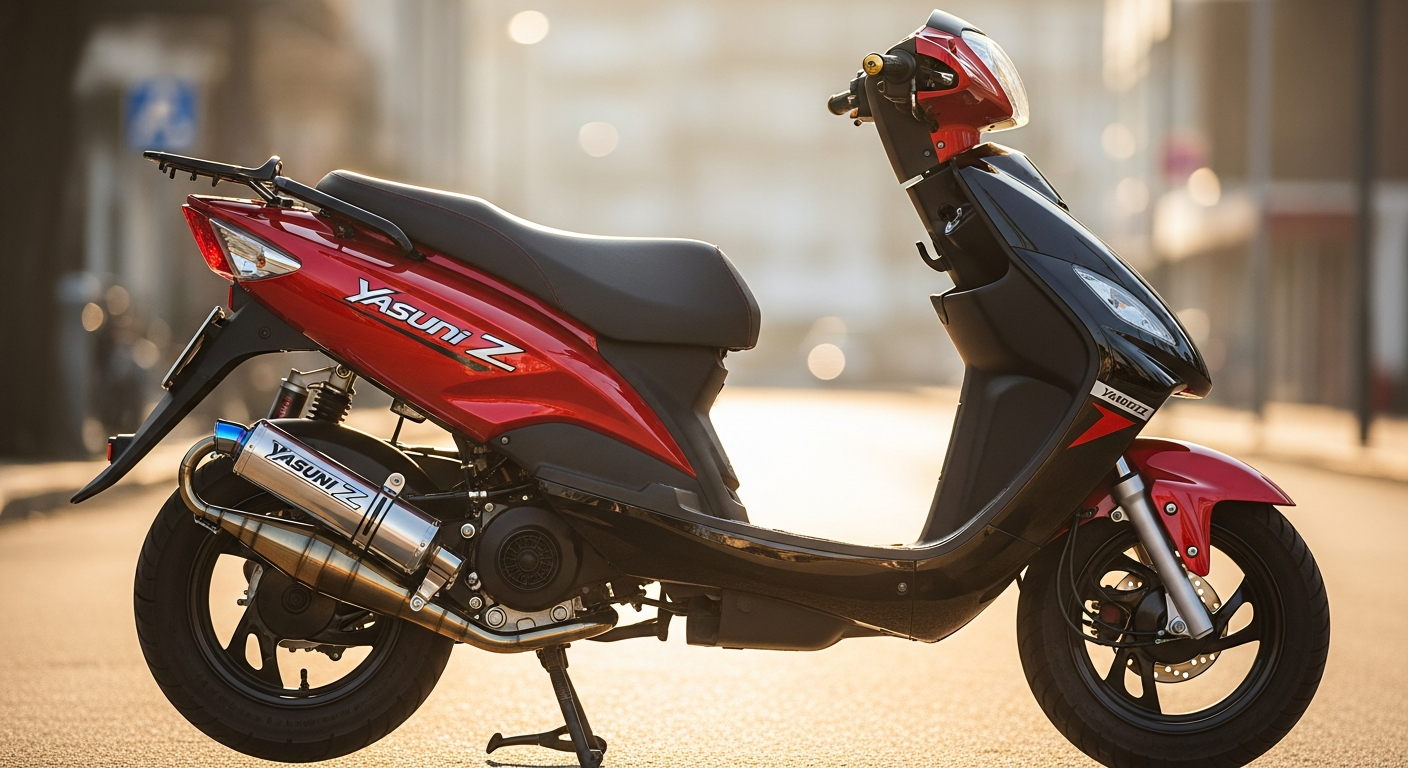
Discover how the Yasuni Z exhaust transforms 50cc scooter performance with expansion chamber technology. Learn installation tips, tuning requirements, and whether this €150-€250 upgrade is worth it.
Most 50cc scooter owners accept that their machines top out around 45 km/h and feel sluggish off the line. Performance feels locked in by design, a ceiling you're forced to live with. But here's the reality: a single component swap can completely change that equation.
The Yasuni Z exhaust is an expansion chamber system engineered specifically for 50cc engines, designed to extract every ounce of power your scooter's motor can deliver. This isn't a cosmetic upgrade—it's a fundamental rethinking of how exhaust gases flow through your engine, translating directly into measurable gains in acceleration and top speed.
Explore the Yasuni Z exhaust system and transform your scooter's performance today.
The Engineering Behind Expansion Chamber Design
How expansion chambers work differently than straight-pipe designs
Stock exhausts on 50cc scooters prioritize simplicity and cost. They're straight pipes with minimal consideration for pressure dynamics. The Yasuni Z takes a completely different approach. Instead of a straight path for exhaust gases, the expansion chamber creates a series of precisely calculated zones that manipulate exhaust pressure waves.
When gases exit the cylinder, they naturally create pressure pulses. A straight pipe allows these to dissipate inefficiently. The expansion chamber captures these pulses, uses them to help scavenge remaining gases from the cylinder, and then re-compresses them at exactly the right moment. This process recycles power that would otherwise be wasted.
The role of primary, secondary, and tertiary cones in power delivery
The expansion chamber's internal geometry isn't arbitrary. Three distinct sections work in concert. The primary cone expands immediately after the cylinder port, allowing high-pressure exhaust gases to expand and cool slightly. This creates a pressure drop that naturally pulls fresh charge into the cylinder—a process called scavenging.
The secondary cone reverses the expansion, compressing the remaining gases. At the precise moment when maximum compression is reached, the cylinder port closes, trapping a supercharged mixture inside for the next combustion cycle. The tertiary cone (the silencer) fine-tunes this pressure wave timing while managing noise.
Why this design specifically benefits 50cc two-stroke engines
Two-stroke engines rely entirely on exhaust timing to manage fuel mixture. Unlike four-stroke engines with dedicated intake and exhaust valves, two-strokes use ports in the cylinder wall. Timing is everything. The Yasuni Z's expansion chamber is optimized for the RPM range where 50cc engines operate best—typically 7,000-11,000 RPM. At these speeds, the pressure wave dynamics create measurable improvements in cylinder filling and combustion efficiency.
Four-stroke engines benefit from expansion chambers too, but the gain is typically modest. Two-strokes see dramatic improvements because their entire breathing cycle depends on timing. The Yasuni Z essentially gives your engine better lungs.
Pressure wave dynamics that improve acceleration and top speed
Acceleration and top speed reflect the same underlying physics: how much power the engine produces across its RPM band. The expansion chamber improves both by enhancing volumetric efficiency—the percentage of the cylinder that fills with fresh fuel mixture on each stroke.
Stock exhausts typically achieve 70-75% volumetric efficiency on 50cc engines. A properly tuned Yasuni Z can push this to 85-90%. That 10-15% improvement translates to roughly 15-20% more horsepower, depending on the specific engine. You'll feel this immediately off the line and at sustained speeds.
Material Quality and Durability Specifications
High-quality steel tube construction for longevity
The expansion chamber tube—the main body—is constructed from high-quality steel. This material choice balances thermal properties, durability, and cost. Steel can withstand the intense heat of exhaust gases (which can exceed 600°C) without warping. The wall thickness is carefully calculated: thick enough to resist corrosion and mechanical damage, but thin enough to keep weight down.
Welding quality matters significantly here. Poor welds create stress points that fail prematurely. The Yasuni Z uses consistent, clean welds throughout. This isn't visible during installation, but it becomes apparent over years of use when the system remains leak-free and structurally sound.
Clear lacquer vs. chrome plating options and their trade-offs
The steel tube can be finished two ways. Clear lacquer provides a natural metallic steel appearance with reasonable corrosion resistance. It's lighter, slightly cheaper, and easier to repair if damaged. The trade-off: lacquer gradually dulls over time from heat cycling and exposure, developing a weathered patina.
Chrome plating offers superior aesthetics and corrosion resistance. It maintains that polished, racing appearance indefinitely. The downside: chrome adds weight, increases cost by €30-50, and can't be easily repaired if the plating cracks. Once chrome fails, the underlying steel corrodes quickly.
Aluminum and carbon fiber silencer materials and weight savings
The silencer section—the end can where sound deadening occurs—typically comes in aluminum or carbon fiber. Aluminum is standard on most Yasuni Z models. It's lightweight, conducts heat well, and resists corrosion. An aluminum silencer adds minimal weight while managing noise effectively.
Carbon fiber silencers are premium options available on higher-end versions. They reduce weight by another 200-300 grams and look exceptionally striking. The trade-off: carbon fiber costs €40-60 more and offers no functional advantage over aluminum—purely aesthetic gain.
Corrosion resistance and maintenance requirements
Despite quality construction, routine maintenance extends lifespan. The interior of the expansion chamber experiences condensation, especially during cool mornings when exhaust temperatures fluctuate. This moisture can cause surface rust if not managed.
Basic maintenance involves occasional inspection for moisture accumulation and ensuring mounting brackets remain tight. If lacquered, applying a thin coat of clear lacquer annually prevents surface oxidation. If chrome, simply clean regularly to maintain appearance. The silencer's interior doesn't require attention—it's sealed during normal operation.
Homologated vs. Non-Homologated: Which Version Do You Need?
What homologation means for road-legal compliance
Homologation is an EU certification process. A homologated exhaust has been tested to confirm it meets noise, emissions, and safety standards. The manufacturer submits documentation proving the system produces acceptable sound levels at specified RPMs and generates emissions within legal limits.
A homologated Yasuni Z carries an approval mark—typically visible as a small stamped logo on the silencer. This mark indicates the system has passed testing for the specific scooter model it's designed for. In France and across the EU, homologated exhausts are road-legal without question.
Noise level differences between homologated and non-homologated versions
Non-homologated systems are louder. Significantly louder. A stock 50cc scooter typically produces 75-80 dB at 7,000 RPM. A homologated Yasuni Z maintains roughly 80-82 dB—noticeable but street-legal. A non-homologated version can hit 88-92 dB, a difference that sounds dramatic in real riding conditions.
This noise difference comes from less sophisticated silencer internals in non-homologated versions. They prioritize unrestricted gas flow for maximum performance, sacrificing noise control. For many riders, this is the entire appeal. For others—especially urban commuters—it's a dealbreaker.
Legal requirements in France and EU regulations
French law permits maximum sound levels of 82 dB for scooters under 50cc. Using a non-homologated exhaust that exceeds this is technically illegal. Police can stop you and fine you for noise violations. In practice, enforcement varies by region and local tolerance, but the law is clear.
EU regulations are consistent across member states. If a system isn't homologated for your specific scooter model, you're technically breaking noise regulations, regardless of subjective sound perception. Homologated systems guarantee compliance; non-homologated systems guarantee legal exposure.
When to choose non-homologated for racing or off-road applications
Non-homologated versions exist for a reason: competitive advantage. On a closed circuit or private property, noise regulations don't apply. A non-homologated Yasuni Z typically produces 2-3 horsepower more than the homologated equivalent due to less restrictive silencer internals. In racing contexts, this matters.
If your scooter never sees public roads—if it's purely for competition or off-road play—non-homologated makes sense. You gain performance with no legal consequences. For street use, homologated is the only responsible choice.
Carburetor Jetting and Tuning Essentials
Why the Yasuni Z demands carburetor re-jetting
Installing a Yasuni Z without changing your carburetor jetting is like opening a dam without adjusting downstream infrastructure. The expansion chamber improves breathing, allowing more air into the engine. Your carburetor must be recalibrated to deliver proportionally more fuel. If you don't adjust jetting, the air-fuel ratio becomes lean—more air than fuel.
Running lean creates several problems. The combustion temperature rises excessively, causing pre-ignition and detonation. The engine knocks audibly, loses power, and accumulates carbon deposits on the piston crown. Continued lean running damages the piston, cylinder wall, and eventually seizes the engine. This isn't theoretical risk—it's a predictable outcome of skipping jetting.
The consequences of running without proper jetting adjustments
Early symptoms appear within hours of installation. You'll notice hesitation at throttle application, a loss of the performance gains you expected, and visible spark plug discoloration (white or tan instead of the normal brown). These signs indicate lean running.
If ignored, progression accelerates. Piston erosion increases, compression drops, and the engine loses more power. Within weeks of regular riding, a lean-running 50cc engine can suffer permanent cylinder wall damage. At this point, engine replacement is the only option. A new engine costs €300-500—far more than the jetting cost.
Step-by-step jetting process for different scooter models
Jetting starts with understanding your carburetor's current jet sizes. On most 50cc carburetors, three jets matter: the idle jet (affects fuel at very low RPM), the needle jet (mid-range), and the main jet (full throttle). A baseline adjustment involves increasing the main jet by one or two sizes—from a stock 78 to an 80 or 82, for example.
The process requires removing the carburetor, accessing the float bowl (where jets reside), and physically replacing the main jet with a larger one. Test rides follow, with attention to spark plug color and throttle response. If the plug is still white (too lean), increase the jet size again. If it turns black (too rich), go back down. This iteration continues until the plug shows that chocolate-brown color indicating proper mixture.
Different models vary slightly. An MBK Booster might need a 80 main jet; a Piaggio Typhoon might need an 82. Consulting model-specific tuning guides or reaching out to experienced tuners prevents guesswork.
Tools and knowledge needed for successful tuning
You'll need basic mechanic tools: screwdrivers, a socket set, and pliers. More importantly, you need replacement jets in common sizes—typically a range from 76 to 85 allows tuning across most scenarios. A spark plug socket and a way to inspect plugs after test rides is essential. Many tuners use a spare carburetor for testing different jets before committing to the final size.
Knowledge is the real requirement. If you're unfamiliar with carburetor anatomy, learning now saves time and mistakes. Countless YouTube tutorials walk through 50cc carburetor jetting. Some riders prefer having a professional tuner handle this—a worthwhile €50-100 investment if you're uncertain.
Get your Yasuni Z exhaust and all the tuning resources you need to maximize performance.
Installation Process and Fitment Compatibility
Precise fitment for MBK Booster, Piaggio Typhoon, Peugeot, and Yamaha models
The Yasuni Z is engineered for specific models. MBK Booster and Piaggio Typhoon are the most common platforms. Peugeot scooters (particularly Speedfight and Vivacity lines) also fit perfectly. Yamaha models like the Aerox and Neo's typically require no modification.
This precision matters. The expansion chamber's primary cone must align perfectly with the cylinder port. The silencer must clear the rear wheel and footpegs. The mounting bracket must bolt to existing engine lugs. Buy a Yasuni Z specifically labeled for your model, and installation is straightforward. Buy a generic expansion chamber, and fitment becomes a nightmare of custom mounting and port misalignment.
Step-by-step installation walkthrough
Installation begins with removing the stock exhaust. Two or three bolts typically hold it to the cylinder. Unbolt these and slide the old system free. Clean the cylinder port of old gasket material using a carburetor cleaner and a gasket scraper. Any remaining debris creates air leaks that ruin tuning efforts.
Install the new gasket onto the Yasuni Z's primary cone. Position the expansion chamber and align the primary cone with the cylinder port. Bolt through the cylinder lug, hand-tightening initially. Next, secure the rear mounting bracket to the frame or swingarm. Many riders use rubber isolators here to dampen vibration. Once both mounting points are hand-tight, tighten progressively to full torque.
Finally, secure the silencer to the expansion chamber body. Most use a simple clamp or bolts. Ensure no components touch the wheel, suspension, or frame. A test ride follows before making any carburetor adjustments.
Tools required for mounting and securing
A basic toolkit suffices: 8mm, 10mm, and 12mm wrenches or sockets (metric, since most European scooters use metric hardware), screwdrivers, and pliers. A torque wrench isn't essential but helps ensure consistent tightness. Having a gasket scraper—a plastic tool that won't damage the cylinder surface—prevents complications during installation.
Rubber isolators are optional but recommended. They cost €10-20 for a set and reduce vibration transmission to the frame. If the Yasuni Z comes with mounting hardware, verify all pieces are present before starting. Missing bolts mean a trip to find replacements.
Potential fitment challenges with specific scooter models
Some scooter variations cause fitment issues. Certain Peugeot variants with reinforced frames have engine mounting differences that shift the cylinder port position slightly. In these cases, spacer rings may be needed to achieve proper port alignment.
Aftermarket plastic bodywork sometimes interferes with silencer clearance. If your scooter has custom panels, measure silencer diameter and rear clearance before purchasing. Another consideration: scooters with added luggage racks or side baskets may have mounting conflicts. These situations aren't common, but they're worth checking before committing to installation.
Real-World Performance Gains You'll Actually Feel
Realistic acceleration gains and 0-50 km/h time improvements
Stock 50cc scooters typically accelerate from 0-50 km/h in roughly 12-15 seconds, depending on weight and engine condition. With a properly tuned Yasuni Z, this time drops to 9-11 seconds—a 25-30% improvement. This is the most noticeable change. Off-the-line sluggishness disappears. The scooter snaps forward when you twist the throttle.
This acceleration gain feels more dramatic than the actual numbers suggest. A three-second improvement transforms how the scooter behaves in real traffic. Merging onto busy roads becomes less precarious. Passing slower traffic takes less time. Commute frustration decreases measurably.
Top speed increases on different scooter models
Stock top speed on a standard 50cc sits around 45 km/h, sometimes reaching 47-48 km/h on optimal days. A Yasuni Z pushes most 50cc scooters to 52-56 km/h, occasionally reaching 58 km/h on well-tuned examples. This 10-15% increase varies by model. Lighter scooters see larger percentage gains. Heavier models with cargo show more modest improvements.
In practical terms, 55 km/h versus 45 km/h changes how you ride. Highways that were previously dangerous become navigable. You're no longer the slowest vehicle on the road. Traffic flow integration improves dramatically.
Horsepower and torque gains from stock baseline
A stock 50cc engine produces roughly 3.5-4.5 horsepower, depending on condition. A Yasuni Z typically adds 0.5-1.2 horsepower, reaching 4.5-5.5 horsepower total. That's a 15-25% increase in power output—substantial for an upgrade that doesn't touch the engine itself.
Torque gains are similarly impressive. Stock engines produce minimal torque (the force that accelerates you forward), usually around 3-4 Nm. The Yasuni Z, combined with proper jetting and spark plug tuning, can push this to 4-5 Nm. This torque increase is what creates the dramatic acceleration sensation.
Throttle response and mid-range power delivery improvements
Stock 50cc scooters feel disconnected. There's a noticeable delay between throttle input and power delivery. The expansion chamber reduces this lag. Your scooter responds more immediately to throttle inputs. This responsiveness makes riding feel sharper, more connected.
Mid-range power delivery—acceleration from 20-40 km/h—improves noticeably. This is where most real-world riding happens. City traffic, suburban commutes, and casual riding occur in this RPM band. Stock exhausts deliver power inconsistently across this range. The Yasuni Z provides more consistent, usable power throughout, making the scooter feel "easier" to ride in realistic conditions.
The Sound Profile and Aesthetic Appeal
Distinctive sound characteristics compared to stock exhausts
Stock 50cc exhausts produce a muffled whine—a high-pitched, relatively quiet sound. A homologated Yasuni Z creates a deeper, more resonant tone. The engine sounds more purposeful, with a hint of sportiness without crossing into obnoxious territory. It's the difference between a coffee maker and an espresso machine: same function, noticeably different character.
Non-homologated versions amplify this further. The sound becomes aggressive—a sharp, commanding tone that announces your presence. At full throttle, it's undeniably loud. Some riders find this exhilarating; others find it socially inconsiderate. The choice between homologated and non-homologated often comes down to whether you want your bike to sound racy (non-homologated) or merely enhanced (homologated).
Visual design and racing-inspired appearance
Aesthetically, the Yasuni Z transforms how your scooter looks. Stock exhausts are bulky, chromed, and visually boring. The Yasuni Z is sleek, with a pointed silencer tip and aggressive cone geometry. It looks like a performance part—because it is. Many riders cite the visual upgrade as half the appeal.
The expansion chamber's large diameter creates visual bulk, which paradoxically looks sportier on most 50cc designs. The system's lines complement modern scooter styling better than stock systems. Add a chrome or carbon fiber finish, and your scooter genuinely looks faster parked than it did before.
Color and finish options available
Standard options include polished steel with clear lacquer or chrome-plated steel. Some retailers offer anodized aluminum options, particularly for carbon fiber silencers, which can match carbon components elsewhere on the scooter. A few premium versions offer matte black finishes, which suit aggressive styling preferences.
Choose finishes based on your scooter's existing color scheme. A white scooter looks sharp with polished chrome. A black scooter suits matte or lacquered finishes. Visual cohesion makes the upgrade feel intentional rather than bolted-on as an afterthought.
Integration with modern scooter styling
Modern 50cc scooters increasingly adopt aggressive, angular designs inspired by larger bikes. The Yasuni Z's tapered cone profile aligns naturally with this trend. It looks like part of the original design rather than an obvious aftermarket addition. Compared to some bulky aftermarket exhausts, the Yasuni Z integrates surprisingly well visually.
Riders often pair the exhaust with complementary upgrades—new grips, sportier rims, or racing-stripe graphics. The Yasuni Z provides a foundation for this transformation, making it the centerpiece of a coherent performance aesthetic.
Pricing, Value, and Investment Considerations
Price range breakdown €150-€250 by version and finish
Entry-level homologated Yasuni Z systems start around €150-170. These feature polished steel with lacquer finish, aluminum silencers, and basic mounting hardware. This is your budget-friendly performance upgrade.
Mid-range versions (€180-210) introduce chrome plating or higher-quality lacquer, sometimes adding carbon fiber silencer options. Premium versions (€220-250) feature full chrome plating, carbon fiber silencers, and sometimes include upgraded mounting kits. Non-homologated versions typically fall within the €160-200 range, sometimes cheaper due to simpler silencer internals.
Price varies by retailer. La Bécanerie, as a leading French supplier, typically sits in the mid-range pricing. Buying from specialized scooter shops versus general retailers can affect cost by €20-30.
Cost comparison to other 50cc performance upgrades
A Yasuni Z provides exceptional value-to-performance ratio. Alternative upgrades include: air filter kits (€40-80, yielding 0.2 horsepower gain), variator tuning kits (€120-180, providing marginal improvements), or complete engine rebuilds (€400+, maximizing performance but requiring specialized knowledge).
The exhaust delivers performance comparable to €300+ in cumulative minor upgrades, while costing less and requiring less installation complexity. For riders seeking maximum bang-per-euro, the Yasuni Z is unmatched among 50cc upgrades.
Hidden costs including jetting tools and professional installation
If you handle jetting yourself, budget €30-50 for replacement jets in multiple sizes. If you prefer professional tuning, expect €80-150 in labor. Installation can be DIY (free, if you're mechanically inclined) or professional (€40-80 for labor). Total hidden costs: €50-230 depending on your approach.
Some riders underestimate these supplementary costs. Budgeting €200 for the exhaust alone, then discovering €100+ in jetting costs, creates sticker shock. Plan for a total investment of €250-350 when including all components.
Resale value and long-term investment return
A used Yasuni Z in good condition typically resells for 60-70% of original purchase price. If you buy at €200 and sell at €120, that's a real cost of €80 for the performance period you owned it. This amortizes well over 2-3 years of riding.
The durability of the Yasuni Z means resale value holds better than cheaper alternatives. A €50 exhaust that rusts after a year has terrible value longevity. A €200 Yasuni Z with proper maintenance remains structurally sound for years, maintaining resale appeal. Long-term cost-per-use typically favors investing in quality.
Potential Drawbacks and Realistic Limitations
Increased noise levels and legal considerations
Homologated Yasuni Z exhausts comply with 82 dB noise regulations, but they're noticeably louder than stock systems. If you live in noise-sensitive neighborhoods or commute during early morning or late evening, complaints from neighbors or authorities are possible. Non-homologated versions virtually guarantee noise-related issues if ridden on public streets.
Even homologated systems can draw unwanted attention in areas with strict enforcement. Understand local noise enforcement culture before purchasing. Urban environments with relaxed attitudes toward scooter noise differ dramatically from suburban areas with HOA-equivalent noise enforcement.
Engine damage risk without proper carburetor adjustments
This cannot be overstated: installing the Yasuni Z without proper jetting risks catastrophic engine damage. A seized engine from lean running is an expensive problem. This risk exists for riders who skip research or attempt installation without consulting jetting guides. It's entirely preventable through education and due diligence, but it's a real hazard for impatient installers.
Complexity of jetting for inexperienced riders
While jetting isn't impossibly complex, it requires mechanical aptitude and willingness to learn. Riders uncomfortable removing carburetors or interpreting spark plug colors face a learning curve. Some riders successfully navigate this curve; others find it discouraging. Having a fallback option—a professional tuner—costs money but eliminates this risk.
Emissions compliance and environmental regulations
Most homologated Yasuni Z versions meet EU emissions standards. Non-homologated versions typically don't. In regions with strict emissions testing, non-homologated systems can fail inspections. This is an issue primarily in areas with vehicle emissions testing programs. Many regions don't enforce this for 50cc scooters, making it a non-issue practically.
That said, environmental consciousness matters to many riders. A properly tuned Yasuni Z actually improves emissions efficiency compared to stock exhausts running lean or overfueled. Performance upgrades and environmental responsibility can align if done properly.
Beyond the Exhaust: Complementary Upgrades
Intake manifold and air filter upgrades
The exhaust works optimally with matching intake improvements. A high-flow air filter (€25-50) allows easier breathing, complementing the exhaust's improved scavenging. Some riders add intake manifold modifications, porting the carburetor opening to match the manifold ID. This is more technical and benefits from professional help, but it compounds exhaust gains.
Logically, upgrading the exhaust first (the most impactful component) then assessing whether additional intake improvements are warranted makes sense. Many riders find the exhaust alone delivers satisfying performance.
Ignition system improvements and spark plug selection
The stock ignition system on 50cc scooters is basic. A higher-quality spark plug (€10-20) improves combustion efficiency, particularly beneficial when using the Yasuni Z and increased fuel (from jetting adjustments). Iridium or platinum plugs outlast copper and ignite mixtures more reliably.
Aftermarket ignition kits exist (€80-150) with electronic ignition modules that fire more reliably than points-based stock systems. These benefit naturally aspirated 50cc engines, but the cost-to-gain ratio is lower than the Yasuni Z. Prioritize the exhaust before investing in ignition upgrades.
Clutch and variator tuning for power transfer
A transmission bottleneck often exists. The stock variator (the mechanism controlling gear ratio changes) isn't optimized for the power the Yasuni Z produces. Upgrading to a high-performance variator (€150-250) and roller weights (€40-80) improves power transfer and acceleration feel.
For serious performance builds, variator tuning follows the exhaust upgrade. But for most riders seeking improvement without deep mechanical involvement, the exhaust alone justifies the investment.
Which modifications to prioritize for maximum impact
If budget is €200 total: allocate it entirely to the Yasuni Z. If budget is €400: add high-flow air filter and professional jetting. If budget is €600: add variator tuning and ignition upgrades. This sequencing maximizes return on investment at each budget level.
The Yasuni Z is the foundational upgrade—the thing that makes everything else worthwhile. Skip it, and other upgrades deliver marginal gains. Start with it, and subsequent improvements multiply in effectiveness.
Why the Yasuni Z Remains the Go-To Choice for 50cc Riders
The Yasuni Z exhaust delivers on its promise. It genuinely transforms how your 50cc scooter accelerates, sounds, and feels on the road. The expansion chamber technology works—there's no marketing hype here, just solid engineering that extracts real performance from your engine. That acceleration improvement, that responsiveness, that distinctive sound—these aren't illusions. They're the result of physics working correctly.
That said, this upgrade demands respect. Proper jetting isn't optional; it's essential. Skip this step and you're risking serious engine damage. A €200 exhaust paired with a €400 engine replacement is a catastrophic value equation. Take jetting seriously, and the Yasuni Z becomes one of the best investments a 50cc rider can make.
At €150-€250, the Yasuni Z sits at a sweet spot between affordability and quality. You're getting a durable, well-engineered product that will outlast your current scooter. Whether you're a casual commuter wanting better acceleration or a scooter enthusiast chasing every performance gain, the Yasuni Z earns its status as La Bécanerie's best-seller.
The system's popularity isn't manufactured. It exists because the Yasuni Z consistently delivers results. Riders invest in it, experience the transformation, and recommend it to others. That word-of-mouth reputation—earned through genuine performance and reasonable value—explains why it remains the standard against which other 50cc exhausts are measured.
Just commit to doing the tuning right, and you'll unlock a genuinely different riding experience.