
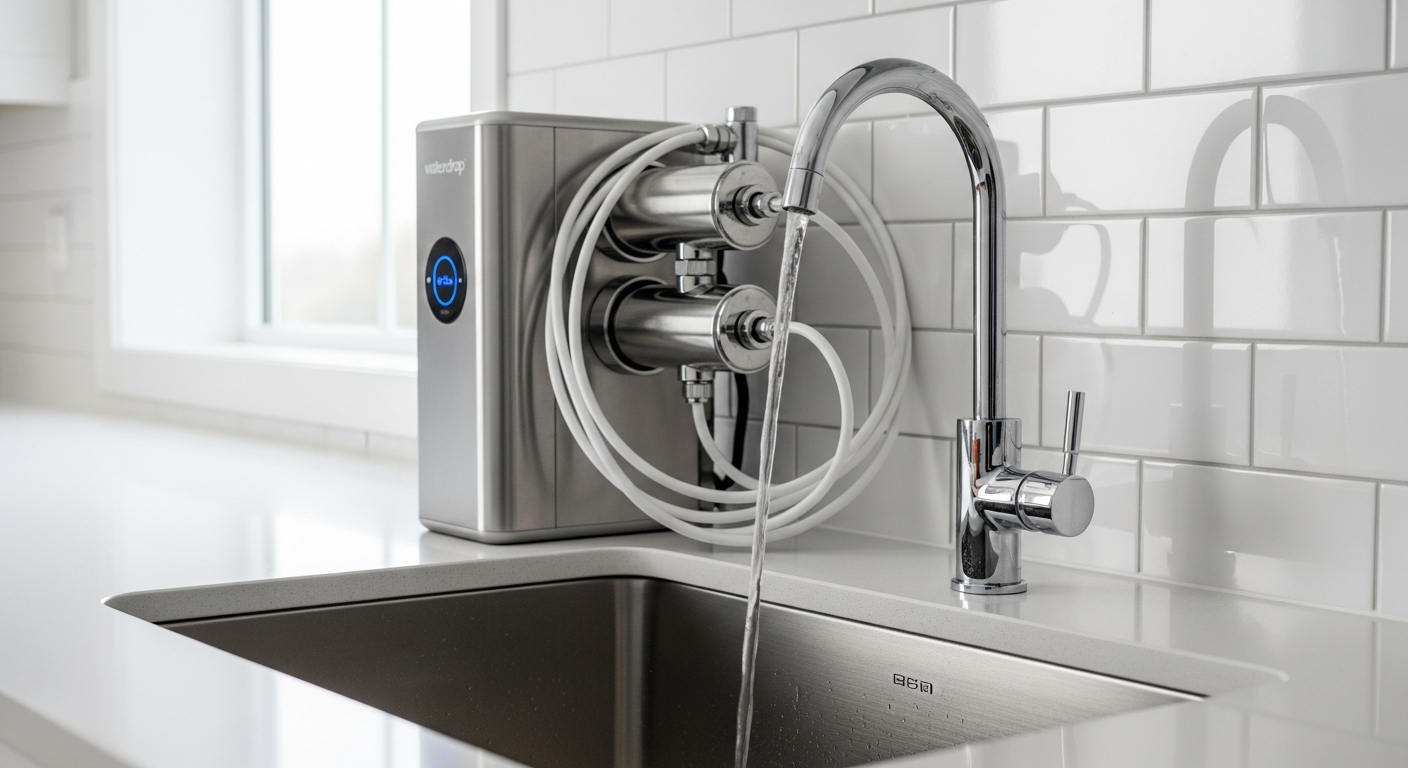
Discover how the Waterdrop G3P800 Tankless RO System delivers premium filtration in minimal space with 800 GPD capacity, 10-stage filtration, and eco-friendly 3:1 drain ratio.
Over 85% of homeowners with limited under-sink space abandon the idea of premium water filtration altogether. That statistic reveals a genuine problem: traditional reverse osmosis systems demand real estate that most modern kitchens simply don’t have. The Waterdrop G3P800 Tankless Reverse Osmosis System represents a fundamental shift in how we approach water purification at home, eliminating the storage tank that has defined RO systems for decades.
Unlike traditional RO systems that rely on bulky storage tanks occupying 15-20 gallons of under-sink cabinet space, the G3P800 operates without one. This isn’t a minor design tweak—it’s a architectural reimagining that changes what’s possible in compact living spaces. The system maintains exceptional filtration performance while freeing up the valuable real estate you’ve been hoarding for cleaning supplies and spare containers.
Throughout this guide, you’ll uncover exactly why the G3P800 has become Waterdropfilter ES’s best-selling product, including its revolutionary tankless architecture, impressive 10-stage filtration performance, environmental benefits of its efficient 3:1 drain ratio, and whether this premium investment aligns with your household needs. Explore the Waterdrop G3P800 on Waterdropfilter.eu to see current pricing and available discounts.
How Traditional RO Tanks Consume Precious Cabinet Space
Standard reverse osmosis systems require storage tanks because pressure-driven filtration works intermittently. Water collects in a tank under pressure, then releases on demand. This design necessitates a cylindrical vessel occupying 15-20 gallons of space—roughly equivalent to a small refrigerator tucked into your cabinet.
For apartment dwellers, RV owners, and anyone with limited kitchen infrastructure, this becomes a dealbreaker. You’re forced to either sacrifice cabinetry or abandon premium filtration altogether. Small kitchens in European apartments, in particular, make tank-based systems impractical or impossible to accommodate.
The Compact Footprint Advantage of the G3P800’s Tankless Design
The G3P800 eliminates the tank entirely through an advanced pressure-driven system that produces filtered water on demand. This tankless approach compresses what traditionally occupies a corner cabinet into a slim, vertical unit that fits discreetly under most sinks. Real-world users report installation in spaces where traditional RO systems couldn’t physically fit.
The space savings apply universally across living situations. Urban apartments gain precious storage real estate. RV and tiny home enthusiasts finally access premium water filtration without permanent fixture compromises. Even those with standard kitchens benefit from the aesthetic advantage—a sleek, modern vertical unit replaces a bulky cylindrical tank.
Real-World Storage Solutions for Small Kitchens, Apartments, and RVs
In compact urban kitchens, every cubic inch matters. The G3P800’s narrow profile allows installation alongside existing plumbing without requiring cabinet reorganization. Users in tight spaces report that the system fits comfortably between pipes and waste disposal units, leaving room for storage containers and cleaning supplies.
Apartment renters appreciate the minimal footprint for another reason: installation doesn’t require permanent modifications that landlords typically object to. The system mounts cleanly under the sink with straightforward plumbing connections that don’t damage cabinetry.
RV enthusiasts have embraced the G3P800 specifically because traditional tank-based systems are incompatible with mobile living. The tankless design accommodates the spatial constraints of vehicle kitchens while delivering the same premium filtration quality found in full-sized home installations.
Why Eliminating the Tank Doesn’t Compromise Filtration Quality or Water Purity
Some assume removing the storage tank reduces filtration effectiveness. The opposite is true. Tankless systems maintain water purity through direct pressure-driven filtration without storing treated water in a reservoir where quality can degrade. Biological growth, mineral redeposition, and oxidation—all risks in stored water—are eliminated entirely.
The G3P800’s 10-stage filtration process functions independently of tank storage. Each stage performs its designated function whether water moves directly to your glass or sits in a tank. Removing the tank actually prevents the degradation that occurs during storage, delivering fresher, purer water each time.
The Aesthetic Appeal of a Sleek, Modern System Versus Bulky Traditional Models
Design matters in modern homes. A cylindrical tank occupying visible cabinet space feels dated and industrial. The G3P800’s vertical, minimal profile aligns with contemporary kitchen aesthetics. Its sleek design reflects premium engineering rather than industrial necessity.
Homeowners upgrading their kitchens increasingly prioritize systems that don’t look like utilities. The G3P800 satisfies that aesthetic preference while delivering uncompromising performance. You get modern water filtration that doesn’t announce itself as a bulky afterthought.
Unmatched Flow Rate: Pure Water in Seconds, Not Minutes
Traditional tank-based RO systems operate under a fundamental constraint: water builds pressure in the tank slowly, sometimes taking minutes to fill a glass. The G3P800 obliterates this limitation through direct pressure-driven filtration that produces water on demand at impressive flow rates.
800 GPD Capacity Explained: What It Means for Daily Household Consumption
GPD stands for Gallons Per Day—the theoretical maximum volume a system can produce during continuous operation. The G3P800’s 800 GPD capacity means it can generate 800 gallons of filtered water in 24 hours under ideal conditions. For household context, that translates to approximately 33 gallons per hour, or roughly one gallon every two minutes.
Most families consume between 10-20 gallons of drinking and cooking water daily. The 800 GPD capacity ensures the G3P800 never struggles to meet typical household demand, even during peak usage periods. You’re not constrained by tank capacity or pressure buildup cycles.
The 6-Second Cup-Fill Feature and Its Practical Implications for Busy Families
The most striking performance metric for the G3P800 is its 6-second cup-fill capability. Turn the tap and have purified drinking water ready almost instantly. For families juggling morning routines, this speed becomes practically valuable—no more waiting for filtered water while managing breakfast preparations or school-time logistics.
Parents filling water bottles for children’s sports, professionals making quick drinks before commuting, and anyone who values convenience recognize that 6 seconds to a full glass represents a genuine quality-of-life improvement. The system adapts to real household rhythms rather than requiring you to plan ahead for water filtration.
Comparison of Flow Rates Between Tankless and Traditional Tank-Based RO Systems
Standard tank-based RO systems typically produce water at 10-15 GPH (gallons per hour) into their storage tank. Even with a full tank available, dispensing water is limited by the tank’s capacity. Once depleted, you must wait for the system to slowly refill the tank—a process taking 30 minutes to several hours depending on the system.
The G3P800’s direct pressure-driven system produces water at rates exceeding 50 GPH, delivering immediate access without waiting for tank refill cycles. The practical difference is profound: traditional systems force you to adapt your usage around system capacity, while the G3P800 adapts to your usage patterns.
How Pressure-Driven Filtration Maintains Speed Without Sacrificing Purity
Pressure-driven filtration doesn’t compromise purity by operating at higher speeds. In fact, the reverse osmosis membrane’s ultra-fine 0.0001 micron pore size functions identically whether water flows quickly or slowly. What changes is throughput, not filtration effectiveness.
The G3P800 achieves this speed through advanced membrane technology and system design that maintains optimal pressure across the filtration stages. Water molecules pass through the membrane at the same molecular level regardless of flow rate. Higher speed means more molecules processed per unit time, not less stringent filtration.
10-Stage Filtration Breakdown: What Each Layer Removes
The G3P800’s comprehensive filtration process operates through 10 distinct stages, each targeting specific contaminant categories. Understanding these stages reveals why the system achieves its certified performance across such a broad contamination spectrum.
Stage-by-Stage Explanation of the Comprehensive Filtration Process
The filtration process begins with sediment capture and progresses through increasingly refined stages before culminating in the reverse osmosis membrane. Each stage serves a distinct purpose: removing large particles, eliminating chlorine, capturing organic compounds, blocking dissolved solids, and finally, polishing the water to pharmaceutical purity standards.
This multi-stage approach addresses limitations of single-stage systems that attempt to handle all contaminants through one membrane. The G3P800 distributes filtration responsibility across specialized stages, extending membrane life and improving overall system efficiency.
Sediment and Pre-Filtration Stages: Removing Visible Particles and Chlorine
Initial stages capture sediment, sand, silt, and visible particles that would otherwise clog downstream components. These mechanical filtration stages protect the system’s longevity while improving water clarity. Subsequent carbon pre-filters target chlorine and other volatile organic compounds that can damage the reverse osmosis membrane.
Chlorine removal is particularly important because chlorine degrades RO membranes, reducing their lifespan. The G3P800’s dedicated carbon stages ensure chlorine is eliminated before water reaches the membrane, extending filtration system durability and maintaining membrane integrity across its service life.
Carbon Filtration Layers: Targeting Taste, Odor, and Organic Compounds
Activated carbon excels at capturing taste and odor contaminants that mechanical filtration misses. These compounds include pesticides, herbicides, and volatile organic compounds that affect water palatability. The G3P800’s carbon layers work through absorption, bonding contaminant molecules to the carbon surface.
Carbon filtration also addresses chlorine byproducts and other chemical residues common in municipal water supplies. Multiple carbon stages ensure comprehensive coverage of the organic compound spectrum, producing water that tastes clean and fresh rather than chemically treated.
RO Membrane Specifications: 0.0001 Micron Pore Size and Molecular Selectivity
The reverse osmosis membrane represents the filtration system’s centerpiece. Its 0.0001 micron pore size is approximately 1/5000th the width of a human hair. At this scale, only water molecules and certain minerals pass through. Dissolved solids, salts, heavy metals, and microorganisms are blocked entirely.
This molecular selectivity is why reverse osmosis achieves TDS (Total Dissolved Solids) reduction superior to any other residential filtration method. The membrane’s precision is absolute—contaminant molecules larger than the pore size cannot pass, regardless of their chemical properties or electrical charge. This makes reverse osmosis effective against an extraordinarily broad range of contaminants.
Discover the complete 10-stage filtration specifications of the G3P800 on Waterdropfilter.eu.
Environmental Efficiency: The 3:1 Drain Ratio Advantage
Water conservation matters increasingly in our resource-conscious world. Traditional reverse osmosis systems generate significant wastewater—typically 3:1 or 4:1 wastewater-to-product ratios, meaning three to four gallons of water drain for every gallon of filtered water produced. The G3P800 inverts this equation through its efficient 3:1 product-to-drain ratio.
Understanding Wastewater Production in Traditional RO Systems
Reverse osmosis inherently produces wastewater because the process involves forcing water through a semi-permeable membrane. Contaminants unable to pass through the membrane become concentrated in reject water that must drain. Standard RO systems struggle to balance high flow rates with wastewater minimization.
Many households running traditional RO systems operate at 1:4 or 1:5 ratios—producing only one gallon of filtered water for every four to five gallons drained. For a family using 15 gallons of filtered water daily, that translates to 60-75 gallons of wastewater flowing down the drain. Over a year, this represents thousands of wasted gallons.
How the G3P800 Achieves Its Efficient 3:1 Ratio for Water Conservation
The G3P800 achieves its superior efficiency through advanced membrane technology and system design that optimizes pressure distribution and membrane surface area. Rather than forcing water through the membrane at maximum speed regardless of waste consequences, the G3P800 balances flow rate with efficiency.
This isn’t a compromise between speed and conservation. The system delivers both 800 GPD capacity and minimal wastewater through engineering that maximizes the membrane’s productive output while minimizing reject water. The 3:1 ratio represents genuine improvement over competitive systems operating at significantly worse water-to-waste ratios.
Water Conservation Impact Over a Year of Typical Household Use
Consider a household using 15 gallons of filtered water daily. With the G3P800’s 3:1 ratio, producing that 15 gallons requires approximately 5 gallons of wastewater drain. Over a year, that totals roughly 1,825 gallons of filtered water and 608 gallons of drain water.
A traditional system operating at 4:1 would require 60 gallons of drain water daily to produce those same 15 gallons of filtered water. Annually, that represents 21,900 gallons of drain water—roughly 35 times more waste than the G3P800 generates. For water-conscious homeowners, this difference carries real environmental and economic significance.
Ecological Benefits of Reduced Drain Water and Utility Bill Savings
Reduced wastewater directly lowers your municipal water consumption. Water authorities increasingly charge for both consumption and sewage disposal, making wastewater reduction financially advantageous. The G3P800’s efficiency can reduce your water bill noticeably over months of operation.
The ecological impact extends beyond your household bill. Municipal water systems experience reduced strain when households operate efficient filtration. Less water diverted to filtration and less wastewater processed through treatment facilities both decrease infrastructure demand. Collectively, efficient RO adoption reduces the environmental footprint of residential water consumption.
Certified Performance: What the Certifications Actually Guarantee
Certification claims mean nothing without understanding what certifications actually validate. The G3P800 carries certifications that address specific performance parameters, not universal water quality guarantees.
NSF/ANSI 58 Certification: What It Means for TDS Reduction Claims
NSF/ANSI 58 specifically certifies reverse osmosis system performance for TDS (Total Dissolved Solids) reduction. This rigorous standard requires systems to reduce TDS by at least 75% across a defined test water composition. The certification validates that the system performs as advertised for its primary function—reducing dissolved mineral content.
NSF/ANSI 58 doesn’t certify removal of specific contaminants like PFAS or lead, though many RO systems excel at removing these substances. The certification establishes baseline performance expectations that legitimate manufacturers meet through testing and ongoing quality control.
NSF/ANSI 372 Lead-Free Material Standard and Why It Matters
NSF/ANSI 372 certifies that system components contacting water meet lead-free material standards. This prevents lead leaching from plumbing materials into filtered water—a significant concern with older systems using brass fittings or other potentially contaminated materials.
Lead contamination represents a legitimate health concern, particularly for children and pregnant individuals. NSF/ANSI 372 certification guarantees that the G3P800’s wetted materials don’t introduce new contaminants while removing others. It’s a fundamental safety standard that responsible manufacturers maintain.
SGS Testing Methodology and Third-Party Validation Importance
SGS (Société Générale de Surveillance) represents an independent third-party laboratory conducting rigorous contaminant testing. Unlike manufacturer claims, SGS testing occurs under standardized conditions by professionals without financial interest in the product’s success. This independence ensures credibility.
SGS testing documented the G3P800’s effectiveness against PFAS, fluoride, lead, chromium, iron, nitrate, and chloride—demonstrating removal across a contamination spectrum far broader than NSF/ANSI 58 addresses. Third-party validation transforms manufacturer claims into verified performance data.
How Certifications Protect You From Unsubstantiated Filtration Claims
The filtration industry includes numerous unsubstantiated claims about contaminant removal. Companies marketing systems as removing everything from bacteria to radioactive particles without supporting evidence flood consumer markets. Certifications establish a verification baseline that separates legitimate products from marketing exaggeration.
When a manufacturer presents NSF/ANSI certification or SGS testing results, you’re examining independently verified performance data. This distinction matters enormously because your family’s water quality depends on accurate information, not optimistic marketing language. The G3P800’s certifications mean you’re purchasing verified performance rather than promises.
Premium Investment Breakdown: Pricing and Long-Term Value
The G3P800 positions itself as a premium product with pricing reflecting its advanced technology and certified performance. Understanding the cost structure and long-term value proposition clarifies whether the investment aligns with your priorities.
Current Pricing Structure and Typical Discount Availability
The G3P800 typically carries a mid-to-high-hundreds price point in euros or dollars, reflecting premium engineering and certification. European pricing frequently features discounts around €200 off the original price, while US pricing includes comparable reductions around $240. These discounts don’t indicate inflated original pricing—they reflect standard promotional strategies for premium water filtration systems.
The existence of frequent discounts suggests the system maintains strong market demand and benefits from high sales volumes that allow promotional pricing. Unlike obsolete products offered at discount to clear inventory, the G3P800’s frequent promotions reflect its popularity among informed consumers willing to invest in quality filtration.
Cost-Per-Gallon Calculation Over the System’s Lifespan
Premium filtration economics require long-term thinking. If you purchase the G3P800 at a discounted price of roughly €300-400 and operate it for five years, producing 15 gallons daily of filtered water, the calculation becomes approximately:
3,650 gallons yearly × 5 years = 18,250 total gallons produced. At a €350 initial investment divided across 18,250 gallons, the baseline cost-per-gallon is roughly €0.02. Adding estimated filter replacement costs (approximately €150-200 over five years) brings the total cost-per-gallon to roughly €0.03-0.04 per gallon.
Compare this to bottled water costs ranging from €0.30-1.00 per gallon, and the G3P800’s value becomes compelling. Even accounting for municipal water costs and electricity consumption, the system’s per-gallon cost dramatically undercuts bottled water alternatives.
Comparison With Pitcher Filters, Faucet-Mounted Systems, and Traditional RO Setups
Pitcher filters cost €20-40 but require frequent replacement (monthly cartridges at roughly €5-10) and offer limited contaminant removal. Over five years, pitcher filters exceed €400 in cumulative costs with inferior filtration performance.
Faucet-mounted systems cost €30-80 upfront but deliver poor flow rates and require cartridge replacement every 2-3 months. Five-year costs approach €200-300 with filtration performance adequate only for basic chlorine and taste improvement.
Traditional tank-based RO systems cost similarly to the G3P800 (€300-500) but consume significant cabinet space and produce substantially more wastewater. The G3P800’s premium positioning reflects its superior efficiency and space savings, not inflated pricing relative to comparable systems.
Filter Replacement Costs and Replacement Frequency Schedules
The G3P800’s 10-stage filtration system requires replacement cartridges on varying schedules. Sediment and carbon pre-filters typically require replacement every 6-12 months depending on water quality and usage patterns. The reverse osmosis membrane lasts 2-3 years under typical household conditions.
Filter replacement costs vary by region but generally total €150-200 annually for a typical household, or roughly €750-1,000 over a five-year period. This ongoing investment represents the true operating cost beyond initial purchase price. Factor these replacement expenses into your long-term value calculation to understand total cost of ownership.
Maintenance & Longevity: Keeping Your System Running Strong
Like all water filtration systems, the G3P800 requires periodic maintenance and filter replacement. Understanding maintenance requirements ensures optimal performance and system longevity.
Filter Replacement Schedule for Each of the 10 Stages
The G3P800’s filtration stages operate on different replacement schedules reflecting their varying contaminant loads. Sediment pre-filters typically require annual replacement or sooner depending on water turbidity. Carbon pre-filters require replacement every 6-12 months for optimal chlorine removal and taste improvement.
The reverse osmosis membrane, representing the system’s core filtration component, typically lasts 2-3 years before performance begins declining. Subsequent filtration stages have varying replacement frequencies, with manufacturers providing specific guidance based on local water conditions. Tracking replacement schedules prevents performance degradation and extends system lifespan.
Cost and Availability of Replacement Cartridges
Replacement cartridges for the G3P800 are widely available through Waterdropfilter.eu and authorized retailers. Pre-filter cartridges cost roughly €15-30 each, while RO membranes cost €60-100 depending on the specific component and regional pricing. Post-filtration cartridges complete the replacement spectrum.
Availability differs by geographic location, so purchasing replacement cartridges during initial system installation ensures you maintain adequate inventory. Waterdropfilter maintains robust supply chains for their popular G3P800 system, minimizing delays in filter delivery and replacement.
System Flushing and Membrane Care Protocols
Regular system flushing removes accumulated sediment and minerals that can degrade membrane performance. Monthly flushing with clean water helps maintain optimal flow rates and extends membrane life. The G3P800’s design accommodates simple flushing procedures that most users complete in minutes.
Membrane care protocols vary by water hardness and contamination levels. Users in areas with high mineral content should consider periodic membrane cleaning using specialized solutions that prevent mineral buildup. Following manufacturer guidance optimizes membrane longevity and maintains system efficiency throughout its service life.
Troubleshooting Common Issues and Preventative Maintenance Tips
Low flow rate—the most common issue—typically indicates sediment or mineral accumulation in pre-filters or the membrane requiring replacement. Following recommended replacement schedules prevents this problem entirely. If flow rate decreases between scheduled replacements, water quality or mineral content may have changed, suggesting more frequent replacements are necessary.
Water pressure fluctuations often signal pre-filter cartridge saturation. Replacing sediment or carbon filters usually restores normal operation. Unusual sounds or water leakage indicate potential system or connection issues requiring professional inspection.
Preventative maintenance primarily involves maintaining filter replacement schedules and periodic system flushing. These simple practices ensure the G3P800 operates at peak performance throughout its lifespan, delivering consistently excellent water quality while minimizing future problems.
Your Path to Pure Water Without the Space Sacrifice
The Waterdrop G3P800 Tankless Reverse Osmosis System isn’t just another premium filtration option—it’s genuinely transformative for anyone forced to choose between water quality and kitchen space. The revolutionary tankless design eliminates the bulky storage tank that has defined reverse osmosis systems for decades, freeing up cabinet real estate while maintaining uncompromising filtration performance.
The impressive 800 GPD capacity delivers pure water in seconds rather than minutes, adapting to real household rhythms instead of constraining your usage around system limitations. The comprehensive 10-stage filtration process, backed by rigorous third-party certifications from SGS and NSF/ANSI standards, removes a contamination spectrum from PFAS and fluoride to lead and chromium with documented, verified performance.
The 3:1 drain ratio demonstrates that performance and environmental responsibility don’t conflict. This efficiency simultaneously reduces your water bill, minimizes environmental impact, and eliminates the guilt of operating a wasteful system. You gain premium filtration while being genuinely water-conscious.
Whether you’re managing a compact urban kitchen where traditional RO systems simply don’t fit, concerned about specific contaminants degrading your tap water, or simply exhausted with plastic bottle waste cluttering your home, the G3P800 delivers on its flagship reputation. The initial investment is substantial, but the long-term value becomes compelling when calculated across five years of operation—the cost-per-gallon dramatically undercuts bottled water while providing superior consistency and safety.