
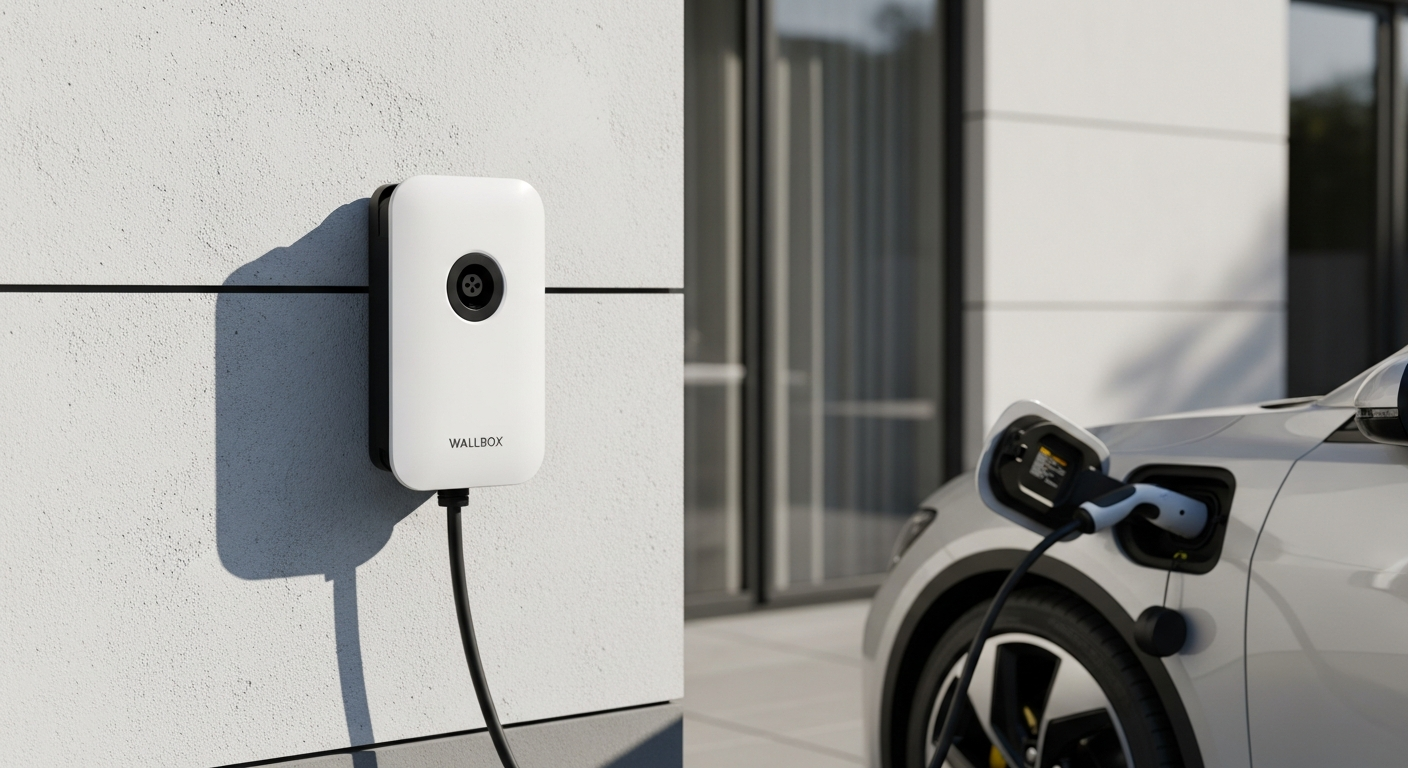
Discover how the WALLBOX Pulsar Plus 7.4kW EV charger combines intelligent app control, adjustable power, and compact design for seamless home charging. Learn why it’s France’s top choice for EV owners.
Smart EV Charging for Your Home: The WALLBOX Pulsar Plus 7.4kW Guide
Over 40% of European EV owners struggle with slow, inflexible charging solutions that don't adapt to their household's electrical capacity or their vehicle's needs. The gap between what homeowners have and what they actually require has created a real problem in the EV adoption journey. Traditional chargers operate on a rigid, one-size-fits-all principle that ignores the complexity of modern household electricity distribution.
The WALLBOX Pulsar Plus 7.4kW represents a fundamental shift toward intelligent, user-centric EV charging for residential spaces. This compact unit from Carplug FR delivers dynamic power adjustment, smartphone connectivity, and weather-resistant durability—all packed into a sleek 16x16cm frame. It's become France's best-selling home charger because it actually responds to what homeowners need rather than forcing them to work around its limitations.
Discover the Pulsar Plus 7.4kW on Carplug FR today
This guide will help you understand how smart charging technology works and whether the Pulsar Plus 7.4kW aligns with your household setup, examining its adaptive power features, real-world charging speeds, installation considerations, and financial value.
Smart Charging Meets Household Flexibility: Understanding Adjustable Power Technology
How the 1.4 kW to 7.4 kW power range adapts to different electrical panel capacities
Your home's electrical panel has limits. Most residential properties operate with a specific maximum capacity, and attempting to exceed that capacity triggers circuit breakers or threatens the stability of your entire electrical system. The Pulsar Plus 7.4kW acknowledges this reality through adjustable power technology that scales from 1.4 kW up to 7.4 kW based on what your installation can actually handle.
This flexibility means the charger doesn't assume your household has a fresh 7.4kW capacity available. If your electrical panel runs at 6kW maximum, you adjust the charger to 6kW. If you've got a newer installation with abundant capacity, the charger operates at full 7.4kW. The technology prevents the impossible scenario where a charger demands more power than your infrastructure can provide.
Managing multiple household devices without circuit overload or tripped breakers
Charging an electric vehicle consumes significant electricity. A 7.4kW charger operating at full capacity pulls as much power as multiple household appliances combined. When you're running the washing machine, heating water, and charging your EV simultaneously, electrical systems can become severely strained.
The Pulsar Plus adjusts to prevent this overload scenario. Rather than operating at a fixed power draw that could clash with your microwave, oven, or heating system, dynamic adjustment allows the charger to reduce its consumption when other devices activate. The result: no tripped breakers, no dangerous electrical strain, no need for expensive panel upgrades in many cases.
Real-world scenarios: charging during peak hours versus off-peak optimization
Peak charging hours typically coincide with evening meal preparation when household electricity demand peaks. Charging during these hours means competing with kitchen appliances for electrical capacity. Off-peak hours—usually late night or early morning—offer abundant electrical headroom and often feature lower electricity rates.
The Pulsar Plus 7.4kW enables these strategic charging windows. You can schedule charges for off-peak hours through the smartphone app, automatically reducing your electricity costs while avoiding circuit strain. Weekend mornings might allow full 7.4kW charging, while weekday evenings might require reducing to 3.7kW to accommodate dinner preparation.
The role of dynamic load balancing in preventing electrical strain
Dynamic load balancing represents the intelligence layer within the charger. The system continuously monitors your home's total electrical consumption and automatically adjusts the charging rate to maintain safe margins. If a heating system activates or your air conditioning kicks in, the charger detects this change and reduces its draw proportionally.
This prevents the scenario where your charger and household systems compete for limited capacity. The technology works quietly in the background, ensuring that charging never compromises your home's comfort systems or electrical safety. You don't manually manage these adjustments—the charger handles them autonomously.
Smartphone app controls that let you adjust charging power in real-time
Manual control remains available whenever you need it. The Pulsar Plus smartphone app provides immediate access to power settings, allowing you to reduce charging from 7.4kW to 3.7kW with a single tap. This proves valuable when you notice unusual electrical strain, when electricity rates change, or when household demands shift unexpectedly.
The app interface presents clear information about current charging power, session duration, and energy consumption. Rather than approaching the charger physically in your garage or driveway, smartphone management happens from anywhere inside your home or even remotely when away.
Integration with household energy management systems for maximum efficiency
Modern smart home systems can communicate with the Pulsar Plus 7.4kW to optimize charging around solar panels, battery storage, or variable electricity rates. If your household has rooftop solar panels generating excess power at noon, the integration can trigger charging to capture that renewable energy. If your electricity rate drops during specific hours, the system can automatically schedule charging for those windows.
This integration capability elevates the charger from a standalone device into a component of your household's broader energy strategy.
Explore how Pulsar Plus integrates with your smart home setup at Carplug
Connectivity and Remote Control: The Modern EV Owner's Advantage
Bluetooth and WiFi connectivity features explained
The Pulsar Plus 7.4kW connects to your smartphone through dual connectivity pathways: Bluetooth for direct communication when you're near the charger, and WiFi for permanent connection when you're at home or remotely monitoring from elsewhere. Bluetooth handles initial setup and troubleshooting without requiring WiFi infrastructure. WiFi enables the persistent connectivity that keeps you informed during charging sessions regardless of your location.
This dual-connectivity approach ensures you're never disconnected from your charger's status and capabilities.
Smartphone app functionality: monitoring sessions, adjusting power, scheduling charges
The accompanying app transforms the Pulsar Plus into a controllable device rather than a fixed installation. You monitor real-time charging progress, view energy consumption for each session, and receive notifications when charging completes. Power adjustment happens through simple interface controls—reducing from 7.4kW to lower settings requires just a few taps.
Scheduling functionality proves particularly valuable for cost optimization. You can program the charger to begin charging at specific times, allowing you to capture off-peak electricity rates or maximize solar generation timing.
Real-time notifications about charging status and completion
Rather than physically checking your charger or driveway, notifications arrive on your smartphone throughout the charging session. You'll receive alerts when charging begins, periodic updates on progress, and confirmation when the session concludes. This eliminates the uncertainty of wondering whether your vehicle actually charged or whether something interrupted the process.
Remote access capabilities when away from home
Imagine being away during the day and receiving an alert that your vehicle's charge has reached 80%—you can then reduce the charging rate to 1.4kW to preserve battery health or stop the session entirely. This remote capability means you're never truly disconnected from managing your EV's charging cycle, even during extended absences or work commitments.
How app-based scheduling aligns with electricity tariff variations
Many electricity providers offer different rates based on time of day, day of week, or season. Off-peak rates might be 40% lower than peak rates. The Pulsar Plus scheduling functionality allows you to automatically align charging with these favorable rate windows, accumulating substantial savings across months and years of ownership.
Integration potential with smart home ecosystems
The charger works within broader smart home platforms, communicating with other connected devices to optimize household energy consumption holistically. This integration potential makes the Pulsar Plus a forward-thinking choice that grows with your smart home infrastructure.
Durability in Every Weather: IP55 and IK08 Protection Standards
What IP55 weather resistance actually means for outdoor installations
IP55 rating indicates the charger can withstand powerful water jets from any direction. This covers scenarios from heavy rain to carwash spray. The first digit (5) means protection against dust—not complete dust-proof, but resistant to limited dust ingress. The second digit (5) represents water protection from jets at pressures and volumes typical of heavy rainfall or outdoor cleaning.
For residential installations in nearly any climate, IP55 provides sufficient weather protection to ensure safe operation through multiple seasons.
IK08 impact protection rating and real-world durability implications
IK08 measures impact resistance. Specifically, it indicates the charger can withstand impacts equivalent to 5 joules of energy—roughly the force of a 1.6kg mass dropped from 0.5 meters directly onto the unit. This covers accidental bumps, impacts from tools or equipment, and the normal wear of outdoor installations without catastrophic failure.
The combination of IP55 and IK08 ratings means the Pulsar Plus tolerates the harsh realities of outdoor charging infrastructure.
Performance in rain, snow, and extreme temperature conditions
Rain presents no operational threat to the charger. Snow accumulation on the unit doesn't impair function, though heavy snow loads might eventually require manual clearing. Extreme temperatures—from freezing winters to scorching summers—don't compromise the unit's electronics or structural integrity. The robust construction ensures performance across the full spectrum of European climates, from Mediterranean heat to Nordic winters.
Corrosion resistance for coastal or humid environments
Coastal properties face particular challenges from salt spray and corrosive environmental factors. The Pulsar Plus materials resist corrosion, maintaining functionality in these demanding conditions where less durable chargers might degrade rapidly. This proves especially valuable for properties near the ocean or in regions with persistently high humidity.
Longevity expectations and maintenance requirements
The sturdy construction suggests a lifespan extending well beyond typical consumer electronics. With minimal maintenance—occasional cleaning to remove dirt or debris—the charger should function reliably for a decade or more. No regular calibration, no complex servicing, no moving parts to wear out. The robust build quality directly translates to extended operational life.
How robust construction reduces repair costs over the charger's lifetime
A charger that survives multiple seasons without degradation eliminates expensive repair and replacement costs. The upfront investment in durability returns value through years of trouble-free operation. Compared to budget alternatives that might require replacement after 5-6 years, the Pulsar Plus's construction promises substantially lower lifetime costs.
Installation Reality Check: What You Need to Know Before Purchasing
Why professional installation is non-negotiable for safety and compliance
EV charger installation involves high-voltage electrical work that carries real safety risks. Professional installation ensures proper wiring, correct grounding, appropriate circuit protection, and full compliance with electrical codes and regulations. Attempting DIY installation exposes you to electrocution hazards, fire risks, and potential invalidation of product warranties.
Carplug FR's certified installation network handles this critical work according to legal requirements and safety standards specific to your region.
Electrical requirements and panel upgrades if necessary
Some properties require electrical panel upgrades before supporting a 7.4kW charger. The installation professional assesses your current capacity and recommends upgrades if needed. Older homes with limited electrical service might need panel expansion, adding to the overall installation cost. Modern homes with adequate capacity proceed without additional work.
This assessment during consultation allows you to understand the complete financial picture before committing to installation.
Timeline expectations from ordering to first charge
Typical timelines span 2-4 weeks from order placement to operational charging. Initial consultation and electrical assessment require scheduling flexibility. Parts availability, installation scheduling, and final electrical inspections all factor into the timeline. Understanding these expectations prevents frustration and allows you to plan vehicle charging around the installation period.
Carplug FR's certified installation network and service quality
Carplug FR's reputation as France's leading EV charging specialist extends to installation service quality. Their certified technicians bring specialized knowledge and professional standards to each installation. This professional network removes the burden of finding qualified electricians familiar with EV charger specifications and requirements.
The 5-meter Type 2 cable: advantages and limitations
The included 5-meter cable provides convenient reach to most vehicles parked in typical residential driveways or parking spaces. Five meters covers positioning flexibility without requiring excessive cable lengths that create tripping hazards or unsightly installations. For garages where the charger mounts directly above the parking space, five meters proves more than sufficient.
However, if your parking location sits significantly farther from the proposed charger installation, you might need either to relocate the charger or use an extension cable.
Wall mounting considerations for different property types
Garage walls, exterior walls, carport structures, and freestanding mounting poles all accommodate the Pulsar Plus. The compact 16x16cm size means installation fits most locations without requiring extensive structural modifications. The installation professional evaluates your specific property layout and recommends optimal placement balancing accessibility, weather exposure, and electrical cable routing.
Charging Speed in Practice: What 35 Kilometers Per Hour Really Means
How 7.4kW translates to real-world range extension per charging hour
The Pulsar Plus at full 7.4kW output extends your EV's range by approximately 35 kilometers per hour of charging. This assumes your vehicle accepts the full power delivery and accounts for average efficiency across common EV models. One hour of charging provides roughly the range needed for a typical daily commute.
This metric helps you calculate actual charging times for your specific needs and vehicle.
Comparison with slower 3.7kW chargers and faster 11kW+ installations
A 3.7kW charger provides approximately 17-18 kilometers of range per hour—precisely half the speed. Overnight charging over 8-10 hours accumulates substantial range for daily driving. Faster 11kW+ chargers operate at roughly triple the Pulsar Plus speed, but require three-phase electrical supply unavailable in many residential properties and add significant installation complexity.
The 7.4kW sweet spot balances charging speed against household electrical capacity and installation complexity for most residential applications.
Overnight charging scenarios for typical daily commutes
If your daily commute covers 50 kilometers, an overnight charging session at 7.4kW (approximately 7 hours) provides ample range for the next day. Most EV owners' daily driving falls well within the range delivered by 7-8 hours of overnight charging at 7.4kW. This eliminates anxiety about charge depletion and allows you to operate the vehicle with confidence in your household's charging capability.
Weekend fast-charging capabilities for longer trips
While overnight charging handles daily driving, weekend trips requiring longer range benefit from daytime fast-charging sessions. A 6-hour weekend charging session at 7.4kW adds approximately 210 kilometers of range—sufficient for most weekend excursions or longer journeys when starting from a fully charged state.
Time-to-full-charge calculations for popular EV models
Renault Zoe with its 50kWh battery reaches full charge in approximately 6-7 hours at 7.4kW. Nissan Leaf with 40kWh battery requires roughly 5-6 hours. Tesla Model 3 with larger battery capacity needs 8-10 hours. These calculations vary based on battery size, charger efficiency, and whether charging begins from empty or partial charge.
The sweet spot between charging speed and electrical capacity for most homes
The 7.4kW power level represents optimal balance for residential installations. It delivers meaningful charging speed for practical daily use and weekend trips without requiring extensive electrical infrastructure upgrades. Faster chargers demand three-phase power or significant panel upgrades. Slower chargers demand extended charging durations that impair convenience. The 7.4kW Pulsar Plus occupies the center point where speed meets practical residential electrical capacity.
Financial Breakdown: Is the €707.94 Investment Worth It?
Purchase price analysis and what's included in the box
The €707.94 price includes the charger unit itself, the 5-meter Type 2 cable, mounting hardware, and documentation. This represents the hardware cost before professional installation labor. The price point reflects the charger's smart connectivity features, adjustable power technology, and durable construction. Budget chargers omitting smart features might cost €400-500, while premium alternatives approach €1,000+.
Professional installation cost estimates and labor considerations
Professional installation typically costs €300-600 depending on your location, electrical complexity, and any required panel upgrades. Straightforward installations at homes with adequate electrical capacity fall toward the lower end. Installations requiring panel modifications or extensive cable routing approach the higher range. Carplug FR provides specific quotes after electrical assessment.
The 5.5% reduced VAT saving of approximately €110
Carplug applies reduced VAT of 5.5% on supply and installation—a significant regulatory savings compared to standard 20% VAT. This reduction saves approximately €110 on the total investment. The savings emerge automatically when purchasing and installing through Carplug FR's certified network.
Comparison with competitor chargers in the same power range
Similar 7.4kW chargers from other manufacturers range from €650-900. The Pulsar Plus positions itself in the mid-range, offering smart connectivity features that justify its price relative to basic alternatives while remaining accessible compared to premium brands. Purchasing through Carplug FR's network and accessing reduced VAT makes the value proposition particularly attractive.
Long-term savings through optimized charging during off-peak hours
If your electricity rates drop 40% during off-peak hours and you shift most charging to those windows, annual savings could reach €200-400 depending on your annual mileage and local electricity pricing. Over a 10-year ownership period, these accumulated savings might total €2,000-4,000. The app scheduling functionality makes capturing these savings straightforward rather than requiring constant manual management.
Potential government incentives or rebates for home EV infrastructure
Many European regions offer government subsidies, tax credits, or rebates for EV charging infrastructure installation. These incentives vary significantly by location, from direct rebates covering 20-50% of installation costs to tax deductions on capital expenditures. Consulting with Carplug FR about available incentives in your specific region could substantially reduce your net investment.
Making Your Home EV-Ready: The Pulsar Plus 7.4kW Decision
The WALLBOX Pulsar Plus 7.4kW isn't just another wallbox charger—it's a smart infrastructure upgrade that transforms how you interact with EV ownership. Its adjustable power adapts to your household's electrical reality, its app connectivity puts control in your pocket, and its rugged construction promises years of reliable service through any weather.
The professional installation requirement adds complexity and cost that deserves serious consideration. The €707.94 price tag, combined with installation labor, represents a meaningful investment. However, when you factor in the reduced VAT savings of approximately €110, the potential government incentives varying by region, the long-term durability that reduces repair and replacement costs, and the convenience of intelligent charging management aligned with off-peak electricity rates, the investment aligns with what modern EV owners actually need.
The charger's adjustable power from 1.4 kW to 7.4 kW means you're not locked into a fixed electrical configuration. Your household needs change—adding appliances, upgrading your electrical panel, or modifying your parking setup. The Pulsar Plus adapts rather than becoming obsolete. Its broad compatibility with all Type 2-equipped vehicles across European manufacturers ensures relevance as your vehicle ownership evolves over years of ownership.
I'd recommend the Pulsar Plus 7.4kW if you're looking for a charger that grows with your EV lifestyle—one that handles your current vehicle while remaining compatible with future electric cars. If cost represents your primary concern and you're willing to sacrifice smart connectivity for a basic charger, budget alternatives exist. But if charging convenience, energy optimization, and robust long-term reliability matter to you, this charger justifies its investment.
Contact Carplug FR to discuss your household setup and receive an installation quote today