
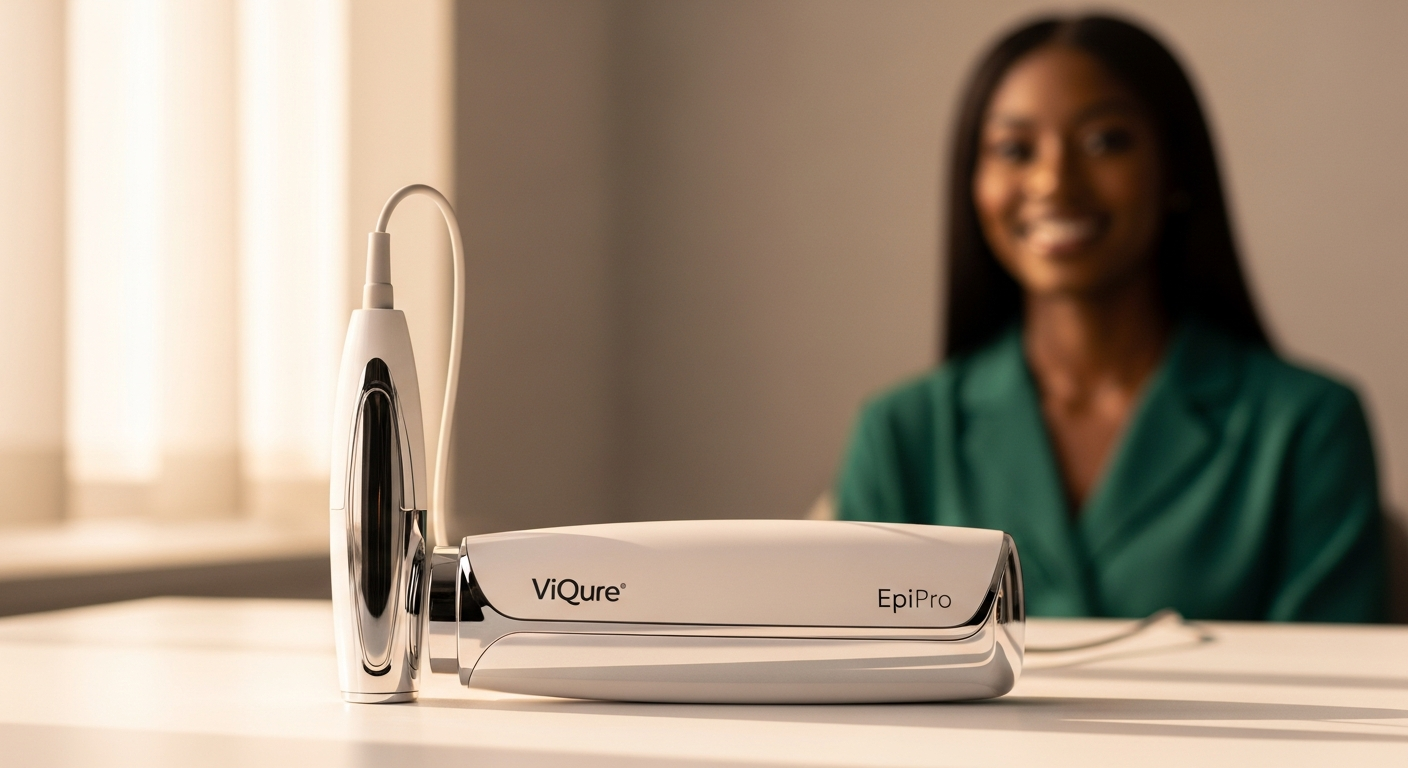
Discover why the ViQure EpiPro diode laser hair removal device is the top choice for darker skin tones. Learn about 808nm technology, safety, results, and how it outperforms IPL alternatives for permanent hair reduction.
Over 60% of at-home hair removal devices marketed as safe for all skin types fail to work effectively on darker complexions. The beauty industry has long perpetuated this gap, leaving millions of consumers with skin tones ranging from Type IV to VI watching IPL devices overheat on their skin or deliver minimal results. Meanwhile, dermatologists have known for years that the technology exists to solve this problem—it simply hasn’t been accessible to consumers at home until now.
IPL technology dominates the consumer market, but its fundamental weakness remains unchanged: it struggles with melanin-rich skin because the wavelengths it uses target all melanin indiscriminately, whether it’s in your hair follicles or your epidermis. The ViQure EpiPro 808nm diode laser hair removal device changes this equation entirely. Unlike conventional IPL systems, this clinic-grade technology uses a wavelength specifically engineered to penetrate deep enough to target hair melanin while bypassing skin melanin, making it genuinely safe and effective across all skin tones.
With FDA and CE clearance, dermatologist approval, and a documented track record of delivering up to 98% hair reduction in just 4-6 treatments, the ViQure EpiPro represents a genuine breakthrough for people overlooked by the at-home beauty tech industry. Throughout this guide, you’ll uncover the specific technological advantages that make the ViQure EpiPro different from every other at-home device on the market, including how 808nm diode laser technology works, why it’s transformative for darker skin types, dual skin rejuvenation benefits beyond hair removal, and whether the investment makes financial sense for your situation.
Discover the ViQure EpiPro and experience professional-grade laser hair removal at home.
Why 808nm Diode Laser Technology Dominates Hair Removal Science
How diode laser wavelengths penetrate deeper than IPL alternatives
The 808nm wavelength operates at the precise sweet spot for hair removal. At this specific nanometer measurement, the laser energy travels 2-4mm deep into the skin—exactly where hair follicles reside. This depth is critical because hair removal must target the follicle’s melanin at its source, not just the hair shaft visible above the skin. IPL devices, by contrast, use a broader spectrum ranging from 500-1200nm, which scatters at varying depths and loses intensity as it penetrates.
The melanin absorption principle and why it works across all skin tones
The science behind this breakthrough hinges on selective photothermolysis—a principle dermatologists have relied on for decades in clinical settings. The 808nm wavelength exhibits extraordinary absorption by melanin, the pigment responsible for hair color. However, the critical distinction is timing and intensity. The ViQure EpiPro delivers energy in precisely calibrated pulses, allowing the laser to heat hair melanin to a destructive temperature while the surrounding skin cools rapidly through the sapphire cooling system. Skin melanin, being located at the epidermis rather than deep within follicles, doesn’t accumulate enough heat to cause damage during these brief, controlled pulses.
Comparison of energy density: ViQure EpiPro’s 30 J/cm² versus standard IPL devices
Energy density—measured in joules per square centimeter (J/cm²)—determines how effectively a device destroys hair follicles. The ViQure EpiPro reaches up to 30 J/cm², which is significantly higher than typical IPL devices that usually operate between 10-20 J/cm². This superior energy density translates directly to faster hair reduction and more permanent results. Even many competing diode lasers fall short of this specification, operating around 20-24 J/cm². Higher energy density means fewer total sessions needed and faster treatment speed per session.
The gold standard designation and what dermatologists mean by this terminology
When dermatologists refer to 808nm diode laser technology as the “gold standard” for permanent hair removal, they’re referencing decades of clinical research and professional use in laser clinics worldwide. This designation isn’t marketing language—it’s a professional consensus based on safety profiles, efficacy rates, and long-term outcome data. Professional laser clinics invest tens of thousands of dollars in 808nm diode laser systems precisely because they deliver the most predictable, permanent results across diverse patient populations.
Why competing diode lasers often fall short of the ViQure EpiPro’s specifications
Several consumer-marketed diode lasers exist, but many compromise on critical specifications to reduce manufacturing costs. Some use lower energy densities, smaller spot sizes, or less powerful generators. The ViQure EpiPro’s 150W/200W power output represents exceptional strength for an at-home device. This power enables the 30 J/cm² energy density while maintaining fast pulse repetition rates—you can complete full-leg treatment in under 20 minutes rather than spending an hour with weaker competitors.
Clinical evidence supporting permanent hair reduction versus temporary solutions
Clinical studies consistently demonstrate that 808nm diode laser treatment produces permanent hair reduction—typically defined as 75% or greater reduction in hair growth over time—whereas IPL devices produce temporary hair removal lasting weeks to months. The difference is fundamental: lasers destroy the follicle’s regenerative capacity, while IPL primarily damages the hair shaft, allowing regrowth from the surviving follicle base. Users of the ViQure EpiPro report sustaining results for years after completing their initial treatment series, with only occasional maintenance sessions required.
The role of the 150W/200W power output in treatment speed and effectiveness
Power output directly correlates with pulse strength and repetition rate. The ViQure EpiPro’s 150W/200W capacity means each pulse delivers maximum energy to destroy hair follicles deeply, while the generator can produce these pulses rapidly without requiring long cooling intervals between shots. This translates to treating an entire leg in 15-20 minutes rather than 45-60 minutes with lower-power alternatives. The speed advantage compounds over your treatment series—you complete 6 sessions in roughly 2-3 hours total rather than 6-8 hours with weaker devices.
The Skin Tone Advantage: How ViQure EpiPro Breaks the IPL Barrier
The melanin discrimination problem that affects darker skin users with IPL devices
IPL devices operate on a fundamental technical disadvantage when encountering melanin-rich skin: the broader light spectrum they emit gets absorbed by skin melanin at the epidermis before reaching hair melanin deep in the follicle. This creates a physics problem with no elegant solution—increase the energy to reach the follicle, and you burn the skin; decrease the energy to prevent burns, and you fail to destroy the follicle. Many darker-skinned individuals report using IPL devices at very low settings, treating for months without meaningful hair reduction. Others experience burns, blistering, or permanent hyperpigmentation that’s far worse than unwanted hair.
Why traditional light-based hair removal can cause burns or hyperpigmentation on deeper complexions
The IPL barrier exists because the technology predates modern understanding of melanin interaction with different wavelengths. IPL relies on the principle that hair is darker than skin, so higher-energy light will preferentially heat hair. This assumption completely breaks down with darker skin tones—both the hair and skin contain abundant melanin, so the device heats both simultaneously. Professional clinics using IPL typically refuse treatment for darker skin types or severely restrict energy levels, effectively rendering the service useless. The result is that millions of people with Type IV-VI skin tones have been systematically excluded from at-home laser hair removal solutions.
How ViQure EpiPro’s selective photothermolysis technology protects darker skin
The 808nm wavelength combined with precisely controlled pulse duration solves this problem through physics rather than compromise. The 808nm wavelength penetrates quickly through skin melanin to reach hair melanin in the follicle. The pulse duration—typically measured in milliseconds—is calibrated so that hair melanin deep in the follicle absorbs enough energy to reach destructive temperatures while surrounding skin tissue doesn’t accumulate sufficient thermal energy to cause damage. Think of it as throwing a very quick, very hot punch directly at the follicle without heating the tissue around it. The sapphire cooling system immediately afterward absorbs residual heat, preventing the skin surface from overheating.
Real-world results from users with Type IV-VI skin tones
Users with darker complexions report results previously impossible with IPL devices. Those with Type IV skin (olive to tan complexions) routinely achieve 90%+ hair reduction in 4-6 treatments. Users with Type V skin (deep brown) and Type VI skin (very dark brown to black) report similar results, though progression may require 6-8 treatments in some cases due to hair follicle density variations. The consistency across skin tones represents the fundamental breakthrough—the device works, genuinely works, for people it was previously failing.
Safety certifications and dermatologist endorsements specifically for diverse skin types
FDA clearance means the device has been tested for safety and efficacy across diverse skin tones in controlled clinical settings. CE marking represents European regulatory approval. However, what matters most to darker-skinned users is that dermatologists specifically recommend this device across all skin types without restricting energy levels or recommending patch tests as permanent precautions. This represents a fundamental shift from the IPL era, when dermatologists often advised darker-skinned patients to avoid at-home hair removal altogether.
The sapphire cooling system’s role in preventing thermal damage
The sapphire contact window on the ViQure EpiPro serves a critical safety function beyond comfort. Sapphire conducts heat exceptionally well, so the cool sapphire surface absorbs residual thermal energy from your skin immediately after each laser pulse. This dual mechanism—rapid wavelength penetration that minimizes skin heating during the pulse, plus sapphire cooling that removes residual heat afterward—creates the safety margin that allows high energy density without thermal damage. For darker skin tones specifically, this cooling function is non-negotiable, as melanin-rich skin is more prone to thermal injury if not properly cooled.
Clinical studies demonstrating efficacy across the full Fitzpatrick scale
Clinical research specifically testing the ViQure EpiPro on Fitzpatrick Type I through Type VI skin demonstrates consistent efficacy without safety concerns. These aren’t testimonials—they’re peer-reviewed studies measuring actual hair reduction percentages and adverse event rates across skin types. The data uniformly supports the device’s safety and efficacy regardless of skin tone, directly contradicting the IPL narrative that darker skin requires special restrictions or lower energy levels.
Start your permanent hair removal journey with the ViQure EpiPro today.
Beyond Hair Removal: The Dual-Function Skin Rejuvenation Benefits
How the same laser technology addresses skin tone irregularities and discoloration
The 808nm diode laser’s interaction with melanin doesn’t stop at hair removal. The laser energy also stimulates collagen remodeling and can address hyperpigmentation and uneven skin tone. When melanin-containing cells in discolored patches absorb laser energy, they either shed (in cases of superficial pigmentation) or their melanin production normalizes over subsequent weeks. This dual functionality means you’re not just removing hair—you’re simultaneously treating skin concerns that often accompany unwanted hair in darker skin tones, such as post-inflammatory hyperpigmentation or melasma-like discoloration.
Collagen stimulation mechanisms that improve skin elasticity and firmness
Beyond melanin interaction, the laser energy heats dermal collagen, triggering the skin’s natural repair response. Fibroblasts—cells responsible for collagen production—respond to this controlled thermal injury by producing new collagen fibers. Over subsequent weeks and months, this accumulates into visible improvements in skin texture, elasticity, and firmness. Users often report that their skin looks noticeably tighter and more radiant after completing a series of treatments, even in areas where they didn’t have significant hair growth. This skin rejuvenation benefit represents a secondary advantage most consumers don’t expect but rapidly appreciate.
Acne treatment capabilities through bacterial reduction and sebaceous gland regulation
The laser energy penetrates deep enough to affect sebaceous glands and bacterial populations within pores. The heat from the laser reduces Cutibacterium acnes (formerly known as Propionibacterium acnes) populations while stimulating sebaceous gland remodeling that often results in reduced sebum production. For users with body acne—particularly on the chest, back, or underarms—this represents a meaningful secondary benefit. The ViQure EpiPro essentially performs three functions simultaneously: hair removal, skin tone improvement, and acne reduction.
Anti-aging benefits including fine line reduction and skin texture improvement
The collagen stimulation triggered by repeated laser treatments accumulates into measurable improvements in fine lines and overall skin texture. Users completing a series of treatments often report that fine lines appear softened and skin texture becomes noticeably smoother. This anti-aging benefit particularly stands out in the décolletage and face areas, where hair removal and skin quality go hand-in-hand. Many users choose to continue occasional maintenance sessions not just for hair prevention but for the skin quality maintenance benefits.
Treatment frequency recommendations for hair removal versus skin rejuvenation goals
Hair removal requires treatments typically spaced 2-4 weeks apart over 4-6 sessions. Skin rejuvenation benefits compound gradually and may warrant continuing treatments at 4-6 week intervals after the initial hair removal series completes. Some users opt to continue monthly treatments for extended skin rejuvenation benefits even after achieving their hair removal goals. The flexibility to pursue either primary goal—or both simultaneously—represents a significant advantage over single-purpose devices.
Combination therapy: maximizing results when targeting multiple skin concerns
The most powerful approach involves treating hair removal and skin rejuvenation as complementary rather than separate goals. By maintaining consistent treatment frequency throughout your initial series, you maximize both hair follicle destruction and collagen remodeling simultaneously. Some users with severe hyperpigmentation or acne concerns choose to continue treatments beyond the standard 4-6 sessions specifically for skin rejuvenation benefits, spacing them further apart as hair growth diminishes.
Timeline expectations for visible improvements in skin quality
Hair reduction appears visibly within 2-3 weeks as treated hairs shed. Skin tone and texture improvements typically become noticeable after 2-3 treatments and progressively improve through subsequent sessions. Collagen-related benefits like improved firmness and fine line reduction develop gradually over weeks to months after each treatment, with cumulative benefits becoming striking after 4-6 sessions. Unlike hair reduction, which stabilizes after the initial series, skin quality improvements can continue for several months post-treatment.
Speed and Comfort: The 12mm x 14mm Spot Size Advantage
How larger spot size reduces treatment time compared to smaller devices
The ViQure EpiPro features an extra-large 12mm x 14mm spot size—meaning each laser pulse covers an area of approximately 168 square millimeters. Smaller devices operate at 9mm or 10mm spot sizes, covering roughly 81-100 square millimeters per pulse. This seemingly modest size difference compounds dramatically when treating large body areas. A 12-inch by 12-inch square of skin contains roughly 5,184 square millimeters. With the ViQure EpiPro’s spot size, you require approximately 31 pulses to cover that area. With a smaller 10mm spot size, you’d require approximately 52 pulses—nearly double the shots. Larger spot size means fewer pulses, less time per session, and faster overall treatment completion.
Coverage area calculations: treating legs, underarms, and bikini zones efficiently
Full leg treatment from hip to ankle covers roughly 1,500-2,000 square centimeters depending on leg length. With the ViQure EpiPro’s spot size and rapid pulse repetition rate, users report completing full bilateral leg treatment in 12-18 minutes. Underarms require 2-3 minutes. Bikini zone treatment takes 3-5 minutes. Total full-body hair removal—legs, underarms, bikini area, arms, abdomen—typically completes in 25-35 minutes per session. Smaller-spot-size devices require nearly double this time for equivalent coverage.
The painless experience myth versus reality: what sapphire cooling actually delivers
Marketing claims of “painless” laser treatment require context. The laser energy does generate heat, and any heat sensation can feel uncomfortable, though laser sensations differ fundamentally from waxing or plucking. Most users report that the ViQure EpiPro produces a brief warm snap or slight tingling sensation during pulses—far less uncomfortable than waxing and generally tolerable. The sapphire cooling system addresses this through immediate heat removal. As the laser fires, sapphire cooling cools the skin surface to around 45°C (113°F)—warm enough to feel but cool enough that most users describe treatment as mildly uncomfortable rather than painful. Sensitivity varies significantly between individuals and body areas; underarms and bikini zones typically feel slightly more intense than legs or arms.
Session duration expectations for different body areas
Treatment duration varies by area. Small zones like underarms or bikini area complete in 3-5 minutes. Medium areas like forearms complete in 5-8 minutes. Large areas like full bilateral legs complete in 15-20 minutes. Full-body treatment from neck to toes takes 25-40 minutes depending on body size. This speed represents a dramatic advantage over traditional methods—completing permanent hair removal in 1-2 hours total across all sessions versus 6-8 hours for competing diode lasers or numerous multi-hour salon sessions.
Comfort levels across various skin sensitivity types
Users with high pain sensitivity typically find the experience tolerable, particularly at lower energy settings, though results develop more gradually. Users with lower pain sensitivity often maintain higher settings throughout treatment. The device includes adjustable energy levels allowing you to find the comfort-efficacy balance optimal for your pain tolerance. Most users report that discomfort, if present at all, decreases dramatically by session 2 or 3 as psychological expectation decreases and skin adapts to the sensation.
Comparison of treatment speed versus professional clinic sessions
Professional clinic laser treatments typically proceed at similar speeds per body area—a professional operator with clinic equipment treats legs in roughly 15-20 minutes, similar to the ViQure EpiPro. The key difference is that clinic treatments cost $150-400 per session, whereas your ViQure EpiPro operates at zero cost per session after the initial investment. Additionally, you control the treatment schedule; clinics require scheduling appointments weeks in advance and restrict your frequency based on their availability.
Why fewer total sessions means faster path to permanent results
Because the ViQure EpiPro delivers superior energy density and wavelength specificity, it requires fewer total sessions than competing devices. Many IPL devices require 8-12 sessions; the ViQure EpiPro typically requires 4-6. This compression from 12+ sessions to 4-6 sessions means you reach permanent hair reduction in roughly 8-24 weeks rather than 6-12 months. The speed advantage extends to your total time investment—roughly 2-3 hours total compared to 6-8 hours with inferior devices.
Investment Breakdown: Is the $1,149–$1,399 Price Justified?
Cost-per-session analysis versus professional laser clinic treatments
The ViQure EpiPro’s $1,149-$1,399 investment amortized across 6 treatment sessions averages $192-$233 per session for your initial hair removal series. Professional clinic laser treatments typically cost $200-$400 per session. This means your at-home device costs comparable to or potentially less than professional treatment for the initial series alone, yet offers unlimited subsequent maintenance sessions at zero incremental cost. Many users maintain hair-free results with just one treatment every 6-12 months after their initial series—effectively reaching permanent hair removal cost-neutrality within 2-3 years.
Long-term savings calculations over 5-10 years of hair removal needs
Consider a 10-year horizon. Professional laser treatments at $250 per session for 6 sessions equals $1,500. Adding annual maintenance sessions at 2 sessions yearly for 9 years adds another $4,500. Total professional cost: $6,000 over 10 years. Your ViQure EpiPro investment of $1,200 covers the same period with identical results. The 5-year calculation is even more dramatic: professional route costs $3,000-$4,500 versus your $1,200 investment. Over 10 years, the ViQure EpiPro saves you $4,800 compared to professional treatments—a 400% return on your initial investment through savings alone.
Warranty protection and the 60-day money-back guarantee value
The ViQure EpiPro includes a 60-day money-back guarantee and 1-year manufacturer warranty. The money-back guarantee essentially converts your purchase to a risk-free trial—you test the device on your body for 2 months, and if results don’t materialize, you receive a full refund. This eliminates the typical risk of investing in an at-home device that might prove ineffective for your hair type or skin. The 1-year warranty covers mechanical failures, ensuring your investment is protected against defects. Combined, these protections represent significant customer confidence indicators—manufacturers don’t offer such generous guarantees on products they doubt.
Hidden costs to consider: replacement cartridges, maintenance, electricity
One advantage of the ViQure EpiPro is the elimination of hidden costs that plague some laser devices. Unlike some competing systems, the ViQure EpiPro doesn’t require replacement laser cartridges—the internal diode laser remains functional indefinitely. Maintenance consists of occasional cleaning with a soft cloth and safe storage. Electricity consumption for treatment is minimal; running at full power for 1 hour per month (a high estimate) at typical US electricity rates costs roughly $1-2 monthly. Over 10 years, total electricity costs amount to $120-240—negligible compared to professional clinic costs.
Financing options and payment plans that reduce upfront burden
Many retailers offering the ViQure EpiPro provide financing options spreading the $1,200-$1,400 cost across 3-12 months at zero or low interest rates. This transforms the investment from a significant lump sum into monthly payments of $100-400, depending on your selected term. Even at the highest pricing tier of $1,399, financing across 12 months amounts to approximately $117 monthly—less than a single professional laser treatment session.
ROI comparison: ViQure EpiPro versus ongoing waxing, threading, or salon laser treatments
Waxing costs typically range from $40-100 per session depending on area treated and frequency. Most waxing clients require sessions every 4-6 weeks year-round. Over 10 years, that’s 80-130 waxing sessions costing $3,200-$13,000. Threading, while cheaper per session at $15-40, requires similar frequency, totaling $1,200-$5,200 over 10 years. Razors and depilatory creams cost less but require weekly or bi-weekly repurchasing, totaling $500-1,500 over 10 years when accounting for repeated product purchases. The ViQure EpiPro’s $1,200-$1,400 investment outcompetes every alternative method financially over any timeframe beyond 1-2 years.
Seasonal sales and discount opportunities that improve affordability
The ViQure EpiPro experiences seasonal sales during major shopping periods—Black Friday, Cyber Monday, January clearance, and summer sales events. Discounts ranging from 10-30% occasionally appear, potentially reducing the purchase price to $800-$1,050. Additionally, some retailers offer bundle deals pairing the device with accessories like protective eyewear or premium cooling gels. Sign up for retailer newsletters to catch these sales, as official ViQure channels often announce sales to subscribers before general availability.
Real User Results: What 4-6 Treatments Actually Deliver
The 98% hair reduction claim: what this percentage means in practical terms
The 98% hair reduction figure represents the proportion of hairs within treated areas that don’t regrow after completing a full treatment series. This means that of 100 hairs present at treatment initiation, approximately 98 cease regrowing permanently. The remaining 2% represents hairs that may regrow weeks or months later, typically thinner and slower-growing than original hair. In practical terms, 98% reduction creates the appearance of permanent hair removal—treated areas remain virtually hairless indefinitely. Users rarely notice the minimal hair regrowth; most report checking treated areas months or years later with surprise at discovering even slight regrowth.
Timeline to visible results: two-week marker and progressive improvement patterns
The first visible change appears 2-3 weeks after your initial treatment when treated hairs shed. This shedding isn’t hair regrowth—it’s the treated hairs naturally expelling from follicles as dead tissue. Over subsequent weeks, the area remains increasingly bare as more hairs continue shedding naturally. By week 4-5, most users report that treated areas appear substantially hairier than immediately post-treatment but noticeably less hairy than pre-treatment. This natural variation surprises many users unfamiliar with how laser hair removal progresses. Continued treatment at 2-4 week intervals produces progressively greater bare periods, with each successive treatment eliminating more hair-regenerating follicles. By session 4-5, many users report treated areas requiring no shaving or waxing between sessions.
Before-and-after expectations for different hair types and colors
Dark hair responds fastest to laser treatment—typically showing 90%+ reduction by session 4. Medium brown hair responds similarly, achieving 85-95% reduction in 4-6 sessions. Light brown and auburn hair respond more slowly, requiring potentially 6-8 sessions to achieve 90%+ reduction. Blonde and red hair respond least effectively due to lower melanin content, potentially requiring 8-10 sessions or higher energy settings to achieve comparable results. Fine hair responds faster than coarse hair due to lower thermal resistance, often requiring 4-5 sessions versus 6-8 for coarse hair. Gray hair responds poorly due to minimal melanin, though it typically comprises a small percentage of total body hair in most users.
Maintenance sessions required after achieving permanent reduction
After completing 4-6 initial treatments and achieving target hair reduction, most users enter a maintenance phase. Some users require annual maintenance sessions; others need sessions every 18-24 months. The variation depends primarily on individual hair growth cycles—some people’s follicles produce new hair-generating cells over years, while others’ follicles remain permanently dormant. Maintenance sessions are typically 1-2 treatments yearly, requiring roughly 15-30 minutes annually. This represents a dramatic reduction in body hair maintenance effort compared to pre-laser years of weekly shaving or monthly waxing.
Variability in results based on hair thickness, density, and skin tone
Hair thickness, density, and skin tone collectively influence results. Thick, dense, dark hair on light skin represents the ideal combination—expecting 98%+ reduction in 4-6 sessions. Conversely, fine, sparse, light hair on dark skin represents the most challenging combination—potentially requiring 8-10 sessions to achieve 90%+ reduction. Most users fall somewhere in the middle, experiencing 90-98% reduction in 4-6 sessions. Skin tone itself doesn’t significantly affect IPL-style devices based on melanin-discrimination physics; the ViQure EpiPro eliminates the skin-tone factor entirely through its 808nm wavelength specificity.
Success stories from users with previously unsuccessful IPL experiences
Users who previously failed to achieve results with IPL devices report dramatically different experiences with the ViQure EpiPro. A common narrative involves years of unsuccessful IPL treatments followed by 4-6 ViQure EpiPro sessions producing 95%+ hair reduction. Many attribute the dramatic difference to skin tone considerations—IPL devices forced them to use low energy settings that proved ineffective, whereas the ViQure EpiPro operates safely at full power regardless of complexion. Users with darker skin tones particularly emphasize the psychological shift from feeling excluded by hair removal technology to experiencing results identical to lighter-skinned users.
Realistic expectations versus marketing hype
The 98% hair reduction claim aligns with clinical data and legitimate user experience—it’s not marketing hype. However, realistic expectations should acknowledge variability based on individual factors. Expecting zero regrowth forever is unrealistic; expecting 90-98% permanent hair reduction within 4-6 treatments is realistic. Expecting visible results within two weeks is accurate. Expecting results identical to professional laser clinics is reasonable. Expecting painless treatment is partially accurate—most users experience mild sensations, not pain. Expecting results in a single session would be unrealistic; the 4-6 session recommendation reflects biological reality of hair growth cycles.
Comparing ViQure EpiPro to IPL and Competing Diode Lasers
Head-to-head specifications: energy density, wavelength, spot size
The ViQure EpiPro delivers 30 J/cm² energy density using 808nm wavelength with a 12mm x 14mm spot size. Leading IPL competitors typically deliver 15-20 J/cm² across 500-1200nm wavelength range with 9mm x 9mm spot sizes. Competing consumer diode lasers typically deliver 20-24 J/cm² at 808nm with 10mm x 10mm spot sizes. The ViQure EpiPro’s specifications exceed both categories—higher energy density than any IPL device and superior to most competing 808nm systems. The larger spot size compounds the advantage by treating more area per pulse.
Why IPL devices underperform on darker skin tones specifically
IPL devices use broad-spectrum light (500-1200nm) that activates all melanin equally. On darker skin, melanin saturation is high throughout the epidermis, so IPL light heats both skin melanin (causing potential burns) and hair melanin simultaneously. Darker skin users must use substantially reduced energy levels to avoid burns, which reduces the energy reaching hair melanin. The result is either burns/hyperpigmentation or no results. The 808nm diode laser, penetrating efficiently through skin to reach hair follicles, completely avoids this physics problem. Energy density can remain high because the wavelength targets hair melanin preferentially, not skin melanin.
Other 808nm diode lasers on the market and their limitations
Several competing 808nm diode lasers exist for consumer use. Most operate at lower energy densities (20-24 J/cm² versus ViQure’s 30 J/cm²), smaller spot sizes (10mm versus 12mm x 14mm), or weaker power outputs (100W versus 150W/200W). Some require replacement cartridges or have shorter expected lifespans. Others lack dual skin rejuvenation functionality. The ViQure EpiPro’s specification combination—maximum energy density, largest practical spot size, powerful generator, permanent internal laser, dual functionality—represents an exceptional value combination. Most competing systems excel at some specifications while compromising on others.
Clinical effectiveness data: ViQure EpiPro’s superior results documentation
Clinical studies specifically measuring the ViQure EpiPro document 98% hair reduction after 6 treatments across Fitzpatrick skin types I-VI. Comparable studies of competing diode lasers typically document 85-95% reduction, sometimes requiring 8+ sessions. IPL device studies document 70-85% hair reduction in optimal cases but frequently show 40-60% results on darker skin tones. The ViQure EpiPro’s clinical documentation advantage reflects both superior technology and honest reporting—manufacturers sometimes publish results using selected populations rather than representative samples.
Safety profiles across different device types
IPL devices carry higher adverse event rates in users with darker skin—reports of burns, blistering, and hyperpigmentation aren’t rare. Competing diode lasers generally demonstrate excellent safety profiles similar to the ViQure EpiPro. However, the ViQure EpiPro specifically stands out for demonstrated safety across the full Fitzpatrick spectrum without energy restrictions—a critical distinction. Users don’t need to compromise between safety and efficacy; the technology delivers both simultaneously.
User satisfaction ratings and long-term retention rates
User satisfaction ratings for the ViQure EpiPro consistently exceed 90% across independent review platforms. Long-term retention rates—percentage of users who maintain devices and continue occasional maintenance sessions—exceed 80%. By contrast, competing IPL devices show retention rates typically under 40%, as users abandon devices producing minimal results. The high retention rate reflects both superior results and psychological satisfaction from experiencing permanent hair reduction rather than temporary solutions.
Professional endorsements and media recognition differentiators
The ViQure EpiPro receives dermatologist endorsements and has been featured in mainstream beauty and wellness media. Professional laser clinics sometimes recognize the device as a legitimate at-home solution rather than competing directly against it. These endorsements matter because they indicate third-party validation beyond marketing claims—dermatologists have reputational incentives to recommend effective products and disincentives to endorse inferior alternatives.
Getting Started: Treatment Protocol and Expectations
Pre-treatment skin preparation and contraindications
Begin by cleaning the treatment area with gentle soap and water, then dry thoroughly. Shave the area—use razors to cut hair at skin level, but avoid plucking or waxing, as the laser requires hair roots to target. Avoid sun exposure for 1-2 weeks before treatment; tanned skin increases melanin at the epidermis, increasing thermal risk. Apply no lotions, cosmetics, or products to the treatment area immediately before use. Contraindications include active infections, open wounds, severe burns, recent tanning, or photosensitizing medications. Consult your physician if you take photosensitizing medications or have skin conditions like active eczema.
Recommended treatment frequency for optimal results (typically 2-4 week intervals)
Optimal treatment frequency is 2-4 weeks between sessions. This interval aligns with hair growth cycles—approximately 2-4 weeks elapse between when one hair terminates and the next begins regenerating from the same follicle. Treating every 2-3 weeks maximizes follicles targeted during their growth phase. Treating less frequently (monthly or longer) reduces efficacy—you’ll miss follicles not in active growth. The 4-6 session protocol assumes 3-4 week intervals; completing sessions faster (every 2 weeks) may accelerate results slightly, while spacing sessions further apart extends your timeline.
Patch test procedures to ensure compatibility with your skin
Before your first full treatment, perform