
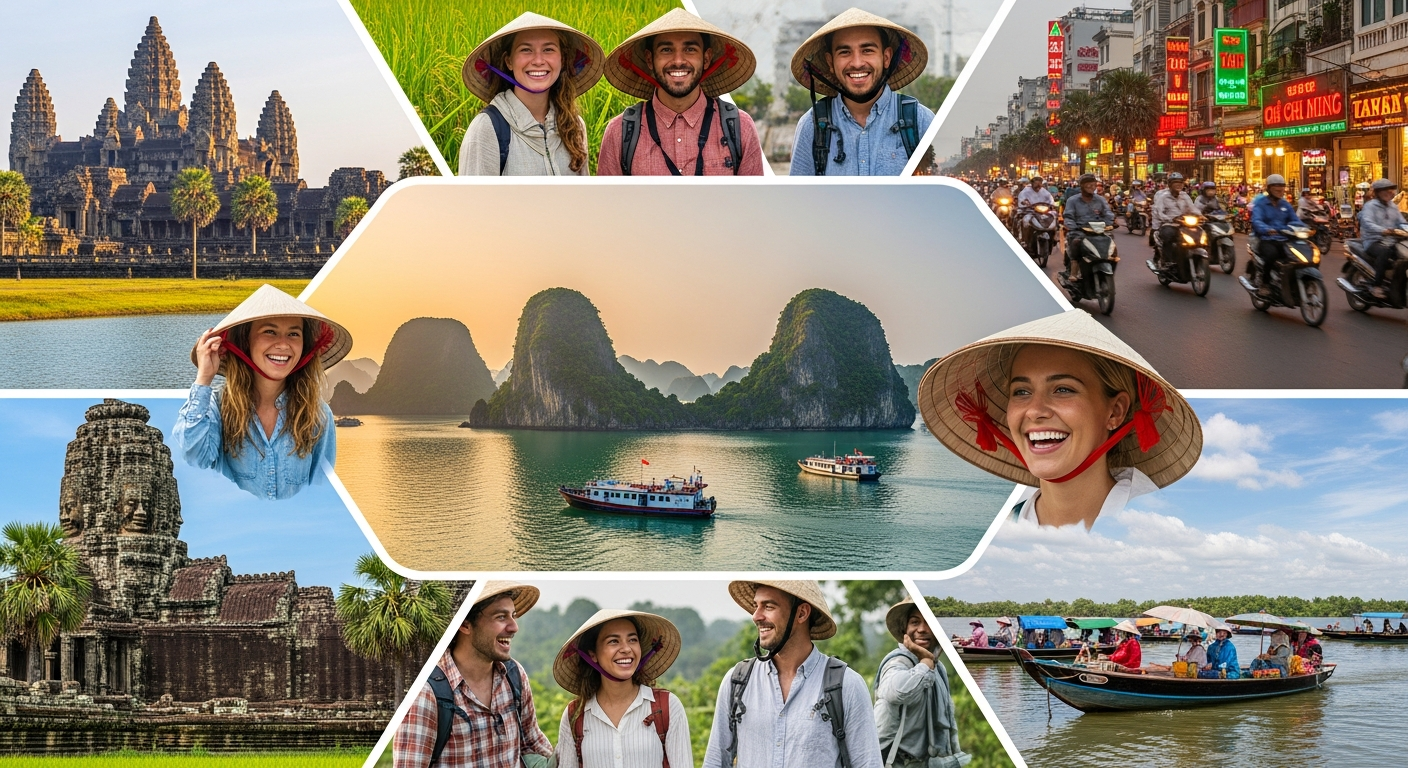
Discover why SKR Reisen’s Vietnam & Cambodia: Highlights Tour is Southeast Asia’s most beloved small-group experience. Explore Halong Bay, ancient temples, and authentic culture on this 15-day journey starting from €2,999.
Over 1,400 travelers have rendered their verdict with remarkable consistency: this 15-day Southeast Asian adventure ranks among the most transformative trips they've ever taken. SKR Reisen's Vietnam & Cambodia: Highlights Tour delivers what larger tour operators simply cannot replicate. Group sizes capped at 4-12 travelers mean you experience genuine cultural encounters and meaningful interactions with local communities rather than moving through attractions in massive waves.
The tour starts at €2,999 with flights included and prioritizes authenticity over volume. Every decision—from hotel partnerships to guide selection to itinerary pacing—reflects a philosophy that travel should transform, not just transport. This distinction separates this tour from the thousands of cookie-cutter Southeast Asia packages flooding the market.
This guide uncovers exactly what makes this tour resonate so powerfully with travelers. You'll examine iconic destinations that shaped Southeast Asian history, understand how the small-group model transforms your experience, explore sustainable tourism practices that set SKR Reisen apart, and determine whether this adventure aligns with your travel style and budget.
Start your Vietnam and Cambodia journey with SKR Reisen today.
The Route Unveiled – From Hanoi's Energy to Siem Reap's Mystique
Hanoi's Pulse and Colonial Heritage
Your adventure begins in Hanoi, where motorbikes outnumber cars and the air carries the aroma of street food vendors working their craft at dawn. The Old Quarter pulses with centuries of mercantile energy, its narrow streets organized by trade—silver street, silk street, spice street. French colonial architecture stands as architectural reminders of Vietnam's complex history, seen in shuttered villas and tree-lined boulevards that contrast sharply with modern highrises. Hoan Kiem Lake offers a serene counterpoint to urban chaos, its waters reflecting centuries of Hanoi's spiritual life. Local markets reveal how daily Vietnamese life actually unfolds—not the sanitized version tourists typically see, but real neighborhoods where residents shop, gossip, and negotiate prices with vendors they've known for decades.
Halong Bay's Limestone Theater
Halong Bay represents nature's architectural ambition—thousands of towering limestone karsts rising from emerald waters like the teeth of some ancient beast. An overnight cruise through this UNESCO World Heritage site places you directly in the landscape rather than viewing it from shore. Kayaking through hidden grottos and swimming in jade-colored waters creates physical connection to the environment. Sunrise breaks across the water in shades of gold and pink, casting shadows that transform rock formations into constantly shifting sculptures. This is where nature's grandeur becomes visceral rather than photographic.
Red River Delta's Agricultural Soul
Beyond tourist circuits, the Red River Delta reveals how millions of Vietnamese actually live. Rice paddies stretch to the horizon in geometric precision, the result of centuries perfecting water management and crop rotation. Encounters with farming communities provide windows into rhythms governed by monsoon seasons and market cycles rather than clock hours. Farmers share their knowledge—which crops thrive where, how they manage water in drought years, what their children hope for beyond agricultural life. These conversations transform statistics about rural poverty into human narratives.
Hoi An's Lantern-Lit Preservation
Hoi An exists as a 15th-century frozen moment, its ancient town remarkably preserved despite modern Vietnam's transformation. Lantern-lit streets lined with wooden shophouses create an atmosphere that historical dramas merely approximate. UNESCO World Heritage designation protects the town's architectural integrity, and strict regulations prevent the shopping-mall standardization that plagues many tourist destinations. Local artisans still practice traditional crafts—silk tailoring, lantern making, woodcarving—not as performances for visitors but as actual livelihoods. Walking these streets at dusk, when lanterns illuminate shop windows, you genuinely feel transported backward in time.
Ho Chi Minh City's Contradictory Vitality
Saigon, as many locals still call it, embodies modern Vietnam's contradictions. The War Remnants Museum confronts visitors with the brutal history many Westerners downplay or avoid. The Reunification Palace stands as both symbol and relic of a unified nation. Motorbikes swarm in organized chaos that would terrify drivers accustomed to orderly traffic patterns. Rooftop bars showcase Vietnam's emerging affluence while street-level vendors sell noodles for less than a dollar. This is Vietnam becoming, not Vietnam was—a country still processing its past while racing toward its future.
Phnom Penh's Historical Weight
Cambodia's capital carries historical weight that shapes every corner. The Royal Palace and Silver Pagoda represent Khmer civilization's artistic and spiritual achievements. The National Museum displays treasures of Angkorian greatness. Yet Cambodia's history includes trauma most visitors know primarily from films and books—the Killing Fields represent less distant history than many realize. Local guides offer context that prevents tourism from becoming aesthetic consumption disconnected from human reality. Understanding Cambodia requires grappling with this complexity rather than retreating into comfortable narratives.
Angkor Archaeological Park's Temple Constellation
Angkor Wat ranks among humanity's greatest architectural achievements—a temple complex built in the 12th century that rivals medieval cathedrals in ambition and execution. Angkor Thom's massive stone faces regard visitors with expressions spanning centuries. Bayon's towers covered in carved faces create an unsettling sense of being watched by history itself. Lesser-known temples scattered through the jungle offer solitude rarely available at Angkor Wat's sunrise gathering. Exploring these ruins across multiple days allows understanding how the Khmer built empires through hydraulic engineering and artistic vision. The temple complex represents not just religious devotion but sophisticated urban planning and artistic confidence.
Siem Reap's Artisan Culture
Siem Reap extends beyond Angkor into contemporary Cambodian creativity. Local workshops showcase silk weaving, stone carving, and traditional crafts practiced by artisans supporting their families through tourism revenue. Night markets pulse with energy as residents shop alongside visitors. Supporting these craftspeople means tourism directly benefits communities most needing economic opportunity. Conversations with artisans reveal personal stories—why they chose their craft, how they learned from parents or grandparents, what they hope their children will accomplish. This transforms purchasing crafts from souvenir collection into genuine economic exchange with human meaning.
Small-Group Travel Reimagined – Why 4-12 Travelers Changes Everything
Personalized Pacing Creates Space for Experience
Large tour groups operate on schedules designed for efficiency—45 minutes at a temple, 90 minutes at a market, then onward to the next checkpoint. A group of 12 travelers moves with human rhythm rather than mechanical precision. When you discover a hidden café serving exceptional pho, your group might linger rather than moving to the predetermined lunch spot. If a temple's architecture fascinates you more than anticipated, you have time to explore deeper rather than retreating to the bus. This flexibility transforms travel from checking boxes to actually experiencing places.
Local Guides Engage Rather Than Broadcast
Large groups force tour guides into megaphone performers delivering scripted information to the back rows. Small groups enable conversation. Your guide becomes something closer to a knowledgeable friend sharing their world rather than an information dispenser. They have time for questions that emerge organically from what you're seeing. They can adjust their focus based on what interests your specific group. A guide passionate about architecture can spend extra time explaining structural details if your group leans that direction. Another group interested in food culture might spend more time at markets and with local cooks.
Hidden Experiences Remain Hidden
Major tour operators have negotiated relationships with restaurants and hotels that can accommodate 40-person groups. These businesses function professionally but anonymously. Small-group operators cultivate relationships with family-run restaurants where the owner's mother cooks in the kitchen, small hotels where the proprietor lives upstairs and remembers guests' preferences, villages where interactions occur because relationships matter rather than because tour companies paid for "cultural performances." These experiences cost more to deliver but create memories large-group tourists never access.
Genuine Community Among Travelers
Spending 15 days with 11 other people creates bonds impossible in larger groups. You share meals, navigate challenges together, celebrate discoveries, and process transformative moments as a community. Many travelers report that friendships formed on these tours extend far beyond the trip's conclusion. You're not anonymous faces in a crowd but individuals who become known to each other and to guides. This transforms solo travelers feeling isolated in their exploration into participants in collective adventure.
Responsive Itinerary Adjustment
Unexpected discoveries shift itineraries. Perhaps a conversation with a local suggests a nearby village worth visiting, or weather creates opportunity for an unplanned activity. Small groups adapt because the logistics involve fewer people and fewer pre-arranged reservations. Large groups cannot deviate because doing so affects dozens of interconnected arrangements. This flexibility means your trip shapes itself partially through spontaneity rather than existing entirely as predetermined sequence.
Environmental Responsibility Through Scale
Fragile ecosystems and archaeological sites suffer from overuse. Halong Bay experiences environmental pressure from the thousands of daily visitors. Angkor Wat's stones degrade faster as crowds grow. Small groups inherently minimize impact. Fifteen people navigating a temple creates minimal damage compared to hundreds grinding their shoes into stone floors daily. This environmental benefit extends beyond tourism—it represents a philosophy that popularity need not require destructive scale.
Accommodation That Reflects Place
International hotel chains provide consistency but erase locality. You could be anywhere—the decor, amenities, and service protocols follow corporate standardization. Small-group tours utilize locally-owned hotels that reflect regional character, architectural traditions, and local business priorities. These hotels generate employment for residents and recycle tourism revenue through local economy rather than funneling it to multinational corporations. Staying in a family-run colonial hotel in Hanoi rather than a Hilton means your accommodation itself becomes a cultural experience.
Discover authentic small-group travel with SKR Reisen's Vietnam and Cambodia tour.
Sustainable Tourism in Action – More Than Greenwashing
Locally-Owned Hotel Partnerships
Every accommodation dollar spent at a family-run hotel circulates through local economy rather than flowing to distant shareholders. The hotel owner hires relatives and neighbors. Profits fund children's education or family business expansion. Hotel staff bring their genuine selves to work rather than following corporate scripts. These partnerships require more relationship-building than booking hotels through mass reservation systems, but SKR Reisen invests that effort because their business model depends on genuine community relationships.
Community-Based Tourism Revenue Streams
Visiting villages generates economic incentive for cultural preservation rather than cultural commodification. When tourism becomes a meaningful income source, communities protect traditions and invest in education that enables younger generations to maintain cultural knowledge. Revenue flows directly to residents through guide employment, meal provision, and craft sales rather than being extracted by middlemen. This contrasts with exploitative models where communities provide tourist entertainment while tour companies capture most economic benefit.
Respectful Engagement with Sacred Spaces
Temples represent living spiritual centers, not archaeological museums. Responsible tourism involves pre-visit education about appropriate behavior, dress codes, and the difference between observing and participating in spiritual practice. Guides trained in cultural protocols ensure visitors understand not just what they're seeing but why these spaces matter to the people who created and maintain them. This prevents tourism from becoming aesthetic consumption of religious spaces stripped of their spiritual meaning.
Ethical Wildlife Standards
SKR Reisen commits to animal welfare standards that exclude exploitative attractions common in Southeast Asia. This means no riding elephants, no tiger temple photos, no animal performances designed for entertainment. Wildlife encounters, when they occur, follow ethical guidelines that prioritize animal welfare over tourist experience. This reflects a philosophy that connection with nature should not require harming nature.
Local Guide Employment and Storytelling
Guides represent more than information sources—they embody the region's identity and share their own cultural knowledge. Employment as tour guides provides dignified work for educated locals who speak multiple languages and possess sophisticated understanding of their culture. Rather than outsourcing guiding to specialists flying in from capital cities, SKR Reisen employs community members who sleep in the same towns where they guide. Their economic interest aligns with community wellbeing.
Mass Tourism Prevention Through Scale
The sustainable tourism concept becomes concrete through limiting group size. Angkor Wat accommodates roughly 500,000 annual visitors despite being a finite archaeological site. When your group of 12 explores the temples, you join those thousands, but your group's footprint remains manageable. Multiply this across all SKR Reisen's small groups versus what would occur if they operated 40-person mega-tours, and the environmental difference becomes substantial.
Cultural Respect Protocols
Pre-trip materials educate travelers on appropriate dress, behavioral expectations, photographic ethics, and spiritual protocols. Guides reinforce these standards during the journey rather than assuming visitors automatically know how to respectfully engage with unfamiliar cultures. This prevents the casual offense that occurs when travelers unknowingly disrespect sacred spaces or photograph without consent. Education transforms potential cultural friction into respectful cross-cultural exchange.
The Ratings Tell the Story – 4.5/5 Stars Across 1,422 Reviews
Itinerary Quality and Balance
Travelers repeatedly highlight that this 15-day span achieves rare balance among activity, cultural immersion, natural wonder, and rest. The route doesn't sacrifice depth for breadth—you spend multiple days in major destinations rather than one-night stands. You experience Vietnam's diversity from north to south, then transition to Cambodia's historical weight. Yet the pace never feels rushed despite covering two countries. This balance emerges from meticulous itinerary design informed by thousands of prior travelers' experiences.
Guide Expertise and Personality
The overwhelmingly consistent praise for guides suggests SKR Reisen's selection and training processes work exceptionally well. Guides clearly possess deep knowledge of their regions' history, culture, and geography. They communicate this knowledge engagingly rather than boringly. Travelers describe guides as genuinely interested in their guests' experiences and questions. Some reviews mention specific guides by name years after trips, suggesting guides make lasting impressions through their warmth and expertise.
Accommodation Satisfaction
Guests appreciate hotels that combine comfort with character. These aren't luxury resorts but authentically charming, locally-owned establishments that exceed expectations precisely because they offer genuine experience rather than corporate anonymity. Rooms provide adequate comfort—reliable hot water, clean linens, functional amenities—without sterile standardization. Breakfast served at the hotel restaurant features local specialties rather than continental buffet mediocrity.
Logistics and Organization
A 15-day multi-country tour involves hundreds of coordinated details—flights, transfers, hotel reservations, guide arrangements, permit bookings for archaeological sites, meal reservations. Reviews consistently note that these logistics flow seamlessly. Travelers rarely encounter delays, confusion about timing, or logistical failures that plague poorly organized tours. This operational excellence enables guests to focus on experience rather than worrying about what happens next.
Value-for-Money Recognition
At €2,999 including flights for 15 days covering two countries with small-group access, professional guides, and curated experiences, travelers consistently recognize exceptional value. This price point attracts mid-range travelers seeking quality experiences without luxury pricing. Reviewers frequently note they paid less for this comprehensive tour than they would have for comparable independent travel once accommodations, meals, guides, and logistics costs accumulated.
Transformative Emotional Impact
Beyond logistical praise, many reviews describe emotional and psychological impact. Travelers mention gaining new perspectives on history, feeling moved by encounters with local communities, experiencing spiritual moments at temples, and returning home with fundamentally altered worldviews. These testimonials transcend typical travel satisfaction—they suggest the tour genuinely transforms how people understand themselves and the world.
Pace Considerations
A minority of reviews note that 15 days covering two countries moves briskly, particularly for travelers preferring slower exploration. However, most who acknowledge the pace do so while embracing it as appropriate—fast enough to see remarkable geographic and cultural diversity, slow enough to develop genuine understanding rather than superficial impressions. The reviews suggest SKR Reisen has calibrated pace intentionally rather than accidentally.
Repeat Booking Patterns
Perhaps the most compelling metric: many guests return to book additional SKR Reisen tours. Repeat customers represent tangible evidence that satisfaction extends beyond a single positive experience. They chose this company again because they trusted the quality they'd experienced once before. For a travel company, repeat customers represent the highest possible endorsement.
Your Southeast Asian Awakening Awaits
The numbers speak volumes: 1,422 reviews averaging 4.5 stars don't lie. SKR Reisen's Vietnam & Cambodia: Highlights Tour delivers something increasingly rare in modern travel—genuine connection wrapped in logistical excellence. You're not just visiting temples and beaches; you're stepping into the rhythms of ancient civilizations while supporting communities that depend on respectful tourism. The 15-day span covers remarkable ground from Hanoi's chaotic energy to Angkor's spiritual grandeur, yet the small-group model ensures you're never rushing through experiences.
At €2,999 including flights, you're investing in memories that reshape how you see the world. Whether you're a first-time Southeast Asia traveler or a seasoned explorer seeking depth over breadth, this tour addresses what most travelers actually want—authentic encounters, comfortable accommodations, knowledgeable guides, and space to process transformative moments. Your 15-day journey through Vietnam and Cambodia isn't just a vacation—it's a conversation with two of the world's most compelling cultures.
Book your transformative Vietnam and Cambodia adventure with SKR Reisen now.