
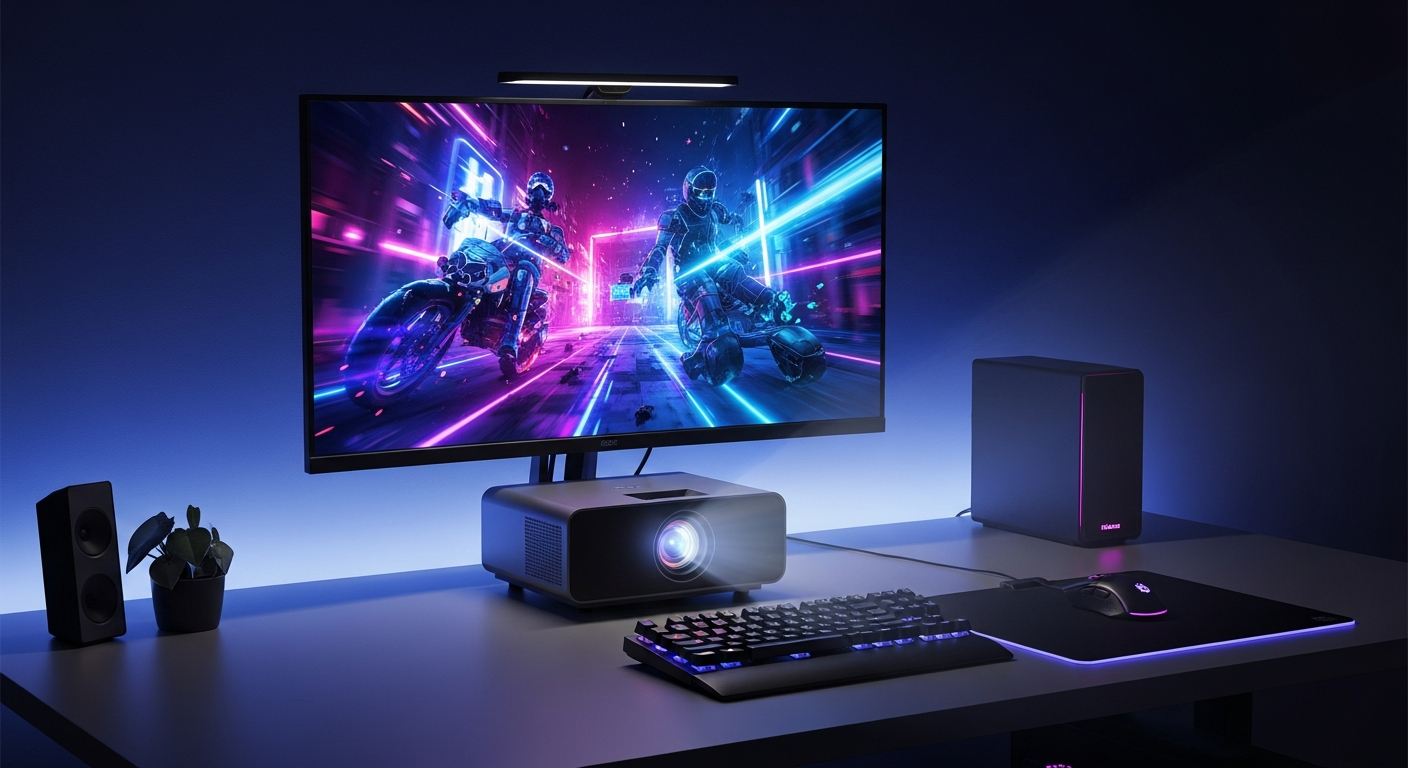
Discover whether the Valerion VisionMaster Pro2 4K Triple-Laser Projector delivers on its gaming promises with low input lag, refresh rates, and performance specs for serious gamers.
When you've experienced gaming on a truly massive display, returning to a standard monitor feels claustrophobic. The Valerion VisionMaster Pro2 has generated considerable buzz within gaming circles—not merely for its cinematic prowess, but for gaming specifications that stand shoulder-to-shoulder with dedicated gaming monitors. With input lag ratings of 4ms at 1080P and 15ms at 4K, this projector shatters the old assumption that premium home theater equipment sacrifices responsiveness for visual splendor.
Valerion US engineered the VisionMaster Pro2 with a specific user in mind: someone unwilling to compromise on either image quality or input responsiveness. The convergence of triple-laser RGB technology, HDMI 2.1 support, and WiFi 6e connectivity creates something genuinely rare in the projector market—an environment where competitive gaming and visual fidelity coexist as equals rather than opposing forces.
This review examines whether the VisionMaster Pro2 truly serves gamers as effectively as it serves cinephiles, breaking down gaming-specific features, comparing input lag performance across resolutions, and determining whether the $2,099–$2,299 investment aligns with your gaming ambitions.
Discover the VisionMaster Pro2 and transform your gaming experience today.
Gaming Performance Specs That Actually Matter
Input Lag: Where Milliseconds Define Responsiveness
The 4ms input lag at 1080P resolution and 240Hz refresh rate positions the VisionMaster Pro2 in genuinely competitive territory for fast-paced gaming. That figure matches the response times you'd expect from high-end gaming monitors—a threshold most serious competitive gamers consider acceptable. At 4K, the 15ms input lag increases noticeably, but remains within viable range for most gameplay scenarios outside of frame-perfect fighting games or reaction-dependent esports titles.
For practical purposes, the difference between 4ms and 15ms manifests most acutely in twitch-based games where split-second responses determine outcomes. Strategy games, role-playing games, and single-player titles experience virtually zero perceptible impact at 15ms. The distinction matters less for players accustomed to console gaming, where standard input lag hovers around 16-20ms.
HDMI 2.1 Bandwidth: Future-Proofing Your Setup
HDMI 2.1 support unlocks higher bandwidth capacity than standard HDMI 2.0, enabling the projector to handle 4K content at 120Hz—a specification that current gaming hardware rarely pushes but increasingly will. For present-day gaming, this means smoother data transmission and reduced likelihood of signal degradation across longer cable runs.
The practical gaming benefit centers on eliminating one potential bottleneck in your signal chain. Whether you're running an RTX 4090 or the latest PlayStation console, HDMI 2.1 ensures the projector receives whatever your hardware outputs without compromise.
WiFi 6e Connectivity and Online Latency
Wireless connectivity for gaming carries inherent skepticism from competitive players, yet WiFi 6e represents a genuine upgrade over previous wireless standards. The technology operates across three frequency bands and supports higher throughput, theoretically reducing network-related latency for online multiplayer.
Practical application depends entirely on your router and network environment. Players in homes with strong WiFi 6e coverage may notice reduced ping times compared to WiFi 5. Those with congested 2.4GHz networks or distance-related signal degradation should prioritize hardwired ethernet connections regardless of projector capabilities.
The 300-Inch Gaming Canvas—Immersion Beyond Standard Displays
Psychological Impact of Massive Projection Surfaces
Gaming across a 150-inch, 200-inch, or 300-inch canvas fundamentally alters perception and engagement. Your peripheral vision fills with game content rather than your living room walls. Environmental details, distant enemies, and environmental hazards enter your awareness naturally rather than requiring active screen scanning. Open-world games benefit most conspicuously—the sheer scale transforms exploration from a focused activity into an environmental experience.
First-person shooters gain spatial awareness advantages; you perceive enemy positions with greater positional accuracy across the expanded field of view. Racing simulations feel genuinely faster at 300 inches compared to 27-inch monitors because velocity perception increases with visual scale.
Viewing Distance Considerations for Different Gaming Styles
Competitive gaming typically benefits from tighter viewing distances, typically 8-12 feet from a 150-inch display. This positioning maintains detailed image clarity while keeping the entire screen within comfortable eye movement range. Campaign gaming and casual play accommodate greater distances—sitting 12-16 feet from a 200-inch display creates an enveloping experience without sacrificing essential visual information.
The VisionMaster Pro2's 0.9-1.5x optical zoom enables fine adjustments to image size within your available throw distance, accommodating various room configurations without repositioning the projector itself.
Field-of-View Advantages at Scale
At 300 inches, your natural field of vision fills primarily with game content. Competitive players gain tactical advantage through expanded situational awareness—peripheral details register without deliberate visual attention. Casual gamers experience enhanced presence; environmental storytelling lands with greater impact when architectural details surround rather than occupy a centered rectangle.
The psychological shift from watching a game unfold to inhabiting a game space occurs naturally at these scales.
Triple-Laser RGB Technology and Gaming Visual Quality
Color Accuracy During High-Speed Action
Triple-laser RGB technology delivers native color information across the entire visible spectrum without relying on color wheels or phosphor conversion. During fast-moving scenes—explosions, environmental transitions, rapid camera pans—color information remains consistent and accurate because the light source output remains constant. Games featuring detailed environments, subtle lighting effects, and color-critical visual information appear noticeably sharper than on standard gaming displays.
Racing games showcase this advantage particularly well; the pavement texture, track barrier color, and environmental detail separation improves visibly with triple-laser technology compared to single-lamp or dual-lamp projectors.
3000 ISO Lumens: Gaming in Real-World Lighting
The brightness specification matters profoundly for gaming in rooms with ambient light. Unlike darkened home theaters, many gaming setups occupy living spaces with windows, overhead lighting, or reflected light. The 3000 ISO lumens brightness level maintains visibility and color accuracy even with ambient light present—a significant advantage for daytime or casual gaming sessions.
Console gamers frequently play during daylight hours; the VisionMaster Pro2's brightness means you're not confined to gaming exclusively during evening hours.
Explore the VisionMaster Pro2's full specifications and gaming capabilities.
15000:1 Contrast Ratio: Visibility in Dark Gaming Scenes
Contrast ratio significance escalates during gaming more than during passive viewing. Horror games, atmospheric adventures, and nighttime game sequences demand visibility in shadow detail without inflating overall brightness. The 15000:1 contrast ratio ensures black-level scenes maintain visibility while preventing blooming or halo effects around bright elements.
Stealth-based games benefit significantly; enemy detection in shadowed environments improves when the projector maintains contrast separation between dark background and player characters.
The Bottom Line: A Projector That Refuses to Choose Sides
The Valerion VisionMaster Pro2 doesn't demand that gamers sacrifice cinematic quality for performance—it delivers both with genuine engineering conviction. The 4ms input lag at 1080P proves this isn't simply a home theater projector borrowing gaming credentials; it's specifically engineered for responsiveness. Combined with triple-laser technology, 3000-lumen brightness, and the immersive scale of a 300-inch canvas, you're examining a gaming platform that standard displays fundamentally cannot match.
Certainly, the $2,099–$2,299 price tag requires serious financial consideration. Firmware updates need active management to fully unlock features like Anti-RBE technology. Yet for gamers who've wondered what competitive play truly feels like on a massive, color-accurate display, the VisionMaster Pro2 provides a decisive answer. This projector excels equally at midnight gaming marathons and weekend movie nights—stretching your investment across your entire entertainment ecosystem.
Gamers ready to experience performance and visual quality at a scale that redefines home possibilities should examine what the VisionMaster Pro2 delivers.
Start your VisionMaster Pro2 journey and elevate your gaming experience now.