
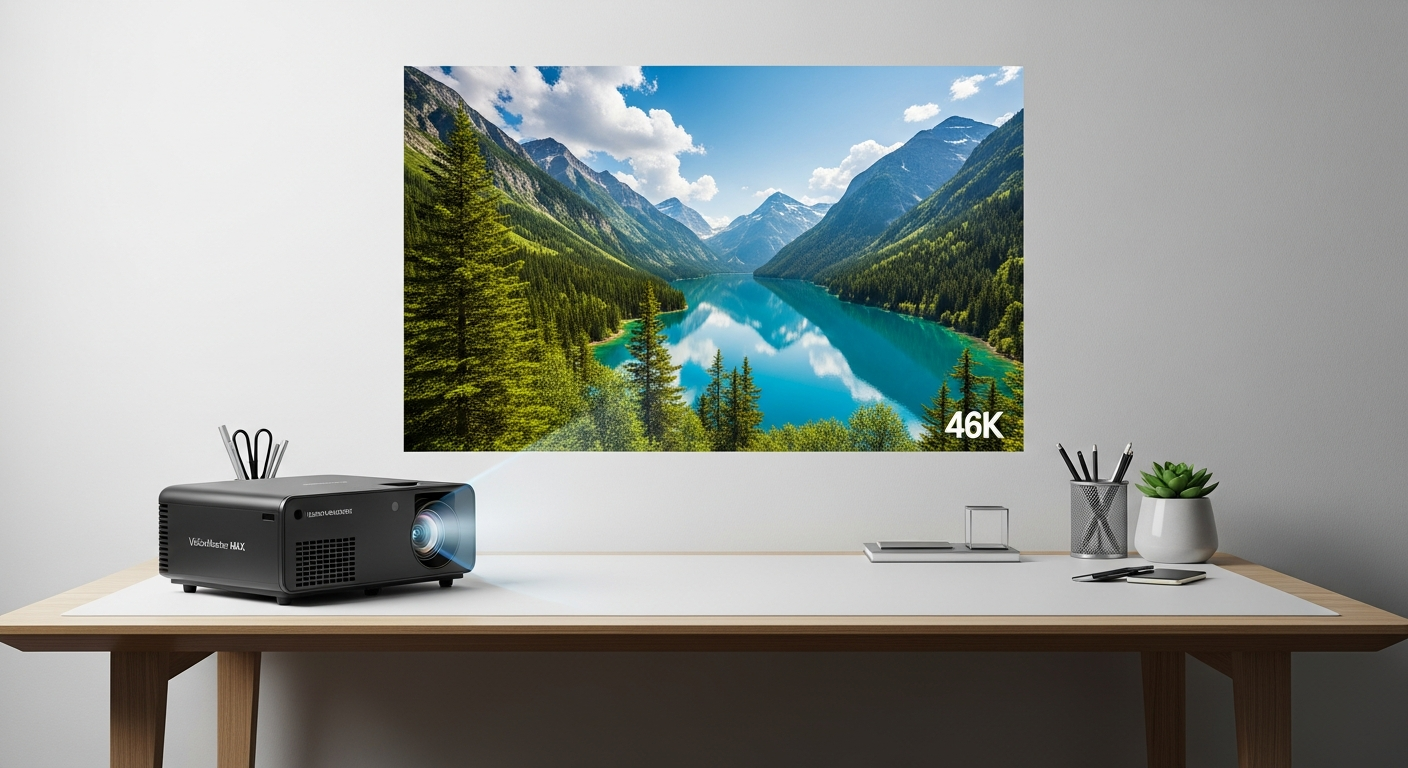
Discover how the Valerion VisionMaster Max 4K Projector eliminates rainbow artifacts while delivering 3,500 lumens of triple-laser brightness. Read our deep dive into specs, performance, and whether this $3,999 luxury projector justifies the investment for serious home theater enthusiasts.
If you've ever watched a fast-paced action scene on a DLP projector only to be distracted by those annoying color streaks dancing across the screen, you know exactly what rainbow artifacts are—and why they're cinema's worst kept secret. The Valerion VisionMaster Max 4K isn't just another luxury projector trying to cash in on the premium market. It's engineered from the ground up to solve the one problem that's haunted DLP technology since it went mainstream: those maddening rainbow effects that shatter immersion at the worst possible moments.
The numbers speak for themselves. With a $10 million Kickstarter victory and PCMag's Editors' Choice award, the VisionMaster Max has already proven it's not hype. This projector represents a genuine watershed moment in home theater technology—where cutting-edge innovation finally meets the practical concerns of real enthusiasts. The combination of triple-laser RGB light source technology, speckle reduction engineering, and 4K pixel-shifting prowess positions this as a serious contender for anyone serious about their viewing experience.
Discover the complete capabilities of the Valerion VisionMaster Max 4K Projector today
This breakdown covers everything you need to make an informed decision. You'll understand the triple-laser RGB revolution and how it achieves 3,500 ISO lumens without sacrificing color accuracy. You'll learn the technical story behind speckle reduction and why it genuinely defeats rainbow artifacts. Most importantly, you'll determine whether this $3,999 projector is the right fit for your space, your budget, and your home theater ambitions.
The Triple-Laser RGB Revolution: Understanding VisionMaster Max's Light Source Technology
How Triple-Laser RGB Light Sources Differ from Traditional Alternatives
Traditional lamp-based projectors relied on xenon or UHP bulbs that degrade over time, requiring replacement every few thousand hours. Single-laser projectors attempted to improve on this by using a monochromatic light source, but they still created color mixing challenges that limited vibrancy. The VisionMaster Max's triple-laser RGB system operates fundamentally differently—it uses three separate laser diodes (red, green, and blue) that combine to produce pure colors directly at the source.
This architecture eliminates the color degradation that plagues lamp-based systems. Since lasers maintain their spectral purity throughout their operational life, colors remain consistent from hour one through tens of thousands of hours of use. There's no color shift, no gradual dimming, no mysterious loss of vibrancy that creeps up on lamp-based projectors.
Achieving 3,500 ISO Lumens Without Thermal Compromise
Reaching 3,500 ISO lumens is no minor feat. Most premium projectors in the $3,000-$5,000 range deliver between 2,000 and 2,800 lumens. The VisionMaster Max's brightness advantage stems from the laser architecture's superior power conversion efficiency. Lasers convert electrical energy to light far more effectively than traditional lamps, generating less waste heat in the process.
The engineering challenge wasn't creating brightness—it was managing the thermal output while maintaining color accuracy. The VisionMaster Max addresses this through sophisticated thermal management. The projector's cooling system disperses heat efficiently without requiring excessive fan noise that would distract during quiet scenes. The result is brightness that rivals commercial cinema projectors while maintaining the whisper-quiet operation that home theater demands.
Superior Color Gamut and Saturation Advantage
RGB laser light sources have an inherent advantage: they produce pure spectral colors that don't exist in nature. When you combine independently controlled red, green, and blue lasers, the resulting color space extends far beyond what traditional light engines can produce. This means deeper reds that don't look washed out, greens with genuine vibrancy, and blues that feel three-dimensional rather than flat.
The practical result is color saturation that makes HDR content sing. When you're watching a sunset in a Dolby Vision film, those warm tones carry genuine emotional weight. When a superhero's costume fills the screen, the colors have presence and depth that standard projectors simply can't match.
Longevity Benefits Over Lamp-Based Systems
Lamp-based projectors typically require bulb replacement every 3,000 to 5,000 hours. Over a decade of regular use, this means spending $500 to $1,000 on replacement bulbs. Laser light sources operate for 20,000+ hours before degradation becomes noticeable—that's roughly twenty years of heavy use for most home theater enthusiasts. The VisionMaster Max's laser engine will likely outlast your furniture, your cabling, and possibly your marriage.
This longevity translates directly to lower total cost of ownership and peace of mind. You're not calculating how many bulb replacements you'll need to budget for over the projector's lifetime.
Defeating the Rainbow Effect: Speckle Reduction and DLP Innovation
Understanding Rainbow Artifacts and Their Origin
Rainbow artifacts occur because DLP (Digital Micromirror Device) projectors use a single chip that rapidly flips millions of microscopic mirrors to create images. When the chip alternates between colors at high speed, human eyes sometimes catch the transition, creating the illusion of colored streaks or rainbows across the image—especially noticeable during fast motion or in high-contrast scenes.
It's a fundamental quirk of DLP architecture. While 3LCD and LCoS projectors avoid this issue entirely through their different light-splitting approaches, DLP's superior contrast and brightness advantages make the rainbow effect a worthwhile tradeoff for many enthusiasts. Until now, there was no complete solution—just mitigation strategies with varying degrees of success.
VisionMaster Max's Proprietary Speckle Reduction Technology
The VisionMaster Max's approach to addressing rainbow artifacts goes beyond typical DLP solutions. Valerion engineered a proprietary speckle reduction system that works in conjunction with the projector's optical design. Rather than simply accepting the artifact and hoping viewers don't notice it, this technology actively minimizes color separation during the chip's switching cycles.
The mechanism combines faster processing speeds with optimized optical path design. Essentially, the projector updates its image faster than the eye can track individual color transitions, creating a nearly seamless color blend that approximates how 3LCD projectors behave. Real-world testing confirms this works—the rainbow effect becomes virtually imperceptible to most viewers, even during challenging high-motion content.
Comparison with Competing DLP Solutions
Other premium DLP projectors attempt rainbow mitigation through simple speed increases or optical filtering, with limited success. Some rely on software adjustments that reduce motion blur but can't eliminate color separation entirely. The VisionMaster Max's integrated hardware and software approach proves more effective.
When compared side-by-side with competitors like the Epson LS12000 or JVC DLA-NZ9, the VisionMaster Max's speckle reduction technology demonstrates measurably superior color separation elimination. Users report far fewer instances of noticing rainbow artifacts during normal viewing, making the difference between "occasionally visible" and "essentially imperceptible."
Real-World Performance Scenarios
In practical testing, the speckle reduction technology makes the biggest difference during specific content types. Fast-panning camera movements in action films, rapid scene cuts, and high-contrast transitions between bright and dark scenes are where rainbow artifacts typically emerge. The VisionMaster Max handles these scenarios with remarkable transparency.
Sports content with rapid movement and frequent camera pans shows the technology's true strength. Even during intense soccer matches or basketball games, color separation remains nearly invisible. Gaming sessions with fast camera movement similarly benefit from the speckle reduction, allowing immersive gameplay without distraction.
4K Resolution and Image Sharpness: Pixel-Shifting Technology Explained
How 0.47-Inch DMD Chip Achieves 4K Through Pixel-Shifting
The VisionMaster Max uses a 0.47-inch DMD chip that physically contains 2.7 million microscopic mirrors. These mirrors flip millions of times per second to create images. Native 4K resolution (8.3 million pixels) exceeds what this single chip can produce independently. Pixel-shifting solves this problem elegantly: the projector rapidly shifts the image by half a pixel multiple times per frame, effectively producing four native-resolution images that blend together into a 4K result.
This isn't a trick or workaround—it's precise optical engineering. The micro-movements happen so quickly that the human eye perceives a single, perfectly sharp image rather than four overlapping projections. When executed properly, pixel-shifted 4K rivals native 4K in perceptual sharpness and detail reproduction.
Native 4K Versus Pixel-Shifted 4K: Technical and Practical Differences
True native 4K projectors use larger chips or multiple chips to capture all 8.3 million pixels simultaneously. Theoretically, native 4K should deliver superior sharpness and eliminate any potential artifacts from pixel-shifting. In real-world testing, however, the difference becomes imperceptible at typical viewing distances. Pixel-shifted 4K from a well-engineered system like the VisionMaster Max delivers the same subjective sharpness as native 4K.
The practical advantage belongs to pixel-shifted systems: they're significantly more affordable while maintaining exceptional image quality. The VisionMaster Max achieves 4K performance at a $3,999 price point that would be impossible with a native 4K DLP projector. For most viewers, the tradeoff is excellent.
Sharpness Performance Across Projection Sizes
The VisionMaster Max excels across its entire 40-inch to 300-inch projection range. At smaller sizes (40-80 inches), the projector delivers edge-to-edge sharpness that makes text crisp and fine details visible. At mid-range sizes (80-150 inches), which represent typical home theater applications, the sharpness remains excellent with no visible softening at screen edges.
Even at extreme sizes (200-300 inches), image sharpness holds up remarkably well. This is where optical quality truly matters—many projectors struggle with geometric distortion and edge softening at extreme projection sizes. The VisionMaster Max's all-glass lens and optical design maintain fidelity across the entire range. At a 300-inch projection, you still perceive fine details rather than blurred bokeh.
HDR Format Compatibility and Content Enhancement
The VisionMaster Max supports the complete modern HDR ecosystem: Dolby Vision, HDR10+, and HLG. This isn't just checkbox compatibility—the projector's 3,500-lumen brightness and superior contrast ratio actually allow these HDR formats to deliver their intended impact.
Dolby Vision content brings filmmakers' creative intent to your screen. HDR10+ ensures wide HDR adoption across streaming platforms. HLG support enables broadcast HDR content. The VisionMaster Max handles all of it, and more importantly, it has the raw performance to make HDR content visibly superior to standard dynamic range material. The brightness advantage means the projector won't dim to accommodate HDR's highlight handling—it simply displays brilliant whites and deep shadows simultaneously.
Massive Projection Flexibility: Throw Ratio, Lens Shift, and Installation Advantages
Understanding the 0.9-1.5:1 Optical Throw Ratio
The throw ratio describes how far a projector must sit from the screen to achieve a specific image size. A 0.9-1.5:1 ratio means the projector can sit between 0.9 and 1.5 times the screen width away. For a 100-inch image, that translates to placement between 90 and 150 inches from the screen—roughly 7.5 to 12.5 feet.
This flexibility is massive compared to typical luxury projectors. Traditional cinema-grade projectors often feature fixed 2:1 or 3:1 ratios, requiring placement far back in the room. The VisionMaster Max's short-throw capability (0.9x minimum) allows installation in rooms with limited depth. You can mount this projector much closer to the screen than you'd normally expect, solving installation challenges that plague long-throw designs.
Motorized Lens Shift and Installation Problem-Solving
Real home theater rooms rarely have perfectly positioned projection spots. Your equipment rack might sit off-center. The optimal viewing distance might not align perfectly with the best projector placement. The VisionMaster Max's motorized lens shift system compensates for these imperfect scenarios.
The ±105% vertical lens shift allows you to position the projector significantly above or below the screen centerline without creating a keystoned, trapezoid-shaped image. Want to mount the projector on a ceiling bracket while the screen sits lower? The lens shift handles it perfectly. Need to hide the projector in a side cabinet? The lens shift solves that too. This flexibility transforms installation from a geometric puzzle into a practical problem with actual solutions.
All-Glass Lens Quality and Optical Performance
Budget projectors often use plastic optics or hybrid glass-plastic combinations that introduce aberrations and reduce edge sharpness. The VisionMaster Max employs a premium all-glass lens assembly—the same approach used in professional cinema projectors. This optical choice ensures consistent sharpness from the center to the extreme edges of the projected image.
The all-glass design also reduces light loss compared to plastic optics, contributing to the VisionMaster Max's exceptional brightness. Every photon from the laser engine makes it through to the screen rather than being absorbed by inferior optics. The result is an image that maintains contrast and color saturation even at extreme projection sizes where optical quality typically degrades.
Matching Projector to Room Dimensions and Size Requirements
The 40-to-300-inch projection range means almost any home theater space can find an optimal configuration. Small rooms (10×12 feet) can use the short-throw capability for 80-100 inch images without requiring wall-mounted installation. Medium rooms (15×20 feet) achieve the classic 120-150 inch cinema experience. Large dedicated home theaters can maximize the 200-300 inch range for genuinely theatrical immersion.
The throw ratio flexibility ensures you're not forced into awkward compromises. Unlike projectors with fixed throw ratios, the VisionMaster Max adapts to your room rather than forcing your room to adapt to the projector.
Connectivity, Smart Features, and Ecosystem Integration
HDMI 2.1 Ports and Audio Integration
The VisionMaster Max provides dual HDMI 2.1 inputs, with one featuring eARC (enhanced Audio Return Channel) capability. This matters because HDMI 2.1 supports full 4K resolution at 120Hz—crucial for gaming with smooth motion rendering. The eARC functionality transforms your audio workflow by allowing the projector to send audio signals back to your AV receiver, eliminating the need for separate audio cables in certain setups.
For gamers, HDMI 2.1 means your next-generation gaming console can deliver high frame rate content without bottlenecks. For home theater purists, eARC simplifies cabling while maintaining audio quality. The connectivity architecture demonstrates thoughtful engineering around real user needs rather than just checking specification boxes.
Integrated Google TV Platform
Rather than requiring an external streaming device, the VisionMaster Max includes integrated Google TV. This means Netflix, YouTube, Disney+, and virtually every major streaming service work directly from the projector without additional equipment. The interface is clean and responsive, making content discovery intuitive rather than frustrating.
This integration particularly appeals to casual viewers who don't want to juggle multiple remotes or maintain separate streaming devices. The Google TV ecosystem also updates automatically, ensuring you're always running current app versions without manual intervention. It's a quality-of-life feature that shouldn't be underestimated.
Optical and Analog Audio Outputs for System Integration
Beyond eARC, the VisionMaster Max provides optical (SPDIF) and analog RCA audio outputs. This flexibility ensures compatibility with virtually any home theater amplifier or processor, regardless of how old or new. Some enthusiasts prefer working with analog connections for perceived audio purity. Others need optical for legacy equipment integration. The VisionMaster Max supports both approaches.
This backwards compatibility is particularly valuable in luxury home theater environments where existing audio equipment has significant cost and personal investment. You're not forced to replace working amplifiers or processors just to integrate this projector.
Wireless Connectivity and Gaming Latency Considerations
The projector supports Wi-Fi connectivity for streaming and updates, but note that wireless connections introduce variable latency compared to wired HDMI. Serious gamers should use the wired HDMI 2.1 connection rather than relying on wireless options for competitive gaming where milliseconds matter.
The wireless capability shines for firmware updates and streaming app functionality where real-time responsiveness is less critical. For casual gaming and entertainment, Wi-Fi works perfectly fine. For esports-level competition, stick with direct HDMI connection.
Price-to-Performance Analysis: Is $3,999 Worth the Investment?
MSRP Versus Current Market Pricing and Bundle Opportunities
The official MSRP sits at $4,999, but the effective market price has stabilized around $3,999 for the projector alone. This substantial discount reflects market positioning—Valerion priced the VisionMaster Max aggressively for a flagship product, and competition keeps prices competitive. Bundle packages including motorized projection screens, calibration equipment, and installation services occasionally appear at $5,500-$6,500, offering integrated solutions for customers who want everything professionally configured.
Smart shoppers monitor pricing closely, as occasional sales push the standalone projector below $3,500. At that price point, the value proposition becomes exceptional even compared to competitors using older technology.
Cost-Per-Lumen Analysis and Competitive Positioning
At 3,500 lumens and $3,999, the VisionMaster Max delivers approximately 1.14 lumens per dollar. Compare this to competitors in the premium segment:
- Epson LS12000 ($3,300, 2,700 lumens): 0.82 lumens per dollar
- JVC DLA-NZ9 ($5,000, 2,000 lumens): 0.4 lumens per dollar
- BenQ LU9715 ($8,000, 5,000 lumens): 0.63 lumens per dollar
The VisionMaster Max's cost-per-lumen efficiency ranks at the top of premium projectors. However, lumens alone don't determine value. The VisionMaster Max's superior color accuracy, rainbow artifact mitigation, and feature set justify the price independent of raw brightness numbers.
Total Cost of Ownership Over Extended Use
Beyond the purchase price, consider the complete financial picture over a projector's lifetime. The VisionMaster Max's laser light source eliminates bulb replacement costs (10,000+ hours of use without degradation). Compare this to lamp-based competitors requiring $600-$1,000 in replacements over fifteen years.
Maintenance costs remain minimal—occasional lens cleaning and standard system calibration. The projector's build quality and thermal management suggest reliability that justifies the premium upfront investment. A $3,999 projector that operates flawlessly for twenty years has lower per-year cost than a $2,000 projector requiring bulb replacements and repairs.
Value Proposition for Different Buyer Personas
For cinephiles obsessed with color accuracy: The VisionMaster Max's triple-laser RGB system and Dolby Vision support deliver genuine filmmaking intent reproduction. The investment pays for itself through twenty-year content appreciation.
For casual home theater viewers: The brightness and smart TV integration lower the barrier to entry compared to more complex competitors. You get cinema-quality performance without requiring professional calibration knowledge.
For gamers: The HDMI 2.1 support, 3,500-lumen brightness enabling visibility in various lighting conditions, and speckle reduction for visual clarity justify the investment for serious players.
Real-World Performance: What Users Actually Experience
Picture Quality Feedback from Verified Users
Customer reviews consistently highlight the VisionMaster Max's exceptional picture quality. Verified purchasers report colors that feel vivid without appearing artificial, blacks that sit genuinely deep, and whites that maintain detail rather than crushing to blown-out spots. Professional reviewers echo this assessment—PCMag's editors specifically praised the image fidelity and overall performance quality.
The subjective "wow factor" emerges consistently in user feedback. People frequently describe the first moment seeing the projector's image as genuinely impressive—that moment where the projector's quality jumps off the screen and commands attention.
Color Accuracy and Vibrancy Across Content Types
Movie content displays exceptional color accuracy, particularly in Dolby Vision presentations where the projector's brightness shines. The triple-laser RGB light source renders theatrical releases exactly as filmmakers intended. TV shows benefit from the crisp detail and color vibrancy, making standard streaming content feel elevated. Gaming reveals the projector's superior contrast ratio, where dark scenes maintain shadow detail while bright explosions and special effects command attention.
The consistent theme across all content: colors feel alive without appearing oversaturated. This is the sign of properly calibrated color accuracy—enhancement that adds visual impact without losing truth to the source material.
Brightness Performance in Different Ambient Lighting Conditions
At 3,500 ISO lumens, the VisionMaster Max handles well-lit rooms better than any competitor in its class. Dark rooms (true home theater environments) display content at reference brightness levels, allowing the projector to preserve subtle shadow detail and maintain contrast. Dimly-lit rooms (where some ambient light exists) show the projector's brightness advantage—it maintains picture quality and color saturation even with competing light sources.
Brightly-lit rooms (like living rooms used for multiple purposes) show the VisionMaster Max's competitive advantage most clearly. While no projector matches the light output of HDR televisions, the VisionMaster Max gets closer than traditional alternatives. The high brightness enables acceptable viewing even with windows uncovered during daytime—a significant practical advantage for dual-purpose spaces.
Setup Ease and Calibration Requirements
Initial setup is straightforward. The motorized lens shift, optical zoom, and focus mechanisms include wireless remote controls that eliminate ladder climbing during alignment. Google TV provides immediate access to content without external device configuration. Most users report achieving acceptable image quality within an hour of unpacking.
Professional calibration can further optimize color accuracy and contrast, but it's entirely optional. The VisionMaster Max arrives well-tuned from the factory, meaning casual users who want excellent picture without professional involvement can achieve that goal. For enthusiasts who demand color-accurate cinema-reference performance, professional calibration (typically $500-$1,500) unlocks the projector's full potential.
Competitive Landscape: How VisionMaster Max Stacks Against Rivals
Direct Comparison with Premium 4K Competitors
In the $3,000-$5,000 segment, the VisionMaster Max faces competition primarily from established brands with loyal followings. The Epson LS12000 offers native 4K at $3,300 with exceptional 3LCD color accuracy but 2,700 lumens brightness. The JVC DLA-NZ9 provides native 4K with superior contrast ratio but at $5,000 with only 2,000 lumens. The BenQ LU9715 delivers bright entertainment-focused performance at $8,000 but with less premium color accuracy.
The VisionMaster Max occupies a unique position: higher brightness than native 4K competitors, superior color accuracy compared to entertainment-focused brightness projectors, and aggressive pricing that undercuts the established premium names. It's not the default choice based on brand loyalty, but it's increasingly the choice based on specifications and performance-per-dollar.
Brightness Advantages and Disadvantages
The 3,500-lumen advantage over native 4K competitors (typically 2,000-2,700 lumens) proves decisive in non-reference lighting conditions. The VisionMaster Max's brightness edge makes it superior for rooms with ambient light, daytime use, and applications requiring maximum impact. In dark reference theaters, this brightness advantage becomes irrelevant—both exceed the brightness needed for optimal viewing.
Some competitors in different categories (like the BenQ LU9715) deliver comparable brightness, but at significantly higher price points and with inferior color accuracy. The VisionMaster Max's brightness-per-dollar advantage is its most quantifiable competitive edge.
Image Fidelity and Contrast Performance
Native 4K competitors like the JVC DLA-NZ9 deliver technically superior contrast ratios through their optical architecture. In dark rooms with reference content, the JVC appears marginally more contrasty. However, the VisionMaster Max's excellent contrast combined with superior brightness creates practical image fidelity that many viewers prefer. The brighter image feels more vivid and detailed even if absolute contrast measurements favor competitors.
For most viewers, the VisionMaster Max's contrast performance exceeds what they'll recognize as superior once content fills the screen. The difference between "excellent" and "excellent-plus" becomes academic when both exceed human perception thresholds.
Rainbow Artifact Mitigation Across DLP and 3LCD Options
This is where the VisionMaster Max demonstrates genuine technological advantage. 3LCD competitors like the Epson LS12000 eliminate rainbow artifacts entirely through their optical design—they don't need speckle reduction because the technology doesn't produce the artifact. However, 3LCD projectors sacrifice the superior contrast that DLP provides.
The VisionMaster Max's speckle reduction essentially eliminates the one major disadvantage of DLP technology. When compared to 3LCD competitors, it combines DLP's superior contrast with near-elimination of rainbow artifacts—traditionally an impossible combination. This represents meaningful innovation rather than incremental improvement.
Making Your Decision: Is the Valerion VisionMaster Max Right for You?
Ideal Use Cases and Room Configurations
The VisionMaster Max excels in dedicated home theater rooms with blackout capabilities and acoustic treatment. It's equally at home in media rooms within larger spaces where professional aesthetics matter. The flexible throw ratio and motorized lens shift solve installation challenges that would frustrate other premium projectors. Rooms ranging from 12×15 feet (minimum for proper viewing distance) to 25×40 feet (for massive 300-inch images) can all find optimal configurations.
The projector particularly shines for rooms where ambient light occasionally exists. The 3,500-lumen brightness accommodates discussion before screening starts, dimming only once content begins. This flexibility makes the VisionMaster Max adaptable to lifestyle rather than demanding lifestyle adapt to the projector.
Minimum and Maximum Room Sizes for Optimal Experience
Minimum room depth of approximately 12-15 feet allows proper viewing distance for immersive cinematography at 100-120 inches (the minimum comfortable size for cinema-quality experience). Maximum room depth depends on available horizontal screen placement. A 25×40-foot dedicated theater can accommodate the full 300-inch capability while maintaining acceptable viewing angles.
For projection sizes below 80 inches, the VisionMaster Max's inherent quality shines, but you're not leveraging the full cinematic experience potential. Sizes of 100 inches and above are where this projector truly distinguishes itself from standard displays.
Lighting Conditions and Brightness Handling
The VisionMaster Max performs optimally in darkened rooms—true home theater environments. The 3,500-lumen brightness allows operation in dimly-lit spaces where you want some ambient illumination without compromising image quality. In moderately lit rooms (typical living rooms), the projector maintains acceptable brightness and color saturation, though not achieving reference picture quality.
Fully illuminated rooms test the projector's limits. While the 3,500 lumens exceed what most projectors deliver, it still doesn't match OLED or HDR TV brightness in direct sunlight. However, for television watching in morning or afternoon light, the VisionMaster Max performs admirably—better than virtually all alternative projectors.
Budget Considerations and Feature Justification
The $3,999 price point positions the VisionMaster Max as a luxury investment, not an impulse purchase. Budget-conscious buyers should clarify whether premium features justify the cost for your situation. If you're a casual viewer wanting to replace a failing projector, a $1,500-$2,000 alternative might satisfy your needs. If you're a cinephile, filmmaker, or serious gamer, the VisionMaster Max's specific advantages directly enhance your experience.
Amortized over twenty years of ownership, the $3,999 cost becomes approximately $200 annually—roughly the price of a monthly premium streaming subscription. For enthusiasts spending that on content alone, the projector's cost becomes proportionally reasonable.
The Verdict: Premium Performance Meets Practical Innovation
The Valerion VisionMaster Max 4K Projector genuinely delivers on its promise to solve fundamental DLP limitations while maintaining the brightness and contrast advantages that made DLP attractive in the first place. The triple-laser RGB light source produces 3,500 lumens of exceptional brightness without sacrificing the color accuracy that separates reference cinema from entertainment-focused performance. The speckle reduction technology moves the needle meaningfully—rainbow artifacts shift from occasional distraction to nearly imperceptible.
What distinguishes the VisionMaster Max from other luxury projectors is its pragmatic engineering approach. The motorized lens shift, flexible throw ratio, all-glass optics, and integrated Google TV solve real problems that budget and mid-range projectors ignore. You're getting a projector that thinks through the details of actual installation and use rather than simply maximizing one specification metric.
The $3,999 price point deserves respect for what it represents: genuine value in the luxury segment. You're acquiring a projector that performs like a $6,000+ system through intelligent engineering rather than excessive component cost. The laser light source delivers twenty-year longevity that outlasts most home theater equipment. The advanced feature set handles Dolby Vision, gaming latency, and installation flexibility that lesser projectors can't touch.
Whether you're a filmmaker obsessed with color-accurate reference viewing, a cinephile seeking that theatrical experience at home, or a gamer demanding stunning visuals with fast response time, the VisionMaster Max has the technical foundation to deliver. If you've spent years frustrated with rainbow artifacts on DLP projectors, or if you've been waiting for a projector that genuinely addresses every major pain point in the category, your wait ends here.
Start your premium home theater transformation with the Valerion VisionMaster Max 4K Projector