
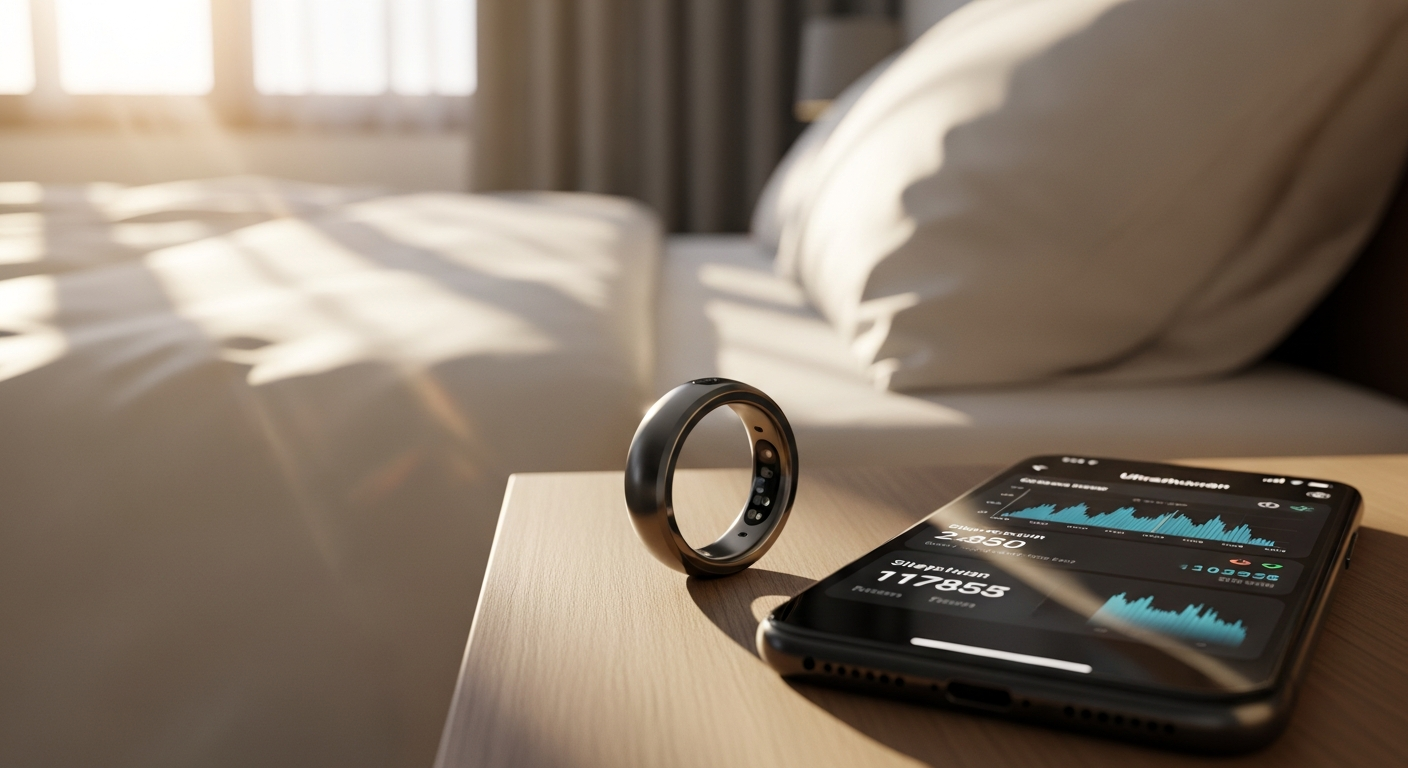
Discover how the Ultrahuman Ring AIR delivers advanced sleep and recovery tracking without subscription fees. Learn about HRV monitoring, battery life, pricing, and whether this smart ring outperforms competitors like Oura.
Over 40% of adults struggle with sleep quality, yet most never track what's actually happening during their rest cycles. The standard approach—guessing whether you slept well based on morning grogginess—leaves critical data on the table. The Ultrahuman Ring AIR changes that equation entirely by combining clinical-grade sleep insights with the comfort of something you'll actually want to wear every single night.
Ultrahuman Healthcare has carved out serious credibility in the wearables space, and their Ring AIR stands as one of their flagship products. This isn't just another smart ring; it's engineered specifically for people who want deep physiological data without the subscription trap that plagues competitors. The device represents a calculated approach to health tracking—one that prioritizes long-term value and accessibility over recurring revenue models.
What Makes the Ultrahuman Ring AIR Different from Other Smart Rings
The smart ring market has exploded over the past three years, but most options funnel users toward mandatory subscriptions. The Ultrahuman Ring AIR breaks that mold with a straightforward one-time purchase model—no hidden monthly fees, no locked features behind paywalls. You own the device and access its core functionality indefinitely.
The physical design deserves attention. At 2.4 to 3.6 ounces depending on your size, this ring feels like wearing almost nothing. That matters enormously for sleep tracking, where any weight or discomfort will eventually trigger the "I'll take it off tonight" mentality. The titanium-wrapped construction handles daily abuse—sweat from workouts, accidental shower exposure, the occasional bump against a doorframe—without degrading. Plastic competitors simply don't offer this durability profile.
The Adenosine Clearance Window feature represents genuinely novel thinking. Most wearables track sleep after the fact; this ring anticipates it by analyzing your adenosine buildup patterns and recommending optimal caffeine cutoff times. If your body typically clears adenosine by 3 PM, the app tells you so. That's actionable intelligence most other devices ignore entirely.
Advanced Sleep Tracking: How the Ring Monitors Your Nightly Recovery
Sleep Architecture Analysis
The ring doesn't just measure how many hours you sleep—it maps the architecture of those hours. REM, light sleep, and deep sleep stages each appear on your dashboard with timestamps and duration. This granularity matters because an eight-hour night with 90 minutes of deep sleep is neurologically different from eight hours of primarily light sleep.
Heart Rate Variability and Nervous System Recovery
HRV—the variation in milliseconds between heartbeats—reveals your autonomic nervous system state better than any single metric. A higher HRV suggests parasympathetic dominance (rest-and-digest mode), while lower HRV indicates sympathetic activation (fight-or-flight). The Ultrahuman Ring AIR monitors this continuously, giving you a window into whether your body is actually recovering or just lying still.
Skin Temperature Tracking
Core body temperature fluctuations during sleep signal recovery status and sleep quality. The ring's temperature sensors detect these micro-fluctuations, feeding data into algorithms that assess whether your sleep environment and physiological state are optimized. When temperature patterns deviate from your baseline, the app flags potential issues—ambient temperature problems, illness onset, or stress-induced dysregulation.
Personalized Recommendations
The accompanying Ultrahuman app transforms raw sensor data into narratives you can act on. Rather than staring at graphs, you receive specific recommendations: "Your HRV suggests continue avoiding intense training for another day" or "Your sleep quality improved 18% after you eliminated screen time before 9 PM." This translation from data to action is where the ring earns its value.
Battery Life, Charging, and Practical Durability for Frequent Travelers
Six days of battery longevity sounds incremental until you consider the travel implications. Most smartwatches demand daily charging—another cable in your carry-on, another device competing for outlet space in airport lounges. The Ultrahuman Ring AIR charges once per week, meaning a two-week trip requires just two charging cycles. For people who move frequently, this distinction separates genuine convenience from theoretical advantage.
The titanium construction handles the rougher aspects of travel environments. Water exposure from pool days, sauna sessions, or simply forgetting to remove it during a shower poses no threat. The ring isn't purely waterproof in extreme diving conditions, but standard water resistance covers real-world scenarios.
Durability concerns do surface in isolated user reports. Some customers have noted battery reliability degradation after extended use, with capacity dropping noticeably after 18+ months. One user reported the ring "bloating" after continuous wear, suggesting potential manufacturing defects in specific units. These aren't widespread patterns, but they indicate quality control isn't perfectly consistent across production batches.
Pricing, Value Proposition, and Cost Comparison
At $349 USD retail (often discounted to $289–$299.99 at various retailers), the Ultrahuman Ring AIR occupies a specific market position. It costs less than a high-end smartwatch but operates in the premium wearables category. The real value emerges when you factor subscription costs over time.
Oura Ring Gen 3, the primary competitor, carries a similar upfront price ($299–$349) but layers a $5.99 monthly subscription onto that investment. Over five years, that monthly fee compounds to $360 in recurring costs—essentially a second ring purchase. The Ultrahuman model eliminates this entirely. For someone purchasing at 35 and potentially wearing the ring for two decades, that's $1,440 saved relative to Oura's subscription model.
The one-time purchase approach isn't purely philanthropic; it reflects Ultrahuman's broader business strategy. They monetize through an expanding ecosystem—their M1/M2 Glucose Monitor, the Ultrahuman Circle app membership, and enterprise partnerships. The ring serves as entry point to that ecosystem rather than a primary revenue driver.
Understanding HRV, Recovery Metrics, and Physiological Insights
Heart Rate Variability Explained
HRV measures the millisecond variations between consecutive heartbeats. A resting heart rate of 60 beats per minute doesn't mean precisely one beat per second; instead, intervals might fluctuate between 900 and 1,100 milliseconds. Greater variability typically indicates better parasympathetic tone—your body's recovery system is active and responsive.
Parasympathetic Activation Tracking
The parasympathetic nervous system governs sleep, digestion, and recovery processes. When your ring detects elevated parasympathetic tone (measured through HRV patterns and skin temperature), it's signaling that your body is genuinely in rest-and-digest mode, not just lying in bed. This distinction separates actual recovery from merely being inactive.
Recovery Scores and Training Load Optimization
The ring calculates daily recovery scores, typically 0–100, indicating your physiological readiness for intense exercise. A score of 75+ suggests your body has adequately recovered from previous training stress; scores below 40 suggest the nervous system needs more recovery time. Athletes leveraging this data systematically outperform those ignoring HRV and recovery metrics.
Training load optimization prevents the common mistake of pushing intensity while depleted. A runner with a low recovery score gets clear feedback: prioritize easy running or rest today. This prevents the overtraining spiral that creates injury risk and plateaued performance.
Ultrahuman Ring AIR vs. Oura Ring: Head-to-Head Comparison
The competitive landscape narrows to one serious alternative: Oura Ring Gen 3. Both occupy the premium smart ring space; both cost around $300–$350 upfront; both track sleep, HRV, and recovery. The differences matter substantially, though.
Subscription Model: Ultrahuman requires zero monthly fees; Oura demands $5.99/month for premium features. Basic Oura features work without subscription, but advanced insights remain locked. This creates philosophical tension—you've already paid premium price, yet ongoing costs apply.
Battery Longevity: Ultrahuman achieves six days reliably; Oura's battery depends on the specific model generation and can range from four to seven days. The Ultrahuman advantage matters for travel, particularly multiweek trips where reducing charging infrastructure simplifies logistics.
Unique Features: Ultrahuman's Adenosine Clearance Window offers practical utility—caffeine timing optimization—that Oura doesn't address. Oura counters with Period Prediction, targeting women tracking menstrual cycles. Neither feature is universally applicable, making this a draw.
Durability: Both use titanium construction; both handle water exposure. Oura has been on market longer with more user data; Ultrahuman remains newer, creating slightly higher uncertainty around long-term durability, though current reports are largely positive.
App Interface: Oura's app maintains a gentler learning curve; Ultrahuman's interface rewards deeper exploration but overwhelms casual users initially. If you're comfortable with biohacking toolkits and quantified self approaches, Ultrahuman's complexity becomes an asset.
Real User Feedback: Amazon Reviews and Customer Satisfaction
The Ultrahuman Ring AIR maintains a 4.4 out of 5-star rating across 562 verified Amazon reviews. This places it solidly in "proven performer" territory—not perfect, but substantially reliable.
Consistent praise centers on three elements: the lightweight design (users mention forgetting they're wearing it), all-day wearability, and sleep stage detection accuracy. Multiple reviewers validate that the ring's sleep architecture breakdown aligns with subjective sleep quality perception. When the ring reports 45 minutes of deep sleep, users reliably feel more rested than nights showing only 15 minutes.
The six-day battery life generates genuine surprise—users don't expect it to last this long and repeatedly comment on how this changes the ownership experience compared to smartwatches.
Negative reviews cluster around the app's steep learning curve. New users frequently express frustration navigating features and understanding what data means. Some reviewers also mention the app's occasional bugs and crashes, though these reports remain minority feedback.
A small contingent of users have encountered durability issues—primarily the reported "bloating" phenomenon after extended use and battery capacity degradation. These represent perhaps 2–3% of reviews, suggesting isolated manufacturing defects rather than systemic design problems.
The Bottom Line: Is the Ultrahuman Ring AIR Worth Your Investment?
The Ultrahuman Ring AIR delivers genuine value for anyone serious about understanding their sleep and recovery patterns. Its subscription-free model, lightweight design, and advanced physiological monitoring create a compelling package that outperforms competitors in the mid-range smart ring category. The Adenosine Clearance Window feature alone offers practical utility that most wearables overlook.
However, the app's complexity might frustrate casual users, and occasional durability concerns suggest quality control isn't bulletproof. If you're a biohacker, athlete, or sleep-obsessed professional willing to navigate the learning curve, this ring will become indispensable. The $289–$349 investment makes sense when you consider the elimination of subscription fees over time.
For someone tracking sleep and recovery over a five-year period, the subscription-free model saves money while delivering equivalent or superior data quality compared to competitors. The device earns its place as one of the smartest choices in the wearables space for 2026 if your priorities align with independent health data ownership and physiological precision.
Start your sleep tracking journey with the Ultrahuman Ring AIR today.