
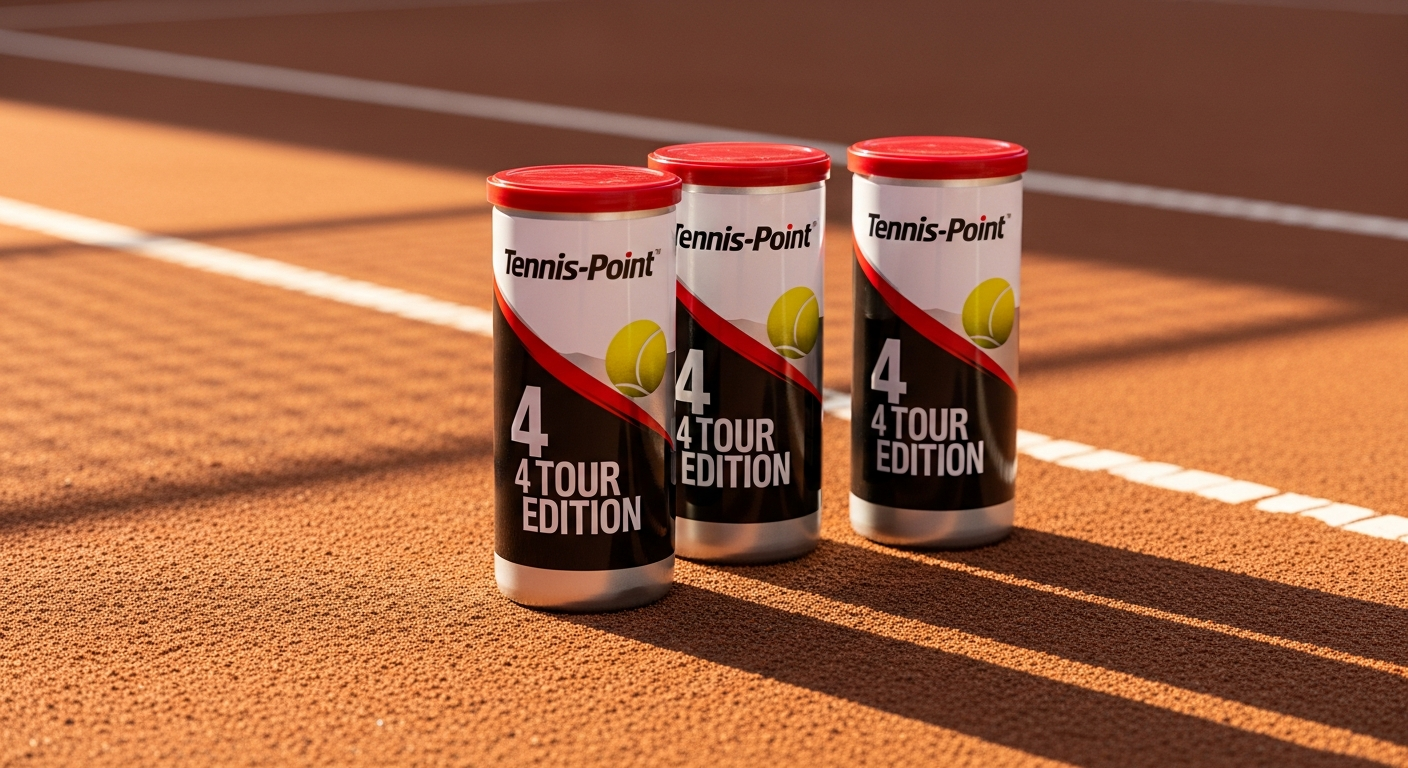
Discover why Tennis-Point Premium 4-Ball Cans deliver tournament-certified performance without the premium price tag. ITF-approved balls for all court surfaces—perfect for serious players on a budget.
When your tennis partner reaches into their bag and pulls out balls costing three times what you're spending, you might assume they're getting superior equipment. The truth reveals itself on court: performance doesn't correlate linearly with price. Tournament-level tennis balls command premium prices largely due to brand positioning rather than construction differences, yet serious players often overlook alternatives that deliver identical performance at a fraction of the cost.
Tennis-Point has fundamentally disrupted the private-label ball market by engineering a product that stands shoulder-to-shoulder with Wilson and Dunlop offerings. The Premium 4-Ball Can combines a natural rubber core with woven English felt—the same construction philosophy you'll find in professional-grade equipment—yet positions itself as an accessible alternative for serious recreational and competitive players alike.
Tournament Certification & Official Standards—What Actually Matters
ITF (International Tennis Federation) Certification Requirements and What They Guarantee
ITF certification isn't merely a marketing badge—it represents rigorous laboratory testing and standardized performance metrics. Tennis balls meeting ITF standards undergo precise measurements for diameter, weight, deformation, and rebound characteristics. These specifications ensure that whether you're training in Madrid or competing in Melbourne, your ball behaves predictably and consistently. The Tennis-Point Premium ball holds this certification, meaning it has passed the same technical scrutiny applied to professional tournament equipment.
FFT (French Tennis Federation) Official Ball Designation and Competitive Eligibility
Beyond ITF approval, Tennis-Point's designation as an official ball of the French Tennis Federation carries particular significance for European competitive circuits. The FFT serves as the governing body for tennis competition across France and maintains partnerships with manufacturers who meet exacting performance standards. This dual certification—both ITF and FFT—positions Tennis-Point Premium balls as legitimate competition equipment, not merely training alternatives. Players can confidently register these balls for sanctioned matches without concern about equipment eligibility challenges.
How Certification Impacts Tournament Acceptance Across Different Playing Circuits
Tournament directors across amateur and semi-professional circuits reference ITF-certified equipment lists when approving match conditions. A ball carrying ITF certification immediately qualifies for acceptance in most competitive contexts, from regional championships to national qualifying tournaments. This distinction matters practically: certified balls eliminate administrative friction before competition begins, allowing focus to remain on preparation and performance rather than equipment verification.
Pressure Standards and Consistency Benchmarks That Meet Official Specifications
ITF standards mandate specific pressure ranges measured in pounds per square inch (PSI). Tennis-Point Premium balls maintain pressurization within these official tolerances, ensuring consistent bounce height and speed characteristics throughout their usable lifespan. This pressure retention technology prevents the common frustration of balls becoming progressively "dead" mid-season. Competitive players depend on this consistency; a ball that loses pressure unpredictably introduces variables that undermine match preparation and confidence.
Construction Deep-Dive—Natural Rubber Core & English Felt Combination
Natural Rubber Core Benefits for Consistent Bounce and Speed Retention
The natural rubber core represents the foundation of Tennis-Point's performance equation. Natural rubber, sourced from rubber tree plantations, offers superior elasticity compared to synthetic alternatives. This elasticity directly translates to consistent rebound characteristics—when your racket strikes the ball at specific speeds and angles, natural rubber cores produce predictable responses. Professional manufacturers have consistently chosen natural rubber construction because it delivers the bounce consistency that competitive play demands.
Woven English Felt Properties and Their Impact on Ball Feel and Durability
English felt differs measurably from lower-grade felt alternatives. The weave density and fiber composition affect both immediate playability and long-term durability. Woven English felt provides a pleasant feel immediately upon opening the can—players consistently report that Tennis-Point balls don't require an extended break-in period before reaching optimal touch and spin characteristics. The felt construction contributes to the felt-to-court interaction that generates spin, directly influencing your control during baseline exchanges and net approaches.
Pressure Retention Technology That Keeps Balls Playable Across Multiple Sessions
Beyond initial pressurization, maintaining internal pressure throughout the ball's lifespan separates premium balls from budget alternatives. Tennis-Point Premium balls employ construction techniques that minimize pressure loss through the felt and rubber layers. This engineering choice explains why players report extended playability across multiple training sessions—the balls maintain their bouncing characteristics session after session rather than degrading noticeably after initial use.
How Premium Construction Prevents the Dead Ball Phenomenon Mid-Match
Every competitive player understands the frustration of a ball becoming progressively less responsive during important matches. This dead ball phenomenon results from pressure loss combined with felt deterioration. Tennis-Point's construction philosophy addresses both factors: the pressurization technology maintains internal bounce, while the English felt quality resists the degradation that typically causes feel-related performance loss. This combination ensures that balls remain reliably playable throughout their intended lifespan.
Multi-Surface Versatility—Clay, Grass, and Hard Court Performance
Consistent Flight Behavior Across Artificial Grass, Natural Grass, and Clay Courts
Surface variation introduces significant variables affecting ball behavior. Clay courts produce different bounce patterns than hard courts; grass courts introduce yet another set of physical characteristics. Tennis-Point Premium balls are specifically engineered for multi-surface compatibility, meaning the felt composition and core construction work effectively across these distinct playing environments. This versatility matters particularly for players who train or compete across multiple facility types within the same season.
Court-Specific Considerations and How Tennis-Point Balls Adapt to Each Surface
Clay courts demand balls that maintain consistent bounce despite surface friction and particle accumulation. Grass courts require balls that perform predictably despite the reduced friction and variable surface height. Hard courts expose any inconsistencies in felt quality and core elasticity because bounce precision becomes immediately obvious at high speeds. Tennis-Point Premium balls perform adequately across these environments because the construction addresses each surface's specific demands rather than optimizing for a single playing context.
Yellow Visibility Standards and Optical Performance in Different Lighting Conditions
Tournament regulations mandate specific yellow coloration for ball visibility. This standard isn't merely cosmetic—the yellow pigmentation directly affects visibility against court backgrounds, overhead sun positions, and artificial lighting conditions. Tennis-Point balls meet these visibility standards through engineered pigment application, ensuring players can track ball movement reliably across various environmental conditions.
Spin Generation and Control Characteristics on Varied Court Types
The felt composition affects your ability to generate spin through racket-string contact. English felt properties enable consistent spin generation whether you're hitting heavy topspin drives on clay or sliding shots on hard courts. Players report that Tennis-Point balls respond predictably to aggressive spin strokes, supporting the technical variety that competitive tennis demands.
Experience consistent performance across all court surfaces with Tennis-Point Premium balls.
The Durability Question—Felt Degradation vs. Extended Playability
Real-World Lifespan Expectations Across Multiple Training Sessions
Tennis-Point Premium balls consistently deliver across multiple training sessions—a capability that directly impacts cost-effectiveness. Players report that individual cans remain usable for 8-12 training sessions depending on court type and intensity, representing substantial value compared to budget alternatives that often become notably degraded after 3-4 sessions. This extended lifespan reflects the construction quality; natural rubber cores and English felt simply perform better over extended use periods.
Felt Roughening Patterns and Whether They Impact Actual Performance
The English felt naturally roughens with repeated racket contact and court friction. This visible roughening does not correlate proportionally with performance loss—the felt can appear noticeably worn while bounce characteristics and spin generation remain reliable. Players should recognize that felt appearance and actual performance represent separate considerations; a rough-looking ball often performs adequately for several additional sessions before truly reaching end-of-life status.
Bounce Consistency Maintenance Throughout the Ball's Usable Life
Bounce consistency represents the primary performance metric that deteriorates as balls age. Tennis-Point Premium balls maintain acceptable bounce consistency throughout their extended lifespan because the natural rubber core and pressurization technology resist the degradation patterns that affect lower-quality alternatives. This characteristic means the balls don't suddenly transition from "good" to "unplayable"; instead, they gradually lose responsiveness over sessions, allowing players to extend usable life by continuing to use them for practice scenarios with less demanding performance requirements.
Cost-Per-Use Calculation When Accounting for Extended Durability
Standard pricing for Tennis-Point Premium balls ranges between €5.00 and €10.90 per can. Assuming a can provides 10 training sessions of usable performance, the cost per session approximates €0.50-€1.09, markedly lower than premium brands that deliver roughly 6-8 sessions per can. When calculated across an annual training schedule with high ball volume, this difference compounds substantially. Players consuming 50 cans annually spend €250-€545 on Tennis-Point balls versus €500-€1,000 on equivalent premium alternatives, creating genuine budget impact without sacrificing performance standards.
Value Proposition Breakdown—Competitive Pricing Without Performance Sacrifice
Standard Pricing Range €5.00–€10.90 Per Can Versus Brand-Name Alternatives
Premium brands position tennis balls as luxury products commanding €12-€18 per can, pricing that reflects brand prestige more than construction superiority. Tennis-Point Premium balls occupy the €5.00-€10.90 range, representing direct price competition with flagship brands despite functionally similar construction. This pricing strategy enables serious players to access ITF-certified, competition-ready equipment without the financial burden typically associated with professional-grade balls.
Bulk Purchasing Options and Cost Reduction at 18-Piece Volume €4.87 Per Can
Purchasing discipline directly impacts equipment budgets. Tennis-Point offers meaningful volume discounts; purchasing 18-piece quantities reduces per-can pricing to approximately €4.87—a reduction that adds meaningful savings across an annual buying cycle. Players managing training programs with consistent ball consumption benefit substantially from these bulk options, effectively reducing equipment costs by 10-15% through simple purchasing strategy adjustments.
Price-to-Performance Ratio Analysis Across Competitive Ball Categories
Performance exists on a spectrum rather than a binary competitive/non-competitive distinction. Tennis-Point Premium balls deliver performance characteristics—ITF certification, natural rubber construction, English felt composition, extended durability—associated with balls priced 50-100% higher. This performance-to-price ratio positions Tennis-Point balls as genuinely competitive within the broader tennis equipment landscape. No meaningful performance compromises emerge when comparing Tennis-Point balls to Wilson, Dunlop, or Babolat alternatives at standard pricing.
Long-Term Budget Impact When Calculating Annual Ball Consumption
Consider a competitive player consuming 60 cans annually (roughly 240 balls yearly). Tennis-Point balls at €5.50 average per can total €330 annually, while equivalent performance from premium brands costs €720-€900. Over a five-year competitive career span, this difference approaches €2,000-€3,000—funding that might instead support coaching, tournament entries, or equipment upgrades. Budget-conscious players can access equivalent performance through informed purchasing without accepting lower quality standards.
The Smart Equipment Choice for Serious Players
Tennis-Point Premium 4-Ball Cans deliver precisely what competitive players demand: tournament-certified performance without the financial burden that typically accompanies professional-grade equipment. The natural rubber core paired with woven English felt construction ensures consistent bounce, reliable speed, and extended playability—characteristics that directly translate to match-day confidence and training efficiency.
What genuinely sets these balls apart is the absence of compromise. You're accessing ITF and FFT certification, multi-surface versatility, and durability that spans multiple training sessions, all while keeping your equipment budget realistic. Whether you're preparing for tournament competition, managing a training program with high ball volume, or simply refusing to overpay for equipment that performs identically to premium alternatives, Tennis-Point Premium cans represent the intersection of quality and value that's becoming increasingly rare in competitive sports equipment.
The evidence accumulates through consistent user experience: players repeatedly choose Tennis-Point balls as their go-to brand, report satisfaction with performance characteristics, and recognize extended playability that justifies continued purchasing decisions. These outcomes emerge not from brand loyalty or marketing influence, but from straightforward equipment performance matching what competitive play requires. Tournament certification validates competitive eligibility; construction quality ensures performance consistency; extended durability maximizes budget efficiency. The remaining question reduces to whether you'll continue accepting the premium brand pricing convention or recognize that superior alternatives exist at substantially lower cost.