
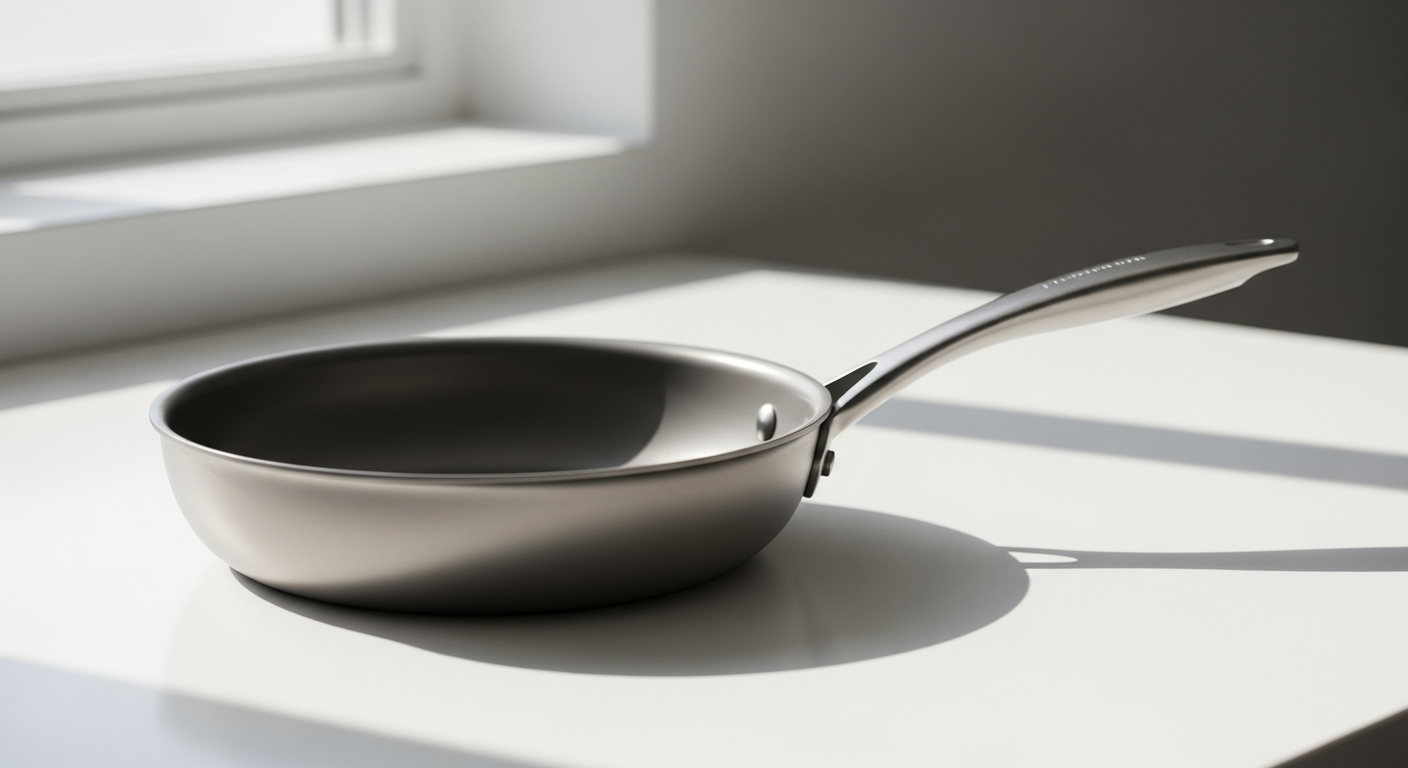
Discover why the Taima Pure Titanium Classic Pan Pro is revolutionizing healthy cooking with medical-grade titanium construction, non-toxic SlipScale surface, and lifetime durability.
Over 80% of American households use traditional non-stick cookware, yet most remain unaware that their daily cooking surfaces may be leaching harmful PFAS chemicals into their meals. The stakes are higher than convenience—they’re about the health of your family and the quality of every meal prepared in your kitchen. When you cook with conventional non-stick pans, you’re trusting that synthetic coatings remain stable and inert, a promise that chemicals like PFAS and PTFE have repeatedly failed to keep.
The Taima Pure Titanium Classic Pan Pro is engineered from 100% medical-grade titanium that eliminates chemical guesswork entirely, offering durability without compromise and performance without toxins. This cookware represents a fundamental shift in how we approach kitchen safety—moving away from reliance on chemical coatings toward materials that are inherently safe by their very nature. Rather than adding protective layers that degrade over time, titanium is the protection.
Medical-Grade Titanium vs. Traditional Non-Stick: Understanding the Health Difference
What makes Grade 1 pure titanium fundamentally different from conventional non-stick coatings
Grade 1 pure titanium exists in a different category entirely from the polymer-based coatings applied to traditional non-stick pans. When manufacturers coat conventional cookware with non-stick materials, they’re adding a layer of artificial protection—a coating that sits between your food and the underlying material. This coating, no matter how carefully engineered, remains subject to degradation through heat cycling, mechanical stress from utensils, and simple age.
Pure titanium takes a different approach. It is the cookware itself, not a surface treatment applied to something else. The medical-grade designation means this titanium meets strict purity standards established for biomedical implants. If titanium is safe enough to place inside the human body, it’s certainly safe enough for your cooking surface.
The PFAS and PTFE chemical concern: why these compounds are problematic for human health
PFAS (per- and polyfluoroalkyl substances) and PTFE (polytetrafluoroethylene, commonly known as Teflon) have become subjects of serious scientific scrutiny. These chemicals don’t break down naturally in the environment or in your body—they accumulate over time, which is why researchers classify them as “forever chemicals.”
Exposure to PFAS has been linked to elevated cholesterol, thyroid disease, liver damage, and kidney problems. When non-stick coatings degrade through normal cooking use—particularly when scratched, overheated, or used with high heat—these chemicals can leach into food. The risk escalates dramatically when cookware is damaged, yet many households continue using worn pans without realizing the potential harm.
How titanium’s inert nature prevents chemical leaching into food
The molecular structure of titanium is remarkably stable. It doesn’t break down at typical cooking temperatures, it doesn’t degrade when scratched by metal utensils, and it doesn’t leach compounds into food through any normal cooking scenario. Titanium’s inertness is why it’s chosen for surgical implants, dental work, and medical devices that remain in the body for decades without causing harm.
This inert quality means you’re cooking on a surface that simply cannot contaminate your food with synthetic chemicals. The protection isn’t temporary or dependent on maintaining a coating—it’s permanent and inherent to the material itself.
Comparing titanium cookware to ceramic, cast iron, and stainless steel alternatives
Ceramic cookware, while non-toxic, lacks the durability of titanium. The ceramic coating chips and wears away, eventually exposing the underlying material and requiring replacement. Cast iron develops a seasoning layer over time, which works well for many applications but demands specific maintenance and handling. Stainless steel is durable and safe but lacks any non-stick properties without added fat or oil.
Titanium occupies the middle ground—combining the non-stick advantage of coated cookware with the durability of cast iron and the safety profile that exceeds all alternatives. It performs the function of non-stick cookware without the chemical liability that comes with conventional options.
Breaking Down the SlipScale Technology: How Non-Stick Performance Works Without Chemicals
The mechanics behind SlipScale surface design and food release capability
SlipScale is Taima’s proprietary surface treatment, engineered to provide food release properties through physical structure rather than chemical coating. The surface features a carefully designed microscopic pattern that reduces friction between food and the cooking surface. This is mechanical non-stick functionality—physics rather than chemistry doing the heavy lifting.
The aluminum core integrated into the pan plays a supporting role here, distributing heat evenly across the surface and preventing hot spots that would cause food to stick in concentrated areas. When the cooking surface reaches the proper temperature uniformly, food naturally releases without requiring a chemical coating to achieve that result.
How the proprietary surface achieves non-stick properties naturally
The SlipScale pattern creates a surface topology that minimizes contact points between food and the pan. Rather than relying on a slippery chemical layer, the design uses the geometric properties of the surface itself to reduce adhesion. This approach means the non-stick properties remain effective indefinitely—they cannot wear away because they’re not a coating that degrades, but rather an integral part of the titanium surface structure.
Why proper preheating and minimal oil usage maximize the SlipScale effect
Many users initially struggle with the Taima pan because they approach it with expectations shaped by chemical non-stick cookware. Traditional non-stick pans work at room temperature and low heat settings because the chemical coating provides slip regardless of conditions. SlipScale, conversely, requires the surface to reach proper cooking temperature for optimal food release.
Preheating the pan for 2-3 minutes allows the surface to reach the temperature threshold where SlipScale performs its function most effectively. The addition of minimal oil—even just a light coating—creates a cooking environment where the titanium surface and the natural properties of SlipScale work together. This requirement represents a minor adjustment in technique that yields excellent results once understood.
Real-world cooking scenarios where SlipScale excels
SlipScale performs beautifully for sautéing vegetables, searing proteins, and making omelets. Eggs, which require careful heat management and gentle handling, release cleanly from the SlipScale surface when properly preheated. Root vegetables and mushrooms brown evenly without sticking. Proteins develop proper browning through the titanium’s excellent heat distribution while releasing cleanly once they’ve developed a golden crust.
The scenarios where SlipScale requires the most attention involve high-moisture foods at lower temperatures—situations where traditional non-stick truly shines. Understanding this boundary helps you use the pan in ways that align with its strengths.
Durability and Longevity: Why This Pan Could Be Your Last Major Cookware Purchase
Scratch-resistant properties and metal utensil compatibility
The defining durability feature of the Taima pan is its tolerance for metal utensils. While conventional non-stick cookware requires wooden or silicone utensils to protect the coating, titanium withstands steel and aluminum utensils without degradation. You can use metal spatulas, whisks, and scraping implements without concern about damaging the cooking surface.
This scratch resistance stems from titanium’s hardness—a material property that doesn’t diminish over time. The surface won’t develop the rough, worn appearance that characterizes aging non-stick cookware. Years of vigorous cooking leave conventional pans damaged and potentially unsafe; the same years leave the Taima pan essentially unchanged.
Corrosion resistance and long-term structural integrity
Titanium resists corrosion from acidic foods, salt, and water exposure that can compromise other cookware materials. Stainless steel can develop pitting corrosion under certain conditions; cast iron rusts without proper maintenance; conventional non-stick coatings degrade with exposure to acids. Titanium remains chemically stable through all normal cooking scenarios.
The rivetless interior design further enhances durability by eliminating crevices where water and food particles accumulate, potentially causing corrosion or creating sanitation challenges. The smooth, single-piece construction means fewer points of failure and easier cleaning.
How titanium’s natural properties prevent degradation over decades
Titanium’s atomic structure simply doesn’t degrade through thermal cycling, mechanical stress, or chemical exposure in normal cooking conditions. This isn’t a coating that wears away or a seasoning that requires maintenance—it’s a material property that remains constant throughout the pan’s life. A titanium pan used daily for 30 years performs essentially identically to a titanium pan used the same way for 3 years.
Cost-per-use analysis: calculating the investment over a 20+ year lifespan
The upfront investment in the Taima pan starts at €151.95 on sale, with a regular price of €320.95. These numbers seem substantial until placed against the reality of traditional cookware replacement cycles. Most households replace non-stick cookware every 3-5 years due to coating degradation and reduced performance. A household using the Taima pan for 20+ years instead replaces cookware 4-6 times during that period.
Calculate the true cost: five replacements of quality non-stick cookware at €100-200 each means €500-1,000 spent on replacing cookware over two decades. The Taima pan’s €320 regular price means you’re investing roughly 30% of what you’d otherwise spend while gaining a superior product that never requires replacement due to degradation. When amortized across 20+ years of daily use, the cost per cooking session becomes negligible—essentially pennies per meal.
Versatility Across Your Entire Kitchen: From Stovetop to Oven to Dishwasher
Induction cooktop compatibility and performance considerations
The aluminum core integrated into the Taima pan’s construction makes it fully compatible with induction cooktops. The aluminum conducts the electromagnetic energy effectively, heating the pan quickly and evenly. Induction cooking actually highlights one of titanium’s advantages—the rapid, even heating that the aluminum core facilitates results in better SlipScale performance since the entire surface reaches optimal temperature uniformly.
Oven-safe capabilities and maximum temperature thresholds
The pan is oven-safe, expanding its functionality beyond stovetop cooking. Braising begins on the stovetop and finishes in the oven; a baked pasta dish or vegetable gratin can transition directly from cooktop browning to oven cooking without requiring a transfer. The titanium construction means no concerns about handle degradation or coating failure from oven temperatures.
Dishwasher safety and cleaning recommendations
Hand-washing remains the recommended approach for all quality cookware, including titanium. The rivetless interior design makes hand-cleaning straightforward—there are no hidden crevices where food particles accumulate. A simple wipe with a soft cloth and warm soapy water restores the pan to pristine condition. Should you place it in the dishwasher, the titanium surface suffers no damage, though the high heat and harsh detergents offer no practical benefit over basic hand-washing.
Cooking methods suited to titanium cookware
Sautéing vegetables, searing proteins, braising meats, making sauces, baking frittatas, and roasting vegetables all work excellently in titanium cookware. The material’s excellent heat distribution prevents burning while the SlipScale surface ensures even cooking. The only cooking scenario where titanium might require slight adjustment is deep-frying, which demands consistent oil temperature at sustained high heat—titanium excels here too, though the high heat exposure is more intense than typical stovetop cooking.
The Antibacterial Advantage: Beyond Non-Stick Performance
Titanium’s natural antimicrobial properties at the molecular level
Titanium possesses inherent antimicrobial properties at the atomic level. The material actively inhibits bacterial growth on its surface through mechanisms that don’t rely on coatings, finishes, or chemical treatments. This property remains constant and doesn’t diminish with use, scratching, or aging.
How antibacterial surfaces reduce foodborne illness risk
Bacteria require surfaces where they can establish colonies and proliferate. Conventional cookware, particularly non-stick surfaces with microscopic imperfections and stainless steel with its grain structure, can provide niches where bacteria find purchase. The naturally antimicrobial titanium surface actively discourages bacterial colonization, creating a more hygienic cooking environment.
This becomes particularly important for households with immunocompromised members, young children, or when preparing foods that carry higher foodborne illness risk. The antibacterial property provides an additional layer of protection beyond conventional food safety practices.
Hygiene benefits compared to traditional non-stick and stainless steel cookware
Stainless steel requires aggressive cleaning and sanitization to minimize bacterial presence; traditional non-stick’s compromised surface integrity can harbor bacteria in microscopic cracks and degraded areas. The titanium surface actively works against bacterial growth through its molecular properties while remaining smooth and impervious to the kinds of damage that creates microbial harbors.
Scientific research supporting titanium’s antibacterial claims
Medical and dental research has extensively documented titanium’s antimicrobial properties, which is precisely why it’s chosen for implants and surgical instruments that must remain sterile within the body. This extensive research foundation means the antibacterial claims aren’t marketing rhetoric—they’re properties established through rigorous scientific investigation.
Making the Titanium Transition: Your Path Forward
The Taima Pure Titanium Classic Pan Pro represents a product that genuinely prioritizes your health without sacrificing performance or durability. The upfront investment is significant and you’ll need to adjust cooking habits slightly, but consider the mathematics: this single pan could outlast five or six conventional non-stick pans while keeping your family’s food free from harmful chemicals.
For families serious about eliminating chemical exposure and home cooks who view cookware as a long-term investment, the answer is clear. Start with one pan, master the technique of proper preheating and minimal oil usage, and let your experience guide whether a full titanium cookware collection makes sense for your kitchen. The transition requires patience and a willingness to approach cooking differently, but the reward—knowing that every meal is prepared on a surface incapable of contaminating your food with synthetic chemicals—makes the adjustment worthwhile.
Begin your journey toward chemical-free cooking with the Taima Pure Titanium Classic Pan Pro today.