
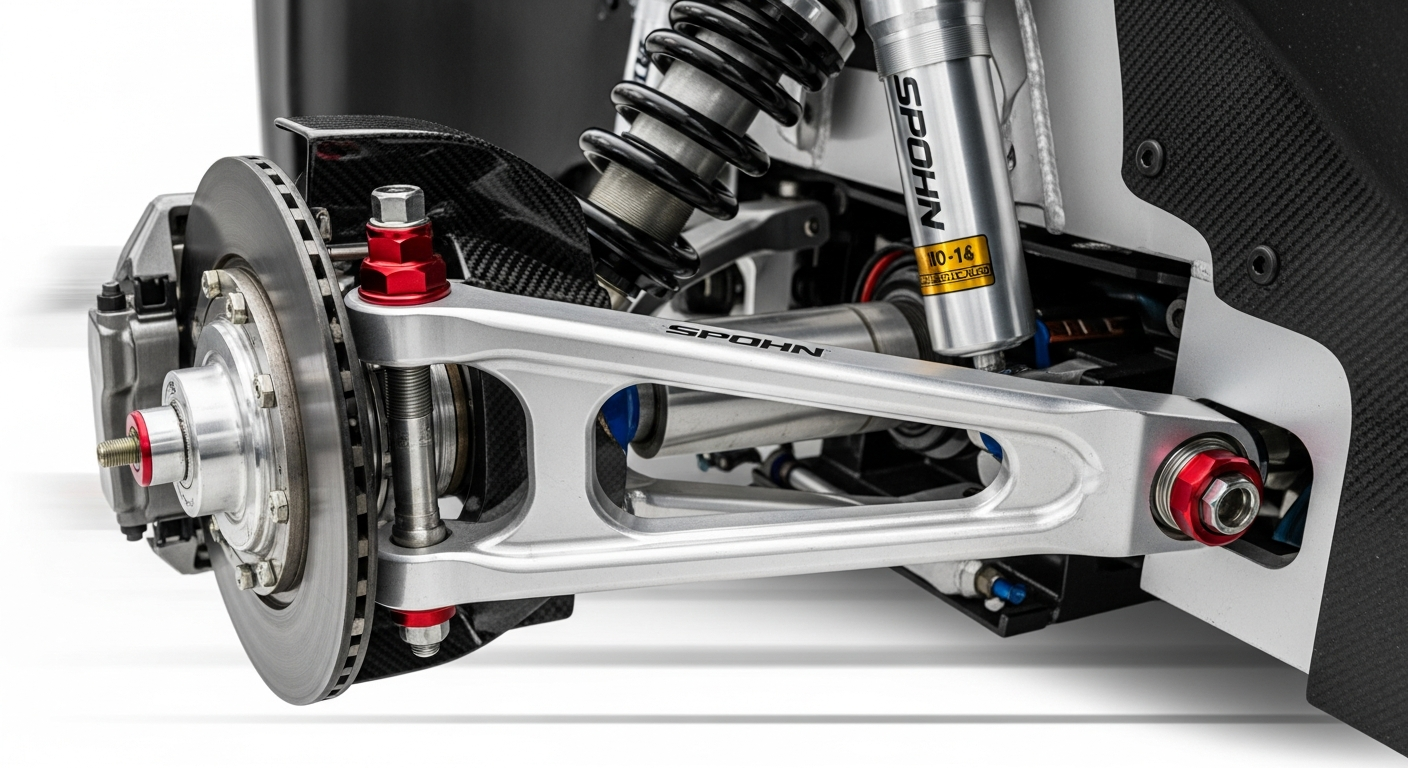
Discover how Spohn Performance adjustable control arms with Del-Sphere joints transform track performance. Learn about materials, adjustability features, and real-world applications for serious drivers.
Factory control arms weren't built for the demands of track days, autocross events, or aggressive cornering—they're engineered for comfort and cost-cutting. Most drivers never realize how much their factory suspension compromises handling until they experience the difference a purpose-built alternative delivers. The gap between OEM components and performance-oriented upgrades has only widened as manufacturers prioritize ride comfort over responsiveness.
Spohn Performance's adjustable control arms, particularly those featuring the proprietary Del-Sphere pivot joint technology, represent a significant leap forward from OEM components. These aren't just bolt-on upgrades—they're engineered solutions that allow drivers to dial in suspension geometry, reduce unsprung weight, and maintain consistent handling characteristics across different driving conditions. Built from premium materials like DOM tubing and 4130N chrome moly steel, these arms deliver the precision and durability that serious drivers demand.
Explore Spohn Performance adjustable control arms and transform your suspension geometry today.
Understanding the Engineering Behind Del-Sphere Pivot Joint Technology
What makes Del-Sphere joints different from traditional spherical rod ends and polyurethane bushings
The Del-Sphere pivot joint represents a deliberate engineering compromise between two competing suspension philosophies. Traditional spherical rod ends deliver maximum articulation but introduce harsh vibration and noise into the chassis. Polyurethane bushings, conversely, dampen noise effectively but restrict motion and bind under extreme suspension travel. Spohn's Del-Sphere design occupies the middle ground—a heat-treated chrome moly spherical ball encased in Delrin bushing cups that aims to preserve articulation while maintaining acceptable noise levels.
This hybrid approach addresses a real problem experienced by suspension enthusiasts. When you corner hard or encounter rough track surfaces, factory rubber bushings deflect and bind, causing unpredictable handling and lost feedback. Full-on spherical rod ends eliminate binding but transmit every vibration directly into your chassis. The Del-Sphere solution seeks to give you the best of both worlds through carefully selected materials and design geometry.
The 28-degree articulation range and how it prevents binding during extreme cornering
The Del-Sphere joint allows up to 28 degrees of rotation, a substantial range that addresses the real-world demands of aggressive driving. This articulation range matters most during hard cornering, trail braking into apexes, and rapid direction changes where suspension geometry shifts dramatically. With a 28-degree range, the control arm maintains full contact with its pivot point throughout these maneuvers, eliminating the bind that creates uncertainty and reduces grip.
This capability becomes particularly valuable during autocross events where steering inputs are sudden and sustained cornering loads extreme. A control arm that maintains consistent geometry under these conditions provides the driver with predictable feedback and confidence to push harder. The arm's ability to articulate freely means suspension travel translates directly into chassis movement rather than being lost to binding and compliance.
Heat-treated chrome moly construction and Delrin bushing cup design for durability
The physical construction of the Del-Sphere joint directly enables its performance characteristics. The chrome moly spherical ball undergoes heat treatment to achieve specific hardness and wear resistance properties. This process hardens the surface while maintaining toughness in the core material, creating a component that resists deflection under load while resisting catastrophic failure from shock loads.
The Delrin bushing cups that surround the sphere provide the damping function—they're stiffer than rubber or polyurethane but more compliant than solid metal. Delrin is an engineering plastic chosen specifically for its low friction coefficient and dimensional stability across temperature ranges. This material choice prevents the joint from becoming sticky or sluggish as temperatures rise during extended track sessions, ensuring consistent feel and performance whether you're on lap five or lap fifty.
Material Science and Construction Methods That Define Performance
DOM tubing vs. 4130N chrome moly steel—strength-to-weight ratios explained
Spohn Performance offers control arms in both DOM (Drawn Over Mandrel) tubing and 4130N chrome moly steel, each with distinct advantages. DOM tubing provides excellent strength-to-weight characteristics at lower cost. It's a cold-drawn seamless steel tube that offers sufficient strength for most street and moderate track applications while keeping unsprung weight minimal. For drivers prioritizing weight savings and operating within normal suspension forces, DOM represents solid value.
4130N chrome moly steel delivers superior strength in a lighter package compared to DOM. This aerospace-grade alloy contains chromium and molybdenum, elements that dramatically increase tensile strength and fatigue resistance. The result is a control arm that can withstand more intense suspension forces—crucial for high-horsepower vehicles, extreme track applications, or builds destined for sustained abuse. The trade-off is cost; 4130N control arms command premium pricing because the material itself costs more and demands more sophisticated welding techniques.
TIG welding techniques for superior joint integrity and reduced unsprung weight
The construction method separates precision engineering from basic fabrication. Spohn Performance uses TIG (Tungsten Inert Gas) welding throughout their control arm construction, a technique that requires greater skill and time than MIG welding but produces superior results. TIG welding allows the operator to precisely control heat input and filler material, creating joints with no porosity, minimal distortion, and maximum strength.
This precision matters because the control arm is a highly stressed component where failure could compromise vehicle safety. TIG welding creates joints strong enough to handle years of aggressive driving without weakening. Additionally, precise welding minimizes heat-affected zones around the joint, preserving material properties and allowing engineers to achieve lower overall weight. A properly TIG-welded control arm can use thinner wall tubing without sacrificing strength, directly reducing unsprung weight—mass that doesn't follow the suspension geometry and therefore degrades handling.
Why material selection impacts both durability and vehicle handling characteristics
Material selection isn't merely about preventing failure; it fundamentally shapes how the suspension behaves. A control arm made from inferior material or using improper welding techniques will deflect under cornering loads, changing suspension geometry mid-corner. This deflection ruins predictability—the driver can't maintain consistent camber or caster angle, causing tire loads to shift unexpectedly and confidence to evaporate.
Spohn's attention to material quality ensures the control arm maintains its designed geometry regardless of cornering forces. This consistency transforms the driving experience. Your chassis geometry remains stable, tire contact patches stay optimized, and feedback through the steering wheel becomes crisp and responsive. You know how the car will behave entering a corner because the suspension geometry remains constant rather than flexing and changing in unpredictable ways.
Adjustability Features That Transform Suspension Geometry
Fine-tuning pinion angle for optimal driveline angle and traction
Adjustable control arms solve a problem that plagues many modified vehicles: improper pinion angle. The pinion angle—measured between the driveshaft centerline and the transmission output shaft—directly impacts rear-end geometry and traction. Factory control arms lock you into fixed pinion angles optimized for stock ride height and spring rates. Modify the vehicle and suddenly your pinion angle is wrong, creating inefficient power transfer and traction loss.
Spohn's adjustable control arms allow you to dial in the precise pinion angle your modified vehicle requires. Lowering the vehicle typically increases pinion angle; adjustable arms let you correct this. Optimal pinion angle—typically zero degrees or slightly negative—maximizes driveshaft efficiency and minimizes shock-induced traction loss. The result is noticeably improved acceleration feel and reduced wheel hop during hard launches.
How adjustable control arms enable geometry corrections across different vehicle platforms
Every vehicle platform presents unique geometric challenges. GM F-body Camaros and Firebirds have different suspension geometry than Ford Mustangs, and SUV applications introduce entirely different constraints. A one-size-fits-all approach to control arm design cannot accommodate these variations. Adjustable arms recognize that optimal geometry depends on the specific vehicle, its modifications, and its intended use.
For instance, a Mustang might benefit from subtle caster angle increases to improve on-center handling feel. A Camaro racing in autocross might need camber compensation to maintain tire contact patches during extreme lateral acceleration. An SUV used for off-road driving might require geometry tweaks to maintain articulation through rock gardens while keeping on-road handling predictable. Adjustable control arms accommodate all these scenarios by allowing precise correction of suspension parameters.
Suspension geometry parameters you can dial in (caster, camber, and alignment considerations)
Understanding suspension geometry parameters transforms your perspective on suspension upgrades. Caster angle—the forward or backward tilt of the steering axis when viewed from the side—affects steering effort, on-center feel, and high-speed stability. Increasing caster improves on-center feel and straight-line stability but requires more steering effort. Adjustable control arms allow you to fine-tune caster without compromising other parameters.
Camber angle—the inward or outward tilt of the tire when viewed from the front—directly impacts cornering grip. Negative camber (top of tire tilted inward) loads the tire's outside edge during cornering, maximizing grip. Most stock vehicles run slight positive camber for tire wear reasons; performance adjustments typically involve adding negative camber. Control arm adjustability lets you dial in the precise camber angle your tires and springs prefer.
Toe angle—the convergence or divergence of the front wheels—affects both straight-line stability and cornering response. Most adjustable control arms allow fine-tuning of toe specifications, enabling drivers to precisely dial in the balance between straightness and responsiveness they prefer.
Application-Specific Performance Across Multiple Vehicle Platforms
GM F-body vehicles (Camaro, Firebird) and their unique suspension challenges
GM F-body vehicles represent a massive portion of Spohn Performance's customer base, and for good reason. Second and third-generation Camaros and Firebirds have fundamental suspension design limitations that adjustable control arms directly address. The factory short-and-long-arm (SLA) suspension geometry was engineered around 1980s performance expectations—by modern standards, it's severely compromised.
Factory F-body control arms lock geometry in place without any tuning capability. Add engine modifications, change ride height, or increase horsepower, and the stock geometry works against you rather than supporting performance. Spohn's adjustable F-body control arms maintain the original suspension packaging while unlocking geometric adjustability. Suddenly you can correct camber angles to maintain optimal tire contact, dial in pinion angle to maximize traction, and fine-tune caster for improved steering response. The difference between stock and properly adjusted F-body suspension is genuinely night-and-day.
Ford Mustang applications and how adjustable arms improve handling balance
Ford Mustangs present their own geometric challenges. Fox-body Mustangs (1979-1993) suffer from understeer-biased stock geometry—the front tends to push before the rear steps out. This characteristic requires more driver skill to exploit fully and limits ultimate handling balance. Adjustable control arms allow Mustang drivers to increase front caster and camber, creating a more neutral handling balance and increasing confidence during hard cornering.
Modern Mustangs benefit from adjustable control arm upgrades as well. Even with modern engineering, there's always tuning potential. Adjustable arms enable precise dial-in of suspension geometry to match your specific driving style, your local track's corner characteristics, and your vehicle's power level. A Mustang equipped with Spohn adjustable control arms feels fundamentally more responsive and predictable than one running factory geometry.
GM SUV suspension upgrades for both street and off-road performance
GM SUV applications represent an emerging performance opportunity. Trucks and SUVs increasingly attract performance enthusiasts interested in combining capability with handling. Factory SUV suspension geometry prioritizes ride comfort and load carrying over handling precision. Spohn's SUV-specific adjustable control arms address this by enabling geometry optimization without compromising off-road articulation.
For street-focused builds, SUV adjustable control arms enable dramatic improvements in handling balance and cornering feel. For off-road applications, the adjustability allows compensation for lift kits and alternative suspension configurations. Whether you're building an autocross-capable SUV or a lifted off-roader that still handles decently on asphalt, Spohn's application-specific control arms support your goals.
Del-Sphere vs. Polyurethane Bushing Options—Making the Right Choice
Articulation capabilities: Del-Sphere's 28-degree range versus polyurethane limitations
The choice between Del-Sphere and polyurethane bushings fundamentally comes down to your performance priorities. Del-Sphere's 28-degree articulation range delivers maximum suspension freedom—the arm can move through large angles without binding. This matters most during extreme driving on track surfaces where suspension forces approach physical limits. The Del-Sphere joint maintains consistent geometry throughout this full range, translating suspension movement into predictable chassis movement.
Polyurethane bushings, by contrast, offer limited articulation. They deflect and compress under load rather than articulating cleanly. This limitation becomes problematic during aggressive driving where you need the suspension to move through large angles. The bushing simply can't accommodate the movement, causing binding and unpredictability. For track-focused applications, Del-Sphere's superior articulation range delivers noticeably better performance.
Noise and vibration characteristics of each joint type during normal driving
This is where the trade-offs become apparent. Polyurethane bushings dampen vibration effectively, maintaining relatively quiet operation even under hard use. If you're building a street car where noise and smoothness matter, polyurethane offers real advantages. The bushings naturally absorb vibration and road noise, keeping the interior quiet and isolating occupants from suspension activity.
Del-Sphere joints, while dramatically improved over solid spherical rod ends, introduce more vibration and noise than polyurethane. Some users report a "clunky" feel if the arms aren't properly tightened or if the inherent stiffness of the Delrin material creates noise transmission. For street applications where comfort matters, this can be a disadvantage. However, track-focused drivers often prefer the more direct feel, accepting increased noise as a trade-off for superior feedback and consistency.
Budget considerations: premium Del-Sphere pricing versus economy polyurethane options
Cost is the final consideration. Polyurethane bushing control arms typically cost less than Del-Sphere versions. If budget is a primary constraint, polyurethane offers respectable performance improvements at lower price points. For drivers on tight budgets upgrading basic suspension, polyurethane represents good value.
Del-Sphere command premium pricing because the technology is proprietary and manufacturing requires greater precision. For serious track enthusiasts and drivers prioritizing ultimate performance, the investment justifies itself through improved articulation and consistency. Think of it as spending more upfront to eliminate a potential limitation during your most demanding driving.
Installation, Maintenance, and Longevity Expectations
Pre-installation inspection and preparation steps
Proper installation begins before the wrench comes out. Inspect your existing control arms for damage or excessive wear. Even if you're replacing them, understanding what failed or wore prematurely guides your installation approach. Check all suspension bushing attachment points for corrosion, cracked welds, or stripped threads. Clean these areas thoroughly before installation.
Prepare the vehicle for work by elevating it safely and supporting it with jack stands at multiple points. Remove wheels to access the control arm fastening points. Many control arm installations benefit from having a helper—one person manipulating the arm while another ensures alignment and threads fasteners. Take your time removing factory arms, noting any shims or spacers that control alignment; you'll need equivalent components for proper installation of the adjustable arms.
Proper tightening procedures to eliminate clunking or noise issues
Correct fastener torque is absolutely critical for Del-Sphere equipped control arms. Under-tightened fasteners allow micro-movement of the Delrin bushings against the chrome moly ball, creating the "clunky" noise some users report. Over-tightening can crush the Delrin bushings or strip threads. Follow Spohn's specific torque specifications exactly—typically in the 45-70 foot-pound range depending on fastener size.
Apply fasteners in the proper sequence: thread all fasteners hand-tight first, then progressively tighten in a cross pattern to ensure even load distribution. This prevents tilting or misalignment of the arm. After tightening, gently rock the control arm by hand to verify smooth operation without excessive play or binding. A properly installed control arm should move smoothly through its articulation range without play at connection points.
Maintenance schedules for optimal performance and longevity
Spohn adjustable control arms require minimal maintenance compared to some suspension components, but periodic inspection ensures longevity. Every 5,000 miles or after track events, visually inspect the arms for any cracks, bending, or loose fasteners. Check that fasteners maintain proper torque; vibration can occasionally loosen fasteners even on properly installed arms.
Annually, remove the wheels and carefully inspect the Del-Sphere joints (if equipped) for any unusual play or noise. Grasp the arm and attempt to move it—there should be no discernible play at the joint. If you notice new play developing, the Delrin bushings may be wearing and require replacement. This is normal wear after years of hard use, but catches the problem before it impacts handling. Replace bushings as needed to maintain the precise feel the arms originally delivered.
Performance Gains You Can Expect From This Suspension Upgrade
Quantifiable improvements in cornering grip and stability
Properly adjusted suspension geometry delivers measurable improvements in cornering grip. Track testing consistently shows lap time reductions in the 0.5-2 second range per lap, depending on the track, vehicle, and driver. These improvements stem from optimized tire loading throughout the corner. With correct camber and caster angles, tires load more efficiently, generating more grip across a wider range of steering inputs.
Stability during rapid direction changes improves dramatically. Stock suspension geometry often becomes unstable under extreme lateral acceleration; adjustable control arms with optimized geometry maintain predictable, planted handling. The vehicle feels like it's glued to the track rather than fighting you for control. This stability translates directly into confidence and speed.
Enhanced traction during acceleration and power transfer to pavement
Pinion angle correction alone can transform launch characteristics. A properly angled driveshaft transfers power to the pavement more efficiently, reducing shock-induced traction loss. Drivers often report noticeably improved acceleration feel and reduced wheel hop during hard launches. The rear end plants harder and hooks better, translating engine power directly into forward motion rather than seeing it dissipated through suspension compliance.
This improvement becomes increasingly valuable as vehicle horsepower increases. A naturally aspirated engine produces torque gradually; suspension compliance might go unnoticed. A supercharged or turbocharged engine produces massive torque instantly; improper pinion angle causes dramatic wheel hop and traction loss. Adjustable control arms optimizing pinion angle unlock the full potential of modified engines.
Steering response and feedback improvements over factory arms
Steering response sharpens noticeably with properly optimized suspension geometry. Factory arms flex under load, causing steering input delays and mushy feedback. Spohn's rigid construction and optimized geometry translate steering inputs more directly into suspension response. Point the car into a corner and it responds immediately and predictably.
Feedback through the steering wheel improves as well. You feel the tires working, sense when they're approaching their grip limit, and can modulate your inputs accordingly. This is the difference between driving a car that responds to you versus driving a car you're constantly fighting. Over a lap or throughout a track day, this improvement compounds—with better feedback, you naturally drive smoother and more precisely, generating faster lap times through improved precision rather than just increased aggression.
Investment Analysis—Pricing, Value, and ROI for Serious Drivers
Price range breakdown ($200–$500+ per pair) based on specifications
Spohn Performance adjustable control arms typically range from approximately $200 to over $500 per pair, depending on the specific application, material, and joint type. Entry-level DOM tubing control arms with polyurethane bushings start around the lower end of this range. Upper control arms typically cost around $279, while lower control arms average around $219. These basic versions deliver solid performance improvements at reasonable cost.
Upgrading to 4130N chrome moly steel construction increases cost moderately. The superior material justifies the expense for vehicles with high horsepower or those destined for extreme track use. Del-Sphere equipped versions command additional premium due to the proprietary technology and precision manufacturing required. A fully equipped set of Del-Sphere chrome moly control arms can exceed $500 per pair.
Upper control arm pricing ($279 average) versus lower control arm costs ($219 average)
The price difference between upper and lower arms reflects engineering complexity and material usage. Lower arms typically use slightly less material, explaining the moderate cost difference. However, both are equally important to your suspension's performance.
Planning your budget, expect to spend $500-$1,000 for a complete front suspension upgrade with quality adjustable control arms. This investment competes directly with other popular suspension upgrades like coilover kits or sway bars. What distinguishes adjustable control arms is their direct impact on suspension geometry—they address fundamental limitations rather than merely adjusting compliance or spring rates.
Cost-per-performance-gain analysis for track enthusiasts
For track-focused drivers, the cost-per-performance-gain calculation favors adjustable control arms heavily. A quality set of adjustable arms delivers lap time improvements comparable to far more expensive upgrades. Many drivers report 1-2 second per lap improvements on typical autocross courses—performance gains that would require thousands of dollars in engine modifications or tens of thousands in lightweight components to achieve.
The value extends beyond just lap times. The consistency and predictability adjustable arms provide eliminates a major source of driver uncertainty. You can focus on driving technique and line optimization rather than fighting the vehicle's geometry. The satisfaction of driving a vehicle that responds exactly as intended carries value beyond simple lap time mathematics. Over the lifecycle of vehicle ownership, investing in proper suspension geometry proves to be one of the smartest upgrades available.
Real-World Track Performance and Driver Feedback
Case studies from autocross competitors using Spohn adjustable arms
Autocross competitors represent the most demanding users of suspension components, routinely pushing vehicles through extreme lateral accelerations and rapid direction changes. Spohn Performance adjustable control arms have proven themselves consistently in this environment. Competitors in various classes report dramatic improvements in turn-in response and mid-corner stability after upgrading to Spohn adjustable arms.
One representative case involved a third-generation Camaro competing in autocross with factory suspension geometry. Stock geometry produced consistent understeer, limiting turn-in speed and requiring the driver to slow entry speed more than the track layout demanded. Upgrading to Spohn adjustable control arms enabled geometric optimization for the Camaro's specific weight distribution. With optimized caster and camber, the vehicle transitioned from understeer-prone to neutral handling. The driver immediately posted faster lap times and reported dramatically improved confidence.
Track day testimonials and performance improvement stories
Track day drivers using Spohn adjustable control arms consistently report improved experiences across multiple dimensions. Safety improves as handling becomes more predictable—drivers know they can rely on the suspension to behave consistently throughout a lap. The eliminated surprises mean fewer lock-ups, off-track excursions, and scary moments. Racing is challenging enough without fighting your car's geometry.
Performance testimonials emphasize the cumulative effect of proper geometry. Early laps show modest improvements; by lap fifteen or twenty, the driver has adapted to the improved feedback and consistency, posting significantly faster lap times. The adjustability aspect gets praise for enabling tuning to match individual driving styles. One driver might prefer more responsive steering and add caster; another might prioritize turning capability and adjust camber. Spohn's adjustable arms accommodate both philosophies.
Before-and-after handling characteristics reported by drivers
Drivers consistently describe before-and-after changes in similar terms. Stock suspension produces vague feedback, unpredictable handling under stress, and a general feeling of not fully controlling the vehicle. It's like driving with gloves on—you can feel general inputs but lack precision.
After upgrading to adjustable arms with optimized geometry, the experience transforms. Feedback sharpens dramatically. The vehicle responds immediately to steering inputs. Confidence increases because you know the suspension will do exactly what you ask it to. Cornering feels planted and controlled rather than uncertain. Launches hook harder without traction loss. The overall sensation is driving a vehicle that's genuinely responsive rather than tolerating one that's sluggish and unpredictable.
Elevating Your Suspension Game: Why Spohn Performance Adjustable Control Arms Belong in Your Build
Spohn Performance adjustable control arms represent far more than a simple bolt-on upgrade—they're a gateway to genuine suspension control and predictable handling characteristics that factory components simply cannot deliver. Whether you're chasing faster lap times on the track, seeking confidence during aggressive cornering, or building a vehicle that responds exactly how you envision it, these control arms address fundamental weaknesses in factory suspension systems.
The precision engineering behind Spohn's approach—from their proprietary Del-Sphere pivot joints to their meticulous TIG welding and material selection—translates directly into driving experience. You gain the ability to optimize suspension geometry to your specific vehicle, your local track's demands, and your personal driving preferences. This level of control separates enthusiast vehicles from well-configured performance machines.
The investment—ranging from $200 to $500+ per pair—pays dividends through improved handling, enhanced traction, and the satisfaction of driving a vehicle engineered to your exact specifications. Factor in the lap time improvements and confidence gains, and the cost-per-performance ratio compares favorably to virtually any competing suspension upgrade.
Your path forward starts with identifying your specific vehicle platform and honestly assessing whether you prioritize track performance or street comfort. Determine whether Del-Sphere's superior articulation aligns with your driving goals or whether polyurethane bushings' quieter operation suits your preferences better. Then connect with Spohn Performance to discuss the ideal control arm configuration for your build.