
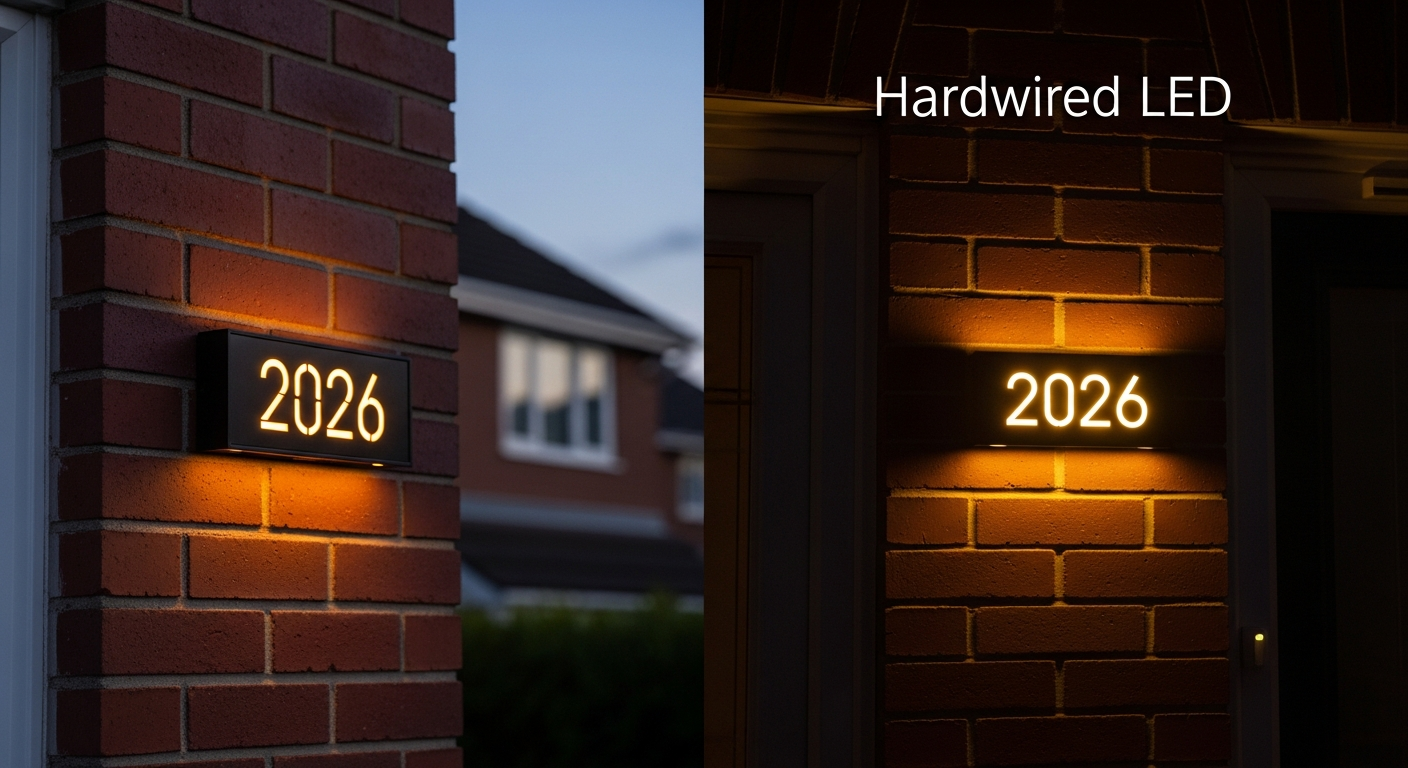
Compare solar and hardwired modern LED backlit house address numbers for your home. Discover which power option offers the best installation, cost savings, and curb appeal in 2026.
When emergency responders need to find your home in the dark, every second counts. Yet countless families still rely on traditional address markers that fade into the shadows the moment the sun sets, forcing firefighters, paramedics, and police to waste precious minutes searching. Delivery drivers circle residential blocks frustrated, unable to locate properties with faded numbers or obscured signage. Over 5,000 homeowners have ditched this problem entirely by upgrading to modern LED backlit house address numbers because they solve what traditional markers simply cannot.
The modern LED backlit house address numbers from Lighted Address Numbers have become the gold standard in the illuminated signage market, commanding a 4.88-star rating from thousands of satisfied customers who've experienced the difference firsthand. These aren't just bright numbers tacked to a wall—they're engineered solutions that combine premium stainless steel and acrylic construction with cutting-edge LED technology designed to last 20+ years while demanding virtually no maintenance.
Your biggest decision won't be whether to upgrade, but rather which power system suits your home best. Two fundamentally different approaches power these address numbers: solar-powered models that require zero wiring and offer complete installation freedom, and hardwired versions that deliver maximum brightness and operate reliably regardless of weather or season. Understanding the strengths and trade-offs of each system determines which one truly fits your property, lifestyle, and goals.
Discover how to transform your home's nighttime visibility today.
Solar-Powered Modern LED Backlit House Address Numbers: The Wire-Free Revolution
Solar-powered address numbers eliminate the most common barrier to upgrading your home's visibility: the hassle of electrical work. These systems arrive with everything needed for installation in under an hour, making them ideal for renters, homeowners avoiding electrical modifications, or anyone who values simplicity above all else.
Built-in dusk-to-dawn sensors automatically activate illumination at sunset and deactivate at sunrise, meaning your address numbers work without any manual intervention or scheduling. The system learns your local sunrise and sunset times, adapting throughout the year to deliver consistent performance through every season.
The solar panels integrated into each unit charge during daylight hours, storing energy to power nighttime illumination. No wiring runs through your home's walls. No electrical permits or inspections. No concerns about low-voltage transformer placement or circuit integration. The panels silently collect energy from the sun while you go about your day, then deliver reliable nighttime visibility without drawing a single watt from your home's electrical system.
Annual maintenance requirements are virtually nonexistent. Unlike hardwired systems that occasionally need inspection, solar models simply require an occasional cleaning to remove dust or debris that might slightly reduce panel efficiency. The lack of ongoing electricity costs represents a significant financial advantage over time, particularly for homeowners in sunlit regions.
Hardwired LED Address Numbers: Maximum Brightness and Reliability
Hardwired systems represent the opposite philosophy: optimize performance without compromise. Where solar models balance convenience with adequate brightness, hardwired versions prioritize luminosity and consistent operation under any conditions.
A 24V transformer system provides the backbone of hardwired installations, delivering power that generates noticeably brighter illumination compared to solar alternatives. This brightness advantage matters most for homes set far back from the street, properties surrounded by tall trees or architectural features that create shadows, or neighborhoods where maximum visibility is essential for emergency response times.
Energy consumption remains remarkably efficient at just 6-10 watts per number—approximately $24 annually for a four-digit address illuminated 12 hours nightly. This minimal power draw means hardwired systems cost less to operate than running a single LED bulb, making the electricity argument against hardwired installation largely irrelevant for cost-conscious homeowners.
Hardwired models excel in coastal environments, heavily shaded properties, regions with short winter days, and homes where uninterrupted, predictable illumination matters most. Weather conditions—cloudy skies, heavy snow, seasonal changes—never affect performance because the system draws power directly from your home's electrical infrastructure rather than depending on solar charging.
Installation Complexity: DIY vs. Professional Setup Considerations
Solar models arrive with mounting templates, all necessary hardware, and straightforward installation guides that walk homeowners through each step. The process genuinely qualifies as plug-and-play: position the unit according to the template, secure the mounting hardware, and you're finished. No electrical knowledge required. No permits needed. Installation typically takes 30-60 minutes from unboxing to complete operation.
Hardwired versions include comprehensive wiring diagrams and low-voltage components but require familiarity with electrical systems and comfort working with 24V transformer connections. The actual wiring work isn't dangerous when approached correctly, but it does demand electrical knowledge to ensure proper installation and safety compliance.
Professional installation for hardwired systems typically costs $100-$300+ depending on your area's labor rates and installation complexity. For homeowners without existing low-voltage infrastructure, this expense represents a legitimate consideration in the total cost of ownership. However, experienced DIYers comfortable with basic electrical work can successfully install hardwired systems themselves, provided they follow the included diagrams carefully and verify all connections before energizing the system.
Explore professional installation options and find the perfect fit for your property.
Cost Comparison: Annual Operating Expenses and Long-Term Investment
Hardwired models consume minimal electricity at approximately $24 annually for typical operation—six to ten watts per number, twelve hours nightly throughout the year. This figure makes hardwired systems exceptionally affordable to operate once installation is complete.
Solar models eliminate electricity costs entirely, consuming zero power from your home's electrical grid. This advantage appeals particularly to environmentally conscious homeowners and those seeking to reduce their carbon footprint alongside improving home visibility.
Premium lighted address numbers typically range from $100-$300+ per unit depending on size, customization options, and power system selection. Solar and hardwired versions occupy similar price ranges, with the choice driven by your specific needs rather than cost differentials.
The financial break-even point for solar systems occurs within two to three years for homes with average sunlight exposure. After that window, years of free operation provide genuine financial advantage compared to the ongoing $24 annual electricity cost of hardwired systems. Over a 20-year LED lifespan, solar systems could save $400-$500 in cumulative electricity costs—meaningful savings that reward the initial installation choice.
Climate Considerations: Choosing the Right Power System for Your Region
Geographic location and local weather patterns significantly impact which power system performs optimally at your property. Solar models excel in sunny climates with consistent daylight hours year-round, delivering reliable performance with minimal seasonal variation.
Northern regions with short winter days present challenges for solar systems because reduced daylight means reduced solar charging capacity. Properties in these climates may require supplemental battery capacity to ensure nighttime illumination throughout winter months when days are significantly shorter.
Coastal properties benefit from hardwired systems' superior corrosion resistance and consistent performance regardless of salt spray, moisture, and environmental stress. While modern solar models include weatherproofing rated to IP65 standards and can withstand extreme temperatures from -40°F to 140°F, hardwired systems' independent power source eliminates weather-related performance concerns entirely.
Heavily shaded properties—those surrounded by mature trees, tall buildings, or architectural features that block direct sunlight—may struggle with solar system efficiency. In these situations, hardwired models unaffected by shading or seasonal light reduction deliver consistent performance without compromise.
The Verdict: Making Your Power System Decision
Choose solar if wire-free installation ranks as your top priority, electricity costs concern you, and your property receives adequate daily sunlight. Solar systems deliver genuine convenience and long-term cost savings for homeowners willing to prioritize ease of installation.
Choose hardwired if maximum brightness, consistent year-round performance, and uninterrupted operation matter most. These systems excel for properties set far from the street, heavily shaded locations, or regions where solar charging limitations present genuine concerns.
Solar suits renters who cannot modify their properties, homes without nearby electrical outlets, or homeowners who prefer avoiding electrical modifications entirely. The zero-installation-complexity approach and absence of professional installation needs make solar particularly attractive for these situations.
Both systems deliver identical exceptional durability thanks to premium stainless steel and acrylic construction. Both offer extensive customization flexibility across four font styles, seven colors, and three LED temperature options. Both provide the remarkable 20+ year LED lifespan that makes these address numbers a genuine long-term investment rather than a temporary fix.
Transform Your Home's Nighttime Presence: Your Modern LED Address Solution Awaits
The choice between solar and hardwired modern LED backlit house address numbers ultimately comes down to what matters most at your specific property. Solar systems deliver unbeatable convenience and zero electricity costs, while hardwired models provide maximum brightness and unwavering reliability regardless of weather or season.
Three factors should guide your decision: your home's sunlight exposure throughout the year, your comfort level with electrical work and installation requirements, and whether you prioritize installation simplicity or maximum brightness output. Homeowners in sunny regions without shading concerns might find solar's convenience and zero-cost operation irresistible. Those in challenging climates or properties far from the street might determine that hardwired brightness justifies the installation complexity.
What makes these modern LED backlit house address numbers genuinely compelling is their ability to solve multiple problems simultaneously. Emergency responders get a clear target when seconds matter most. Delivery drivers stop circling, frustrated and lost. Your home gains that sophisticated, upscale appearance that communicates care and intentionality about your property's presentation.
With 20+ years of LED performance ahead and a 2-year warranty backing your investment, you're looking at a home upgrade that truly pays dividends across multiple dimensions. Better emergency response times. Improved accessibility for guests and service providers. Enhanced curb appeal that reflects your home's value. These aren't minor conveniences—they're practical improvements that make life easier while elevating your property's presence.