
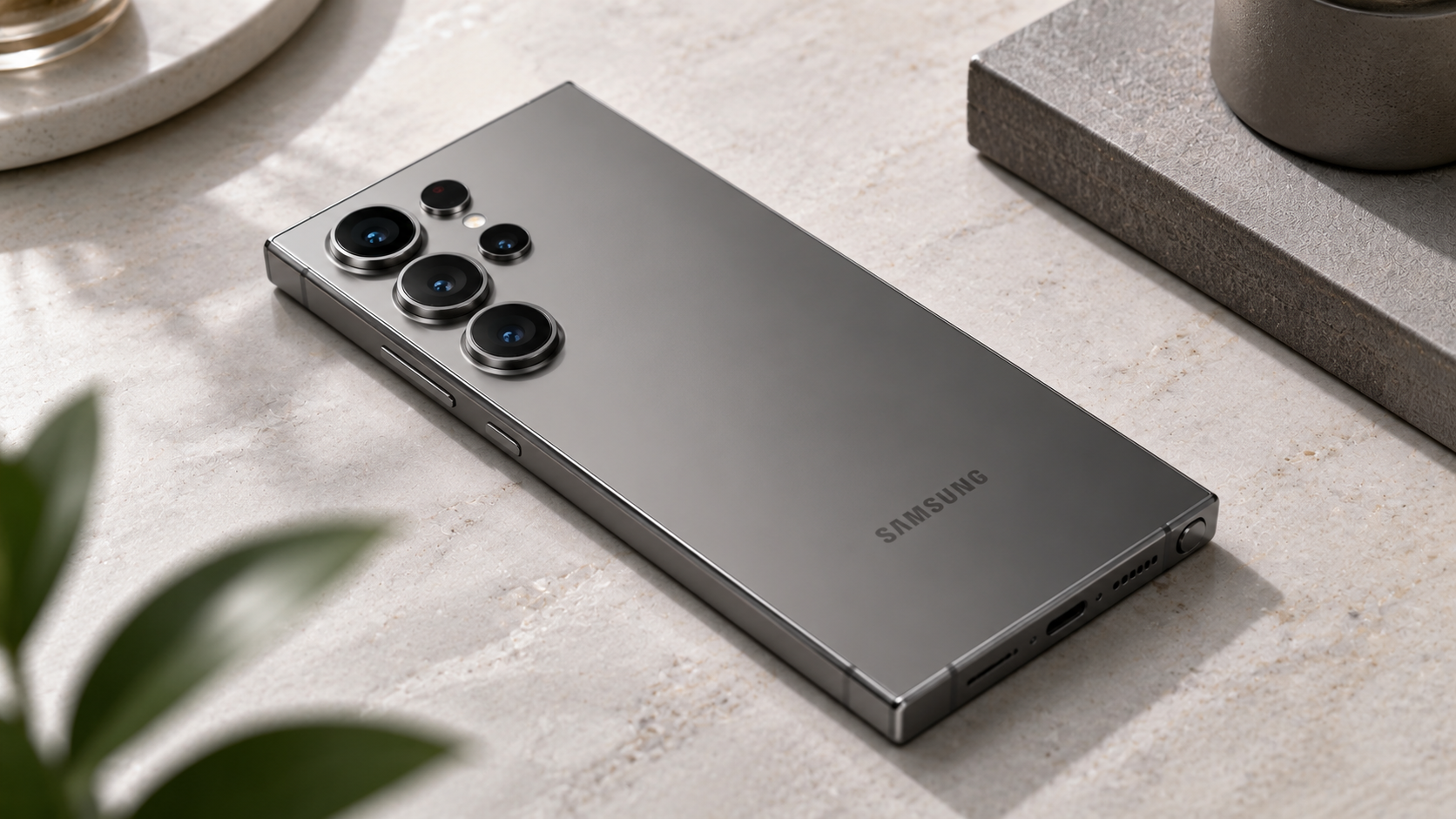
Discover how Samsung Galaxy S26 Ultra’s revolutionary Privacy Display and AI-powered security features protect your data. Explore the world’s first built-in privacy technology in a flagship smartphone—only €1199 at MediaWorld.
Your smartphone knows more about you than your closest friends. With over 4 billion mobile users worldwide, privacy breaches and data exploitation have become normalized—but one flagship device is challenging that status quo. The Samsung Galaxy S26 Ultra represents a pivotal moment in smartphone evolution, featuring a world's first built-in Privacy Display that shields your screen from prying eyes.
This guide walks you through the S26 Ultra's groundbreaking privacy architecture, sophisticated display technology, and AI-enhanced security ecosystem that work together to keep your information protected. Whether you're a content creator handling sensitive projects, a professional managing confidential data, or simply someone tired of feeling exposed in public spaces, this device addresses the vulnerabilities that plague modern smartphones.
Discover how the Samsung Galaxy S26 Ultra transforms smartphone privacy today.
The Privacy Display Revolution: What Makes It Different
How the built-in Privacy Display technology shields your screen from side angles
The Privacy Display isn't merely a marketing term—it's a fundamental shift in how smartphone screens handle information visibility. Unlike traditional displays that broadcast content to anyone within a 160-degree viewing angle, the S26 Ultra's built-in Privacy Display technology uses advanced polarization and directional filtering to drastically limit horizontal visibility. When someone sits beside you on public transport or leans over your shoulder in a café, they see a darkened or obscured screen. Only users viewing directly ahead see crisp, vibrant content.
This technology operates at the hardware level, eliminating the need for software workarounds or external screen protectors. The engineering achieves this through a combination of liquid crystal alignment and micro-lens arrays that direct light primarily toward the viewer's eyes when they're positioned directly in front of the device.
The engineering behind Corning Gorilla Armor 2 and its role in privacy protection
Corning Gorilla Armor 2 serves dual purposes on the S26 Ultra. Beyond its well-documented anti-reflective properties and scratch resistance, this glass formulation integrates seamlessly with the Privacy Display's polarization layers. The combination creates a cohesive optical system where privacy isn't compromised by reflections or glare patterns that might reveal information to observers.
The coating reduces ambient light reflections by up to 75% compared to standard Gorilla Glass, meaning even in brightly lit environments—airports, conference rooms, sunny outdoor spaces—the screen's content remains difficult for bystanders to discern. This eliminates a significant privacy vulnerability that traditional privacy screen protectors struggle to address.
Comparison with traditional privacy screen protectors and their limitations
Third-party privacy screen protectors have long been the privacy-conscious user's fallback solution. However, they introduce numerous compromises. They typically reduce screen brightness by 20-40%, create visible grid patterns at certain angles, diminish color accuracy, impair touch responsiveness, and add thickness to an already substantial device.
The S26 Ultra's integrated approach eliminates these trade-offs entirely. Users maintain full display brightness, complete color accuracy, and unchanged touch precision while gaining privacy as a fundamental device feature rather than an afterthought accessory. Moreover, built-in solutions eliminate the degradation that occurs as adhesive-based protectors age and lose effectiveness.
Real-world scenarios where Privacy Display technology proves invaluable
Consider a financial analyst reviewing quarterly reports on a flight. Competitors could previously extract valuable information by observing the screen. Medical professionals handling patient records, lawyers reviewing case files, creative professionals showcasing work-in-progress projects—all face genuine privacy exposure in everyday situations.
Content creators reviewing footage or photos immediately after shooting face particular vulnerability, as do individuals managing personal finances, accessing healthcare portals, or engaging in sensitive communications. The Privacy Display transforms these routine activities from potential security liabilities into genuinely private experiences, regardless of physical surroundings.
AI-Powered Security Architecture in the S26 Ultra
How the Snapdragon 8 Elite Gen 5 processor handles encryption and security operations
The Snapdragon 8 Elite Gen 5 For Galaxy represents custom engineering specifically for privacy-critical operations. This 3nm processor includes dedicated security cores that handle encryption independently from general processing, meaning sensitive operations never compete for resources with standard tasks. The processor implements AES-256 encryption at the hardware level, with latency so minimal that encryption overhead becomes virtually undetectable during normal usage.
Samsung's customization ensures that cryptographic operations receive priority processing, completing security calculations in microseconds. This hardware-level encryption makes brute-force attacks exponentially more difficult while maintaining seamless user experience.
The dedicated AI image enhancer's role in secure photo processing
The dedicated AI image enhancer doesn't just improve photo quality—it performs secure processing on-device without transmitting image data to external servers. This processor handles noise reduction, color grading, and object recognition entirely locally, meaning your photos never leave your device during enhancement. Users receive professional-grade image processing while maintaining absolute control over visual data.
The AI system also enables intelligent privacy detection, automatically identifying and blurring faces, license plates, or sensitive documents in photos if the user enables this feature.
On-device AI processing versus cloud-based solutions and privacy implications
Most smartphone manufacturers rely on cloud computing for advanced AI features, which inherently requires uploading user data to remote servers. The S26 Ultra's approach fundamentally differs: processing occurs on-device, meaning data never transfers across networks. This distinction carries profound privacy implications. Your photos, facial recognition data, voice patterns, and personal information remain entirely within your physical possession.
Cloud-based solutions introduce multiple vulnerability points: servers can be breached, data can be subpoenaed, and user information may be analyzed for commercial purposes. On-device processing eliminates these risks entirely.
Real-time threat detection and malware prevention mechanisms
The S26 Ultra employs real-time threat detection at multiple layers. The processor continuously monitors system behavior, application permissions, and network connections, identifying suspicious patterns instantly. Machine learning models trained on millions of malware samples run locally, analyzing each application's behavior without requiring internet connectivity or external analysis.
The device automatically isolates applications exhibiting malicious behavior, restricts their permissions, and alerts the user. This proactive approach catches threats before they can steal data, compared to reactive methods that detect threats only after infection occurs.
Experience AI-powered security with the Samsung Galaxy S26 Ultra's advanced threat protection.
Protecting Your Visual Data: Advanced Camera Privacy Features
How the 200MP main sensor and quad-camera system handle sensitive imagery
The 200MP main sensor captures extraordinary detail, but the S26 Ultra implements privacy controls directly into the capture pipeline. Users can enable automatic metadata removal at the moment photos are taken, preventing sensitive information from being embedded in image files. The f/1.4 aperture and optical image stabilization ensure quality regardless of lighting conditions, while advanced processing protects the resulting imagery.
The quad-camera system (200MP main, 50MP ultra-wide, 50MP telephoto with 5x zoom, 10MP telephoto with 3x zoom) means users maintain privacy options across different focal lengths. No camera bypasses privacy protections—all data flows through encrypted processing pathways.
AI-powered content recognition for automatic privacy detection
The device's AI system can recognize sensitive content patterns: financial documents, medical records, identification cards, personal information displays. When users enable content privacy mode, the AI automatically applies privacy protections to detected sensitive material without manual intervention. This prevents accidental exposure when sharing photos or storing imagery.
The system learns user preferences over time, adapting its privacy detection to align with individual sensitivity levels and use cases.
Metadata stripping and EXIF data removal capabilities
Digital photos contain embedded EXIF data—location coordinates, timestamps, device information, camera settings—that can expose sensitive information when photos are shared. The S26 Ultra provides granular control over metadata, allowing users to selectively remove specific data types or strip all metadata instantly with a single tap.
Users can enable automatic metadata removal for all photos, ensuring that shared imagery contains only visual content without revealing where, when, or how photos were captured. This prevents location tracking and chronological pattern analysis that bad actors exploit.
Secure photo vault and encrypted gallery organization
The S26 Ultra includes a dedicated secure vault that encrypts sensitive photos with biometric or PIN protection. Photos stored in the vault never appear in standard gallery views or search results, remaining completely compartmentalized. Users can password-protect access and set automatic lock timers that trigger when the vault hasn't been accessed for specified periods.
This creates genuine separation between public-facing photos and sensitive imagery, preventing accidental exposure or unauthorized access even if someone gains physical device access.
Seven Years of Security Updates: Long-Term Privacy Protection
Android 16 foundation and its enhanced privacy architecture
Android 16 introduces significant privacy enhancements beyond previous iterations. Granular permission controls, advanced sandboxing, and enhanced app isolation create fundamental OS-level protections. The S26 Ultra launches with these protections fully implemented, providing security depth that older devices cannot match.
Samsung's integration with Android 16 means users benefit from Google's privacy innovations immediately upon purchase, without the delay that affects standard Android devices.
Samsung's commitment to 7 years of major Android updates
Most Android devices receive major OS updates for three years at most. The S26 Ultra's promise of seven years of major updates means users receive new Android versions through 2033, ensuring the device remains protected against threats that don't yet exist. Each major update introduces new security architectures, privacy features, and threat detection improvements.
This commitment transforms the device from a temporary possession into a long-term investment in digital privacy and security.
Security patch frequency and vulnerability response timelines
Beyond major updates, Samsung commits to monthly security patches throughout the device's supported lifetime. These patches address newly discovered vulnerabilities within days of identification, preventing exploitation windows that plague less-supported devices. The security patch timeline operates on a predictable monthly schedule, allowing enterprise users and security professionals to plan updates with certainty.
Critical vulnerabilities receive emergency patches outside the normal schedule, ensuring that serious threats don't remain unaddressed for extended periods.
How extended software support protects against emerging threats
Cybersecurity evolves constantly. New attack vectors emerge, encryption standards advance, and threat sophistication increases annually. Extended software support ensures the S26 Ultra's security posture strengthens continuously rather than stagnating. Users purchasing this device in 2026 will receive protection against threats that emerge in 2030, 2031, and beyond.
This future-proofing creates genuine long-term value, preventing the security obsolescence that renders older devices vulnerable within 3-5 years.
Securing Your Digital Life: The S26 Ultra's Privacy Promise
The Samsung Galaxy S26 Ultra isn't just another flagship smartphone—it's a deliberate pivot toward privacy-first mobile technology. From its revolutionary built-in Privacy Display to its AI-enhanced security architecture, Samsung has created a device that acknowledges what matters most in 2026: your personal data protection.
The combination of advanced encryption, seven years of security updates, and innovative hardware features creates a compelling case for anyone serious about digital privacy. At €1199 at MediaWorld, this device demands a genuine commitment to privacy consciousness, but if you're a content creator, professional, or simply someone exhausted by data exploitation, the S26 Ultra represents genuine innovation that transcends marketing hype.
The Privacy Display eliminates vulnerability to shoulder surfing. On-device AI processing keeps your data local. Extended software support protects against future threats. Together, these features form a comprehensive privacy ecosystem rather than scattered security features. Content creators can review sensitive footage without exposure. Professionals can handle confidential information in public spaces. Individuals reclaim control over their visual data, secure from both corporate surveillance and casual observers.
The S26 Ultra signals that flagship smartphones can prioritize user privacy without sacrificing performance, camera quality, or display excellence. For anyone tired of trading privacy for functionality, this device proves that compromise isn't necessary.
Secure your digital privacy now with the Samsung Galaxy S26 Ultra.