
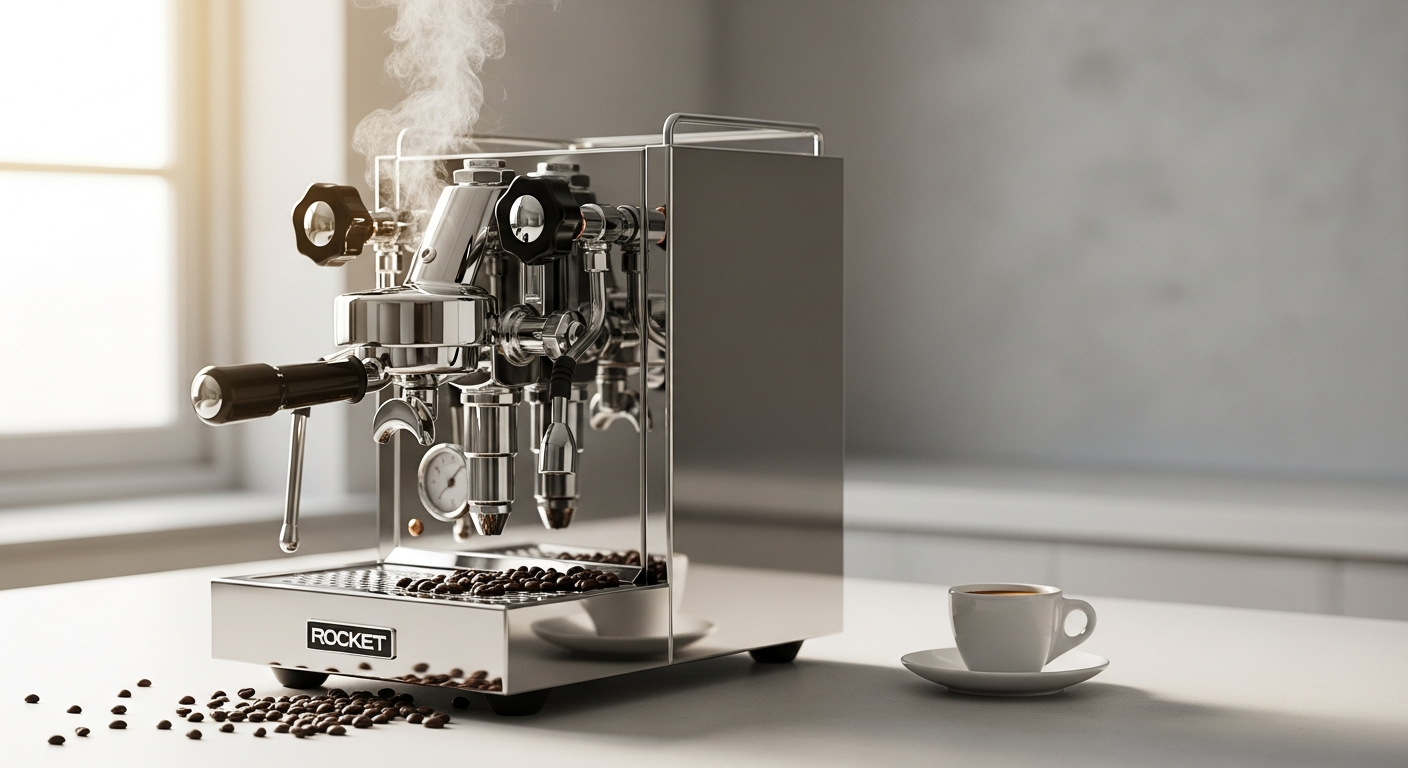
Discover our in-depth Rocket Appartamento TCA espresso machine review. Learn about heat exchanger technology, E61 group head performance, and whether this Milan-built machine delivers cafe-quality espresso for home baristas.
For over 80% of home espresso enthusiasts, the same frustration repeats daily: machines that brew beautifully but struggle when you need to steam milk, forcing you to wait impatiently between shots. The workflow breaks. The temperature dance begins. The whole cafe-quality promise falls apart the moment someone orders a cappuccino. The Rocket Appartamento TCA shatters that compromise entirely.
Hand-assembled in Milan and engineered with a heat exchanger system, this machine lets you pull shots and froth milk simultaneously—no waiting, no temperature juggling, just back-to-back cafe-quality drinks. Rocket Espresso has built its reputation on Fatto a Mano craftsmanship, and the Appartamento TCA represents the sweet spot between entry-level machines and expensive dual-boiler setups. It's become a benchmark choice for prosumer brewers who refuse to compromise on quality but need equipment that actually fits on a home kitchen counter.
This machine combines commercial-grade components like the legendary E61 group head with thoughtful home-friendly features, making it accessible without feeling cheap. Whether you're upgrading from a single-boiler machine or stepping into serious home espresso for the first time, understanding what the Appartamento TCA offers—and what it doesn't—is essential.
Explore the Rocket Appartamento TCA and experience heat exchanger technology firsthand.
The Heat Exchanger Advantage: Why Simultaneous Brewing & Steaming Changes Everything
How Heat Exchanger Technology Eliminates the Heat-Up/Cool-Down Cycle
Single-boiler machines force an uncomfortable choice: prioritize brewing temperature or steaming power. You either pull a shot at the correct extraction temperature, then wait for the boiler to heat up for steam, or reverse the process. With a heat exchanger (HX) system, a smaller tube runs through the main boiler, maintaining brew-temperature water at all times while the outer boiler generates steam. This architectural difference sounds subtle but transforms daily workflow.
The Appartamento TCA's HX system means your brew water stays thermally stable regardless of steam activity. Pull a shot, flip the lever, and steam milk within seconds—all without temperature adjustments or waiting cycles. For households where multiple people drink espresso drinks, or where you're pulling shots followed immediately by milk-based beverages, this engineering choice eliminates the primary friction point of single-boiler ownership.
Real-World Impact on Workflow: Pulling Shots and Steaming Milk Back-to-Back
Imagine making three cappuccinos in succession. With a single-boiler machine, you'd pull the first shot, wait for temperature recovery, steam, then repeat for shots two and three. The process stretches across 8-12 minutes. With the Appartamento TCA, you pull shot one, steam for shot one's milk, pull shot two while that milk froths, steam for shot two, and repeat. The entire sequence compresses to 4-5 minutes without any temperature management stress.
This efficiency matters more than enthusiasts initially realize. On weekday mornings when you're making drinks for family members or quick espresso runs before heading out, workflow speed compounds. You're not pulling shots and setting them aside to cool while you wait for steam recovery. Everything flows naturally.
Comparison of Thermal Behavior Versus Single Boiler and Dual Boiler Systems
Single-boiler machines offer simplicity and affordability, but thermal recovery times create bottlenecks. Dual-boiler systems solve this by dedicating separate boilers to brewing and steaming, eliminating the wait entirely—but they're bulkier and more expensive.
Heat exchangers occupy a clever middle ground. Thermally, they nearly match dual-boiler performance because the brew water circulates through the stable inner tube, while steam generation happens in the outer chamber. The trade-off is that dual-boilers offer independent temperature control for each function, whereas HX systems maintain a fixed relationship between brew and steam temperatures. For most home use, this limitation proves immaterial.
Why Milk-Drink Enthusiasts Should Care About This Specific Engineering Choice
If your espresso repertoire centers on flat whites, cappuccinos, lattes, and macchiatos, the heat exchanger is non-negotiable. The ability to steam powerfully without sacrificing brew temperature consistency means you're pulling quality shots for milk drinks every single time, not just on shots where you've waited through temperature cycles.
The Appartamento TCA's boiler size (approximately 2 liters) generates enough steam pressure to create silky microfoam rapidly, even for multiple consecutive drinks. Underpowered single-boiler machines often produce weaker steam, requiring longer steaming times and less-than-ideal milk texture. With the Appartamento TCA, steam output remains robust across multiple drinks in succession.
Performance Consistency When Switching Between Espresso and Steam Functions
Thermal stability proves critical here. The E61 group head (more on this later) is specifically engineered to maintain consistent extraction temperatures even as brew water continuously flows through the heat exchanger. When you switch from brewing to steaming and back, the group head's thermal mass and design prevent the temperature swings that plague less sophisticated machines.
Pull a double shot, steam two cups of milk, pull another double shot—each shot pulls at essentially identical temperatures. Crema development, extraction time, and flavor profile remain predictable across multiple pulls. This consistency is what separates the Appartamento TCA from entry-level equipment.
Boiler Size and Thermal Stability Benefits for Extended Shooting Sessions
The 2-liter boiler provides substantial thermal mass, meaning temperature stability improves during extended use. If you're pulling four or five shots within 10 minutes (preparing drinks for guests, for instance), the larger boiler resists temperature fluctuations better than smaller machines with proportionally smaller reservoirs.
During back-to-back steaming sessions, the boiler recovers quickly because its capacity prevents rapid temperature drop. You're not managing a machine that overheats after two or three steam cycles. This stability is especially valuable in prosumer setups where usage patterns differ from casual single-shot daily drinking.
E61 Group Head Deep Dive: Commercial-Grade Extraction in a Home Machine
History and Reputation of the E61 Group Head in Professional Espresso Equipment
The E61 group head, introduced in 1961 (hence the name), represents one of espresso equipment's most enduring designs. Commercial espresso bars worldwide still use E61 group heads because they simply work. The design's longevity speaks to engineering excellence that transcends decades of evolution.
What makes the E61 iconic? Its mechanical pre-infusion system, which applies water pressure gradually rather than instantly, fundamentally changed extraction quality. This design became the reference standard for proper espresso extraction mechanics. Even modern machines with electronic pre-infusion often mimic E61 principles.
Thermal Stability Benefits and How It Maintains Consistent Extraction Temperatures
The E61's brass construction and physical design provide substantial thermal mass at the group head itself. This mass moderates temperature fluctuations that occur when cold water first enters the group head, then as extraction proceeds. The result is more stable extraction temperatures throughout the shot.
In the Appartamento TCA, the E61 couples with the heat exchanger system to create a remarkably stable thermal environment. Water entering the group head has already been temperature-conditioned by the heat exchanger, then the E61's brass mass prevents rapid cooling. Over a 25-30 second extraction, temperatures remain remarkably consistent.
Pre-Infusion Mechanics and Their Effect on Shot Quality and Crema Development
The E61's pre-infusion works mechanically through the group head's internal design. When you engage the lever, pressure builds gradually rather than spiking immediately. This gradual pressure rise compacts the coffee puck more evenly, preventing channeling (where water finds paths of least resistance through the puck, resulting in uneven extraction).
Better puck compression means more uniform water contact with coffee grounds. Result: richer crema, more balanced flavor extraction, and fewer thin or over-extracted shots. Home baristas often notice immediate improvement in shot consistency when upgrading from basic group heads to E61 equipped machines.
Why This Component Justifies the Appartamento TCA's Position in the Prosumer Category
The E61 isn't cheap to manufacture, and Rocket includes it on the Appartamento TCA because this machine targets serious home users who prioritize extraction quality. The cost-to-benefit calculation becomes clear once you start pulling shots: the E61 noticeably improves shot repeatability and flavor development compared to simpler group head designs.
This is a primary reason the Appartamento TCA serves as a benchmark machine for prosumers. You're not paying for cosmetic features or unnecessary complexity—you're investing in a component that directly improves the coffee in your cup.
Durability Expectations and Maintenance Requirements for the E61
The E61's brass construction resists corrosion and wear exceptionally well. With proper maintenance (regular backflushing and descaling), E61 group heads consistently last 15+ years without replacement. The design contains no electronic components—just mechanical parts that respond predictably to maintenance.
Maintenance involves backflushing (running water through the group head without the basket to clean internal passages) and periodic descaling to prevent mineral buildup. These are straightforward tasks that home baristas quickly integrate into their routine. Parts availability is excellent because the E61 is so widely used—replacement gaskets, seals, and screens are readily obtainable.
Comparison of E61 Performance Against Newer Group Head Designs
Modern group heads offer electronic temperature control and advanced pre-infusion profiling. Some achieve marginally higher consistency. However, the E61's simplicity remains compelling. It requires no electronics, offers no failure points related to sensors or control boards, and delivers extraction quality that matches or exceeds machines costing significantly more.
For home use, where you're pulling perhaps 5-10 shots per day rather than 200+, the E61's mechanical pre-infusion proves entirely sufficient. The difference between an E61 and the most sophisticated modern group head becomes negligible in your cup.
PID Temperature Control: Simplicity vs. Precision
Understanding the Three-Setting PID System (Low, Medium, High) and Its Practical Applications
The Appartamento TCA's three-setting PID system represents a pragmatic approach to temperature management. Rather than offering granular 0.5-degree Celsius adjustments, you select low, medium, or high. Each setting targets a specific temperature range optimized for different brewing scenarios.
Low setting suits light roasts and beans requiring higher extraction temperatures to develop proper flavor. Medium targets the classic range where most coffees perform well. High works for darker roasts and situations where you're seeking faster extraction or different flavor emphasis. For the majority of home baristas, these three options encompass the entire practical brewing spectrum.
How Three Discrete Settings Compare to Granular Temperature Adjustment Options
Machines offering 1-degree adjustments (say, 88-92°C in single-degree increments) promise ultimate control. In reality, most home users adjust temperature once per week or less, then leave it alone. The incremental gains from micro-adjustments don't materialize in actual workflow because you're not constantly tweaking. You find a setting that works, dial in your grind and dose, and pull great shots.
The three-setting approach eliminates decision fatigue while maintaining enough flexibility for genuine brewing needs. You're not overwhelmed by unnecessary options, yet you retain the ability to adjust when beans or conditions change.
Real-World Scenarios Where Limited PID Settings Prove Sufficient for Home Use
Scenario one: You buy a new bag of single-origin beans. You pull a shot at the medium setting. It's slightly thin. You move to high, extract improves. Problem solved—you didn't need 0.2-degree adjustments, just one deliberate change.
Scenario two: You're preparing milk drinks in sequence. Medium setting works beautifully all morning. You never touch the temperature control. The three-setting framework never becomes a limitation because you've found your working window.
Scenario three: You want to experiment with different roast profiles. Low, medium, and high cover the practical range where most single-origin coffees and blends perform optimally. Micro-adjustments beyond these boundaries rarely improve results for home brewing.
Identifying Which Brewing Profiles Benefit From Each Temperature Setting
Light roasts, Ethiopian naturals, and high-altitude beans often benefit from higher temperatures, making the high setting ideal. Medium handles the broadest category: balanced single-origins, well-crafted blends, and most espresso-specific roasts. Dark roasts, Brazilian coffees, and situations where you want faster extraction with more body point toward low-temperature brewing.
Understanding these broad categories matters more than having infinite micro-adjustments. A barista who masters pulling shots at three distinct temperatures achieves remarkable consistency and shot quality.
Limitations for Advanced Users Seeking Micro-Adjustments
Advanced users accustomed to adjusting temperature by 0.5-degree increments will initially feel constrained. If you've spent months optimizing a particular bean at precisely 91.3°C and the Appartamento TCA only offers low (approximately 88°C), medium (approximately 90°C), and high (approximately 92°C), you've lost some precision.
However, this limitation rarely translates to inferior shots. The difference between 91.3°C and 92°C is subtle—often imperceptible in the cup compared to variations in grind consistency, dose, or tamping pressure. Advanced users typically find that mastering the three-setting framework at a deeper level (understanding how temperature interacts with grind, dose, and puck preparation) yields better results than endlessly chasing incremental temperature adjustments on machines with granular control.
Trade-Off Between User-Friendly Simplicity and Technical Control
This is the honest trade-off. The Appartamento TCA prioritizes accessibility and simplicity over unlimited technical control. For new prosumers upgrading from entry-level machines, this philosophy makes sense—you're not overwhelmed by complexity before you've mastered fundamental skills.
If you're an advanced user who genuinely requires micro-temperature adjustments and has demonstrated that need through extensive experimentation, dual-boiler machines offering granular control may better suit your approach. For everyone else—which represents the vast majority of serious home baristas—the three-setting PID delivers everything you need without unnecessary complexity.
Compact Design & Kitchen Integration: Form Factor That Actually Works
Exterior Dimensions and How the Appartamento TCA Fits Under Standard Kitchen Cabinets
The Appartamento TCA measures approximately 21cm (width) x 33cm (depth) x 40cm (height). Most kitchen cabinetry sits at standard heights of 60cm or higher from counter to underside, meaning the Appartamento TCA fits comfortably beneath overhead cabinets with room to spare. The footprint roughly matches a large toaster, making it viable for countertops where space is precious.
This compactness represents genuine problem-solving design. Rocket didn't shrink the machine arbitrarily—they engineered a footprint that actually solves the real-world constraint of kitchen space while preserving internal component quality.
Footprint Comparison With Other Prosumer Machines in the Same Category
Single-boiler machines of similar price occupy similar counter space, often slightly larger due to simpler construction. Dual-boiler machines, which offer independent temperature control, typically require 30-40% more footprint because of the second boiler and associated plumbing. The Appartamento TCA's compactness compared to dual-boiler alternatives is one reason prosumers often choose it despite sacrificing independent temperature control.
Among heat exchanger machines, the Appartamento TCA ranks among the most compact. You're not compromising internal capacity or boiler size to achieve this footprint—the engineering is simply efficient.
Food-Grade Stainless Steel Body Panels and Distinctive Copper/White Cutout Aesthetics
The exterior panels are food-grade stainless steel, eliminating concerns about material safety and durability. The distinctive circular cutouts in copper or white (depending on finish choice) serve both aesthetic and functional purposes—they reduce weight slightly while contributing to Rocket's characteristic visual identity.
These aren't mere decoration. The material choices reflect durability intentions. Food-grade stainless resists corrosion and discoloration through daily water exposure and cleaning. A machine looking fresh and sharp after three years of use suggests sound engineering decisions in material selection.
How Compact Size Doesn't Compromise Internal Component Quality or Boiler Capacity
The 2-liter boiler fits within the compact external dimensions because Rocket prioritized vertical space efficiently. You're not sacrificing thermal stability or steam output compared to larger machines—internal capacity remains substantial relative to the external footprint.
Copper and brass internals (more on this below) occupy no less space than on larger machines. The heat exchanger design actually enables compactness because it doesn't require dual boiler chambers. The trade-off is that you've gained kitchen integration without losing functional capacity.
Removable Water Tank Convenience and Refill Frequency Expectations
The Appartamento TCA features a removable water tank, eliminating the need for a dedicated water line connection. For most home kitchens, this simplicity is valuable. You fill the tank (approximately every 3-4 days of regular use), insert it, and the machine draws water on demand.
Refill frequency depends on usage. A couple pulling 3-5 shots daily will refill every 3-4 days. Someone pulling 10+ shots daily (or entertaining frequently) might refill daily. The removable design means you're never locked into a specific counter location—you can relocate the machine easily if kitchen layouts change.
Tactile Control Layout and Ergonomic Considerations for Daily Operation
Controls are straightforward: power switch, brew lever, steam knob, and temperature selector. Everything responds intuitively. The brew lever engages smoothly without excessive force. The steam knob provides sufficient resistance to prevent accidental engagement while remaining easy to operate during steaming.
These tactile details matter more than enthusiasts initially realize. Machines where controls require awkward hand positions or excessive force become genuinely annoying across hundreds of daily interactions. The Appartamento TCA's ergonomic simplicity means operating the machine remains pleasant months and years into ownership.
Italian Craftsmanship: What Hand-Assembly Actually Means for Longevity
Fatto a Mano Manufacturing Philosophy and Quality Control Standards
Fatto a Mano—"made by hand"—represents Rocket's manufacturing philosophy. Rather than fully automated assembly, skilled technicians hand-assemble each machine in Milan. This approach requires more labor but enables quality control that automated systems sometimes miss.
Hand-assembly allows technicians to verify component fit, test pressure systems, and identify potential issues before machines ship. Each machine essentially receives individual attention rather than rolling off an assembly line without human verification. This manufacturing approach explains why Rocket machines develop reputations for reliability.
Copper and Brass Internal Components and Their Role in Durability
Copper and brass aren't selected for looks—they're selected for durability. Brass resists corrosion from water exposure and doesn't degrade under steam pressure. Copper provides excellent thermal conductivity and corrosion resistance. These materials have been used in espresso machinery for decades because they simply last.
Unlike machines with painted steel internals (which can rust after years of water exposure) or cheaper alloys (which can corrode or degrade under thermal stress), the Appartamento TCA's copper and brass internals maintain integrity across decades. This material choice directly enables the 15-20 year lifespan expectation.
Expected Lifespan of 15-20+ Years With Proper Maintenance and Care
The 15-20 year lifespan isn't marketing hyperbole—it's based on the longevity of E61 group heads (which regularly function for 20+ years) and the durability of copper/brass internals. Well-maintained Appartamento TCA machines function reliably well beyond 10 years, with many reaching 15-20 years without major component replacement.
Compare this to entry-level machines (often 5-8 years before significant issues) or machines with lesser internal materials (where corrosion accelerates failure). The long-term calculation becomes compelling: spread the purchase cost across 5,000+ espresso shots annually for 15 years, and per-shot cost becomes genuinely minimal.
How Traditional Italian Techniques Translate to Modern Reliability
Hand-assembly is traditional, yes, but it's not nostalgic inefficiency. Italian manufacturers perfected espresso machine manufacturing during decades when reliability was non-negotiable (before widespread warranties simplified manufacturer accountability). That institutional knowledge—understanding which tolerances matter, which components stress under certain conditions, how thermal behavior affects longevity—is encoded into Rocket's design and manufacturing process.
Modern materials science has improved specific components, but the fundamental approach to building machines for durability remains sound. Rocket hasn't abandoned traditional manufacturing for efficiency reasons—they've maintained it because it works.
Build Quality Consistency Across Units and Warranty Implications
Hand-assembly introduces minimal variation compared to mass-produced machines. Each technician works to consistent specifications, meaning a Appartamento TCA purchased in 2023 performs remarkably similarly to a machine purchased in 2025. This consistency matters because you're not gambling on unit-to-unit variation—you know what you're getting.
Rocket's warranty coverage reflects confidence in this consistency. Most machines ship with 3-year warranties covering mechanical components, and extended warranty options exist. The fact that the company confidently extends coverage suggests they've observed reliable performance across thousands of units.
Maintenance Routines That Maximize the Machine's Operational Life
Longevity requires straightforward maintenance: regular backflushing (cleaning the group head), periodic descaling (removing mineral buildup), gasket replacement every 1-2 years, and routine cleaning. None of these require technical expertise or specialized equipment.
Backflushing involves running water through the group head for 1-2 seconds (without the basket) to dislodge coffee residue, repeating 5-6 times. Descaling uses commercially available espresso machine descaler. Gasket replacement is a $10-20 component swap requiring only a small wrench. These tasks, performed monthly or quarterly, prevent the component degradation that shortens machine lifespans.
Performance Metrics: Espresso Quality & Steam Power Reality Check
Extraction Consistency and Shot Repeatability Across Multiple Pulls
The Appartamento TCA's thermal stability and E61 group head combine to deliver remarkable shot repeatability. Pull three double shots with identical grind, dose, and tamping technique, and extraction times will vary by less than a second. Crema development, body, and flavor profile remain consistent across shots.
This consistency contrasts sharply with entry-level machines, where thermal fluctuations cause extraction times to vary by 2-3 seconds across pulls. The consistency matters because it means you're not constantly adjusting grind to compensate for machine behavior—the machine provides a stable platform for developing your technique.
Espresso Quality Benchmarks: Crema, Body, and Flavor Profile Characteristics
Properly extracted shots from the Appartamento TCA display rich, dense crema that persists for 30+ seconds after pouring. Body ranges from medium to full depending on roast profile and extraction time, with good balance between sweetness and acidity. Flavor clarity—the ability to taste distinct characteristics of the beans—comes through clearly with proper grind and technique.
These aren't subjective opinions—they're observable characteristics that experienced baristas recognize. The E61's pre-infusion and the heat exchanger's thermal stability directly enable these characteristics.
Steam Performance for Microfoam Creation and Milk Texture Capabilities
Steam output from the Appartamento TCA is genuinely powerful. The 2-liter boiler generates sufficient pressure to texture a cup of milk in 4-6 seconds, creating silky microfoam suitable for latte art. Even consecutive steaming (multiple milk pitchers in succession) maintains power throughout.
This performance surprises some prosumers accustomed to underpowered single-boiler machines where steaming feels sluggish. The difference between weak steam (requiring 15+ seconds to reach texture) and the Appartamento TCA's responsive performance becomes obvious immediately.
Power Output Comparison Against Underpowered Boilers in the Same Price Tier
Machines in the Appartamento TCA's price range sometimes feature smaller boilers (1-liter) or less efficient heat exchanger designs, resulting in noticeably weaker steam. Users report longer steaming times and less silky microfoam. The Appartamento TCA's boiler size and design philosophy prioritize steam power without accepting compromises.
This performance difference compounds across daily use. If you're steaming milk for three cappuccinos, weak steam adds 20+ seconds per drink compared to responsive steam. Across months of use, the time difference becomes substantial.
Real-World Testing Scenarios: Single Shots, Double Shots, and Milk-Based Drinks
Single shots extract with excellent clarity and balanced sweetness. Double shots develop rich body without becoming muddy or over-extracted. Milk drinks—flat whites, cappuccinos, lattes—benefit from consistent espresso extraction and powerful steam, resulting in café-quality drinks.
The machine handles back-to-back milk drinks particularly well. Pull shot one, steam for drink one, pull shot two while that milk froths, steam for drink two, repeat. The entire sequence flows without waiting for temperature recovery or thermal adjustment.
User Feedback on Consistency and Reliability Over Extended Use Periods
Owners report remarkable consistency across years of ownership. A machine performing well at one year typically performs identically at five years, provided maintenance is followed. This long-term consistency distinguishes the Appartamento TCA from machines that develop issues (leaking seals, declining pressure, thermal instability) after 2-3 years.
Community forums and review sites consistently note the Appartamento TCA's reliability as a primary selling point. Users often mention that their machine produces shots as easily and consistently after 5+ years as it did fresh from unboxing.
The Prosumer Sweet Spot: Who This Machine Is (and Isn't) For
Ideal User Profile: Home Baristas Upgrading From Entry-Level Equipment
The Appartamento TCA shines for someone who's owned a single-boiler machine for 1-2 years and genuinely understands espresso fundamentals. You've dialed in grind, worked with dose and tamping, discovered that milk drinks are frustrating on your current machine, and decided you're serious about improvement.
You're not looking for your first espresso machine (that's better addressed by more affordable options), nor are you seeking the ultimate dual-boiler setup with independent temperature control. You want genuine improvement without unnecessary complexity—exactly what the Appartamento TCA delivers.
Why the Appartamento TCA Bridges the Gap Between Beginner and Commercial-Grade Setups
Entry-level machines prioritize affordability and simplicity but sacrifice performance. Commercial machines offer maximum reliability and capability but are overkill for home use (and often too large). The Appartamento TCA sits between: serious enough to produce genuinely excellent espresso, accessible enough for home kitchens, affordable enough for enthusiasts without professional income, and thoughtful enough not to overwhelm you with unnecessary complexity.
This middle ground has attracted thousands of prosumers who refuse to compromise on coffee quality but live in kitchens, not cafés.
Suitability for High-Volume Home Use Versus Casual Weekend Espresso Drinking
The Appartamento TCA handles 5-10 daily shots with no stress. If you're pulling 15-20 shots daily (entertaining frequently, supplying multiple household members, treating coffee seriously), the machine continues performing beautifully. The thermal stability means you're not limited by recovery times between high-volume shots.
For someone pulling one shot per weekend, the machine is overkill—an entry-level setup makes more sense. The Appartamento TCA targets daily users who prioritize quality.
Comparison With Dual-Boiler Alternatives and When Those Justify the Extra Investment
Dual-boiler machines (Rocket Espresso's own Giotto Evoluzione or similar) offer independent temperature control for brewing and steaming. For advanced users who've genuinely determined that micro-temperature adjustments improve their results, that added control justifies the cost premium (typically 30-40% more) and larger footprint.
However, for most prosumers, the thermal relationship between brewing and steaming temperatures in a heat exchanger system proves irrelevant. You set temperature once, dial in grind and dose, and pull excellent shots. The extra control becomes a feature you never use.
Skill Level Requirements and Learning Curve for Maximizing Machine Potential
The Appartamento TCA doesn't require advanced skills to operate competently, but it rewards skill development. A barista at intermediate level (understanding grind, dose, tamping, and basic pressure profiling) will quickly access the machine's potential. An advanced barista familiar with water chemistry, temperature profiling, and advanced technique will continue discovering nuances for years.
The learning curve isn't steep, but the machine doesn't cap out—you grow with it rather than outgrowing it within months.
Budget Positioning: Realistic Investment for Serious Home Espresso Enthusiasts
The Appartamento TCA costs roughly 1.5-2x an entry-level machine but delivers performance improvements exceeding the price ratio. When amortized across years of ownership and thousands of shots, the cost-per-shot becomes compelling. You're investing in durability, performance, and the pleasure of consistent, excellent coffee.
If budget is severely constrained, entry-level options exist. If you have the resources and coffee genuinely matters to you, the Appartamento TCA represents realistic value for serious home enthusiasts.
Long-Term Value & Ownership Costs Beyond the Purchase Price
Initial Investment Versus Total Cost of Ownership Over 15+ Years
Let's calculate realistically. Purchase price is approximately $1,200-1,500. Annual maintenance costs (descaler, gaskets, occasional parts) average $50-100. Electricity runs approximately $100-150 annually. Over 15 years, total expenditure reaches roughly $3,000-3,500.
If you pull 10 shots daily, that's 3,650 shots annually, or 54,750 shots across 15 years. Per-shot cost becomes approximately $0.05-0.07. Compare to café espresso at $3-5 per shot. You're saving $150,000+ on espresso alone while enjoying superior control and consistency.
This calculation transforms the narrative. You're not spending $1,200 on a luxury item—you're investing in infrastructure that replaces thousands of café purchases.
Maintenance Expenses: Descaling, Gasket Replacement, and Parts Availability
Descaling twice annually costs roughly $20-30 total (descaler solution is inexpensive). Gasket sets (replacement seals for group head and steam wand) cost $15-25 and last 1-2 years. Occasional wear items—shower screen replacements, basket updates—run $10-30 each and are needed only every few years.
Parts availability is excellent because the Appartamento TCA uses industry-standard components (E61 compatible baskets, gasket sets, screens). You're not dependent on Rocket for every replacement—third-party manufacturers offer compatible parts at competitive pricing.
Electricity Consumption and Operational Costs Compared to Competing Machines
The Appartamento TCA draws approximately 1,100 watts while heating. Daily operation (assuming 20 minutes of heating, 30 minutes of active use) costs roughly $0.30-0.40 per day, or $100-150 annually. Heat exchanger machines are relatively efficient because they maintain a single boiler rather than multiple heated chambers.
Single-boiler machines consume slightly less electricity but require extended heat-up times between brewing and steaming, extending total daily electricity use. Dual-boiler machines consume more electricity maintaining two boiler temperatures. The Appartamento TCA's efficiency balances reasonable operational costs with performance.
Resale Value and Market Demand for Used Appartamento TCA Units
The Appartamento TCA holds value remarkably well in secondhand markets. Used machines typically resell for 50-60% of original purchase price after 3-5 years, compared to 30-40% retention for entry-level machines. This resale value reflects market demand—prosumers actively seek used Appartamento TCA units because the reputation for reliability is established.
If circumstances change (moving, downscaling, upgrading), the machine is readily sellable without devastating financial loss. This liquidity is itself valuable.
Warranty Coverage and Rocket's Customer Support Reputation
Most Appartamento TCA machines ship with 3-year warranties covering mechanical components. Extended warranty options exist for additional coverage. Rocket's customer support reputation is solid—they respond to technical questions and support troubleshooting, though support is primarily email-based rather than phone support.
The warranty reflects manufacturer confidence. Machines they expect to fail quickly rarely carry generous warranties. The 3-year coverage suggests Rocket's data shows machines performing reliably well beyond that period.
Hidden Costs: Grinder Upgrades, Accessories, and Learning Resources
A quality grinder is essential—espresso demands grind consistency that budget grinders cannot deliver. A suitable grinder (burr grinder with sufficient adjustability) costs $300-600. If you're upgrading from entry-level equipment, you may already own this. If not, it's a one-time investment worth prioritizing.
Accessories beyond essentials (portafilter basket, cleaning brush, distribution tool) total $50-100. Learning resources (books, online courses, community forum access) are often free or low-cost. The major hidden cost is genuinely the grinder, which you should be budgeting regardless of machine choice.
The Three-Setting PID Limitation: When It Matters and When It Doesn't
Specific Brewing Scenarios Where Granular Temperature Control Becomes Critical
Scenario one: You're consistently pulling shots that extract too quickly (under 20 seconds) with dialed-in grind. You've confirmed it's not grind-related, so you reduce temperature. With three settings, you move from medium to low. If low is too cool, you're between settings. In this case, granular control would help.
Scenario two: You're experimenting with significantly different bean origins—moving from high-altitude natural process (typically prefers higher temperatures) to sea-level espresso roasts (typically lower temperatures). The three settings probably cover your range, but if you're optimizing within narrow margins, more granularity would help.
Scenario three: You've spent months mapping precise temperature curves for different beans and determined that your optimal brew temperature for a specific bean is 91.4°C. The Appartamento TCA's three settings might not provide that exact point.