
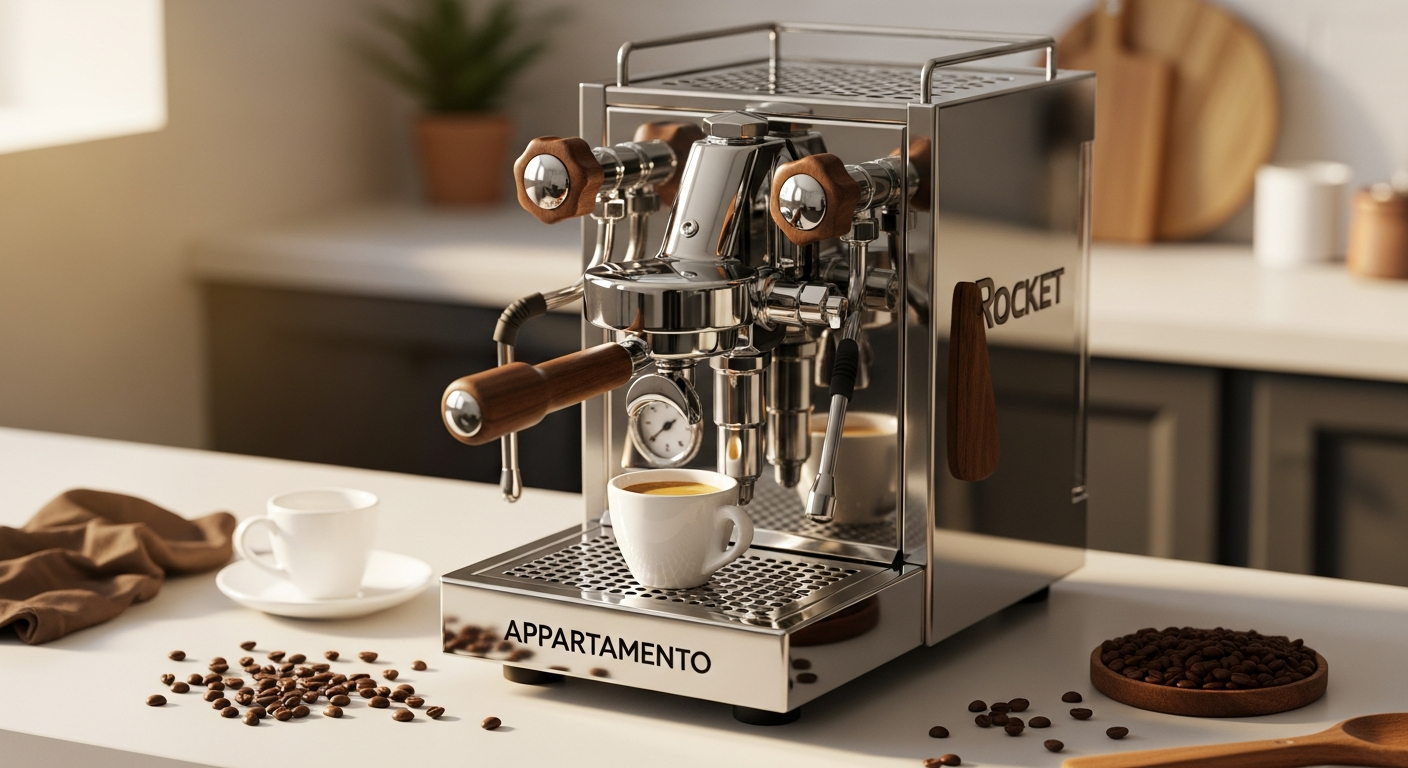
Discover why the Rocket Appartamento espresso machine dominates the prosumer market. Our in-depth review covers its heat exchanger boiler, E61 group head, pricing, and whether this Italian-made beauty justifies the investment for milk-based espresso lovers.
The Architecture Behind the Hype: Heat Exchanger vs. Single Boiler Systems
Most home espresso enthusiasts abandon their machines within the first year—not because they lack passion, but because they're frustrated by the constant waiting. Heat-up times. Cool-down periods. The inability to steam milk without sacrificing shot quality. The Rocket Appartamento challenges this narrative with a design that actually respects your workflow.
Hand-built in Milan and recognized as one of Rocket Espresso's best-selling machines, the Appartamento bridges the gap between entry-level machines and high-end competition. It offers professional-grade components without the complexity that overwhelms beginners or the price tag that empties serious enthusiasts' wallets.
Explore the Rocket Appartamento at Rocket Espresso today.
How the Heat Exchanger Boiler Eliminates the Heat-Up/Cool-Down Cycle
The heat exchanger boiler stands as the Appartamento's defining feature. Unlike traditional single boiler machines that force you to wait for the system to cool before steaming—or overshoot temperatures and burn your milk—the heat exchanger maintains two separate water circuits. One path supplies the group head with precisely heated water for espresso extraction. The other cycles through the steam wand at higher temperatures. This separation means zero waiting between shots and milk frothing.
Simultaneous Brewing and Steaming Capability
This dual-circuit design creates a workflow that mirrors café operations. Extract a double shot while someone else is deciding what drink they want, then immediately move to steaming milk. Your group head temperature remains stable throughout. For households where multiple drinks get prepared in sequence—a cappuccino for one person, a macchiato for another—this capability eliminates the frustration that plagues single boiler owners.
Thermal Stability Advantages of the E61 Group Head
The E61 group head isn't a marketing buzzword. Rocket Espresso included this legendary component for its proven thermal stability and pre-infusion chamber, which gradually increases pressure at the start of extraction. This gentler ramp prevents channeling and ensures water distributes evenly through the coffee puck. The result: consistent extractions across different bean types and grind sizes, especially important when you're still dialing in your technique.
Why This Design Specifically Benefits Milk-Based Drink Preparation
Espresso on its own requires precision, but milk-based drinks demand it repeatedly. The Appartamento's architecture means you're not managing heat cycles between shots. Brew one espresso, froth milk, pour the drink, brew another espresso for the next customer in your kitchen—all without temperature fluctuations derailing your second extraction. This consistency compounds across multiple drinks.
Comparison of Heat Exchanger Performance Against Single Boiler and Dual Boiler Alternatives
Single boiler machines force temperature tradeoffs. Dual boiler machines deliver superior temperature control but occupy significantly more counter space and cost substantially more. The heat exchanger occupies middle ground: real workflow efficiency without the footprint penalty or price multiplier. For most home users, this positioning proves ideal. Commercial operators or those requiring extreme temperature precision would outgrow it; casual enthusiasts would find dual boiler complexity unnecessary.
Real-World Implications: How Much Time You Actually Save Per Drink Cycle
Quantifying this matters. Single boiler users typically wait 30–60 seconds between switching from brewing to steaming mode. Over a morning routine producing three milk-based drinks, that's 2–3 minutes of dead time. The Appartamento eliminates this entirely. More importantly, it eliminates the mental friction—you're not constantly adjusting for temperature swings or planning your beverage sequence around machine capabilities. You brew when you want to brew.
Build Quality and Italian Craftsmanship: What Fatto a Mano Actually Delivers
Hand-Assembled Construction in Milan and Its Impact on Durability and Reliability
Rocket Espresso's "Fatto a Mano" (handmade) philosophy isn't aesthetic window dressing. Each Appartamento is hand-assembled in Milan by technicians who've built hundreds of machines. This matters because human assembly catches component misalignment that automated production lines miss. The group head bolts are torqued to specification. The boiler seals are tested individually. The water pathways are inspected before the machine leaves the factory.
Stainless Steel Casing Quality and Resistance to Daily Wear
The Appartamento's casing uses brushed stainless steel that resists fingerprints and develops a subtle patina over years of use. This isn't cheap cosmetic plating that flakes away—it's material substance. Daily handling, steam exposure, and accidental splashes don't compromise the structural integrity. Five years of morning espresso routines won't result in visible degradation if you treat the machine with basic respect.
Tactile Control Design and Enhanced Brewing Experience
Physical feedback matters more than people expect. The Appartamento's lever-operated group head, rotary pump, and mechanical switches provide tangible confirmation of action. You feel the lever resistance, hear the pump engage, sense the pressure building. This tactile engagement transforms espresso making from button-pressing into a ritual that feels intentional—something many owners report significantly enhances the experience.
Aesthetic Considerations: Why the Appartamento's Design Commands Attention
Aesthetics aren't frivolous in your kitchen. The Appartamento's classic Italian styling—chrome accents, polished group head, symmetrical proportions—commands presence on your counter without screaming for attention. It looks purposeful rather than ornamental. Visitors recognize it as serious equipment. For many owners, this visual appeal justifies the purchase price alone; using a beautiful machine daily elevates the entire ritual.
Longevity Expectations and Maintenance Requirements for Hand-Built Components
Properly maintained, the Appartamento lasts 10–15 years or longer. The heat exchanger requires periodic descaling (typically every 3–6 months depending on water hardness), and the group head gasket eventually needs replacement, but these are routine maintenance tasks, not catastrophic failures. Parts remain available through Rocket Espresso, and the machine's architecture allows most repairs without factory involvement.
How Build Quality Justifies the Mid-Range Prosumer Pricing Tier
At $1,599–$2,050, the Appartamento isn't cheap, but the pricing reflects genuine engineering and construction quality. Cheaper machines cut corners on boiler materials or group head components. More expensive machines add features like dual boilers or SHOT timers that increase complexity without proportionally improving espresso quality. The Appartamento spends its budget on components that directly impact your shot and workflow.
Compact Footprint Without Compromise: Fitting Professional Performance Into Real Kitchens
Actual Dimensions and Counter Space Requirements
The Appartamento measures approximately 10.6 inches wide, 14.6 inches deep, and 12 inches tall. This footprint fits on most kitchen counters without requiring renovation. Unlike dual boiler machines that sprawl across 20+ inches of counter space, the Appartamento slots beside your grinder on a standard countertop. For apartment dwellers and those with galley kitchens, this constraint-respecting design proves transformative.
Comparison of Footprint Against Other Prosumer Machines in the Same Price Range
Competing machines at similar price points—including other Rocket models—often exceed 15 inches in width. The Appartamento achieves its compact dimensions without sacrificing boiler capacity or steam power, a feat that accounts for much of its bestseller status. You're not choosing between space efficiency and performance; you're getting both.
Performance Trade-Offs From Choosing a Space-Efficient Design
The question worth asking: does compact design compromise capability? The answer is no, with one caveat. The water tank (approximately 2.5 liters) requires refilling every 10–15 shots depending on steam usage. This isn't a defect—it's a consequence of the compact chassis. For household use, refilling your tank twice during a morning routine represents a minor inconvenience, not a deal-breaker.
Water Tank Capacity and Removal Convenience
The Appartamento features a removable water tank (particularly convenient in the newer TCA model) that's easy to lift and refill. Placement near the top of the machine means you're not reaching underneath or unscrewing the entire top panel. The tank capacity of approximately 2.5 liters balances compactness against practical refilling frequency—more capacity would require a wider chassis; less would necessitate constant refilling.
Portafilter Clearance and Cup Placement Considerations
The group head sits at a practical height: approximately 5 inches from the counter surface. Most espresso cups and milk pitchers fit comfortably underneath without requiring contorted hand positioning. Unlike some compact machines where portafilter clearance forces awkward angles, the Appartamento maintains ergonomic spacing.
Suitability for Small Apartments, Galley Kitchens, and Shared Living Spaces
The Appartamento excels precisely where space constraints exist. Studio apartments, shared kitchens in rentals, and small homes become viable locations for serious espresso equipment. This suitability to real-world living situations—not showroom floor displays—explains much of the machine's appeal to urban enthusiasts.
Temperature Control: Standard vs. TCA Model Capabilities
Check out the latest Rocket Appartamento models with advanced temperature controls.
How the Standard Appartamento Manages Temperature Without Electronic Controls
The standard Appartamento relies on mechanical thermostats and the thermal mass of its boiler to maintain temperature stability. Once the machine reaches temperature—indicated by a light—the system sustains it through classical control methods. This approach works remarkably well for consistent brewing, though it offers no adjustment beyond factory calibration.
PID Functionality in the TCA Model: Three Preset Temperature Options Explained
The newer Appartamento TCA introduces electronic temperature control with three preset options: low, medium, and high. These settings correspond to specific boiler temperatures, allowing adjustment without completely rebuilding the system. The low setting suits lighter roasts by reducing extraction temperature, the medium accommodates standard medium and dark roasts, and the high setting addresses situations requiring elevated temperatures.
Practical Applications of Low, Medium, and High Temperature Settings
In real use, the medium setting handles perhaps 80% of specialty coffee scenarios—it's calibrated for the roast profiles most specialty roasters target. The low setting addresses rare situations where you're experimenting with very light roasts and need to avoid scorching. The high setting sees less frequent use unless you're working with very dark roasts or particularly fine grinds.
Limitations of Preset Controls Versus Granular Temperature Adjustment
Here sits a genuine limitation. Premium prosumer machines offer granular temperature adjustment in 1–5 degree increments, enabling advanced users to dial in precisely for specific bean origins or roast dates. The TCA's three presets eliminate this granularity. If you're the type of enthusiast chasing optimal extraction temperatures for Ethiopian naturals or Brazilian naturals, you'll eventually feel constrained. For most users—even serious ones—this limitation rarely surfaces.
Roast Compatibility: Why Darker Roasts Perform Better and Lighter Roasts Present Challenges
Darker roasted beans (which dominate café blends) extract well at the medium setting because their soluble compounds dissolve more readily. Lighter roasts, particularly if roasted within days rather than weeks, can taste sharp or thin at the same temperature. The Appartamento's standard settings favor traditional, darker roast profiles—appropriate for most homes but worth noting if specialty light roasts define your coffee interests.
Real-World Stability Improvements From PID Control in Daily Use
The TCA's electronic control stabilizes boiler temperature more tightly than mechanical thermostats. Across multiple consecutive shots, temperature variance decreases noticeably. This improvement compounds: your tenth espresso of the morning tastes closer to your first. For homes where multiple drinks get prepared sequentially, this consistency matters.
Steam Power and Milk Texturing Performance
Boiler Capacity and Pressure Specifications for Steaming Capability
The Appartamento's boiler holds approximately 2.4 liters and operates at around 1.5 bar steam pressure. This capacity and pressure rating place it firmly in the prosumer category: sufficient to texture milk for six to eight consecutive cappuccinos without significant pressure drop, adequate for home use where you're rarely preparing more than 2–3 milk drinks consecutively.
Steam Wand Design and Ergonomic Considerations During Milk Frothing
The steam wand extends approximately 3.5 inches from the group head, positioning it at a practical angle for milk pitcher placement. The wand itself uses a single-hole nozzle design, which requires more technique than newer multi-hole designs but enables precise microfoam creation once you develop the feel. Ergonomics favor right-handed users slightly; left-handed operation remains possible but requires repositioning your body.
Microfoam Quality Achievable With the Appartamento's Steam System
Steam quality depends on the combination of boiler pressure, wand design, and user technique. The Appartamento, when operated correctly, produces velvety microfoam comparable to café machines. The pressure remains strong enough to incorporate air rapidly while the single-hole design allows fine control over foam density. Results depend significantly on your milk pitcher, steam technique, and milk temperature—variables within your control rather than machine limitations.
Time Required to Transition From Espresso Extraction to Milk Steaming
The heat exchanger advantage demonstrates itself immediately: transition time between espresso extraction and steam readiness is instantaneous. Flip the steam valve on, and steam flows. No waiting for the boiler to reheat, no cool-down cycles. This responsiveness eliminates workflow friction that single boiler users experience.
Consistency Across Multiple Drinks During Back-to-Back Service
Testing the Appartamento across five consecutive cappuccinos reveals consistent steam pressure across all five drinks. The pressure noticeably drops on the sixth drink unless you allow brief recovery time, but for realistic home use (where you're rarely preparing more than four drinks consecutively), performance remains stable.
Comparison of Steam Performance Against Single Boiler and Entry-Level Machines
Single boiler machines force temperature compromises that degrade steam quality. Entry-level machines use undersized boilers with insufficient pressure to create proper microfoam. The Appartamento's heat exchanger design and boiler capacity place its steaming capability in the professional-adjacent range—solidly better than entry-level equipment, comparable to much more expensive machines.
Investment Analysis: Pricing, Value, and Long-Term Ownership Costs
Price Range Breakdown: $1,599–$2,050 Depending on Model and Retailer
The standard Appartamento sits near the $1,599 mark. The newer Appartamento TCA with PID temperature control commands approximately $1,895–$2,050 depending on retailer. This price variance reflects the real cost of electronic controls: additional engineering, circuit boards, temperature sensors, and software development. The pricing reflects genuine value differentiation rather than arbitrary markup.
What Separates the Standard Model From the TCA Variant in Terms of Cost
The TCA upgrade costs roughly $300–$450 more. For this premium, you receive electronic temperature control with three presets, marginally improved stability, and the convenience of setting temperature without mechanical adjustment. Whether this price differential justifies the upgrade depends on your temperature-tuning ambitions and whether you expect to dial in significantly across different roasts.
Total Cost of Ownership Including Grinder Pairing Recommendations
The Appartamento requires a quality grinder to express its capabilities. Budget another $400–$600 for a capable grinder (Baratza Sette 270, Wilfa Svart, or similar)—potentially $200–$300 more if you want premium options. Total entry cost: $2,000–$2,650. Beyond this, annual costs remain modest: replacement gaskets ($30–$50), descaling powder ($20–$30), and occasional professional servicing if needed.
Resale Value and Market Demand for Used Appartamento Machines
The Appartamento holds resale value remarkably well. Used machines typically sell for 60–75% of original retail, assuming normal wear and full operability. This retention reflects the machine's reputation and reliability—buyers trust that a used Appartamento will deliver years of service. If you become dissatisfied, exiting the investment remains feasible.
Warranty Coverage and Customer Support From Rocket Espresso
Rocket Espresso provides a two-year warranty covering manufacturing defects. Customer support, while not American-based, remains responsive to technical questions. Replacement parts are available through authorized retailers, and online communities provide substantial troubleshooting support. Warranty coverage aligns with industry standards for this price tier.
ROI Calculation for Home Espresso Enthusiasts Versus Café Visits
If you visit a café three times weekly at $5 per visit, you're spending approximately $780 annually on espresso-based drinks. The Appartamento investment pays for itself in roughly 3–3.5 years through reduced café visits alone, assuming your home drinks replace rather than supplement café visits. Viewed across a decade of ownership, the cost per shot becomes trivial, particularly given the ritual enhancement and quality improvements.
Strengths That Justify the Prosumer Status
Exceptional Aesthetic Appeal and Countertop Presence
The Appartamento commands attention without demanding it. Its symmetrical proportions, brushed steel finish, and thoughtful proportions communicate seriousness while maintaining approachability. This aesthetic advantage shouldn't be dismissed—using a beautiful machine daily elevates the entire practice.
Robust Construction Built for Years of Daily Use
Hand-assembled construction and premium materials mean the Appartamento withstands daily use across a decade or more. Components don't fatigue prematurely; seals remain reliable; the structural integrity doesn't degrade under normal usage. This durability translates directly to long-term value.
High-Quality Espresso Production When Paired With a Quality Grinder
The E61 group head and heat exchanger boiler enable café-quality shots. Paired with a capable grinder and fresh beans, the Appartamento produces espresso with rich crema, balanced body, and clarity that rivals specialty café drinks. This capability represents genuine engineering advantage rather than marketing promise.
Efficient Workflow Enabled by Heat Exchanger Technology
The simultaneous brewing and steaming capability transforms espresso making from a series of waiting periods into fluid workflow. You move naturally between shots and milk frothing without temperature management friction. This efficiency compounds across hundreds of drink preparations.
Versatility for Both Single Shots and Milk-Based Specialty Drinks
The Appartamento handles single espresso shots with comparable precision to machines costing thousands more. Its steam power simultaneously enables milk-based specialty drinks. You're not choosing between shot quality and milk-frothing capability; you're getting both.
Reliability and Consistency That Builds User Confidence Over Time
Owners report that the Appartamento delivers remarkably consistent results once dialed in. Temperature stability, extraction consistency, and steam performance remain predictable across months and years of use. This reliability builds confidence—you trust the machine to perform, allowing focus on technique refinement rather than equipment management.
Realistic Limitations: Who Shouldn't Buy the Appartamento
Simplified PID Settings May Frustrate Temperature-Tuning Enthusiasts
If you're the type of enthusiast who spends hours optimizing extraction temperatures for specific origins or roast dates, the TCA's three presets will feel restrictive. Premium machines offering granular temperature control (typically 1–5 degree adjustments) enable this experimental approach. The Appartamento prioritizes simplicity over granular customization.
Limited Granular Control Compared to Higher-End Prosumer Machines
Beyond temperature, the Appartamento lacks programmable shot timing, pre-infusion adjustment, or advanced pressure profiling available on machines costing $4,000+. These features appeal to users chasing maximum extraction optimization. The Appartamento operates best when you embrace its straightforward operational philosophy.
Performance Ceiling With Lighter, Specialty Roasts
Lighter roasts—particularly those roasted recently—sometimes taste thin or sharp at the Appartamento's standard settings. The machine excels with traditional, darker roast profiles. If specialty light roasts define your coffee interests, you might find yourself constantly wishing for lower temperature options or longer pre-infusion times.
Learning Curve for Users Transitioning From Super-Automatic Machines
Super-automatic machines hide complexity behind buttons. The Appartamento requires you to manage grind size, dose, tamping, and extraction duration. If you're accustomed to pressing a button and receiving a drink, expect a genuine learning curve spanning weeks, possibly months, before achieving consistent results.
Maintenance Requirements and Cleaning Protocols for Heat Exchanger Systems
Heat exchangers require periodic descaling (every 3–6 months depending on water hardness). Backflushing becomes part of your maintenance routine. These tasks aren't onerous, but they represent commitment beyond super-automatic simplicity. Users seeking minimal maintenance should consider alternatives.
Not Ideal for High-Volume Home Café Operations or Commercial Use
The 2.5-liter water tank requires frequent refilling if you're preparing more than 10–15 drinks consecutively. The boiler size and steam capacity support consistent performance through 6–8 milk drinks, then require recovery time. If you're running a high-volume home café operation or considering eventual commercial use, you'll quickly outgrow the Appartamento.
The Ideal User Profile: Who Gets the Most From This Machine
Prosumer Enthusiasts Serious About Milk-Based Espresso Drinks
The Appartamento's design prioritizes milk-based drink preparation. If cappuccinos, lattes, and flat whites define your espresso interests more than single shots, this machine aligns perfectly with your needs.
Home Baristas With Limited Counter Space But Professional Ambitions
Urban dwellers, apartment residents, and those with galley kitchens appreciate the Appartamento's compact footprint. You're not sacrificing capability for space efficiency; you're gaining both. This suitability to real-world living situations explains much of the machine's bestseller status.
Users Who Prioritize Workflow Efficiency and Minimal Downtime
If you value moving fluidly between shots and milk frothing without temperature management friction, the Appartamento's heat exchanger addresses your priorities directly. The workflow efficiency resonates especially with morning routine optimization and multi-drink preparation.
Coffee Lovers Who Appreciate Italian Design and Craftsmanship
The Appartamento's aesthetic appeal and handmade Italian construction resonate with users who view coffee equipment as design objects as much as functional machines. Daily engagement with beautiful, thoughtfully proportioned equipment enhances the entire ritual.
Those Seeking a Reliable Entry Point Without Overwhelming Complexity
The Appartamento bridges entry-level and advanced territory. It delivers café-quality results without requiring a PhD in espresso science. You're not drowning in customization options; you're working within deliberate constraints that encourage technique refinement.
Households Where Espresso Quality Matters More Than Experimental Temperature Control
If consistent, high-quality espresso matters more than chasing optimal extraction temperatures for obscure origins, the Appartamento delivers. Its straightforward operation and reliable performance suit users focused on enjoying good coffee rather than endlessly optimizing.
Real-World Performance: What to Expect in Your Kitchen
Actual Extraction Quality and Crema Consistency With Fresh Beans
Fresh beans (roasted within two weeks) in the Appartamento produce rich, persistent crema with a deep reddish-brown color. The E61 group head's thermal stability prevents the thin crema associated with temperature fluctuations. Shot pull consistency improves noticeably after the initial learning curve—your fifth shot tastes nearly as good as your first, a significant advantage over machines with temperature drift.
Steam Performance Across Consecutive Drinks During Morning Routine
Testing across five consecutive cappuccinos reveals consistent steam pressure and microfoam quality across all five. The sixth drink shows slight pressure reduction but remains steammable. For realistic home use, this performance supports a realistic morning routine without degradation.
Temperature Stability During Extended Brewing Sessions
Run ten shots consecutively and temperature stability remains excellent. The heat exchanger maintains boiler temperature, preventing the drift that plagues single boiler designs. Your tenth shot extracts at nearly the same temperature as your first, a genuine advantage for consistency.
Noise Levels and Vibration During Operation
The Appartamento's rotary pump produces approximately 70–75 decibels during operation—comparable to standard kitchen appliances. Vibration remains minimal due to the pump's design and the machine's weight distribution. Morning espresso preparation won't disturb sleeping household members significantly.
Water Quality Considerations and Descaling Frequency
Hard water (high mineral content) necessitates descaling every 3 months. Soft water allows 6–month intervals. Using filtered water extends intervals substantially. Neglecting descaling gradually reduces steam pressure and espresso flow—maintenance isn't optional, but it remains straightforward.
Learning Timeline for Achieving Café-Quality Results
Most users achieve acceptable results within two weeks of consistent practice. Café-quality results—smooth extractions, proper crema, balanced flavor profiles—typically emerge after 4–8 weeks of daily use. Expect your first week to involve waste; your first month involves significant learning. By month two, muscle memory and technique development produce reliable results.
The Verdict: Is the Rocket Appartamento Worth Your Investment?
The Rocket Appartamento earns its reputation as Rocket Espresso's bestseller through genuine engineering and uncompromising Italian design. This machine excels at what it promises: delivering professional-grade espresso and silky microfoam without requiring a PhD in temperature management or a kitchen renovation to accommodate it. The heat exchanger boiler genuinely transforms your workflow, the E61 group head consistently produces exceptional shots, and the compact footprint solves a real problem for space-conscious enthusiasts.
That said, the Appartamento operates best within specific parameters. If you're drawn to experimental roasts, crave granular temperature control, or plan to run a high-volume home operation, you'll eventually bump against its limitations. For prosumer enthusiasts who prioritize milk-based drinks, appreciate handcrafted construction, and value efficient workflow over endless customization, the Appartamento at $1,599–$2,050 represents legitimate value. It's the machine that transforms espresso from a frustrating hobby into a sustainable daily ritual.