
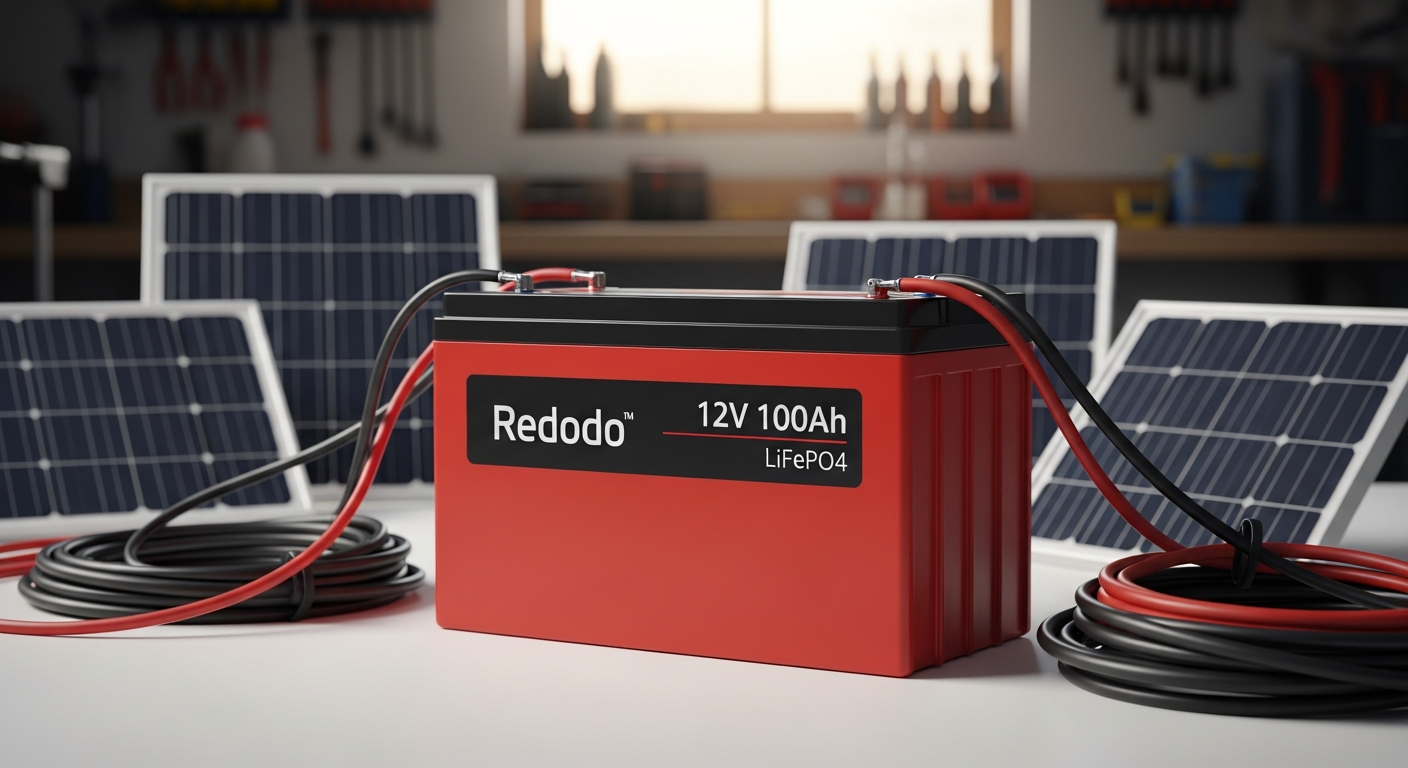
Discover how the Redodo 12V 100Ah LiFePO4 deep cycle battery delivers 10 years of reliable power for RVs, solar systems, and marine applications. Compare specs, pricing, and real-world performance insights.
Lead-acid batteries drain your wallet and fail when you need them most—but what if you could swap them for a power solution that lasts 10 years, weighs 25 pounds instead of 60, and costs less than $300? The shift toward lithium iron phosphate technology is reshaping how off-grid enthusiasts, RV owners, and solar installers approach energy storage.
The Redodo 12V 100Ah LiFePO4 battery has become the go-to choice for anyone serious about portable power. This isn't just another battery on the market—it's engineered with a robust 100A Battery Management System, delivers 1280Wh of usable energy, and handles 4000+ deep cycles at full discharge. Whether you're powering a sailboat, backing up your off-grid cabin, or running a mobile RV setup, this battery punches well above its weight class in reliability and performance.
Explore the Redodo 12V 100Ah LiFePO4 battery and transform your energy storage setup today.
What Makes LiFePO4 Chemistry Superior to Traditional Lead-Acid
Lithium Iron Phosphate Cell Composition and Safety
LiFePO4 chemistry stands apart from other lithium variants because it prioritizes safety without sacrificing performance. The iron phosphate compound is inherently more stable than cobalt-based lithium cells, meaning it resists thermal runaway and maintains structural integrity under stress. This chemical stability translates to fewer fire risks, longer cycle life, and a battery you can trust in enclosed spaces like RV cabins or marine cabins.
Extended Cycle Life: 4000+ Cycles at Full Discharge
Lead-acid batteries typically deliver 300 to 500 cycles before significant capacity loss occurs. The Redodo 12V 100Ah operates at 4000+ deep cycles when discharged completely, and reaches up to 15,000 cycles at 60% depth of discharge. This massive difference means you're replacing a lead-acid battery every 2-3 years, while this lithium battery runs for a decade.
Consistent Voltage Output for Sensitive Electronics
One overlooked advantage of LiFePO4 technology is voltage stability throughout the discharge cycle. Lead-acid batteries sag dramatically as they drain, causing refrigerators to work harder and trolling motors to lose thrust. The Redodo maintains steady 12V output across the entire discharge curve, protecting your equipment and ensuring reliable performance when it matters most.
Zero Memory Effect and Partial Charging Freedom
Traditional batteries suffer capacity loss from repeated partial charges. LiFePO4 cells have no memory effect, meaning you can charge at 20% or 80% without penalty. This flexibility makes real-world use simpler—you charge when convenient, not when the battery reaches a specific threshold.
Environmental and Performance Advantages
Lithium iron phosphate cells use recyclable materials without toxic lead or sulfuric acid. The environmental benefit extends to performance: LiFePO4 maintains efficiency across temperature fluctuations better than lead-acid, and the energy density advantage means 1280Wh packed into a lightweight 25-pound package that's genuinely portable.
Integrated 100A BMS: The Protection System That Keeps You Safe
Overcharge Protection and Solar Charging Compatibility
The integrated 100A Battery Management System automatically prevents overcharging, a critical feature when paired with solar controllers that don't always stop charging at ideal voltages. The BMS cuts charging current when voltage reaches safe limits, protecting cell integrity and extending lifespan without requiring manual intervention.
Over-Discharge Safeguards and Device Protection
Over-discharge damages lithium cells permanently. The BMS monitors voltage in real-time and disconnects loads when the battery drops to a safe minimum threshold, protecting both the battery and your connected devices. This automatic protection means you can't accidentally kill the battery through negligence.
Over-Current Detection and Short-Circuit Prevention
If you accidentally short the terminals or connect an oversized load, the BMS detects the abnormal current draw and shuts down instantly. This short-circuit protection prevents fires and equipment damage—a safety net you get automatically.
Temperature Management Through Built-In Sensors
Thermal sensors monitor heat buildup during charging and discharging. If temperature climbs toward dangerous levels, the BMS throttles charge current or disconnects loads to cool the battery. Some Redodo variants include self-heating functions for cold climates, maintaining performance even in freezing conditions.
Cell Balancing Technology
Internally, the battery contains multiple LiFePO4 cells connected in series. The BMS continuously balances voltage across these cells, ensuring each one operates at optimal levels. This cell-level management extends overall lifespan and prevents weak cells from limiting the entire battery's capacity.
Real-Time Monitoring and Data Tracking
Advanced BMS systems track voltage, current, temperature, and state of charge in real-time. You can connect monitoring displays to watch these parameters, providing visibility into your battery's health and performance. This data helps you optimize charging practices and catch problems early.
Automatic Shutdown Protocols During Faults
If any parameter falls outside safe ranges—voltage too high, current too high, temperature too extreme—the BMS automatically disconnects the battery from all loads. This failsafe design prevents cascading damage and keeps your entire system running safely.
Compatibility with Standard Charging Systems
The BMS works seamlessly with standard 12V chargers, MPPT solar controllers, and battery management systems. You don't need proprietary equipment—the battery integrates with components you likely already own.
Discover how the 100A BMS protects your investment and ensures years of trouble-free operation.
Power Specifications Decoded: Understanding the 1280Wh Capacity
Nominal 12V Voltage and System Integration
The 12V nominal voltage matches existing RV, marine, and off-grid systems perfectly. Your current wiring, connectors, and charging equipment work without modification. This compatibility eliminates expensive rewiring or adapter purchases—you're swapping the battery itself, not redesigning your entire electrical system.
100Ah Capacity: Real-World Runtime Translation
100Ah means the battery can deliver 100 amps for 1 hour, or 10 amps for 10 hours. Total energy storage is 1280Wh (12V × 100Ah). A typical refrigerator draws 3-5 amps; this battery runs it for 20-30 hours on a full charge. A laptop charger at 5 amps runs for 240 hours. Actual runtime depends on your specific loads.
1280W Maximum Continuous Output Power
The battery can supply 1280 watts continuously without damage. This means you can run an inverter powering multiple devices simultaneously: a coffee maker (1000W) and laptop charger (100W) together without exceeding limits. Peak power handling provides flexibility for high-demand appliances.
Depth of Discharge: 100% DOD Versus 60% DOD
At 100% depth of discharge (fully drained), the battery delivers 4000+ cycles. At 60% DOD (only using 60Wh of the 1280Wh capacity), it reaches 15,000 cycles. The deeper you discharge consistently, the fewer total cycles you get—but even the aggressive 100% DOD scenario vastly outpaces lead-acid batteries.
Usable Capacity Advantages
Lead-acid batteries should only be discharged to 50% to avoid permanent damage. This means a 200Ah lead-acid battery only provides 100Ah of usable capacity. The Redodo delivers full 100Ah usable capacity at 100% DOD, giving you twice the practical energy from a smaller footprint.
Expandable Configurations: Scaling to 20.48kWh
You can connect multiple Redodo batteries in series (stacking for higher voltage) or parallel (connecting for more capacity). The system supports up to 4 series and 4 parallel configurations, totaling 20.48kWh—enough for substantial off-grid homes or large RV fleets. Start small and expand as your power needs grow.
Voltage Stability Under Load
When you draw heavy current, lead-acid voltage sags dramatically, causing motor performance loss and electronic glitching. LiFePO4 maintains stable voltage under load, meaning your trolling motor maintains thrust and your sensitive electronics operate at rated specifications throughout discharge.
Power Delivery Consistency Across Discharge Curves
Traditional batteries lose power as they drain. This Redodo maintains nearly flat voltage output until the battery reaches critical low levels, delivering consistent performance from full charge to nearly empty.
Real-World Applications: Where This Battery Shines
RV and Camper Van Systems
RV owners immediately feel the difference. A 25-pound battery replaces a 60-pound lead-acid unit, reducing vehicle weight and improving fuel economy. Extended boondocking becomes realistic—the 4000+ cycle lifespan means you're not replacing batteries constantly, and the consistent voltage keeps your refrigerator running reliably while dry camping. Many RVers report doubling their off-grid days with lithium compared to lead-acid.
Marine and Sailboat Power
Salt-water environments corrode lead terminals aggressively. LiFePO4's sealed construction resists corrosion, maintaining performance despite humidity and spray exposure. The lightweight design improves boat handling and payload capacity, while consistent voltage keeps navigation electronics and fishing gear operating smoothly even in rough seas.
Off-Grid Solar Installations
Solar systems benefit enormously from LiFePO4's efficiency. Charging losses decrease, meaning more of your solar energy gets stored instead of wasted as heat. MPPT controllers integrate seamlessly with the BMS, and the ability to discharge fully (versus 50% for lead-acid) means you extract maximum usable capacity from every solar kilowatt-hour.
Home Backup Power
When the grid fails, this battery backs up essential loads: refrigerator, water pump, communication devices, medical equipment. The consistent voltage protects sensitive electronics, while the 1280Wh capacity handles extended outages when paired with solar panels or generator charging.
Portable Power Stations
The 25-pound weight makes this battery portable enough for emergency preparedness kits, off-site work, or disaster response. Compared to lead-acid alternatives, you can actually carry this battery without industrial equipment.
Trolling Motor and Fishing Boat Applications
Trolling motors demand consistent voltage to maintain thrust. Lead-acid sag frustrates anglers mid-day. This battery's flat voltage curve delivers all-day performance, while the lightweight design matters on smaller boats with weight restrictions.
Tiny Home and Container Living
Space constraints demand efficient energy storage. The compact 13 x 6.77 x 8.43-inch footprint fits tight installations, and the 25-pound weight simplifies mounting in overhead compartments or wall-mounted racks.
Agricultural and Remote Site Operations
Farms, construction sites, and remote locations need reliable backup power. This battery operates reliably in demanding outdoor conditions, handling temperature swings and harsh environments where lead-acid would fail prematurely.
Cost-Benefit Analysis: Is the $250-$300 Investment Worth It?
Upfront Pricing and Competitive Landscape
The Redodo 12V 100Ah typically costs $250-$300, often available with discounts. Competing LiFePO4 batteries from other brands command $350-$500 for equivalent capacity. Comparable lead-acid capacity costs $100-$150, making lithium appear expensive initially.
Total Cost of Ownership Over 10 Years
Here's where the math shifts dramatically. Lead-acid batteries last 2-3 years, requiring 3-4 replacements over a decade. You'll spend $400-$600 total on batteries alone. Add terminal corrosion repairs, acid spill cleanup, and watering supplies. The Redodo runs 10 years as a single investment with zero maintenance, costing less total despite higher upfront expense.
Efficiency Gains and Energy Savings
LiFePO4 charges faster and with fewer losses than lead-acid. Solar installations recover charging losses—energy that would dissipate as heat in lead-acid batteries. Over years of daily charging cycles, these efficiency gains compound into measurable energy savings, particularly valuable for users paying for electricity or counting on limited solar generation.
Weight Savings Impact on Fuel Economy
RV owners report 5-15% fuel economy improvement from removing 35+ pounds of battery weight, depending on driving patterns. Over thousands of annual miles, fuel savings alone recoup portions of the battery investment. Marine users reduce payload and improve performance without sacrificing power capacity.
Maintenance Elimination
Lead-acid batteries demand regular attention: watering cells, cleaning coroded terminals, replacing damaged connectors. Time and materials add up. LiFePO4 requires no maintenance—no water additions, no acid handling, no terminal cleanup. You install it and forget about it.
Resale Value Considerations
RVs and boats equipped with lithium batteries command higher resale prices. Buyers recognize the advantage and pay premiums for batteries lasting remaining years of ownership. A used RV with a 3-year-old Redodo battery appeals far more than one with a failing lead-acid system requiring immediate replacement.
Available Discounts and Promotional Pricing
Redodo frequently offers discounts bringing prices below $250, particularly during seasonal sales or bundle purchases. Watching for promotions can reduce effective cost significantly.
ROI Timeline for Solar-Powered Systems
If you're installing solar panels, lithium batteries accelerate ROI. The combination captures more energy, stores it efficiently, and delivers consistent output to critical loads. Systems reach payback within 5-7 years versus 8-10 years with lead-acid alternatives.
Installation, Compatibility, and Setup Considerations
Physical Dimensions and Mounting Space
The battery measures 13 x 6.77 x 8.43 inches, fitting tight engine compartments, battery boxes, and cabinet spaces. Confirm your mounting location provides adequate clearance before ordering. The compact footprint suits RVs, boats, and closet installations that would never accommodate lead-acid equivalents.
Weight Advantage and Installation Ease
At 25 pounds, this battery is genuinely portable. Two people can handle installation comfortably, versus the industrial effort required for 60-pound lead-acid units. Vertical or overhead mounting becomes feasible without structural reinforcement.
Terminal Connection Types and Cable Compatibility
The battery uses standard M8 bolt terminals compatible with most existing 12V battery cables. You can reuse your current cables and connectors without adapters. If your RV or boat has proprietary terminals, Redodo offers compatible connector options.
BMS Integration with Charging Systems
Connect the BMS to your charge controller, inverter, and monitoring display using simple wiring. MPPT solar controllers, battery chargers, and DC-to-DC converters integrate without special programming. The BMS communicates via basic voltage and current signals, not complex digital protocols.
Low-Temperature Variants for Cold Climates
Standard Redodo models perform well in moderate temperatures. For climates below freezing, upgrade to the low-temperature variant featuring self-heating functionality. This version maintains performance during cold nights and winter operation, though it costs slightly more.
Basic Model Limitations
Entry-level Redodo versions include the core battery and BMS but may lack advanced monitoring displays or communication features. You get full capacity and cycle life, but less real-time data visibility. This matters little if you already have adequate monitoring systems.
Installation Instruction Clarity
Some users report installation documentation could be clearer, particularly for multi-battery systems or complex setups. For straightforward single-battery replacements, instructions suffice. If building a 4-battery bank or custom configuration, budget extra time or consider professional installation.
Parallel and Series Configuration Wiring
Connecting multiple batteries requires proper wiring knowledge. Series connections (positive to negative) increase voltage; parallel connections (positive to positive) increase capacity. Documentation covers basics, but complex installations benefit from professional electrician review.
Ventilation and Thermal Management
LiFePO4 batteries generate less heat than lead-acid, requiring less ventilation. Standard mounting with 2-3 inches of clearance suffices for cooling. Unlike lead-acid, you don't need special vented cabinets—the sealed design handles enclosed installations safely.
Performance Strengths: Why Users Keep Choosing Redodo
Long-Lasting Power Delivery
Users consistently report steady performance across discharge cycles. A refrigerator runs at full cooling capacity until the battery reaches critically low levels, unlike lead-acid where performance degrades throughout discharge. This consistency prevents food spoilage and equipment damage.
Lightweight Portability Enabling Easier Transportation
The 25-pound weight changes what's possible. RV owners move the battery themselves; boat owners don't need deck cranes. Portable emergency kits become practical with lightweight lithium instead of heavy lead-acid.
Built-In Safety Features
The 100A BMS provides peace of mind. Overcharge, over-discharge, over-current, and temperature protection happen automatically. You're not managing these risks manually—they're handled transparently.
Full Depth of Discharge Without Capacity Loss
You extract maximum energy without penalty. Lead-acid users restrict themselves to 50% discharge to preserve battery life. You use the full 100Ah every cycle without shortening lifespan.
Responsive Customer Support
Redodo users praise support responsiveness. Questions get answered quickly; warranty claims process smoothly. When problems arise, you're not left troubleshooting alone.
Robust Packaging
Batteries arrive well-protected through shipping. Padded cases and secure pallet wrapping ensure no damage during transport—important for expensive equipment.
Proven Reliability in Harsh Environments
Thousands of hours of real-world testing across RVs, sailboats, solar cabins, and remote sites prove durability. Users share testimonials of batteries operating flawlessly in extreme heat, cold, and salt-water exposure.
Quiet Operation
Unlike generator alternatives, this battery provides power silently. RV camping, marine use, and backup power all happen without disturbing neighbors or wildlife.
Scalability
Start with one battery and expand later as needs grow. Multiple batteries connect easily, supporting larger systems without replacing the original battery.
Honest Limitations: What You Should Know Before Buying
Low-Temperature Protection in Classic Models
Standard Redodo batteries lack self-heating for sub-freezing operation. In cold climates, performance degrades and cycle life shortens. Solution: purchase the low-temperature variant if you operate in freezing conditions. This matters only for true Arctic users; most climates present no issue.
Installation Documentation Improvements Needed
Complex multi-battery setups require interpretation beyond basic instructions. DIY installers with electrical knowledge manage fine; those unfamiliar with battery systems benefit from professional installation.
Additional Parts Sometimes Required
Occasionally, complete system integration requires additional components: monitoring displays, cable adapters, or mounting brackets. Budget flexibility for these minor additions.
Initial Learning Curve with BMS Monitoring
Understanding battery management system alerts and state-of-charge displays takes time. Optimal charging practices differ from lead-acid habits. Most users master this quickly through trial and real-world operation.
Compatibility Verification Needed with Older Equipment
Ancient charge controllers or inverters might not integrate seamlessly. Verify compatibility with your existing equipment before assuming plug-and-play functionality.
Cold-Weather Performance Trade-Offs
Without self-heating capability, the standard model loses performance in freezing temperatures. Cold nights reduce available capacity. Users in harsh climates need the upgraded version.
Warranty Considerations for DIY Installation
Professional installation typically carries better warranty coverage than DIY setups. If troubleshooting becomes necessary, documentation of proper installation helps warranty claims.
Price Point Still Higher Than Lead-Acid
Despite long-term cost advantages, upfront expense remains higher. Budget-constrained users might feel initial sticker shock, even understanding total ownership benefits.
Limited Extended Warranty Options
Redodo offers standard warranty coverage, but extended plans are limited. Consider this when evaluating long-term protection strategy.
Maximizing Battery Lifespan: Charging and Maintenance Best Practices
Optimal Charging Voltage Settings
Set your charger or solar controller to 14.2-14.6V for 12V LiFePO4 batteries. This charging voltage is lower than lead-acid's 14.8V, protecting cell integrity. Higher settings accelerate degradation. Correct voltage settings maximize lifespan dramatically.
Avoiding Over-Discharge Through Monitoring
Monitor state of charge and avoid regularly discharging below 10% remaining capacity. While the battery handles 100% discharge, limiting regular discharge to 90% extends cycle life toward the 15,000-cycle potential at 60% DOD. Simple monitoring discipline preserves longevity.
Temperature Management and Operating Range
Optimal operation occurs between 32°F and 104°F. Extreme heat accelerates aging; extreme cold reduces capacity. Insulate the battery in harsh environments and provide shade during summer operation.
Seasonal Storage Protocols
Store with 50% state of charge for extended downtime. Full charge during months-long storage accelerates aging; completely discharged batteries risk deep damage. Quarterly check-ups verify charge state during off-season storage.
BMS Monitoring and Alert Code Understanding
Learn what BMS alerts mean and respond appropriately. Over-temperature alerts suggest reducing charging speed; over-current alerts indicate undersized wiring. Understanding codes prevents problems.
Charging Speed Optimization
Slower charging extends lifespan compared to rapid charging. If time permits, charge at half the maximum current rate. This trade-off between convenience and longevity lets you choose based on circumstances.
Load Management and Power Draw Distribution
Distribute loads across time when possible. Continuous maximum-power operation ages batteries faster than varied loads. Spreading power demand preserves cycles for critical applications.
Regular System Inspections
Quarterly checks of connections, terminal cleanliness, and visual condition catch degradation early. Clean corroded terminals (rare with lithium, but possible) and tighten loose connections.
Firmware Updates and Software Optimization
Some advanced Redodo models include firmware updates. Check manufacturer support periodically for improvements that optimize performance and lifespan.
The 10-Year Lifespan Reality: What to Expect Long-Term
Capacity Retention at Year 5 and Year 10
Typical LiFePO4 batteries retain 80-90% capacity at year 5 and 70-80% at year 10, depending on usage patterns. A battery delivering 100Ah initially provides approximately 75-80Ah after a decade. Performance degradation is gradual and predictable.
Degradation Patterns Under Various Scenarios
Heavy daily use with 100% depth of discharge ages the battery faster than light use with 50% DOD. Extreme temperatures accelerate degradation. Cold storage preserves the battery longest. Actual lifespan depends heavily on individual usage patterns.
Cycle Count Milestones
Reaching 4000 cycles takes 10-15 years of daily use. Reaching 15,000 cycles at 60% DOD requires 25-40 years of operation. Most users won't exhaust cycle life before other considerations drive replacement.
Real-World Testimonials from Long-Term Users
Redodo users with 5+ years of operation report consistent performance and reliable power delivery. Capacity loss remains minimal and invisible in daily use. Salt-water marine installations and Arctic RVers share positive long-term experiences.
Warranty Coverage Duration and Post-Expiration
Standard Redodo warranty covers 3-5 years. After expiration, you own the battery outright. Post-warranty operation continues at degraded performance but doesn't suddenly fail. Many users operate successfully beyond warranty periods.
Battery Recycling Options and End-of-Life Considerations
LiFePO4 batteries are recyclable, with lithium and iron recovered for new batteries or industrial uses. Redodo facilitates recycling programs, or you can contact local recycling facilities. Responsible disposal prevents environmental contamination.
Upgrade Pathways When Capacity Eventually Declines
After 10-15 years, you might upgrade to newer technology with higher energy density or expanded capacity. Your original Redodo, recycled or refurbished, has secondary market demand from budget-conscious users seeking reliable used batteries.
Investment Protection and Resale Value
A Redodo battery with remaining lifespan holds value. Resale market for used lithium batteries continues growing as adoption increases. You'll recover 30-50% of purchase price selling a used battery with years remaining.
Technological Advancements Over the Decade
Battery technology evolves continuously. Your 2025 Redodo battery remains capable and functional indefinitely, but future versions might offer higher energy density or extended lifespan. Planned upgrades let you adopt advances while the original battery transitions to secondary applications or recycling.
Your Path to Energy Independence Starts Here
The Redodo 12V 100Ah LiFePO4 battery represents a genuine breakthrough for anyone tired of lead-acid limitations. You're getting 10 years of reliable power, 4000+ deep cycles, and a featherweight 25-pound package—all for under $300. The integrated 100A BMS handles the safety concerns automatically, while the consistent voltage output keeps your sensitive electronics running smoothly.
What really sets this battery apart is the combination of affordability and performance. You're not paying premium prices for luxury features you'll never use. Instead, you're investing in proven lithium iron phosphate chemistry that's been battle-tested in RVs, sailboats, solar cabins, and marine environments. The 10-year lifespan and full depth of discharge capability deliver twice the usable energy of traditional batteries, making your total cost of ownership significantly lower despite the higher upfront investment.
That said, be honest about your needs. If you're operating in extreme cold climates, grab the low-temperature variant. If you're building a complex multi-battery system, budget extra time for installation and consider professional setup. These minor considerations pale against the massive advantages you'll experience once the battery is running.
The question isn't whether the Redodo 12V 100Ah LiFePO4 battery is worth it—it's whether you can afford to keep using outdated lead-acid technology. Take the next step: assess your power requirements, calculate your total cost of ownership over 10 years, and make the switch to lithium. Your future self will thank you for the reliable, efficient, lightweight power solution that finally delivers on the promise of true energy independence.
Start your energy independence journey with the Redodo 12V 100Ah LiFePO4 battery today.

