
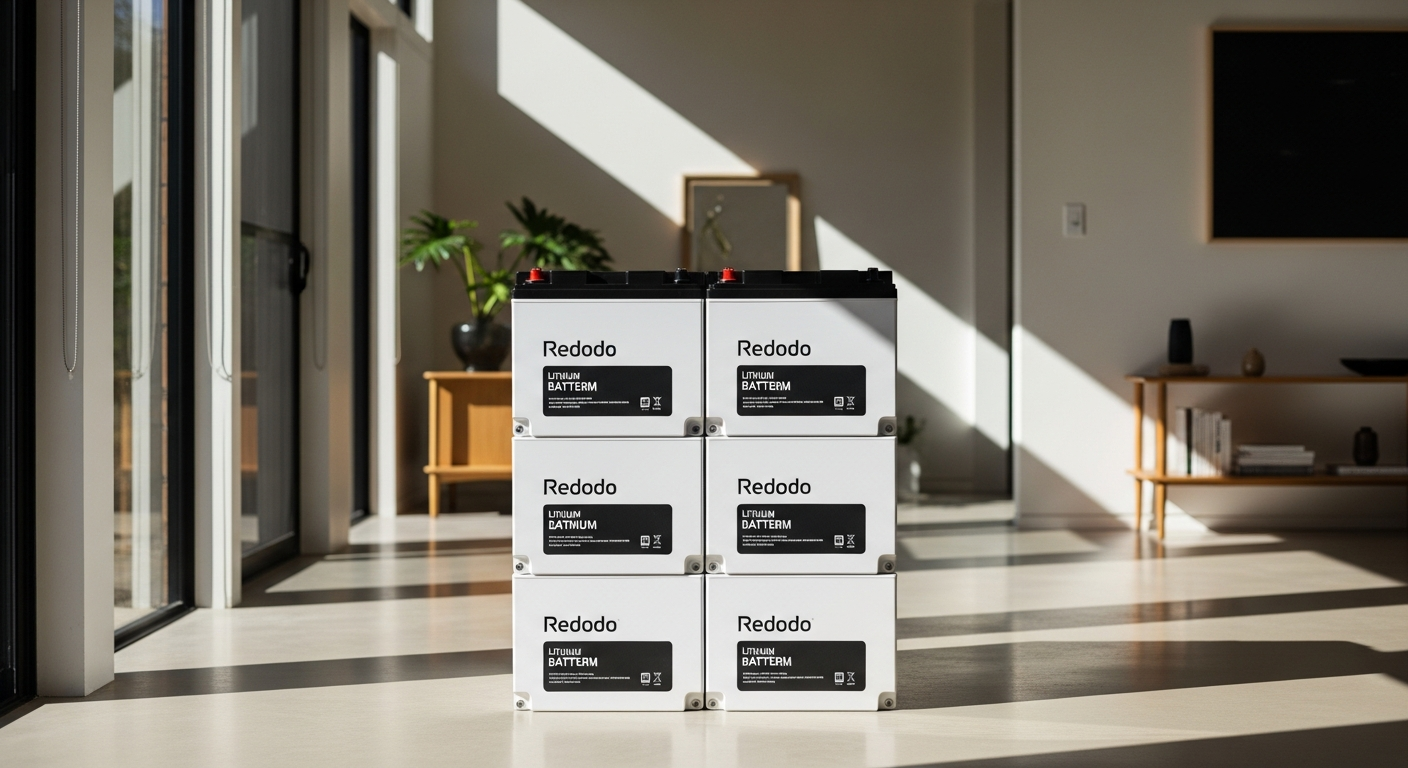
Master battery bank expansion with the Redodo 12V 100Ah LiFePO4. Learn series/parallel configurations, sizing for 48V systems, and scaling strategies for off-grid power.
Most off-grid enthusiasts start small—a single 12V battery powering their cabin or RV. But here's the reality: one battery rarely cuts it for long-term energy independence. The challenge isn't finding a quality battery; it's figuring out how to expand your power bank without replacing everything you've already invested in.
That's where the modular approach becomes a game-changer. The Redodo 12V 100Ah LiFePO4 Deep Cycle Battery has earned its reputation as a best-seller because it's not just a standalone power source—it's a building block. Unlike traditional lead-acid batteries that struggle with expandability, this lithium iron phosphate system was designed with scalability in mind. You can connect multiple units in series or parallel to create custom energy banks that grow with your needs, whether you're upgrading from a weekend cabin to a full-time homestead or expanding a marine power system.
Start building your scalable energy solution with the Redodo 12V 100Ah LiFePO4 battery today.
Series vs. Parallel: Which Configuration Powers Your Goals
Understanding how to wire batteries together is the foundation of any expansion strategy. Two primary configurations exist, and choosing the right one depends entirely on your voltage and capacity requirements.
Understanding voltage multiplication through series connections
When you connect batteries in series, you add their voltages together. Two 12V batteries wired in series create 24V, three create 36V, and four create 48V. The ampere-hour capacity stays the same. This approach is essential when your inverter or charge controller requires higher voltage to operate efficiently. Most modern off-grid systems prefer 48V because it reduces current draw on cables and increases efficiency across longer distances.
Capacity stacking with parallel wiring
Parallel connections work differently. You connect the positive terminal of one battery to the positive terminal of another, and negative to negative. This doubles the ampere-hour capacity while maintaining the same voltage. Two 12V 100Ah batteries in parallel deliver 12V 200Ah. This configuration makes sense when you need more runtime at your current voltage without upgrading your entire system to handle higher voltage.
Hybrid configurations: combining series and parallel for 48V systems
The most powerful approach combines both methods. A 48V 400Ah system requires four batteries in series (creating 48V) with four parallel strings of that series configuration. Essentially, you're building four 48V 100Ah strings, then connecting those strings in parallel to reach 400Ah capacity. This hybrid setup maximizes both voltage and capacity.
Compatibility requirements for seamless multi-battery connections
All batteries in your system should be identical models with the same amp-hour rating and voltage specification. Mixing different Redodo models or brands with different specifications creates voltage imbalances and accelerates degradation. The built-in BMS in each unit communicates with others, and mismatched systems compromise this protection.
BMS interactions when linking multiple units with built-in management systems
Each Redodo 12V 100Ah battery includes a 100A Battery Management System. When connected properly, these systems work in concert rather than conflict. The BMS protects against overcharging, over-discharging, over-current conditions, and temperature extremes. In series configurations, voltage is protected at each stage. In parallel strings, the individual BMS units ensure balanced current distribution.
Common mistakes that damage batteries during configuration setup
Reversing polarity is the fastest way to destroy a battery bank. Double-check your positive and negative connections before powering anything on. Mixing different charge sources without proper isolation (like connecting solar and a generator simultaneously to different batteries) causes conflicts that the BMS can't resolve. Undersizing your interconnection cables creates voltage sag and forces the BMS to limit current, reducing your usable power.
Building a 48V 400Ah Power Bank: The Complete Roadmap
A 48V 400Ah system represents the gold standard for serious off-grid applications. This configuration balances power density, efficiency, and real-world practicality for homesteads, marine installations, and commercial operations.
Why 48V systems dominate modern off-grid installations
Forty-eight volts has become the industry standard because it optimizes the relationship between current and efficiency. At 48V, the same power requires roughly one-quarter the current of a 12V system, which means smaller gauge cables, lower resistive losses, and less heat generation. When you're running power over even modest distances—say 50 feet from a battery bank to a main breaker panel—voltage drop becomes a real concern. 48V systems virtually eliminate this problem.
Battery quantity needed: four 12V units in series, four parallel strings
To build 48V, you need four Redodo 12V batteries connected in series. To reach 400Ah capacity, you need four of these series strings connected in parallel. That's 16 individual 12V 100Ah batteries total. The math might seem daunting initially, but the result is straightforward: four strings of 48V 100Ah units yielding one cohesive 48V 400Ah bank.
Total energy capacity calculation
Each Redodo 12V 100Ah battery delivers 1280Wh of usable energy (12V × 100Ah). Multiply that by 16 batteries, and you're looking at 20,480Wh or approximately 20.5 kWh of total capacity. That's enough to power an average household for one to two days depending on consumption patterns, or sustain critical loads for a week or longer.
Cost breakdown: comparing modular expansion versus buying larger single units
The Redodo 12V 100Ah typically costs between $229.99 and $279.99 per unit. Building a 48V 400Ah bank modularly means purchasing 16 units, translating to roughly $3,680 to $4,480 depending on discounts and promotions. The advantage of modular expansion is that you don't need to buy all 16 units at once. You might start with 4 units (one 48V 100Ah string) for around $920–$1,120, then add more as budget permits. This phased approach spreads costs across months or years rather than requiring one massive capital outlay.
Explore the Redodo 12V 100Ah LiFePO4 battery and plan your modular expansion strategy.
Space requirements and mounting strategies for 16-battery banks
Each Redodo 12V 100Ah measures approximately 13 x 6.77 x 8.43 inches and weighs 22–25 pounds. Sixteen batteries occupy roughly 3,400 cubic inches of space and weigh about 400 pounds total—substantially lighter than equivalent lead-acid systems. Mounting this system requires either custom racks or purpose-built lithium battery enclosures. Proper spacing prevents thermal issues and allows for cable routing underneath or beside the array.
Load capacity: what appliances and systems a 48V 400Ah bank can reliably power
With 20.5 kWh of capacity, a 48V 400Ah bank manages most residential loads for extended periods. Running a 2kW load continuously drains the bank in roughly 10 hours. Typical off-grid households drawing 10–20 kWh daily require this capacity to avoid daily generator use or depleting the battery below safe discharge levels. Refrigeration, heating, lighting, water pumping, and entertainment systems all operate reliably from this capacity.
Upgrade timeline: starting with 2 units and scaling to full capacity over months
A sensible expansion schedule might look like this: Month 1, purchase 2 units and configure as 24V 100Ah; Month 4, add 2 more units to reach 24V 200Ah; Month 8, add 4 more units and reconfigure to 48V 200Ah; Month 12, complete the system with 8 final units reaching 48V 400Ah. This timeline spreads costs while letting you assess actual power consumption and adjust sizing before committing to the full bank.
Maximizing Lifespan Through Proper Battery Bank Management
Adding more batteries to your system increases the complexity of managing them properly. Thoughtful maintenance practices ensure all 16 units age gracefully and maintain performance across decades.
Balancing discharge rates across parallel strings to prevent cell degradation
When four 48V 100Ah strings operate in parallel, ideally each string discharges equally. If one string presents lower resistance due to a corroded connector or slightly different internal impedance, it discharges faster and degrades sooner. Periodically measure voltage across each string during discharge cycles. Parallel string voltages should remain within 0.05V of each other. If one string consistently shows lower voltage, investigate the interconnect cables and connectors.
Temperature monitoring when stacking multiple batteries in confined spaces
Sixteen batteries generate cumulative heat during charging and discharging. Stacking them in a confined space—like an RV cargo bay or marine cabin—creates hotspots where interior temperatures climb. The Redodo BMS includes temperature sensors, but excessive heat still shortens lifespan. Maintain ambient temperatures between 32°F and 131°F for charging, with 70–80°F being optimal. Ensure air circulation around the battery bank, and consider active cooling (small fans) if stacking in tight quarters.
The role of the 100A BMS in protecting expanded systems from overload
The 100A BMS in each Redodo unit protects against current surges, but in a 16-unit system, the cumulative BMS capacity reaches 1600A—far more than any residential application demands. What matters is ensuring the BMS in each unit sees consistent, balanced current. Asymmetrical charging (where one parallel string receives more current than others) confuses the system. Use quality cable interconnects of identical length and gauge across all parallel strings to ensure balanced current distribution.
Maintenance schedules for multi-battery installations
Check interconnection cables and terminals quarterly for corrosion. Inspect the battery enclosure for water ingress, especially in marine or outdoor environments. Review the Bluetooth monitoring app monthly to catch anomalies—unusual voltage differentials, unexpected temperature spikes, or capacity fade. Perform a full system health assessment annually, including a controlled discharge cycle to verify usable capacity hasn't degraded unexpectedly.
Firmware updates and Bluetooth monitoring across interconnected units
Some Redodo models offer Bluetooth connectivity, allowing real-time monitoring via smartphone app. If your units support this, update firmware periodically as Redodo releases improvements. Monitor individual battery voltage, temperature, and cumulative system capacity from a central dashboard. This visibility catches problems early—a failing cell, a loose connection, or thermal runaway risks before they become catastrophic.
Preventing voltage sag in longer cable runs between batteries
Long cable runs between batteries and load equipment cause voltage sag—a temporary voltage drop under load that limits usable power. A 48V system with 100 feet of interconnect cable can experience 1–2V drop under heavy loads. Minimize cable runs, use appropriately gauged cable (typically 2/0 or larger for 48V systems), and keep connections tight. Voltage sag doesn't damage batteries, but it reduces available power and triggers the BMS to limit current.
Thermal management: ventilation and spacing considerations for safety
Space batteries at least 2–3 inches apart to allow airflow. Ensure the enclosure has ventilation openings on at least two sides. If ambient temperatures regularly exceed 100°F, consider passive cooling vents or active fans. The 48V 400Ah bank can charge or discharge at 400A, which generates substantial heat during rapid cycles. Proper ventilation prevents thermal runaway—a rare but catastrophic failure where internal heat triggers a chain reaction.
Real-World Applications: Where Expanded Redodo Systems Shine
Different use cases demand different configurations. Understanding which setup fits your lifestyle ensures you size correctly and avoid over- or under-investing.
Off-grid homesteads: powering refrigeration, heating, and lighting year-round
A homestead typically requires a 48V 400Ah bank to handle daily loads of 15–25 kWh without generator assistance. Refrigeration runs continuously (4–6 kWh daily), heating in winter spikes dramatically (10–15 kWh on cold days), and lighting, water pumping, and entertainment fill the remainder. With 20.5 kWh of capacity and conservative 80% usable depth of discharge (to preserve longevity), a full bank delivers roughly 16 kWh daily before requiring recharge from solar or a generator.
Marine vessels: combining house batteries with trolling motor systems
On larger sailboats and fishing vessels, house batteries power navigation, refrigeration, and creature comforts, while separate high-capacity batteries handle trolling motors. A 48V 400Ah house bank is overkill for most boats, but a 24V 200Ah configuration (two series 12V batteries with multiple parallel strings) works excellently. This provides 2560Wh of capacity while keeping weight and space manageable aboard a vessel. Multiple smaller strings prevent catastrophic failure if one unit fails.
RV and van life: scaling from weekend trips to full-time boondocking
Weekend travelers might start with a single 12V 100Ah for occasional power supplements. Full-time RV dwellers typically prefer 24V 200Ah (two 12V batteries in series, multiple parallel strings) to handle refrigeration, propane heating, hot water, and entertainment without running generators daily. The modular approach lets RV owners upgrade gradually as they transition from seasonal travel to year-round boondocking.
Solar integration: sizing battery banks to match panel output and seasonal variations
A 48V 400Ah bank paired with 10–15 kW of solar panels creates a robust off-grid system. During peak summer production, panels charge the batteries within a few hours. Winter production drops 60–70%, requiring batteries to sustain multi-day autonomy. The larger bank accommodates seasonal variance without demanding constant generator backup during cloudy winter stretches.
Emergency backup power: whole-home systems that keep critical loads running
Homeowners concerned with grid outages often configure a 48V 400Ah bank to power critical circuits—refrigeration, well pump, basic heating, medical equipment, and communications. Even with moderate 5 kW loads, this capacity provides 4+ hours of uninterrupted power, sufficient for most outages to resolve or for backup generation to activate.
Remote cabins: standalone systems requiring minimal maintenance
Cabins visited sporadically benefit from modular systems. A single 12V 100Ah unit powers basic needs during short stays. As usage increases, the cabin owner adds units without redesigning the entire system. Eventually, a full 48V 400Ah bank might support winterization efforts, allowing year-round occupation.
Commercial applications: small businesses and agricultural operations
Small agricultural operations—irrigation systems, cold storage, equipment charging—often require 24V or 48V configurations. A modular Redodo system scales from powering a single well pump to managing an entire operation's energy needs without central infrastructure overhauls.
Addressing Cold-Weather Charging in Expanded Systems
The Redodo 12V 100Ah has one documented limitation: charging below freezing without external heating risks battery damage. In expanded systems, this concern multiplies across multiple units and demands proactive solutions.
The heating challenge: why freezing temperatures affect multi-battery setups
Lithium cells have a chemical reaction rate that slows dramatically in cold. Charging below 32°F can cause lithium plating—a degradation mechanism that permanently reduces capacity. While the Redodo BMS includes low-temperature charging cutoffs to prevent damage, they prevent charging entirely rather than enabling it. A 48V 400Ah bank in a harsh winter climate essentially becomes unavailable during the coldest months without external heating.
External heater solutions for large battery banks
Battery immersion heaters, heated blankets, and battery box heaters all work effectively. A 500–1000W immersion heater can warm a 48V 400Ah bank enough to enable charging even in subzero conditions. These heaters draw power from the batteries themselves, reducing available capacity, but this tradeoff is acceptable during emergency situations or essential charging windows.
Low-temperature charging cutoffs and their impact on expansion strategies
The BMS low-temperature cutoff typically engages around 32°F, preventing charging until temperature rises. For off-gridders in truly harsh climates, this means accepting deep discharges overnight or scheduling charging during warmer daylight hours. Alternatively, a heated enclosure—insulated box with controlled heating—maintains temperatures above 32°F year-round with minimal power draw.
Insulation techniques for protecting batteries in harsh climates
Foam board insulation (2–3 inches thick) around the battery enclosure retains heat effectively. Add a small thermostat-controlled heater inside the box, and external temperatures can drop to -20°F without affecting charging capability. This approach adds $200–500 to the system cost but proves invaluable in northern regions or high-altitude locations with harsh winters.
Performance degradation: what to expect when charging below freezing
Even with protection measures, cold charging reduces efficiency slightly. Expect 10–15% slower charge rates in sub-freezing conditions and slightly higher internal resistance. Once warmed, the battery returns to normal performance with no lasting degradation if the charging cutoff prevented ice-crystal formation.
Seasonal considerations for off-grid systems in northern regions
Plan for seasonal battery cycling. Summer months build reserves through aggressive solar charging. Fall transitions should include thorough system testing. Winter operations should prioritize essential loads and avoid deep discharges if possible. Spring brings the opportunity for reconditioning cycles (full discharge and recharge) to reset battery management parameters.
Workarounds and preventative measures for year-round reliability
Avoid charging during the coldest hours (typically 2 AM–6 AM). Use thermal mass—barrels of water or gravel nearby—to stabilize enclosure temperature. Consider relocating the battery bank temporarily during extreme cold snaps. Keep a backup portable heater accessible for emergency charging situations. None of these workarounds are perfect, but combined they sustain reliable operation even in challenging climates.
Calculating Your True Energy Needs Before Expansion
Oversizing the battery bank wastes capital; undersizing forces constant generator dependency. Accurate load assessment determines the right configuration before you purchase a single unit.
Load assessment: tracking daily power consumption in watt-hours
Monitor your actual power consumption for 2–4 weeks using a plug-in meter or home energy monitor. Record all appliances, their wattage, and daily runtime. A refrigerator drawing 500W for 8 hours daily consumes 4000Wh. A microwave at 1500W for 30 minutes daily adds 750Wh. Sum all loads to find daily consumption in watt-hours. Most households consume 10–30 kWh daily depending on heating, cooling, and appliance efficiency.
Autonomy planning: how many days of battery backup do you need?
Autonomy refers to how many days the battery bank can sustain loads without external charging. A 3-day autonomy requirement means the battery must hold enough power for three complete days of loads. If daily consumption is 20 kWh and you want 3-day autonomy, you need 60 kWh capacity. The Redodo 48V 400Ah delivers approximately 20.5 kWh usable (at 80% depth of discharge), so three units would provide rough 3-day autonomy for a 20 kWh daily consumption home.
Seasonal variations: accounting for shorter winter days and higher heating loads
Winter consumption often climbs 30–50% above annual averages due to heating and reduced solar availability. If summer consumption averages 15 kWh daily, plan for 22 kWh in winter. Simultaneously, winter solar production drops 60–70% compared to summer, meaning battery autonomy requirements extend from perhaps 1–2 days in summer to 5–7 days in winter. This seasonal variance justifies slightly oversizing the battery bank.
Peak versus average power requirements: understanding surge capacity
Average power consumption differs from peak demand. Your refrigerator running alone might draw 500W, but when the water heater kicks in simultaneously, demand spikes to 5000W. Peak demand lasts seconds or minutes, while average sustained demand tells the true story. The Redodo 100A BMS handles peak surges easily, but they require understanding for system design. Smaller battery banks might meet average needs but fail under simultaneous peak loads.
Future-proofing: building extra capacity for planned additions
If you plan to add a hot tub, upgrade heating systems, or eventually run an electric vehicle charger, account for these future loads during initial sizing. Adding extra batteries now is cheaper than retrofitting later. A 25% capacity buffer accommodates future upgrades without system redesign.
Tools and calculators for right-sizing your battery bank
Multiple online calculators assist with load assessment. The REsurety Load Calculator, PVWatts, and NREL's System Advisor Model all estimate daily consumption and necessary battery capacity based on climate and appliance specifications. Use these tools as starting points, then adjust based on your actual monitoring.
Common oversizing and undersizing mistakes
Oversizing occurs when owners purchase 48V 400Ah banks for homes consuming 12 kWh daily. The unused capacity deteriorates slowly, capital lies idle, and costs escalate unnecessarily. Undersizing happens when conservative estimates miss seasonal peaks or when owners add new loads after installation. Err slightly toward oversizing if uncertain—extra capacity costs less than generator operation or late-stage retrofitting.
Investment Strategy: When to Expand Your Battery System
The decision to expand isn't purely technical; it's financial and strategic. Understanding the economics ensures smart investment timing.
Cost-per-watt-hour analysis: comparing phased expansion to upfront investment
The Redodo 12V 100Ah costs roughly $2.40–$3.00 per watt-hour at full retail, or $1.80–$2.20 on sale. Building a 48V 400Ah system costs $3,680–$4,480 upfront or $18–$28 per kWh. Lead-acid alternatives cost $5–$8 per kWh but require replacement every 5–7 years. Over 10 years, Redodo's higher initial cost delivers lower total cost of ownership.
Warranty considerations: how expandability affects coverage across multiple units
Redodo typically warrants each unit independently. A 10-year warranty on one battery doesn't extend the warranty on future purchases. However, each new battery purchased comes with its own full warranty. This means a modularly expanded system maintains full coverage across all units as long as you purchase from an authorized distributor.
Financing options for scaling battery banks over time
Rather than financing the complete system, purchase units as cash becomes available. This approach eliminates interest while preventing capability overages. Some retailers offer 0% financing on purchases over certain amounts, making phased expansion cheaper than waiting and buying everything simultaneously.
Resale value: expandable systems versus fixed-capacity alternatives
Modular systems hold resale value better than monolithic batteries. If circumstances change and you need to downsize, individual units sell readily. A customized 48V 400Ah bank designed for a specific application has narrower resale appeal than four independent 12V units that buyers can repurpose.
Technology obsolescence: future-proofing with modular architecture
Battery chemistry and management systems improve constantly. A modular approach means you can upgrade individual units as better versions become available without scrapping the entire bank. This strategy protects long-term value better than oversized single-unit systems.
Break-even analysis: calculating ROI for larger battery installations
Compare the cost of the 48V 400Ah system against annual generator fuel costs and maintenance for a smaller battery bank. If generator operation costs $1500 annually and a larger battery bank eliminates this cost, the expanded system breaks even in 2–3 years, then provides free power for the remaining 7+ years of life.
Avoiding buyer's remorse through strategic capacity planning
Extensive load assessment and honest autonomy planning prevent costly oversizing regrets. If you're uncertain, start with a conservative configuration and expand within 12 months based on actual usage patterns. This measured approach rarely disappoints.
Your Roadmap to Energy Independence
Expanding your Redodo 12V 100Ah LiFePO4 system isn't just about adding more batteries—it's about building the energy infrastructure that matches your actual lifestyle. The modular design means you're never locked into a single capacity; you can start lean and grow strategically as your needs evolve. Whether you're configuring a 24V 200Ah setup for an RV or committing to a full 48V 400Ah bank for permanent off-grid living, each unit you add compounds your energy security without forcing a complete system overhaul.
The real advantage lies in flexibility. You gain the freedom to experiment with different configurations, test your power consumption patterns, and scale incrementally without financial risk. The integrated BMS protects your investment across every unit, while Bluetooth monitoring keeps you informed in real time. Cold-weather charging remains the one legitimate concern, but external heater solutions and strategic seasonal planning address this limitation effectively.
Start by calculating your actual energy needs—don't guess. Assess your loads, determine your autonomy requirements, and then build your battery bank in phases if budget allows. The Redodo platform rewards thoughtful planning and punishes hasty oversizing. Your first battery might power a weekend cabin; your expanded system could sustain a thriving homestead. That's the promise of modular lithium technology, and it's available at a price point that makes energy independence genuinely accessible.