
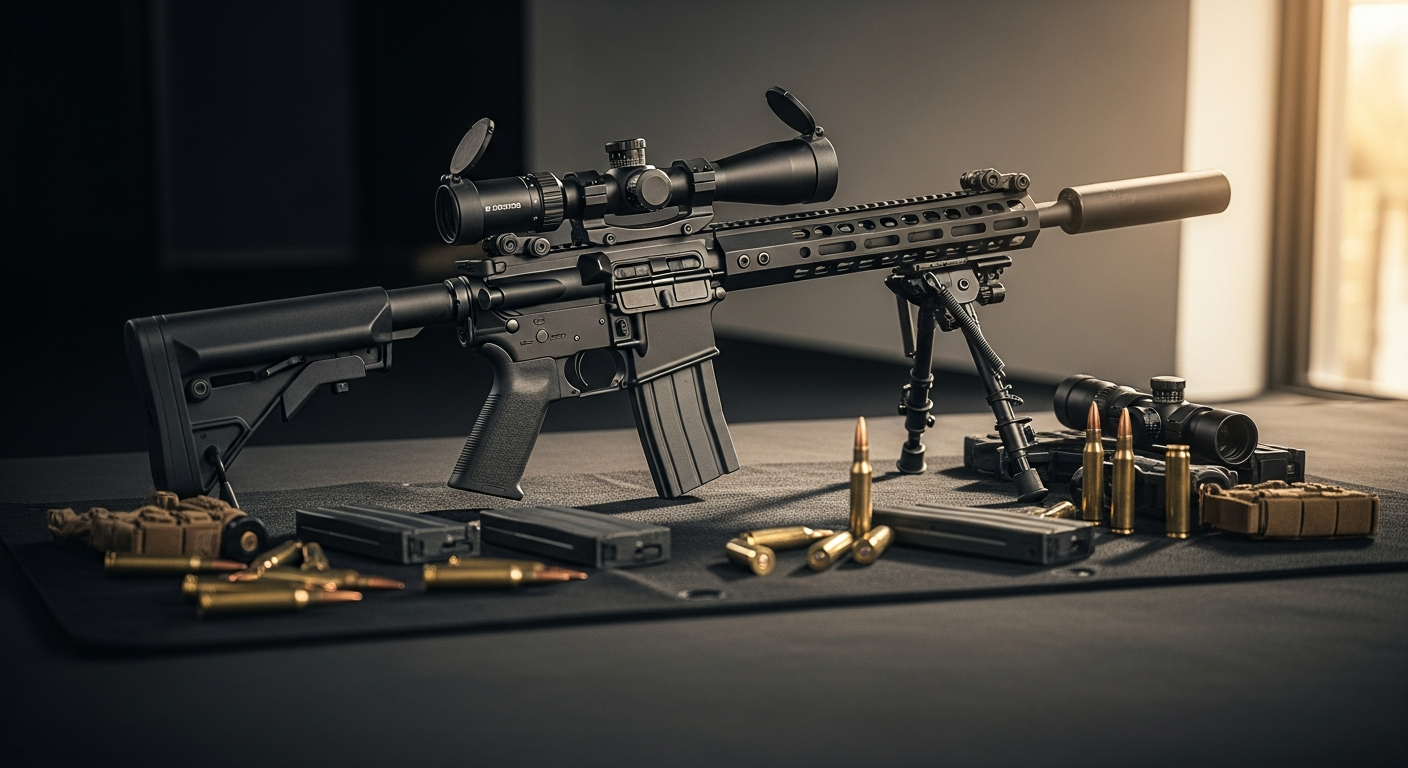
Discover why the Radical Firearms RF-15 SOCOM RPR rifle dominates the budget AR-15 market. Explore its mid-length gas system, free-float handguard, and premium B5 furniture in our comprehensive breakdown.
Budget-conscious shooters face a brutal choice: compromise on quality to save money, or drain your wallet for a reliable rifle. The Radical Firearms RF-15 SOCOM RPR shatters this false dilemma by consistently outperforming competitors twice its price, delivering military-grade components and genuine reliability without the premium price tag. This rifle combines thoughtful engineering with accessible pricing, chambered in 5.56mm NATO and compatible with .223 Remington, making it a versatile choice across home defense, tactical training, and recreational range sessions.
The RF-15 SOCOM RPR has earned its reputation through consistent performance on the market, ranking among the top-selling rifles on Guns.com. Shooters recognize that this platform doesn't cut corners on the components that actually matter—the barrel, the gas system, the receiver quality, and the ergonomics. Instead of skimping on these fundamentals, Radical Firearms invested in features that translate directly to reliability and accuracy, then priced the result aggressively enough to make it accessible to shooters who've been priced out of the market.
This breakdown covers the specific engineering decisions that make this rifle tick, from its mid-length gas system to its premium B5 Systems furniture. You'll understand the real-world advantages of its free-float handguard, why the 1:7 twist rate matters, and whether this rifle deserves a spot in your collection.
Check current pricing and availability of the RF-15 SOCOM RPR today.
Mid-Length Gas System: Why Smoother Cycling Changes Everything
How mid-length systems reduce felt recoil compared to carbine-length alternatives
The RF-15 SOCOM RPR features a mid-length gas system, a choice that immediately separates it from countless budget rifles still using carbine-length configurations. Mid-length systems position the gas port further down the barrel than carbine systems, allowing gas to bleed into the tube over a longer distance. This extended dwell time—the interval between the bullet passing the gas port and the bolt unlocking—results in a noticeably softer recoil impulse. Shooters transitioning from carbine-length ARs often report a tangible difference within the first magazine, describing the midlength experience as smoother and less jarring against the shoulder.
The reliability advantage: fewer malfunctions and more consistent performance
The physics backing this reliability advantage are straightforward. When gas enters the system more gradually through a mid-length tube, it applies force to the bolt carrier group more evenly. This smoother operation reduces wear on critical components and decreases the likelihood of short-stroking—a condition where the bolt doesn't cycle fully, leading to failure to feed or failure to eject malfunctions. Real-world reports from RF-15 owners consistently mention reliable performance after a modest break-in period, with most shooters experiencing zero malfunctions within the first few hundred rounds once the rifle settles in.
Impact on shooter comfort during extended training sessions and duty applications
Anyone who's spent a full day at the range firing hundreds of rounds understands that recoil management isn't purely about precision—it's about endurance. The softer recoil signature of the mid-length system becomes increasingly valuable during marathon training sessions. Reduced felt recoil translates directly to less fatigue, faster sight recovery between shots, and improved shot placement consistency as the day wears on. For duty applications, this advantage compounds when considering qualification strings or tactical training scenarios demanding multiple accurate shots in rapid succession.
Why the 1:7 twist rate stabilizes various bullet weights effectively
The RF-15 SOCOM RPR's barrel incorporates a 1:7 twist rate—meaning the rifling completes one full rotation per seven inches of barrel length. This aggressive twist rate successfully stabilizes the full spectrum of 5.56mm NATO and .223 Remington ammunition, from lighter 55-grain rounds up through heavier 77-grain match-grade loads. A 1:7 twist provides significantly more versatility than the looser 1:9 twist found on many budget ARs, which can exhibit accuracy problems or instability with heavier projectiles. This flexibility means shooters aren't forced into a narrow ammunition selection to achieve consistent performance.
Break-in period expectations and long-term reliability data
Most RF-15 SOCOM RPR owners report a brief break-in window spanning the first 50-200 rounds, during which some minor function issues occasionally surface. This isn't unusual for budget-priced rifles and doesn't indicate a defective platform—it reflects normal mechanical settling as parts wear into their final fit. After this initial period, the rifle typically performs flawlessly. Long-term reliability from owners who've invested in regular maintenance demonstrates that the mid-length gas system and quality barrel prove genuinely durable through thousands of rounds. The mid-length configuration, combined with the 4140 Chrome Moly Vanadium barrel finished in Melonite, provides a solid foundation for a rifle capable of outlasting its shooter's enthusiasm.
Free-Float Handguard and M-LOK Compatibility: Accessory Mounting Freedom
What free-float means and why it matters for accuracy
A free-float handguard doesn't contact the barrel at any point—the barrel floats independently while only the receiver mounting system anchors the handguard to the rifle. This design eliminates a major source of accuracy variation because any pressure or friction between handguard and barrel can shift the barrel slightly, throwing off grouping consistency. Budget rifles often use drop-in handguards that permit slight barrel contact, introducing inconsistency that degrades accuracy. The RF-15 SOCOM RPR's free-float configuration removes this variable entirely, allowing the barrel to vibrate naturally without external interference, which contributes directly to its 2-3 MOA capability with standard ammunition.
15-inch RPR rail specifications and mounting surface advantages
The 15-inch RPR (Radical Parallelogram Rail) provides extensive real estate for mounting accessories without forcing shooters to use cantilever mounts or stack adapters. This length offers genuine versatility—you can mount an optic directly on the rail and still have room for a weapon light and forward-mounted laser system without creating a cluttered platform. The rail geometry provides a solid mounting surface that resists movement once accessories are properly torqued, a crucial factor for maintaining zero through extended use.
M-LOK slot density compared to Picatinny rail systems
M-LOK has become the modern standard for tactical accessories, and for good reason. The RF-15 SOCOM RPR's M-LOK interface uses smaller, horizontally-aligned slots that accommodate M-LOK mounting hardware efficiently without adding weight or bulk like traditional Picatinny rail systems. M-LOK's slot pattern distributes mounting flexibility across the entire rail while maintaining smooth surfaces that won't catch on gear or snag during equipment changes. Most modern tactical accessories—lights, laser systems, vertical grips, and specialty mounts—now come M-LOK compatible, making this choice future-proof.
Compatibility with popular optics, lights, laser systems, and tactical grips
The RF-15 SOCOM RPR's free-float M-LOK handguard accepts virtually every contemporary tactical accessory. Shooters can mount Surefire or Streamlight weapon lights, Steiner or Eotech optics (with appropriate rail mounts), Insight Technology or Crimson Trace laser systems, and vertical or angled grips from B5 Systems, BCM, or Magpul. This compatibility ensures that as your shooting needs evolve, you're not locked into a narrow ecosystem of proprietary components. The platform remains open and flexible, allowing customization that matches your specific training objectives or tactical requirements.
Explore the full range of accessories compatible with the RF-15 SOCOM RPR.
Forged Receivers and Military-Grade Durability: Built to Last
7075-T6 aluminum alloy specifications and why this grade matters
The RF-15 SOCOM RPR uses forged 7075-T6 aluminum for both upper and lower receivers. 7075-T6 represents a premium aluminum alloy engineered specifically for demanding applications requiring exceptional strength-to-weight ratio. The "T6" designation indicates the precise heat treatment and aging process that gives this alloy its hardness and durability. Competing budget rifles sometimes use 6061-T6 aluminum or cast receivers to cut costs—these materials are adequate but noticeably softer and more susceptible to denting or bending under stress. 7075-T6 delivers the hardness necessary for true reliability and longevity.
Type III hardcoat anodizing process and corrosion resistance benefits
Both receivers undergo Type III hardcoat anodizing, a process that electrochemically fuses a protective oxide layer directly into the aluminum surface. This isn't a paint or coating—it becomes part of the metal itself. Type III anodizing produces a harder, more durable finish than thinner Type II anodizing used on many competitors' platforms. The result is exceptional corrosion resistance that withstands moisture, salt spray, and harsh environmental exposure without degradation. Shooters in humid climates or coastal regions especially appreciate this durability, knowing their investment won't corrode even with irregular maintenance.
MIL-STD compliance and what that certification guarantees
The RF-15 SOCOM RPR's receivers comply with MIL-STD specifications—military standards that define dimensional tolerances, material requirements, and performance criteria. MIL-STD compliance means the receivers will accept standard AR-15 components from virtually any manufacturer without fitting issues. More importantly, it certifies that the manufacturing process met stringent quality thresholds established by the U.S. military. While MIL-STD compliance doesn't guarantee a rifle will never experience a malfunction, it does verify that the fundamental design and manufacturing quality meet military-grade standards.
Long-term durability in harsh environments and climate conditions
The 7075-T6 forged receivers combined with Type III anodizing create a platform genuinely capable of withstanding harsh conditions. Shooters have documented reliable performance of RF-15 rifles in desert training exercises, muddy tactical courses, and coastal environments where corrosion claims less robust platforms. The forged construction resists bending or cracking under stress, while the anodizing prevents surface oxidation and metal fatigue. This combination translates to a rifle that will remain functional and reliable for decades with reasonable maintenance—a genuine long-term investment rather than a disposable tool.
B5 Systems Furniture: Premium Ergonomics at Budget Pricing
B5 Bravo 6-position adjustable stock features and comfort advantages
The RF-15 SOCOM RPR includes a B5 Systems Bravo stock—a choice reflecting genuine attention to ergonomics. The Bravo design features a wider, more comfortable cheek weld surface than mil-spec stocks, reducing the sharp pressure point many shooters experience against the face. The 6-position adjustment allows users to modify length of pull to match their build, shooting stance, or protective equipment. From shooters with shorter arms to those wearing body armor, the Bravo accommodates diverse body types without resorting to aftermarket extensions or spacers. The integrated receiver extension eliminates rattle, and the smooth operational surface won't catch on gear during equipment transitions.
Type 23 pistol grip design and improved control characteristics
B5 Systems' Type 23 grip represents a meaningful step above standard mil-spec pistol grips. The ergonomic profile places the shooter's hand in a more natural position with a slightly steeper angle, reducing wrist strain during extended firing. The texture provides adequate purchase without aggressive stippling that can tear gloves or cut hands. The grip diameter accommodates both large and small hands effectively, and the angle naturally leads the shooter's trigger finger into proper trigger press position. These details might seem minor until you're running a 200-round qualification or practicing tactical manipulations—then the ergonomic advantages become tangibly obvious.
How premium furniture reduces fatigue during extended shooting sessions
Cumulative fatigue from uncomfortable ergonomics compounds across extended shooting sessions. A poorly-designed stock that requires awkward cheek positioning, combined with a rough or uncomfortable grip, forces compensatory muscle tension throughout the upper body. The B5 Systems furniture on the RF-15 SOCOM RPR eliminates these ergonomic penalties, allowing natural hand and shoulder positioning that reduces fatigue. Shooters practicing high-round-count training or tactical courses report noticeably less exhaustion at the day's end compared to rifles equipped with basic mil-spec furniture.
Compatibility with standard AR-15 components and aftermarket upgrades
Despite its premium quality, the B5 Systems furniture uses standard AR-15 interfaces, meaning shooters can upgrade or customize without compatibility concerns. The Bravo stock fits any mil-spec receiver extension, and the Type 23 grip uses standard AR-15 grip screw patterns. This flexibility allows future upgrades if shooting preferences evolve—perhaps swapping to a monolithic grip system or specialized stock designed for competition shooting. The stock purchase doesn't lock shooters into a proprietary ecosystem.
Accuracy Performance and Real-World Shooting Data
2-3 MOA accuracy expectations with standard ammunition
The RF-15 SOCOM RPR typically delivers 2-3 minute-of-angle groupings with standard commercial ammunition—a standard that represents genuine capability for a budget-priced rifle. This accuracy level exceeds the requirements for home defense applications, supports effective training at reasonable distances, and provides an enjoyable range experience. Two MOA means shots land approximately two inches apart at 100 yards, tight enough for precision work while realistic about what budget ammunition and standard optics can achieve.
Barrel quality impact on precision and consistency
The 4140 Chrome Moly Vanadium barrel with Melonite finish directly contributes to this accuracy performance. 4140 steel provides an excellent balance between durability and precision, resisting corrosion while maintaining the tight tolerances necessary for consistent groups. The Melonite finish protects the barrel against erosion without adding significant weight. Many budget rifles economize on barrel quality, resulting in loose tolerances and mediocre accuracy—the RF-15 SOCOM RPR invests in barrel integrity, and the results show clearly on target.
Factors affecting accuracy beyond the rifle itself
Realistic accuracy assessment requires acknowledging that rifles don't shoot—shooters do. Ammunition quality, optic quality, trigger control, and shooter position all impact final group size as much as the rifle itself. A quality optic like a Vortex Crossfire or Primary Arms ACOG reveals the rifle's actual capability in ways that budget red dots cannot. Similarly, match-grade ammunition will shoot noticeably tighter than commercial bulk ammunition. The RF-15 SOCOM RPR provides a solid foundation; shooters who invest in quality glass and decent ammunition will see accuracy potential that rivals rifles costing twice the price.
Acceptable accuracy range for home defense and training applications
For home defense purposes, 2-3 MOA represents more than sufficient accuracy—most defensive encounters occur within home distances where this level of precision easily handles target placement demands. For training applications, this accuracy level supports fundamental skill development, marksmanship progression, and tactical scenario practice without frustration from equipment limitations. Once shooters achieve consistent 2-3 MOA performance, they've developed sufficient rifle control to effectively use the platform for any reasonable purpose.
Pricing Strategy: Where the RF-15 SOCOM RPR Delivers Maximum Value
Current price range and typical street pricing under $500
The RF-15 SOCOM RPR typically retails between $400 and $700, with most sales placing it under $500. This pricing positions the rifle at the absolute sweet spot for budget-conscious shooters—low enough to represent genuine accessibility, yet high enough to avoid the durability compromises common in rock-bottom-priced platforms. During sales or promotional periods, prices sometimes drop closer to $400, creating exceptional value for patient shoppers.
Feature-to-dollar ratio compared to competitors in the budget segment
Comparing the RF-15 SOCOM RPR against competitors at similar price points reveals why it consistently ranks as a top seller. Most budget alternatives priced under $500 eliminate one or more significant features—they might skip the mid-length gas system in favor of cheaper carbine-length configurations, use 6061 aluminum instead of 7075-T6, or equip basic mil-spec furniture rather than B5 Systems components. The RF-15 SOCOM RPR refuses these compromises, delivering a mid-length system, premium aluminum, quality furniture, and a free-float handguard at a price competitors charge for stripped-down platforms. This feature density at accessible pricing represents exceptional value.
Long-term cost of ownership including maintenance and upgrades
The RF-15 SOCOM RPR's initial cost represents only part of the ownership calculation. Standard AR-15 maintenance—cleaning, lubrication, and occasional component replacement—costs the same across all platforms. The rifle's reliability and durability mean fewer warranty claims or surprise repair expenses compared to less robust alternatives. Most owners will want to add quality backup sights (the rifle ships without sights) and possibly upgrade to a higher-quality magazine like Magpul's PMAG line. Even accounting for these practical additions, total investment remains well below competitors offering comparable core features.
Resale value retention compared to other budget platforms
The RF-15 SOCOM RPR maintains strong resale value in the used market, reflecting shooter confidence in the platform's capability and durability. Unlike deeply discounted fire-sale rifles that depreciate heavily, the RF-15 SOCOM RPR typically retains 60-70% of its original value in secondary sales—a testament to its reputation. Shooters who later decide to upgrade to premium platforms can recover meaningful value rather than taking steep losses.
The Bottom Line: Why Shooters Keep Coming Back to the RF-15 SOCOM RPR
The Radical Firearms RF-15 SOCOM RPR doesn't win through marketing hype or brand prestige—it wins because it delivers. The combination of a mid-length gas system, free-float handguard, forged receivers, and premium B5 Systems furniture creates a shooting experience that rivals rifles costing significantly more. Yes, you'll want to add quality sights and possibly upgrade the magazine, but these additions still keep your total investment well below competitors offering comparable features. This rifle proves that budget-friendly doesn't mean cutting corners on the components that impact reliability, accuracy, and shooter comfort.
Whether you're building your first AR-15, stocking up for training, or outfitting a home defense platform, the RF-15 SOCOM RPR delivers genuine value that's increasingly rare in today's market. The engineering quality, material selection, and thoughtful accessory integration create a rifle that performs reliably and accurately through years of use. Shooters consistently return to this platform not because they compromised on their expectations, but because a budget rifle finally met them without apology.
Order your RF-15 SOCOM RPR and experience the quality that has made it a top seller.