
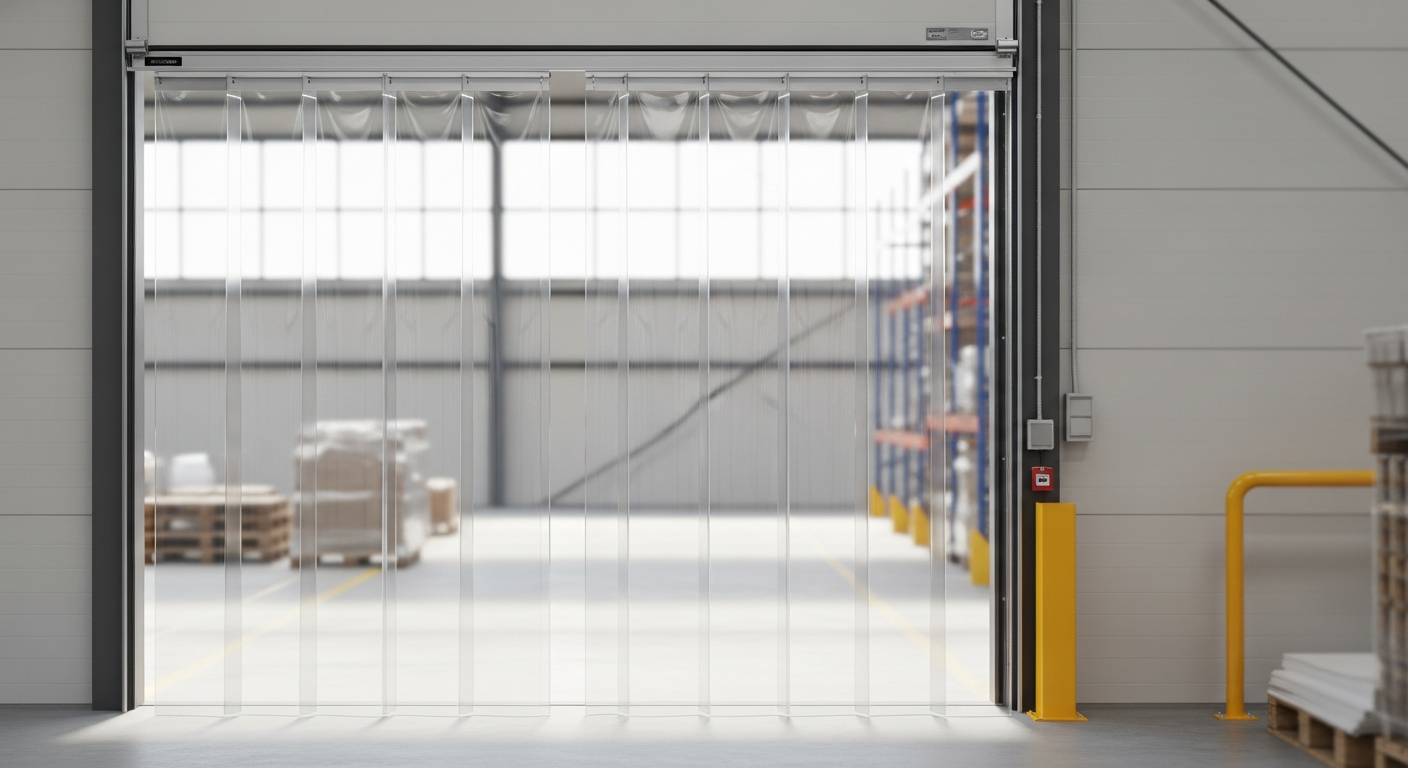
Transparenter PVC Streifenvorhang nach Maß senkt Energiekosten, erhöht Arbeitssicherheit und trennt Betriebsbereiche effizient. Konfigurierbar ab 25,90 €.
Approximately 30% of energy losses in industrial facilities stem from uncontrolled air currents flowing through open passages and gates. Every day, thousands of companies face the same challenge: maintaining climate control while keeping operations fluid. The transparent PVC strip curtain made to measure represents a proven solution that combines transparency with robustness and delivers substantial cost savings.
This solution addresses a fundamental operational problem. When doorways and loading gates stand open, heated or cooled air escapes freely. Equipment works harder. Energy bills climb. Workers encounter uncomfortable drafts and temperature fluctuations. Yet blocking these passages entirely creates new problems—restricted visibility, slower material handling, and operational bottlenecks.
The transparent PVC strip curtain bridges this gap. By understanding how these systems work, which material variants suit specific environments, and how to select the right configuration for your facility size, you gain control over your operational efficiency. This article examines the energy savings potential, the safety advantages of maintained sightlines, the technical specifications that matter, installation processes, and the cost-effectiveness that makes these systems attractive to facilities managers and operations directors.
Discover transparent PVC strip curtains made to measure for your facility
Energieeinsparungen durch intelligente Bereichstrennung – Das Geschäftsargument
The financial case for area separation starts with energy consumption patterns. Open doorways in climate-controlled spaces create continuous thermal losses. Cold air from refrigerated zones mixes with ambient air. Warm conditioned air escapes from heated facilities. This constant exchange forces HVAC systems into overdrive, consuming disproportionate energy to maintain target temperatures.
Quantifiable reductions emerge quickly when PVC strip curtains are installed. The curtains minimize heat transfer while allowing operational flow. Personnel, palettes, and forklifts pass through with minimal resistance, yet the overlapping strips redirect airflow patterns and reduce convective losses significantly. Studies in industrial settings show energy cost reductions ranging from 15% to 30% depending on facility configuration, climate zone, and operational intensity.
Zugluft (draft penetration) creates secondary costs beyond heating and cooling. It affects worker comfort, potentially reducing productivity. Humidity control becomes easier when air exchange is managed. In food storage, warehousing, and manufacturing environments, controlling moisture levels prevents product degradation and extends shelf life. The PVC curtain system handles all three factors simultaneously—temperature, draft, and humidity.
Comparing open doorways to curtain-equipped passages reveals stark differences. An unguarded 2-meter opening in a freezer facility can allow cubic meters of warm air infiltration per minute during peak traffic periods. The same opening with PVC strips experiences perhaps 10-15% of that air exchange. When multiplied across an operational day and across the heating season, the accumulated energy savings translate directly to reduced utility expenses month after month.
Quantifiable Reduktion von Heiz- und Kühlkosten durch Minimierung von Kälte- und Wärmeverlusten
Energy audits in facilities using PVC strip curtains consistently document lower consumption. The mechanism is straightforward: the strips create a thermal buffer. Air molecules moving through the overlapping lamellae encounter resistance and directional separation. Heat transfer slows. Stratification improves. HVAC systems maintain set points with reduced cycling frequency.
Financial projections become concrete when facility managers calculate payback periods. A facility spending €5,000 monthly on climate control might recover a €1,500 curtain investment within 3-4 months through documented energy savings alone. Larger installations with multiple openings see proportionally greater returns.
Wie Zugluft und Feuchtigkeitskontrolle die Betriebseffizienz verbessern
Draft elimination improves worker perception of facility climate. Comfortable employees demonstrate better focus and productivity. In warehouse and logistics environments, reduced drafts mean more consistent environmental conditions around stored goods. For pharmaceutical storage, electronics manufacturing, or food processing, humidity control becomes achievable where it previously required expensive additional systems.
Transparenz und Sicherheit – Warum die Sichtbarkeit entscheidend ist
A PVC strip curtain remains transparent despite its thermal protection function. This transparency represents a critical safety feature often overlooked in facility decisions. When workers cannot see through a barrier, accident risk increases substantially. Forklifts cannot judge spacing or clearance. Pedestrians cannot anticipate approaching equipment. Near-miss incidents multiply.
The clear sightline maintained by PVC strips eliminates these hazards. Workers on both sides of the passage retain visual contact with approaching traffic. A forklift operator can see if the opposite side of the doorway is clear before advancing. A pedestrian can observe equipment movement and adjust their path accordingly. This mutual visibility prevents collisions and creates what safety professionals call "situational awareness across the barrier."
Klare Sichtlinie für Gabelstapler-, Paletten- und Personenverkehr
Material handling equipment in modern facilities operates at speed. Efficiency demands quick passage through doorways. When visibility deteriorates, operators slow down or use mirrors and communication systems to compensate. These workarounds cost time. PVC strip curtains eliminate the need for workarounds by maintaining crystal-clear sightlines despite their thermal function.
Pallet jacks, forklifts, and hand trucks pass through strip curtains continuously without obstruction. Operators maintain full visibility of their path and the space beyond. Loading docks with PVC-equipped doorways experience faster throughput than equivalent facilities using opaque barriers, because no visibility-related delays occur.
Arbeitssicherheit in frequentierten Bereichen – Unfallprävention durch visuelle Kontrolle
High-traffic areas present elevated risk. Thermal doors or solid barriers create "blind zones" where collisions become probable. PVC strip curtains eliminate these zones. Insurance companies recognize this safety advantage. Some facilities report reduced accident rates and corresponding insurance premium decreases after installing transparent barriers.
The visual control extends to environmental observation. A supervisor can monitor activity in adjacent zones without removing barriers. Security personnel can survey multiple areas. Equipment condition becomes visible—a leaking pipe, a fallen object, or an unsafe condition in the adjacent zone can be spotted immediately rather than discovered during the next scheduled passage.
Beidseitige Übersicht ohne Hindernisse oder tote Winkel
The design principle ensures no dead zones where hazards hide. Unlike sliding doors that create restricted viewing angles, or folding gates with obscured sections, PVC strips maintain constant visibility. Even the strips themselves—typically 200mm to 400mm wide—remain transparent. A person looking through several overlapping strips sees the other side with minimal distortion.
Materialvarianten und technische Spezifikationen – Die richtige Wahl treffen
Selecting appropriate materials for specific applications determines system longevity and performance. Standard PVC performs excellently in temperate and moderately cold environments. Polar PVC becomes necessary where extreme cold dominates. Understanding specifications prevents costly mistakes.
Standard-PVC: Breiten (200mm, 300mm, 400mm) und Stärken (2mm, 3mm, 4mm, 5mm) im Überblick
Standard soft-PVC strip curtains come in multiple widths and thicknesses. Width selection depends on passage frequency and required thermal protection. Narrower strips (200mm) facilitate more frequent personnel passage and offer clearer vision but provide less thermal resistance per strip. Wider strips (400mm) create stronger thermal barriers and slow traffic slightly due to increased overlap resistance.
Thickness selection reflects durability requirements. Thinner materials (2mm) cost less and remain flexible for frequent high-traffic passages. Medium thicknesses (3-4mm) balance cost and durability for standard industrial use. Thicker materials (5mm) withstand harsh conditions—frequent equipment contact, abrasive traffic, chemical exposure—and last significantly longer despite higher initial cost.
Standard-PVC maintains flexibility and clarity at typical facility temperatures. It resists UV exposure with proper stabilization, making it suitable for semi-outdoor loading areas and covered exterior passages. The material is food-grade compliant where relevant, meeting hygiene standards in food processing and pharmaceutical environments.
Polar PVC für Extremkälte: Bruchfestigkeit bis -50°C und extreme Weichheit
Extreme cold environments—frozen food storage, ice production facilities, cryogenic applications—demand specialized materials. Standard PVC becomes brittle at low temperatures, potentially cracking under vibration or normal operational stress. Polar PVC maintains pliability and bruchfestigkeit (break resistance) down to -50°C.
This specialized material achieves extreme cold performance through molecular composition modifications. The resin formulation includes plasticizers and additives that prevent molecular stiffening at low temperatures. Polar PVC strips remain soft and flexible even when ambient temperature drops far below the freezing point.
Cost implications exist—Polar PVC commands a premium over standard material. However, in deepfreezer applications, the premium cost proves economical because standard material would require replacement every few months while Polar PVC provides years of reliable service. Facilities operating freezer zones calculate total cost of ownership and find Polar PVC delivers superior value despite higher per-unit expense.
UV-Stabilisierung und Witterungsbeständigkeit für Außenbereiche und intensive Sonneneinstrahlung
Outdoor applications and areas receiving direct sunlight expose PVC to UV radiation. Unprotected materials degrade over time, becoming brittle and yellowed. UV stabilization prevents this degradation through chemical additives that absorb UV energy and dissipate it safely without damaging the polymer structure.
Facilities with loading areas under covered roofs but exposed to significant indirect sunlight benefit from UV-stabilized material. Outdoor passages—even partially protected ones—require UV protection. The stabilization extends material life from 2-3 years (unprotected in heavy sun exposure) to 5-7+ years (properly stabilized), justifying the modest cost premium for any outdoor or high-light-exposure application.
Weather resistance encompasses more than UV protection. Stabilized materials resist thermal cycling—the repeated expansion and contraction from temperature fluctuations—better than standard formulations. Rain and moisture exposure present minimal concern since PVC naturally resists water absorption, but UV-stabilized variants maintain their properties longer in wet climates with seasonal temperature swings.
Get your customized transparent PVC strip curtain configured for your specific environment
Montagesysteme und Installation – Von der Planung zur Fertigstellung
Installation methodology determines whether a PVC strip curtain system performs as designed. Professional-grade systems use the "Fix & Fertig" (fixed and ready) approach—straightforward installation requiring minimal specialized equipment and expertise.
Fix & Fertig-System: Einfaches Einhängesystem mit Aufhängeschienen aus Edelstahl oder verzinktem Stahl
The hanging rail serves as the foundation. Stainless steel offers superior corrosion resistance suitable for wet environments, food processing facilities, and areas exposed to cleaning chemicals. Galvanized steel provides cost-effective durability for standard indoor industrial applications. Rail selection reflects both expected lifespan and operating environment.
The strips themselves slot into the rail system or attach via pre-mounted brackets. Individual lamellae hang vertically from the rail, overlapping slightly. This overlap percentage determines thermal and light-blocking performance—typically 50-70% overlap provides optimal balance between thermal protection and ease of passage.
The system allows individual strips to be raised, rotated, or completely removed without affecting remaining strips. This modularity enables equipment passage (tall machinery, for example, can pass through with strips folded to the sides) and facilitates maintenance or cleaning of passage areas.
Schnelle und unkomplizierte Montage ohne Spezialwerkzeuge
Installation requires basic hand tools—measuring tape, level, basic fasteners, and a drill for mounting the rail. No welding, special lifting equipment, or certified technicians are required. A two-person team can install a typical doorway system in 1-2 hours. This simplicity contrasts sharply with alternatives like sliding doors or folding barriers, which often demand specialized installation.
The straightforward process means minimal facility downtime. Operations continue with temporary barriers while installation proceeds. Once the rail mounts and brackets are in place, hanging the strips takes minutes. The facility begins realizing energy benefits immediately after installation completion.
Individuelle Maßanfertigung: Passgenaue Anpassung an Ihre Öffnungsmaße
Standard sizes accommodate common doorway dimensions, but every facility has unique requirements. Custom manufacturing ensures the system fits precisely. Width customization addresses variable door widths. Height customization accounts for floor-to-soffit clearance. Stripe thickness selection matches application needs.
The measuring process is straightforward: width of opening, height of opening, and desired configuration options. Manufacturers provide templates and guidance for accurate measurement. Once specifications are provided, production typically completes within 5-10 business days, and installation follows immediately upon delivery.
Precise fit delivers multiple advantages. No gaps exist where air can leak around edges. Overlapping coverage patterns maximize thermal efficiency. The system integrates seamlessly with existing architectural elements without requiring modification or compromise.
Kosteneffizienz und Preisgestaltung – Budget-freundliche Lösungen
Cost analysis must encompass initial investment, operational savings, and maintenance expenses. The financial case for PVC strip curtains becomes compelling when all three factors are evaluated.
Einstiegspreise ab 25,90 € (exkl. MwSt.) für konfigurierbare Systeme
Entry-level pricing makes these systems accessible to facilities of all sizes. A small operation with a single modest doorway can implement complete thermal control for under €50 including installation hardware. Larger facilities with multiple openings or specialized requirements invest more, but the per-opening cost remains economical.
Pricing scales with material thickness, width, height, and special features. Standard materials cost less than Polar PVC. Narrower strips cost less than wider widths. Shorter passages cost less than floor-to-ceiling installations. This modular pricing allows budget-conscious operations to start with their highest-priority openings and expand systematically as cash flow permits.
Wirtschaftlichkeit im Vergleich zu Alternativen (Schiebetüren, feste Wände, andere Trennungssysteme)
Alternative systems present trade-offs. Sliding doors provide complete separation but require precision installation, regular maintenance, and frequent replacement of worn components. Cost ranges from €200-€2,000+ depending on specification. Folding gates deliver flexibility but create sightline restrictions. Air curtain systems operate continuously, consuming electricity, yet provide no physical barrier.
Fixed walls eliminate passage entirely, requiring architectural modifications and defeating the purpose of maintaining operational flow. The comparison reveals why PVC strip curtains dominate facilities seeking thermal control without sacrificing accessibility.
Gesamtkostenbetrachtung: Anschaffung + Energieeinsparungen + Wartungskosten
A €500 installation might generate €200-300 in monthly energy savings depending on facility size and climate. Payback occurs within 2-4 months. Maintenance costs minimal—occasional cleaning of strips and periodic inspection of mounting hardware represent the primary upkeep requirements. When strips show wear after years of service, individual lamellae can be replaced affordably rather than replacing the entire system.
Multi-year cost projections show dramatic ROI. A €1,000 installation saving €250 monthly generates €3,000 in annual savings. Over a 5-year lifespan (which is conservative—many systems exceed 10 years), the cumulative savings reach €15,000 against a €1,000 investment. When the facility replaces a worn system or adds additional openings, the investment again pays dividends through energy efficiency.
Praktische Umsetzung: Dein nächster Schritt zu effizienterem Betrieb
A transparent PVC strip curtain made to measure transcends simple partitioning—it represents an investment in operational excellence. The convergence of affordable acquisition costs beginning at €25.90, impressive energy savings potential, uncomplicated installation, and minimal maintenance transforms these systems into the preferred solution for facilities serious about controlling operational expenses while maintaining safety and workflow.
The pathway forward begins with assessment. Examine your current facility layout and identify openings where thermal loss, draft, or humidity control presents challenges. Document your monthly energy expenses—this baseline measurement will clarify the savings potential. Consider traffic patterns and safety requirements. Assess which openings generate the greatest thermal stress on HVAC systems.
Next, engage with experienced providers. Request unbiased consultation and cost calculations tailored to your specific facility dimensions and requirements. Professional advisors understand which material variants suit your climate zone and operational intensity. They help optimize stripe width and thickness for your traffic patterns. They ensure rail mounting integrates properly with your facility architecture.
The timeline from initial consultation to operational installation typically spans 2-3 weeks. Once installed, the system begins delivering measurable benefits immediately. Energy consumption drops. Worker comfort improves. Safety metrics improve. Operational flow remains unimpeded.
Request your custom PVC strip curtain quote and start reducing operational costs today