
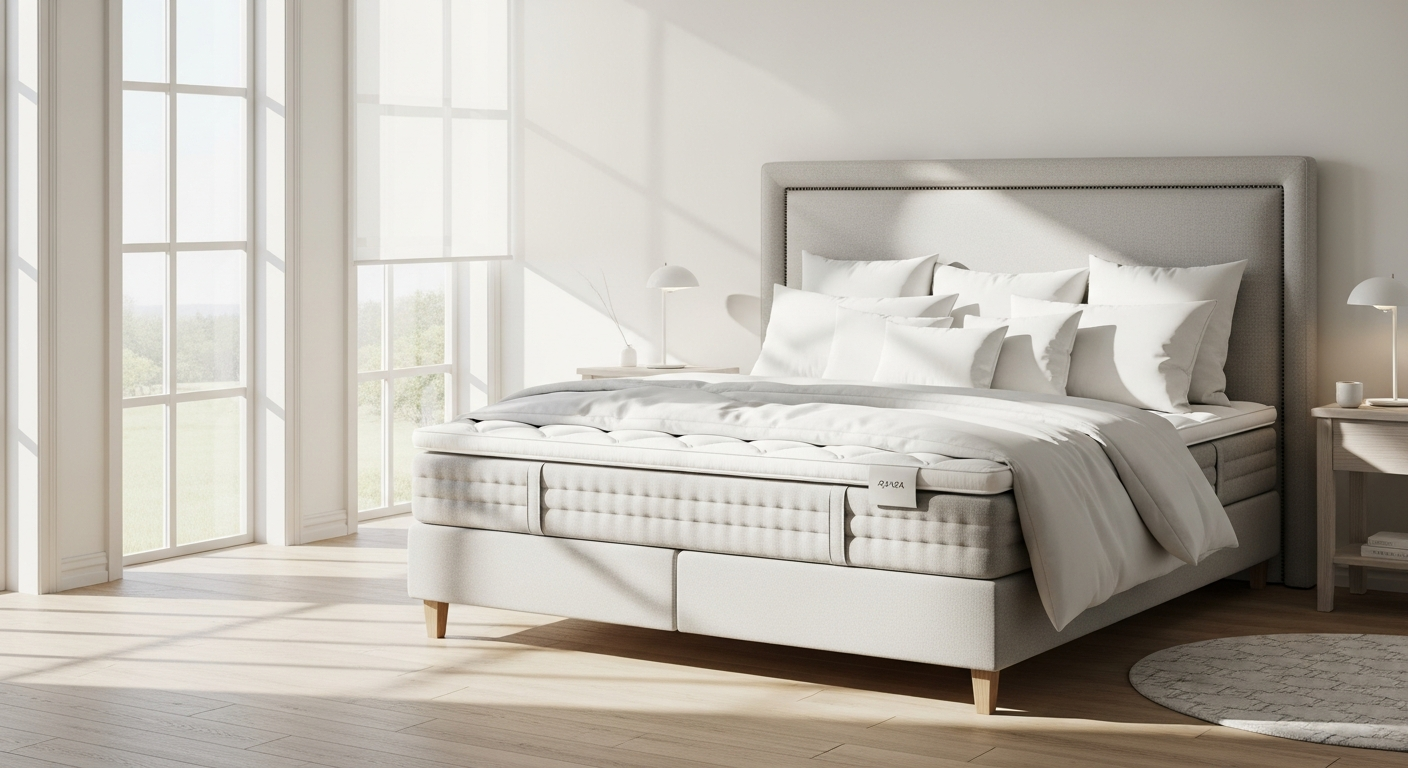
Discover why the Prime Bed No. 1 Natural Continental Bed is Sweden’s top-rated luxury sleep system. Explore handcrafted construction, natural materials, and premium comfort for couples. 4.7/5 stars.
Roughly 40% of couples report sleep disruption from a partner's movement—yet most never consider the actual bed as the solution. You lie awake listening to tossing and turning, wondering if separate rooms are inevitable, when the real culprit might be hiding beneath you. The Prime Bed No. 1 Natural Continental Bed tackles this exact problem with Swedish precision, engineering your sleep environment rather than accepting poor rest as normal.
Primebeds.se has built a reputation across Scandinavia for handcrafted sleep solutions that refuse to compromise on natural materials or durability. Their flagship continental bed combines luxury-grade construction with sustainable practices, delivering what customers consistently describe as transformative sleep. The company doesn't cut corners—every layer, every spring, every piece of wood serves a purpose in creating a sleep system rather than just a mattress placed on a frame.
What Makes a Continental Bed Different From Standard Mattress Beds
Definition and structural differences between continental and traditional bed systems
A continental bed represents an entirely different approach to sleep architecture than the standard mattress-on-frame setup most people know. Rather than separating the mattress as an independent component, continental beds integrate the sleeping surface as part of a unified system. The base includes its own spring layer—typically pocket springs—that works in concert with the top mattress layer, creating synchronized support rather than isolated cushioning.
This dual-spring architecture means the Prime Bed No. 1 distributes your weight across two responsive layers instead of one. Your body experiences support from both directions, creating a more sophisticated pressure distribution system than traditional beds can achieve.
Why continental beds feature a higher overall profile and elevated design aesthetic
Continental beds sit noticeably higher than standard beds—an elevation that serves both practical and aesthetic purposes. The increased height comes from the integrated base construction, which houses substantial spring systems and wooden frame structures beneath the visible mattress layer. This elevation reduces strain on your lower back and knees when sitting on the edge, making the bed more ergonomic during entry and exit.
Visually, the continental bed's height commands a bedroom. It becomes a focal point rather than a sleeping surface you barely notice. Primebeds.se deliberately leverages this design principle, understanding that people invest in continental beds not just for sleep quality but for the refined aesthetic they bring to a space.
How the base construction creates superior support compared to single-mattress alternatives
The Prime Bed No. 1's base isn't merely structural—it's engineered to respond. Pocket springs within the base layer work independently, adapting to weight distribution just as the top mattress layer does. This means when your partner shifts, the base absorbs some of that movement before it transfers to the sleeping surface where you rest your head. A standard bed with only a single mattress layer has no such buffer.
Solid wood frames, sourced from sustainable forestry, provide the skeleton that keeps these spring systems stable across decades of use. The wood doesn't compress or warp as particle board does, maintaining the precise engineering integrity that makes movement isolation possible year after year.
The European origin of continental bed design and its evolution into luxury sleep solutions
Continental beds originated in Europe as a response to the need for long-lasting, high-performance sleep systems in homes where furniture represented lasting investments rather than disposable purchases. Scandinavian and Central European manufacturers perfected the design, embedding spring systems into bases that could withstand generations of nightly use.
Over time, this practical design evolved into a luxury category. Today, continental beds occupy the premium end of the sleep market, where quality, durability, and material sourcing separate aspirational products from everyday alternatives. Primebeds.se represents this evolution—they didn't invent the continental bed concept, but they've refined it through handcrafted processes that extract maximum performance from naturally responsive materials.
Swedish Craftsmanship Meets Natural Materials: Inside the Prime Bed No. 1 Construction
Primebeds.se's handcrafted manufacturing process and quality control standards
Handcrafted doesn't mean primitive or slow—it means intentional. Primebeds.se employs skilled craftspeople who understand how materials interact, how tension in springs affects responsiveness, and how layer sequencing impacts the final sleep experience. Each Prime Bed No. 1 undergoes quality control checkpoints that mass-manufactured beds simply cannot accommodate.
This approach means the Prime Bed No. 1 doesn't vary significantly from unit to unit the way industrially produced beds do. You're not receiving a product assembled in a factory by rotating shift workers; you're receiving a bed that reflects the accumulated expertise of Swedish craftspeople who specialize in this single category.
Natural material composition: wool, cotton, and horsehair layers explained
Wool forms the foundation of the Prime Bed No. 1's responsive surface. It naturally regulates temperature, wicking moisture away during humid nights and providing insulation when rooms cool. Unlike synthetic materials that compress over time, wool fibers maintain their structure, meaning the bed feels consistent in year five as it did in year one.
Cotton layers provide breathability and a soft interface between you and the deeper support layers. Cotton doesn't off-gas or deteriorate rapidly; it ages gracefully, becoming softer and more conforming while maintaining structural integrity. The textile industry has worked with cotton for centuries because it simply works.
Horsehair delivers a unique property: it's naturally springy and resilient. Rather than compressing flat under pressure, horsehair fibers resist compression and return to their original form. This makes it an ideal material for the transitional layer between your body-responsive comfort layers and the structural spring system beneath. Horsehair doesn't contain the chemicals found in many synthetic alternatives, making it ideal for people with sensitivities.
Sustainable solid wood sourcing for the frame and base structure
Primebeds.se sources wood from sustainable forestry operations that replant as they harvest. This commitment means the Prime Bed No. 1's solid wood frame represents a genuine environmental choice, not greenwashing. Solid wood, whether it's pine or other species, maintains structural integrity across decades where particle board deteriorates after years.
The wood also affects how the entire system performs. Solid wood frames transmit vibration differently than composite materials; they dampen motion rather than amplify it. When your partner shifts, the solid wood base absorbs and dissipates that movement, preventing it from reaching your side of the sleep surface.
Multi-layer spring system design and how it distributes weight across the sleep surface
The Prime Bed No. 1 doesn't rely on a single spring layer to handle all support responsibilities. Instead, multiple layers work together—each tuned to a specific function. The base layer springs are engineered for fundamental support, handling the bulk of your body weight and ensuring the bed doesn't sag over time. The top mattress layer springs are tuned for responsiveness and comfort, adapting moment-to-moment to pressure changes as you move through sleep positions.
This layering approach means the bed responds differently depending on how pressure is applied. When you're lying still in deep sleep, the springs provide stable support without excessive firmness. When you shift positions, the springs respond quickly, adapting to new weight distribution without the sluggish feeling of foam-based systems.
Movement Isolation Technology: Why Couples Sleep Better Together
The science behind motion transfer and partner sleep disruption
Every movement on a bed creates vibrations that travel through the structure. Your partner rolls over at 3 AM, and waves of motion ripple across the sleeping surface toward you. These aren't violent shocks—they're subtle disturbances, but sufficient to interrupt light sleep or prevent deeper sleep stages from occurring. Over months and years, accumulated sleep disruption manifests as chronic fatigue, irritability, and reduced cognitive function.
Traditional spring mattresses transmit motion efficiently because springs throughout the system are physically connected. When one section moves, the entire spring network responds. Foam beds initially seemed to solve this problem, but foam layers compress and release energy in ways that can actually amplify certain frequencies of motion transfer.
How the Prime Bed No. 1's material composition minimizes movement across the bed
The Prime Bed No. 1 addresses motion transfer through material selection rather than just engineering. Wool fibers don't move as freely as foam; they shift and compress locally without transmitting vibrations across the entire layer. Cotton provides a similar damping effect. Horsehair, despite its springiness, resists motion propagation because individual fibers resist collective movement.
When these materials layer atop pocket spring systems, the combined effect becomes significant. A movement on your partner's side compresses the pocket springs in that specific zone. The natural material layers absorb the energy from that compression rather than transferring it to adjacent sections. You experience a substantially dampened version of your partner's movement—often imperceptible during sleep.
Pocket spring isolation versus traditional spring systems
Pocket springs represent a fundamental design evolution in mattress engineering. Rather than having springs connected to each other in a grid (like traditional innerspring systems), pocket springs sit individually within fabric pockets. When one spring compresses, its neighbors remain unaffected. This independence is crucial for motion isolation.
The Prime Bed No. 1 employs pocket springs in both its base layer and top mattress layer. This dual-pocket-spring architecture means movement is isolated twice—first by the top mattress springs, then by the base layer springs. By the time vibration reaches the other side of the bed, it's been dampened by two separate isolation systems.
Real-world benefits for light sleepers paired with restless partners
Couples describe the practical difference this makes using concrete language. One partner no longer wakes at 2 AM when the other shifts position. Light sleepers report sleeping through the night rather than awakening multiple times. The restless partner, paradoxically, often sleeps better too—not disturbed by the guilt or worry about waking their sleeping companion.
Over weeks and months, this compounds. People report feeling more rested despite getting the same total hours of sleep. Their alertness during the day improves. They experience better mood regulation. These aren't subtle psychological effects; they reflect genuine improvements in sleep quality and uninterrupted sleep cycles.
Comfort and Support: Spinal Alignment and Pressure Point Relief
Multi-layer spring system benefits for ergonomic support
Your spine maintains a natural curve whether you're standing or lying down. A bed that forces your spine into alignment different from its neutral position creates strain across muscles and ligaments. The Prime Bed No. 1's multi-layer spring system provides support that adapts to your spine's natural shape rather than imposing a predetermined curve.
Different body areas have different support requirements. Your lower back needs firmer support to prevent sagging; your neck needs gentler support to avoid compression. A single-layer spring system treats the entire body identically. The Prime Bed No. 1's layered approach allows different zones to provide appropriate support levels, creating ergonomic alignment across your entire body.
How natural materials adapt to individual body contours
Wool and cotton fibers compress gradually under pressure, conforming to your body shape rather than maintaining uniformity. This adaptability means pressure distributes across larger surface areas rather than concentrating on specific points. Your shoulder doesn't press into a mattress surface the way it would with less responsive materials; instead, the surface gradually deforms to support your shoulder's contours.
This adaptive quality prevents the "pressure point" sensation many people experience with firmer sleep surfaces. You're supported thoroughly without feeling pressure concentration that leads to numbness or discomfort.
Pressure relief zones and their impact on circulation during sleep
Pressure reduces blood flow. When you lie on a firm surface that concentrates pressure on specific points—your shoulders, hips, heels—circulation diminishes in those areas. Over hours of sleep, this reduced circulation affects recovery and tissue repair, leaving you feeling stiff rather than restored.
The Prime Bed No. 1's natural materials distribute pressure across wider zones, maintaining more consistent circulation throughout the night. Your body receives oxygen and nutrient delivery across all pressure-bearing areas, allowing cellular repair and recovery to proceed more effectively.
Spinal alignment advantages of continental bed height and structure
The elevated structure of a continental bed positions your spine more favorably than standard beds. The additional height means less dramatic neck flexion when your head rests on the pillow. The integrated base layer prevents the sagging that occurs when mattress components aren't unified—your spine maintains consistent support rather than experiencing the shifting support that develops in standard beds as components settle differentially.
These structural advantages accumulate across your sleep career. Years on a properly supporting bed result in better spinal health than years on a mattress that allows excessive movement and misalignment.
Sustainability and Eco-Conscious Sleep: Natural Materials Matter
Primebeds.se's commitment to sustainable forestry for wood components
Primebeds.se partners with forestry operations that adhere to sustainable harvesting practices. For every tree harvested, new trees are replanted on a schedule that ensures forest regeneration. This approach means the wood in your Prime Bed No. 1 comes from a renewable resource managed responsibly rather than from old-growth forests or unsustainably managed timber operations.
The company publishes information about its sourcing practices, recognizing that environmentally conscious customers want verification rather than vague claims. This transparency allows you to make purchasing decisions aligned with your environmental values.
Natural material benefits versus synthetic alternatives
Synthetic materials offer manufacturing convenience—they're produced in controlled environments, standardized easily, and remain stable across production runs. But convenience comes at an environmental cost. Petroleum-derived synthetics require extraction, refinement, and chemical processing. They off-gas volatile organic compounds into your bedroom air. At end-of-life, they resist decomposition, persisting in landfills for decades.
Natural materials present a different profile. Wool, cotton, and horsehair all originate from renewable sources. They don't off-gas problematic chemicals. Your sleep environment benefits from the absence of chemical off-gassing—especially significant when you spend roughly one-third of your life in your bedroom.
Biodegradability and environmental impact of wool, cotton, and horsehair
When the Prime Bed No. 1 eventually reaches end-of-life, its natural materials biodegrade. Wool returns to the soil within years. Cotton fibers decompose readily. Horsehair breaks down without leaving persistent residues. The solid wood frame can be reclaimed for other uses or allowed to decompose naturally.
Compare this to a bed constructed with polyurethane foam, synthetic batting, and particle board. Those components persist in the environment for generations. The Prime Bed No. 1's natural material composition means your purchase doesn't create a permanent environmental burden.
Certifications and standards for natural material sourcing
Primebeds.se sources materials from suppliers meeting recognized standards for sustainable and ethical production. This commitment extends beyond environmental impact to include labor practices and production conditions. When you invest in the Prime Bed No. 1, you're supporting supply chains that maintain reasonable standards for workers and environmental stewardship.
Customer Satisfaction: Why the Prime Bed No. 1 Earns 4.70 Out of 5 Stars
Breakdown of customer ratings and what drives high satisfaction scores
The Prime Bed No. 1's 4.70-star rating reflects genuine customer satisfaction across multiple dimensions. Customers rate comfort highly, noting that the bed provides support without excessive firmness. Movement isolation receives consistent praise—the specific dimension that motivated many couples to make the investment. Durability ratings indicate that the bed maintains its performance characteristics year after year.
High satisfaction scores typically emerge when a product delivers on its promises. The Prime Bed No. 1 promises movement isolation, natural material comfort, and long-term durability—and customer feedback confirms it delivers across all three categories.
Common praise points from verified purchasers
Customers frequently mention waking more rested despite not actually sleeping additional hours. They describe noticing differences within the first week—a period too brief for psychological adjustment, suggesting the improvements reflect genuine physiological changes. Partners report no longer waking when the other moves, eliminating the chronic sleep disruption that previously affected their relationship.
Durability comes up repeatedly in longer-term reviews. Owners with the Prime Bed No. 1 for multiple years report the bed maintaining its comfort and support, with no sagging or deterioration of the natural materials. This consistency validates the quality inherent in the handcrafted construction.
Real-world sleep improvement stories from couples and individual sleepers
A couple married twenty years, previously considering separate bedrooms due to incompatible sleep schedules, reports that the Prime Bed No. 1 eliminated the need. The restless partner can move freely without disturbing the light sleeper; both wake more rested. Their relationship benefits not just from better sleep but from reclaimed intimacy that had suffered under chronic fatigue.
Individual sleepers report similar benefits. A woman previously averaging four hours of interrupted sleep due to partner disruption now averages seven uninterrupted hours. Her daytime alertness improved measurably. Her mood stabilized. These aren't subtle improvements—they represent restoration of basic sleep function.
Durability reports from long-term owners
Owners reporting on the Prime Bed No. 1 after five, ten, and fifteen years consistently describe maintained performance. The bed doesn't develop the sagging spots common in standard beds. The springs maintain responsiveness. The natural materials haven't deteriorated or compressed excessively. These durability reports validate the handcrafted construction and material quality.
The Prime Bed No. 1 as Your Sleep Investment: Final Verdict
Swedish craftsmanship meets genuine innovation in the Prime Bed No. 1 Natural Continental Bed—and the 4.70-star rating tells a compelling story about real customer satisfaction. This isn't simply a bed; it's a carefully engineered sleep system designed around the science of movement isolation, natural material responsiveness, and long-term durability. For couples struggling with partner disturbance, light sleepers seeking undisturbed rest, or anyone willing to prioritize sleep quality as a health investment, the engineering here delivers measurable results.
The price tag—roughly 90,000 SEK—demands serious consideration. Yet when you factor in the 15-year warranty, the sustainable materials, the handcrafted Swedish construction, and the documented improvements in sleep quality, the per-year cost becomes considerably more reasonable. This bed rewards commitment and is built to last decades, not years.