
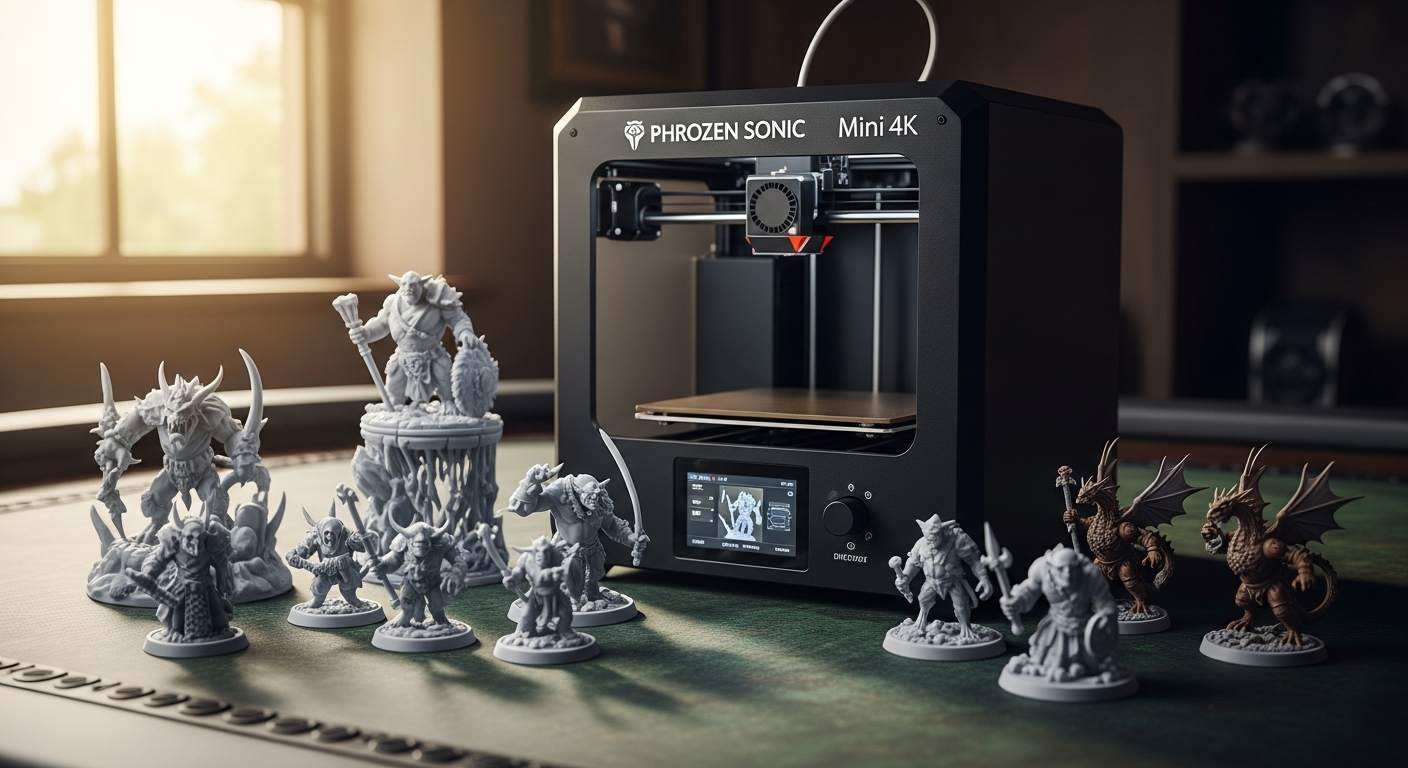
Discover how the Phrozen Sonic Mini 4K delivers ultra-detailed tabletop miniatures at an unbeatable price. Learn why this budget 4K resin printer is revolutionizing gaming model production.
Tabletop gaming enthusiasts spend thousands perfecting their craft—but most never achieve the jaw-dropping detail their custom miniatures deserve. The gap between imagination and execution has haunted creators for years, leaving them stuck choosing between expensive commercial options or settling for mediocre quality.
The resin 3D printing revolution has exploded over the past few years, yet affordable options that deliver true 4K resolution remain rare. Most budget printers sacrifice detail for price, forcing serious hobbyists to choose between their wallets and their vision. That changed when Phrozen introduced a game-changer that flipped the entire value proposition on its head.
The Phrozen Sonic Mini 4K combines cutting-edge 4K technology with a price tag that won't drain your hobby budget, making intricate miniature creation accessible to tabletop creators at every skill level. Explore the Phrozen Sonic Mini 4K today to transform your gaming miniatures into professional-quality pieces.
Why Tabletop Gamers Are Choosing the Phrozen Sonic Mini 4K
The shift from commercial miniatures to custom-printed gaming pieces
The tabletop gaming community has undergone a quiet revolution. For decades, gamers purchased pre-made miniatures from manufacturers, accepting whatever designs and paint schemes came in the box. Today's creators refuse that limitation. Custom 3D-printed miniatures allow players to represent their characters exactly as imagined—not as some manufacturer decided they should look.
This shift isn't about rebellion. It's about ownership. When you print your own miniatures, you control every detail: proportions, facial features, equipment, and pose. A player's D&D character becomes a true extension of their imagination rather than a compromise with available stock.
How 4K resolution elevates miniature detail and visual appeal
Resolution matters more for miniatures than casual observers realize. A standard resin printer might deliver decent results at arm's length, but the moment you inspect a painted miniature up close—which competitive gamers and serious hobbyists do constantly—inferior detail becomes obvious.
4K resolution changes everything. At 3840 x 2160 pixels on a 6.1-inch screen, the Sonic Mini 4K achieves 722 pixels per inch. This density allows printers to capture hair strands, facial expressions, fabric texture, and fine weaponry details that lesser machines simply cannot reproduce. The difference between a 1080p and 4K printed miniature becomes apparent the instant paint touches the model.
Cost comparison: custom printing versus traditional purchasing models
Consider the economics. A single premium commercial miniature costs $15–$30 depending on complexity. A full Warhammer army requires dozens of figures—easily $300–$500 before paint. Professional printing services charge $3–$10 per miniature plus shipping, plus you're waiting weeks for production queues.
The Sonic Mini 4K costs $300–$430 upfront. Resin runs approximately $30–$50 per liter, yielding hundreds of miniatures per bottle. A single army of 50 miniatures costs roughly $5–$15 in materials. The printer pays for itself within the first month for serious creators.
The role of precision in competitive gaming aesthetics
Competitive gaming communities—particularly Warhammer 40K and Age of Sigmar—treat miniature quality as part of their competitive identity. Paint jobs matter, basing matters, and yes, the underlying miniature quality matters. A beautifully painted figure printed on an inferior printer simply doesn't compete with one produced on quality equipment.
The 35-micron XY resolution and 10-micron Z resolution of the Sonic Mini 4K ensure that every layer transitions smoothly, creating surfaces that accept paint flawlessly. Sharp details mean sharper shadows, crisper highlights, and ultimately more impressive finished pieces on the gaming table.
Community adoption among Warhammer, D&D, and custom gaming communities
The Sonic Mini 4K has become genuinely ubiquitous in gaming communities. Walk into a tabletop gaming forum, browse Reddit's 3D printing communities, or check Discord servers dedicated to miniature painting—the Sonic Mini 4K appears constantly. This isn't accidental. It's the result of affordability meeting capability in a way previous budget printers never achieved.
Warhammer communities have embraced it for custom army builds. D&D groups use it to create unique NPCs and creatures. Independent game designers print prototypes for testing. The printer has become the standard reference point for the question: "What budget 4K printer should I buy?"
Technical Specifications That Matter for Miniature Production
4K resolution (3840 x 2160) and what it means for miniature detail
4K resolution refers to the pixel count driving the monochrome LCD screen that cures resin. More pixels mean finer control over which areas cure and which remain liquid. For miniatures, this translates directly to reproducible fine details. Facial features, armor embossments, jewelry, and weapons all benefit from the precision 4K offers.
Think of it as the difference between drawing with a pencil and drawing with a mechanical pencil. Both work, but one provides noticeably sharper results. The Sonic Mini 4K's 3840 x 2160 pixel array ensures designs translate from digital files to physical prints with minimal compromise.
35µm XY resolution: achieving hair-thin details and facial features
XY resolution measures the smallest feature the printer can reproduce across the printing plane. At 35 micrometers, the Sonic Mini 4K can print details thinner than a human hair. Eyebrows, eyelashes, fabric weaving, and delicate chain mail all remain distinct and recognizable.
For gaming miniatures, this matters profoundly. A barbarian's beard becomes a textured surface rather than a smooth blob. A knight's armor gains individual plate definition. These details might seem minor until you're holding the printed miniature and noticing the craftsmanship in every feature.
10µm Z resolution for smooth layering and surface quality
Z resolution controls layer height during printing. Smaller Z resolution means thinner layers, resulting in smoother surfaces and more gradual transitions between features. The Sonic Mini 4K's 10-micron Z resolution produces surfaces so smooth that primer application becomes nearly effortless.
Inferior Z resolution leaves visible stepping—microscopic ridges from layer transitions. These ridges catch paint differently, creating visual artifacts. The Sonic Mini 4K's precision eliminates this problem, delivering miniatures that feel and paint like professionally manufactured pieces.
722 PPI pixel density explained for gaming miniature applications
Pixels per inch (PPI) combines resolution with screen size to determine practical detail capability. At 722 PPI on a 6.1-inch screen, every pixel remains incredibly small relative to the overall build area. This prevents the "pixelation" effect that appears on printers with lower PPI values.
For gaming miniatures typically ranging 25–50mm in height, the PPI density ensures that even the smallest features render crisply. A 28mm fantasy warrior comes out looking like a 28mm fantasy warrior should—detailed, proportionate, and print-ready for painting.
Design and Build Quality for Creative Workflows
Compact 25 x 25 x 33 cm footprint: workspace integration for home studios
The Sonic Mini 4K fits comfortably on a desk, shelf, or dedicated printing station without consuming workspace. At approximately 25 × 25 × 33 centimeters, it occupies less space than many desktop organizers. This compact design makes it accessible for apartment dwellers, students, and hobbyists without dedicated studios.
Workspace limitations shouldn't prevent creative work. The printer's footprint respects real-world constraints while maintaining the build volume necessary for meaningful miniature production. It's a thoughtful engineering decision that recognizes how modern creators actually work.
5 kg lightweight design for portability and storage flexibility
Five kilograms sounds minimal until you're moving it. The lightweight construction means the printer can migrate between locations—from home studio to gaming events to friend's houses for collaborative sessions. It stores easily in closets when not in use, freeing permanent desk space.
This portability opens possibilities larger printers eliminate. Gaming clubs can share a single unit among members. Traveling creators can bring their printing capabilities to conventions. The lightweight design transforms the printer from stationary equipment into a flexible tool.
Phrozen OS interface and 2.8-inch touch panel usability
The 2.8-inch touchscreen running Phrozen OS provides straightforward control without requiring computer connectivity during printing. Navigate jobs, adjust settings, and monitor progress directly from the printer. The interface prioritizes clarity over flashiness—experienced users appreciate the functional design.
The learning curve is gentle. Newcomers pick up basic operation within minutes. More advanced users discover nuanced settings for optimizing specific resin types or challenging geometries. The balance between simplicity and capability makes the printer accessible while offering depth for serious makers.
USB connectivity for seamless file transfers and slicing
USB connectivity keeps the workflow streamlined. Transfer sliced files directly to the printer, monitor progress remotely if desired, and troubleshoot issues without constant physical access. Modern maker workflows demand this integration, and the Sonic Mini 4K delivers without complications.
The compatibility with ChiTuBox and Lychee slicing software means you're not locked into proprietary tools. The broader 3D printing ecosystem supports you, not the other way around.
Resin Compatibility and Material Selection for Gaming Models
Phrozen Aqua-Gray 4K resin: recommended specifications and performance
Phrozen Aqua-Gray 4K resin pairs optimally with the Sonic Mini 4K, offering balanced cure times, excellent surface quality, and reliable detail reproduction. This isn't accidental—Phrozen engineered the resin for their printer's specific light source and layer curing speed.
Aqua-Gray delivers a neutral base color accepting all paint schemes equally. The formula provides reasonable flexibility without excessive stickiness, making support removal manageable even for beginners. It's the safe default choice that consistently produces satisfying results.
Third-party resin flexibility and ecosystem options
You're not locked into Phrozen resins. The printer's 405nm ParaLED Matrix 2.0 light source works with most standard UV resins from other manufacturers. This flexibility matters—it prevents vendor lock-in and allows you to experiment with specialized formulations.
The broader resin market offers options Phrozen doesn't manufacture directly. As your skill grows, you might try different materials exploring specific capabilities without changing hardware.
Resin types for different gaming applications (flexible, translucent, metallic)
Gaming applications benefit from resin variety. Flexible resins enable printing armor joints and appendages that survive handling. Translucent resins create gemstones, magical effects, and translucent armor panes. Metallic resins produce convincing metal finishes without extensive painting.
A single printer with resin versatility eliminates the need for multiple machines. One session might print rigid fantasy warriors, the next flexible dragon wings, the next translucent magical orbs. This versatility justifies the investment across diverse gaming projects.
Color options and post-processing for gaming aesthetics
Resins come in numerous base colors—blacks, grays, greens, blues, reds, and specialty formulations. These base colors accelerate painting workflows. A black resin warrior requires less base coating before detail work. A translucent blue resin becomes a magical effect with minimal additional painting.
Post-processing techniques enhance these advantages further. Priming, base coating, and dry brushing all interact with resin color in ways that experienced painters exploit strategically. The Sonic Mini 4K produces prints that accept these techniques beautifully.
From Digital Design to Tabletop Reality: The Complete Workflow
Sourcing and preparing 3D models for gaming miniatures
Quality digital models determine print quality. Repositories like MyMiniFactory, Thingiverse, and Cults3D offer thousands of gaming miniatures ranging from historical accuracy to fantasy imagination. Paid sites offer professional-grade designs rivaling commercial manufacturers.
Model preparation requires attention. Cleaning up geometry, scaling for proper tabletop proportions (typically 28–35mm), and confirming printability prevents wasted resin. Most models download ready to print, but understanding orientation, support needs, and potential problem areas separates successful prints from failures.
ChiTuBox and Lychee slicer software compatibility and features
Slicing software transforms 3D models into printer-readable instructions. ChiTuBox and Lychee both excel at this task, offering different approaches that appeal to different working styles. ChiTuBox emphasizes reliability and comprehensive settings. Lychee prioritizes intuitive interfaces and preview clarity.
Both software options are free for basic use with paid tiers offering advanced features. Neither requires subscription for meaningful work. This keeps total investment modest while providing professional-grade tools.
Optimal support structure design for miniature printing
Supports prevent models from detaching during printing while minimizing post-processing. Support design affects print success more than most beginners realize. Strategic placement uses less material, accelerates cure times, and leaves smaller removal marks.
Modern slicing software generates supports automatically, but manual optimization often improves results. Learning support design is a valuable skill that improves with practice. The Sonic Mini 4K's speed makes experimentation fast and economical.
Orientation strategies to maximize detail and minimize waste
Model orientation affects detail reproduction and material efficiency. Placing large faces horizontally maximizes LCD contact and detail clarity. Angling models reduces support requirements and waste. These decisions compound across a print library, resulting in measurable savings.
Experience teaches intuitive orientation sense. What initially requires conscious thought eventually becomes automatic. The printer's speed means you can iterate quickly, learning from results without significant penalty.
Real-World Applications Beyond Standard Gaming
Custom hero miniatures and character representation
Every gaming group contains players attached to specific characters. The Sonic Mini 4K enables printing exact character representations—exact equipment, exact proportions, exact aesthetic. This personalization deepens player investment and table immersion.
Commission artists to customize existing models, sculpt entirely new pieces, or modify commercial designs. The printing freedom enables character expression previously impossible without professional sculptors or commercial manufacturers understanding niche requirements.
Terrain and dungeon piece creation for immersive gameplay
Gaming sessions benefit from physical terrain. The Sonic Mini 4K prints dungeon tiles, buildings, natural features, and environmental props. A modular terrain system constructed from printed pieces transforms tabletop presentation from flat maps to three-dimensional immersion.
Designers create free and commercial terrain systems optimized for printing. Mix and match pieces across multiple campaigns. The initial investment in terrain printing pays dividends across years of gaming sessions.
Collectible miniature production for gaming communities
Some gaming communities develop passionate followings around specific franchises or custom game systems. Independent creators print miniatures for these communities, establishing cottage industries around niche gaming. The Sonic Mini 4K makes this economically feasible—low per-unit costs enable sustainable business models.
What starts as a hobby can develop into supplementary income for skilled creators. The printer's capability justifies this entrepreneurial path for those with artistic ability and marketing inclination.
Replacement parts and custom accessories for existing game systems
Expensive game systems sometimes lose pieces or require specific accessories. Printing replacements costs pennies compared to replacement sets. Creating custom dice towers, token holders, card holders, and organizational solutions personalizes gaming spaces.
This practical application often attracts pragmatic players initially skeptical of 3D printing. When they see a custom dice tower perfectly fitting their gaming setup, the technology's utility becomes undeniable.
Honest Assessment—Strengths and Limitations
Exceptional affordability ($300–$430 price range) with beginner-friendly setup
The price point remains genuinely remarkable. Entry-level equipment typically compromises capabilities substantially. The Sonic Mini 4K genuinely delivers professional-grade results despite the budget pricing. This affordability removes the primary barrier preventing hobby creators from entering resin printing.
Setup requires minimal technical knowledge. Unbox, follow calibration instructions, install software, and begin printing within hours. The learning curve is manageable, particularly for users with any 3D printing experience.
Consistent, high-quality output for detailed models and fast curing times
Owner experiences consistently report reliable printing and excellent detail reproduction. The monochrome LCD technology enables rapid curing—each layer cures in as little as two seconds, achieving printing speeds up to 80mm per hour. This speed translates to modest print jobs finishing overnight.
The consistency matters more than single-instance capability. Printers that occasionally produce masterpieces aren't useful—reliable performers that consistently deliver results are worth the investment. The Sonic Mini 4K earns its reputation through reliable performance.
Build volume constraints for larger gaming pieces and bed leveling calibration
The 13.2 × 7.4 × 13.0 centimeter build volume accommodates most gaming miniatures but struggles with large terrain pieces or oversized creatures. Projects exceeding these dimensions require splitting and assembly, adding complexity.
Bed leveling—ensuring the build platform sits at precisely the right distance from the LCD screen—requires attention. The process isn't difficult but demands patience, particularly initially. Many users report this as the steepest learning curve.
VAT design and potential resin splatter management considerations
The vat (resin container) design occasionally allows resin to splatter during printing, particularly with aggressive support structures or rapid movement. This doesn't prevent successful printing but requires careful workspace setup and newspaper protection.
Some users report the printer being noisier than its predecessor due to additional cooling fans. For bedroom studios, this warrants consideration. For dedicated workshop spaces, it's a minor inconvenience.
Investment Breakdown—Is It Worth It for Gaming Creators?
Initial purchase cost versus long-term printing value and resin expenses
Initial investment of $300–$430 seems substantial until calculated against usage. Monthly resin costs run $30–$100 depending on printing volume. Compared to commercial miniature purchases or professional printing services, this investment recovers remarkably quickly.
For active gaming groups, the printer typically pays for itself within weeks. The economics improve with every print—each miniature costs pennies in material versus dollars through traditional channels.
Cost-per-miniature calculations and maintenance replacement part costs
Individual miniatures cost approximately $0.10–$0.30 in resin and electricity. Professional printing services charge $3–$10 per piece minimum. The per-unit savings accumulate dramatically across large armies.
Maintenance costs remain modest. Replacement FEP (fluoropolymer film in the vat) sheets run $20–$30 and last hundreds of prints. The LCD screen theoretically lasts thousands of hours. Plan for periodic expenditures, but nothing catastrophic.
Comparison with professional printing services and ROI potential
Professional printing services remove printing responsibility but add per-unit costs and shipping delays. For one-off miniatures, outsourcing makes sense. For enthusiasts printing dozens or hundreds of pieces annually, owning equipment becomes obviously advantageous.
Calculate your own printing volume honestly. If you'll realistically print fewer than 100 miniatures annually, professional services might prove more economical. Beyond that threshold, the Sonic Mini 4K dominates the value proposition.
Resale value, equipment longevity, and hidden costs to consider
Resin printers generally retain value well. A well-maintained Sonic Mini 4K should resell for 50–70% of the purchase price if circumstances change. This provides downside protection absent from consumable purchases.
Equipment longevity expectations reach three to five years with routine maintenance. The LCD screen represents the primary wear component, but replacement costs remain reasonable. No hidden costs surprise users—what you purchase includes everything needed to begin printing.
Bringing Your Gaming Vision to Life: Making the Decision
The Phrozen Sonic Mini 4K isn't just another resin printer—it's a gateway to creating gaming miniatures that rival professional productions. Its 4K resolution, lightning-fast printing speeds, and budget-friendly price point converge to solve a real problem for tabletop creators: the gap between imagination and execution.
Your custom armies, unique characters, and personalized gaming experiences become attainable rather than aspirational. The financial barrier that once separated enthusiasts from equipment operators crumbles. The Sonic Mini 4K democratizes miniature creation in the same way digital sculpting democratized game design.
Whether you're painting custom D&D characters, building intricate Warhammer armies, or designing terrain for your next campaign, the Sonic Mini 4K delivers the precision your vision demands. The investment pays dividends quickly—a single custom army potentially costing hundreds through commercial services while the printer pays for itself within weeks for serious creators.
Your next masterpiece awaits. The technology is proven, the community is supportive, and the economics work in your favor. Discover how the Phrozen Sonic Mini 4K can revolutionize your tabletop gaming experience by visiting their website today.