
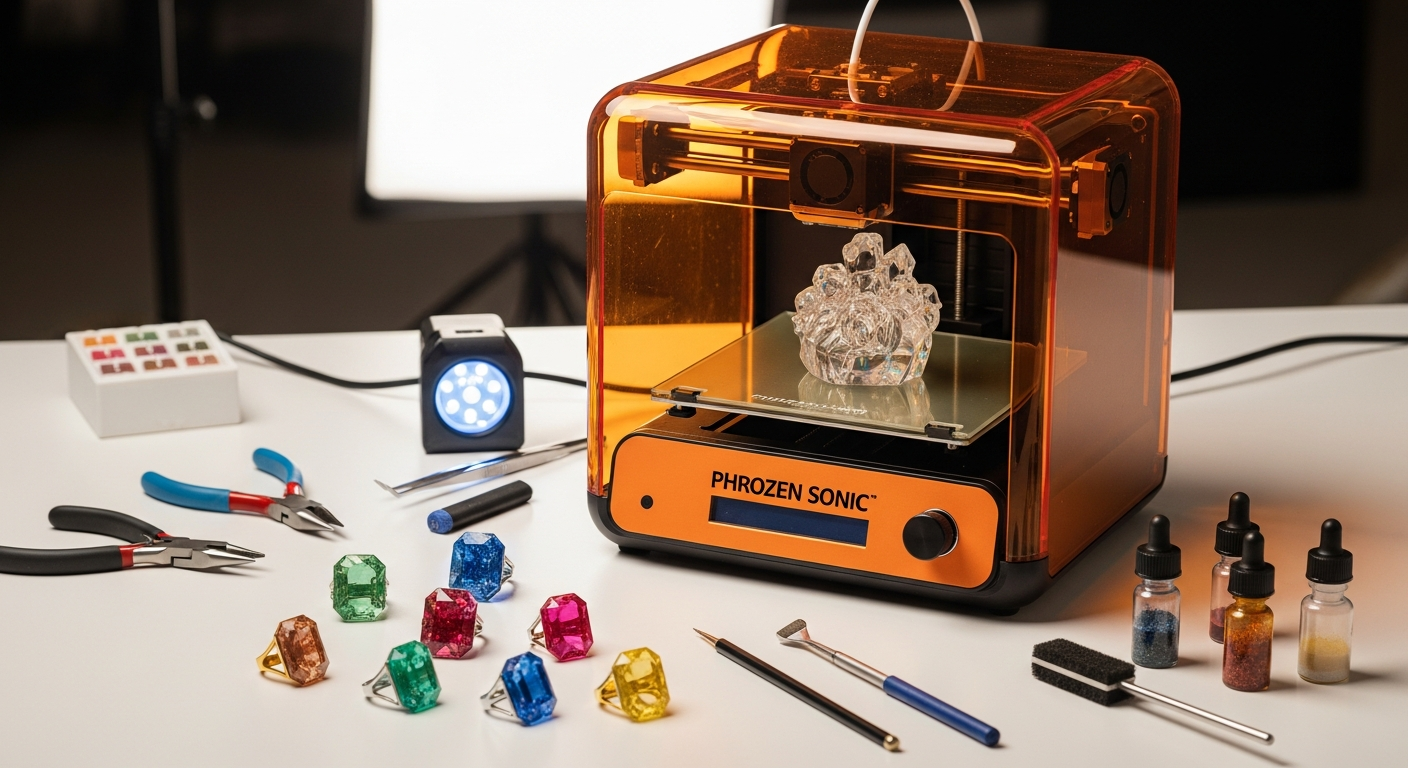
Discover how the Phrozen Sonic Mini 4K delivers studio-quality detail for jewelry makers and miniature creators. Learn specifications, real-world applications, and setup tips for professional results at an unbeatable price.
The Precision Revolution in Your Creative Space
Over 50,000 jewelry artisans and miniature hobbyists have switched to resin 3D printing in the last two years—and the Phrozen Sonic Mini 4K is leading that revolution. The shift isn't just about speed; it's about democratizing precision craftsmanship. The Phrozen Sonic Mini 4K stands apart because it combines professional-grade 4K resolution with a price tag that won't drain your creative budget. This isn't a compromise printer—it's a purpose-built machine for makers who demand micro-level accuracy without the six-figure investment.
With its monochrome LCD screen and ParaLED Matrix 2.0 light engine, this printer punches well above its weight class. The technical foundation alone justifies the investment: 3840 x 2160 pixel resolution across a 6.1-inch printing area translates to 35-micron XY precision—fine enough to capture delicate filigree work, intricate chain links, and surface textures that would be invisible to the naked eye on lesser machines. The 2-second layer cure times mean you're not watching paint dry; you're iterating designs and producing multiple pieces in a single workday.
Explore the Phrozen Sonic Mini 4K and transform your creative practice today.
Why Jewelry Makers & Miniature Creators Are Choosing the Sonic Mini 4K
Precision at the micro-level
The 35-micron XY resolution captures fine filigree, delicate chain links, and intricate surface textures without visible layer lines. This level of detail isn't theoretical—it's the difference between jewelry that looks handmade and jewelry that looks engineered. Miniature creators report that details they thought impossible to reproduce now emerge from the resin with crystalline clarity. The ParaLED Matrix 2.0 light engine ensures uniform UV distribution across the entire build plate, eliminating dark spots and inconsistent curing that plague cheaper alternatives.
Speed advantage for small-batch production
At 2-second layer cure times, the monochrome LCD delivers practical speed advantages that compound across a production workflow. A jewelry maker can design a ring in the morning, print three variations by lunch, and be post-processing by afternoon. This iteration speed is a competitive advantage that translates directly into faster product launches and the ability to respond to market trends without waiting weeks for manufacturing timelines.
Compact footprint for studio spaces
The 134 x 75 x 130 mm build volume fits seamlessly on desks, shelves, or shared maker spaces without requiring dedicated factory floor space. Whether you're working in a apartment studio, a shared maker space, or a professional jewelry workshop, the Sonic Mini 4K doesn't demand real estate. Its compact design means you can house multiple units without overwhelming your workspace—critical when scaling from hobbyist to small business.
Material compatibility flexibility
The printer works with standard 405nm UV-curing resins, including specialty jewelry resins, flexible resins for wearables, and castable resins for lost-wax casting. This flexibility means you're not locked into expensive proprietary materials. You can source from Phrozen, third-party manufacturers, or specialized suppliers depending on your specific project requirements.
Affordability for small business startups
At €200-€300, the price point allows makers to launch resin-based businesses without significant capital investment. Compare this to traditional jewelry equipment—a quality casting furnace, polishing equipment, and metalworking tools easily exceed €5,000. The Sonic Mini 4K removes the financial barrier that has historically prevented talented artisans from launching independent businesses.
Technical Specifications That Matter for Fine Detail Work
4K monochrome LCD display
The 3840 x 2160 pixel resolution over a 6.1-inch printing area ensures razor-sharp detail reproduction. Monochrome displays cure entire layers simultaneously, whereas older RGB displays cured pixel-by-pixel, resulting in slower speeds and heat generation. The monochrome advantage translates directly into faster prints and more consistent curing across complex geometries.
Z-axis precision
The 10-micron minimum layer height provides granular control over surface smoothness and dimensional accuracy. This precision means you can print extremely thin walls for delicate jewelry pieces while maintaining structural integrity. The ability to dial in exact layer heights allows you to balance quality and print time—a 25-micron layer height prints faster than 10 microns but still delivers exceptional detail.
ParaLED Matrix 2.0 light engine
This component delivers uniform UV light distribution across the entire build plate, eliminating dark spots and inconsistent curing. Uneven curing is the silent killer of resin printing—prints appear successful until you start post-processing and discover soft spots or incomplete sections. The ParaLED Matrix eliminates this variable.
Build platform dimensions
The 134 x 75 x 130 mm volume is ideal for jewelry pieces, tabletop miniatures, and collectible figurines. While smaller than some alternatives, this size is deliberately optimized for the projects that matter most to jewelry makers and miniature creators. A standard ring, pendant, or gaming miniature fits easily; you're not paying for build volume you don't need.
Resin compatibility
Support for most standard 405nm UV-curing formulations, including Phrozen's proprietary blends and third-party alternatives, means you have genuine choice in materials. This ecosystem approach prevents vendor lock-in and allows you to experiment with different formulations without equipment limitations.
Real-World Applications Beyond Standard Miniatures
Custom jewelry production
Create engagement rings, pendants, brooches, and earrings with details impossible to achieve through traditional methods. A jewelry designer can now prototype intricate designs digitally, print them in resin, refine the design iteratively, and then move to casting when the design is perfected. This workflow compresses months of traditional design-to-production time into weeks.
Lost-wax casting preparation
Print castable resin models that translate directly into metal jewelry through professional casting services. Castable resins burn out cleanly at low temperatures, leaving detailed molds that transfer your exact design into gold, silver, or bronze. This application has democratized fine jewelry production—independent designers now compete with established manufacturers using identical casting techniques.
Tabletop gaming collectibles
Produce custom D&D miniatures, board game pieces, and gaming terrain with museum-quality detail. The hobbyist gaming market has erupted since resin printing became accessible. Custom painted miniatures now rival professional studio work, and the detail reproduction makes the difference between acceptable and exceptional gaming pieces.
Dental and medical models
Generate precise anatomical models for educational purposes and professional consultation. Dental labs use resin printing to create surgical guides and implant models. Medical schools use custom anatomical prints for training. The 35-micron resolution captures detail that matters in these applications.
Artisan product prototyping
Test product designs for home goods, fashion accessories, and decorative items before mass production. The ability to iterate physical prototypes quickly transforms the design process from theoretical to empirical. You can hold your design in your hand, test its function, and refine it before committing to expensive tooling.
Getting Started: Setup, Calibration & Your First Print
Unboxing and assembly
The Sonic Mini 4K arrives as a complete unit requiring minimal assembly. You'll need to verify build plate levelness—this is critical and takes 15 minutes. Most manufacturers include leveling guides; follow them precisely. A misaligned build plate is the primary cause of first-print failure, so invest time in this step.
Build plate preparation
Clean your build plate thoroughly with IPA (isopropyl alcohol) before every print session. A clean surface ensures proper adhesion; residual resin or dust causes prints to fail. Some users apply specialized primers or coatings to improve adhesion, but a properly cleaned bare plate works well for most applications.
Resin selection for beginners
Start with standard rigid resins designed for jewelry or miniatures. Phrozen's own standard resins are excellent starting points—they're optimized for the hardware and come with recommended exposure settings. Avoid specialty formulations until you've mastered basic printing. Material storage matters: keep resins in cool, dark locations, avoid direct sunlight, and seal containers tightly between sessions.
Slicing software workflow
CHITUBOX is the standard slicing software used with the Sonic Mini 4K. Import your 3D model, position it on the virtual build plate, generate supports (this is critical—insufficient supports cause failed prints), and adjust layer height. Most jewelry prints use 25-micron layers, a sweet spot between speed and detail. Preview the sliced model before printing to catch obvious errors.
First print settings
Start with the manufacturer's recommended exposure times for your chosen resin. These settings are empirically tested and provide a reliable baseline. For most standard resins on the Sonic Mini 4K, 2-second exposure per layer works well. You'll adjust these slightly based on your first results, but manufacturers' recommendations are excellent starting points.
Material Mastery: Choosing the Right Resin for Your Project
Standard resin characteristics
Rigid resins produce glossy finishes ideal for jewelry display pieces and collectible miniatures. These are the workhorses of resin printing—reliable, predictable, and available from multiple manufacturers. Standard resins typically cure hard overnight or with UV post-curing, achieving maximum hardness and stability.
Flexible resin applications
Wearable jewelry, phone accessories, and functional components requiring some flexibility benefit from flexible resin formulations. These materials maintain the 4K detail of rigid resins while offering elasticity that prevents brittleness. Flexible resins are critical for items that will experience repeated flexing or impact.
Castable resin for jewelry makers
Formulations designed to burn out cleanly for lost-wax casting into gold, silver, and bronze represent the intersection of resin printing and fine jewelry. These resins have specific viscosity and curing characteristics optimized for the casting process. If your intention is metal jewelry, castable resin is non-negotiable.
Specialty finishes
Translucent resins create gemstone effects; opaque pigmented resins deliver color straight from the printer; textured resins produce unique surface qualities impossible to achieve through post-processing alone. These materials expand creative possibilities but require experimentation and sometimes adjusted exposure settings.
Resin storage and shelf life
Proper container management and temperature control extend resin lifespan. Store resins away from direct sunlight, in cool environments (below 25°C is ideal), and in sealed containers. Over time, resins can degrade—you'll notice thickening, crystallization, or changes in curing behavior. When this happens, the material has degraded past usefulness.
Post-Processing Techniques That Elevate Your Finished Pieces
Cleaning protocols
IPA washing removes uncured resin without damaging fine details. Use a dedicated IPA container and multiple rinses—the first wash removes bulk uncured material, subsequent washes ensure complete cleanliness. For intricate pieces, ultrasonic cleaning equipment accelerates the process and reaches crevices that manual washing misses. Some makers use specialized rinse systems; others use simple containers with careful hand agitation.
Curing optimization
UV post-curing times depend on resin type and desired hardness. Most standard resins reach full hardness within 15-30 minutes of UV exposure. Over-curing can cause brittleness; under-curing results in tacky surfaces. UV chambers provide consistent, measurable curing; direct sunlight works but produces variable results depending on weather and angle.
Surface finishing
Sanding progressions—starting with 400-grit and progressing to 1000+ grit—create smooth surfaces and remove support marks. The final grit determines the finish: 400-600 produces matte finishes; 800-1200 produces semi-gloss; beyond 1200 produces high-gloss surfaces. Polishing compounds enhance the final appearance, particularly on jewelry pieces where surface quality matters.
Painting and staining
Acrylics, metallics, and specialty paints enhance miniature details and create realistic effects. The 35-micron detail of the Sonic Mini 4K makes hand-painting practical—you can create effects impossible on lower-resolution prints. Some makers seal paint with clear coats to protect against wear.
Assembly and setting
For jewelry, attaching findings (earring posts, ring blanks, chain attachment points) requires precision. Metal components and gemstones integrate into printed pieces through small mounting points designed during the modeling phase. This integration transforms printed components into finished jewelry.
Common Challenges & Practical Solutions for Consistent Results
Support marks and scarring
Support marks occur where supports contact the model. Prevention strategies include positioning supports at less visible locations and optimizing support thickness—thick supports leave obvious marks; thin supports may fail to hold. Post-processing techniques like careful sanding and, when appropriate, secondary coating can minimize visibility.
Failed prints and adhesion issues
Root causes include improper platform leveling, resin viscosity variations, and incorrect exposure settings. Diagnosing failures requires methodical analysis: if the entire first layer fails to adhere, leveling is the issue; if only sections fail, exposure may be insufficient; if the print partially fails partway through, resin contamination or viscosity issues are likely causes.
Incomplete curing in fine details
Intricate sections sometimes receive insufficient light, resulting in under-cured areas that feel tacky. This occurs when tall, narrow features block UV light from reaching lower sections. Solutions include adjusting exposure times, repositioning the model to improve light penetration, or using lower layer heights to reduce shadowing effects.
Resin yellowing and discoloration
UV exposure over time causes some resin formulations to yellow or discolor. This is primarily an issue with display pieces. Selecting UV-resistant formulations and storing finished pieces away from direct sunlight mitigates this issue. Some specialty resins are specifically formulated to resist yellowing.
Build plate damage and maintenance
The build plate is a consumable component that eventually requires replacement. Protective measures include using protective coatings, removing stuck resin carefully with plastic tools rather than metal, and cleaning regularly. Most plates last hundreds of prints before degradation affects print quality.
Comparing the Sonic Mini 4K to Other Resin Printers in Its Class
Budget resin printers
Entry-level alternatives typically use older LCD technology, resulting in slower print speeds and lower resolution. The Sonic Mini 4K outperforms these machines in both speed and detail reproduction while remaining in the affordable category. The difference becomes obvious within the first few prints.
Mid-range competitors
Other 4K printers exist at similar price points. What distinguishes the Sonic Mini 4K is the combination of monochrome speed, the ParaLED Matrix light engine, and Phrozen's established community and software ecosystem. Competitors may match individual specifications but rarely match the complete package at this price.
Larger format alternatives
Printers with bigger build volumes cost significantly more and print more slowly. If you regularly print pieces larger than 134mm, a larger printer becomes necessary. For jewelry makers and miniature creators, the Sonic Mini 4K's size matches the work perfectly—larger isn't better, it's just more expensive.
RGB vs. monochrome LCD debate
Monochrome displays cure entire layers instantly; RGB displays cure pixel-by-pixel. Monochrome speeds are 3-5x faster, generate less heat, and produce more consistent results. The speed advantage of monochrome is substantial and becomes more significant the longer your print time.
Brand ecosystem advantages
Phrozen's software ecosystem, community support through forums and social channels, and ongoing firmware improvements create long-term value. Established communities share techniques, troubleshooting advice, and design inspiration. This ecosystem support accelerates your learning curve and expands creative possibilities.
Building a Sustainable Resin Printing Business at Scale
Production workflow optimization
Batch printing strategies maximize equipment utilization. While one printer cures, you're preparing subsequent prints. Managing multiple prints simultaneously requires organization—tracking which models are at which production stage prevents mistakes. Daily output scales from tens to hundreds of pieces as you develop efficient workflows.
Quality assurance protocols
Implementing consistency checks ensures every piece meets your standards. Maintain documentation of print settings, material batches, and results—this data reveals patterns and prevents recurring failures. Customer confidence depends on consistent quality; one failed print damages reputation more than dozens of successful ones build it.
Pricing strategy
Calculating material costs (resin, electricity, equipment depreciation) and labor time creates rational pricing. Jewelry makers must understand their true cost per piece to price competitively without undervaluing their work. Many makers underprice resin-printed jewelry because they underestimate true costs; accurate accounting corrects this.
Scaling production
When a single printer reaches capacity, adding additional units becomes economical. Two printers running simultaneously doubles output without doubling labor requirements. Inventory management becomes critical at scale—managing material stock, finished goods, and work-in-progress prevents bottlenecks.
Customer communication
Managing expectations around lead times, explaining the resin printing process to customers unfamiliar with the technology, and handling custom requests professionally builds business reputation. Transparency about capabilities and limitations prevents disappointments.
The Future of Resin Printing & What's Next for Makers
Emerging resin formulations
High-temperature resins suitable for functional components, bio-based alternatives reducing environmental impact, and specialized materials entering the market continuously expand what's possible. The next five years will see resin formulations that currently don't exist solving problems that aren't yet solvable.
Hardware improvements on the horizon
Larger build volumes, faster cure times, and next-generation light engines are in development. The Sonic Mini 4K represents current peak performance; future generations will expand these capabilities while maintaining affordability. The trajectory suggests that what's premium today becomes standard tomorrow.
Software advancements
AI-assisted support generation reduces manual work and improves print success rates. Cloud-based slicing enables remote preparation; automation features handle repetitive tasks. Software improvements will make resin printing more accessible and less time-intensive.
Community-driven innovation
Maker communities continuously push resin printing boundaries and share techniques through social channels, forums, and workshops. This knowledge-sharing accelerates everyone's learning and reveals creative applications manufacturers never imagined.
Integration with other technologies
Combining resin printing with CNC finishing, laser engraving, and hybrid manufacturing approaches creates new possibilities. A piece can be resin-printed, then CNC-finished, then laser-engraved—seamless integration of technologies expands creative scope.
The Sonic Mini 4K: Your Creative Catalyst Awaits
The Phrozen Sonic Mini 4K isn't just another resin printer—it's a gateway to creating work that rivals professional studios, all from your own creative space. Makers report going from skeptical to obsessed within their first week, discovering that the barrier between imagination and finished product has collapsed. The combination of 4K resolution, monochrome speed, and accessible pricing creates a rare convergence that rarely happens in maker technology.
Whether you're launching a jewelry business, crafting intricate miniatures for passionate collectors, or exploring resin printing for the first time, this machine delivers. The 35-micron detail, 2-second layer times, and €200-€300 investment make it genuinely hard to justify choosing anything else in this category. You'll spend less time troubleshooting and more time creating—which is exactly where your energy should go.
Your next masterpiece is waiting. Start with a single test print, master the fundamentals covered here, and watch your creative practice transform. The Sonic Mini 4K removes the excuses and opens the possibilities. The only question left is: what will you create first?