
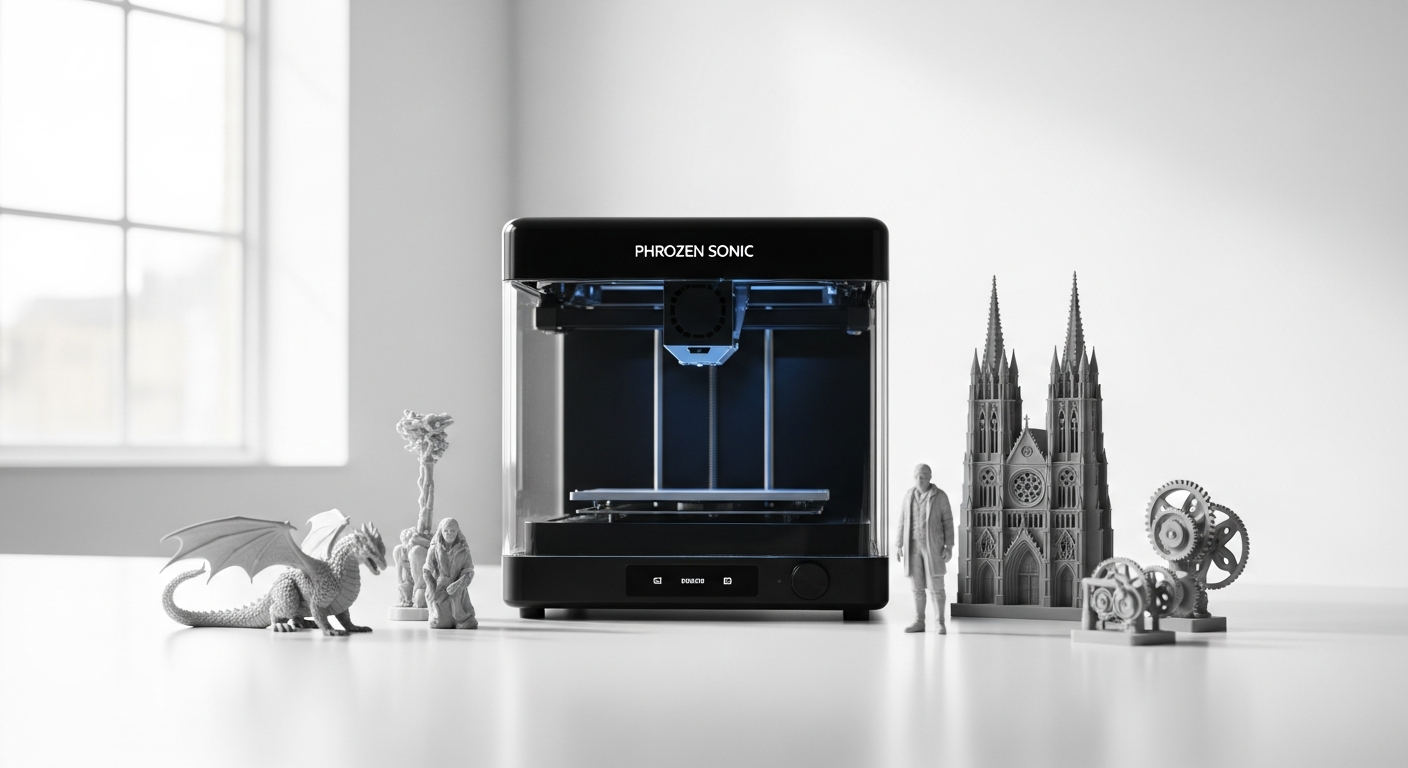
Discover how the Phrozen Sonic Mighty 8K resin 3D printer enables miniature creators to produce detailed gaming miniatures at scale. Learn specs, performance, and ROI for 2026.
The tabletop gaming and miniature collecting market is projected to exceed $5 billion globally by 2026—and creators who can produce high-quality, detailed models at scale are capturing a massive slice of that opportunity. The Phrozen Sonic Mighty 8K has quietly become the go-to machine for hobbyists-turned-entrepreneurs who refuse to compromise on print quality. At $899, it's an investment that pays dividends when you're shipping dozens of detailed models monthly.
This guide breaks down how the Sonic Mighty 8K specifically serves miniature producers and small-scale manufacturers, exploring its 8K resolution capabilities, batch-production workflows, and exactly what ROI looks like when running this machine commercially. You'll discover the technical advantages that separate this printer from competitors, learn production strategies from creators already profiting from their operations, and understand whether this investment makes financial sense for your specific situation.
Explore the Phrozen Sonic Mighty 8K and start your miniature production journey today.
Why Miniature Creators Are Switching to the Phrozen Sonic Mighty 8K
Batch production efficiency
The 218 x 123 mm build plate accommodates 10-20 gaming miniatures simultaneously, fundamentally changing how you approach order fulfillment. Rather than printing single figures one at a time, you're consolidating multiple client orders into strategic batches that maximize the print bed without compromising quality. This efficiency directly translates to faster turnaround times and the ability to accept larger orders without extending your delivery windows.
Detail precision for collectibles
The 28-micron resolution captures intricate features—facial expressions, armor details, weapon engravings, insignia—that collectors specifically pay premium prices to acquire. Miniatures printed on the Sonic Mighty 8K maintain sharpness and dimensional accuracy that FDM printers simply cannot match. This precision becomes your competitive advantage in a market where detail quality directly influences customer willingness to spend.
Speed advantage over competitors
At 70 mm/hour print speeds, overnight turnarounds become standard rather than exceptional. You submit an order in the evening, the printer runs through the night, and you're post-processing by morning. This capability to promise quick delivery without sacrificing quality is a genuine market differentiator, especially for commission-based miniature work where clients expect fast service.
Cost per unit reduction
Spreading machine amortization across larger batches fundamentally improves your per-unit economics. When you're printing 15 miniatures per cycle instead of one, the printer's operational cost per figure drops considerably. Over monthly production volumes, this cost reduction directly expands your profit margins or enables competitive pricing that attracts volume buyers.
Resin flexibility
Compatibility with specialty resins—tough formulations for gaming pieces, flexible variants for articulated figures, castable resins for metal casting—eliminates the constraint of a single material type. Different miniature projects demand different material properties, and having a printer that accepts multiple resin chemistries means you're not locked into a narrow application range.
Technical Specifications That Matter for Production Work
8K monochrome LCD technology
The 8K resolution translates directly to sharper edges and finer detail reproduction on 28mm-scale models. Monochrome LCD panels outperform color screens for precision printing because they deliver consistent light wavelengths across the build area, eliminating the chromatic distortion that sometimes appears with color LCD technology. Pixel density at 28 microns per pixel means even small details render with definition rather than stepping or pixelation.
Build plate dimensions
The 218 x 123 mm plate size creates a strategic printing canvas where you can nest 15-25 miniatures depending on their individual dimensions. Strategic arrangement—positioning figures to minimize wasted space while maintaining adequate spacing for resin flow—becomes a skill that directly impacts production efficiency. Larger plates reduce the number of print cycles needed to fulfill substantial orders.
Print speed mechanics
The 70 mm/hour capability significantly reduces print times for complex models while maintaining layer adhesion quality. Speed doesn't sacrifice precision because monochrome LCD technology cures each layer instantaneously without the motion precision requirements of slower mechanical systems. You're not trading detail for speed; you're gaining efficiency through superior technology.
XY resolution performance
28-micron precision translates to reproducible feature sizes on the sub-millimeter scale. Eyes render with depth, weapon details capture definition, insignia maintain legibility—all the micro-details that distinguish premium miniatures from basic prints. This XY resolution consistency across the entire build plate means figures printed in different positions on the bed maintain identical detail quality.
Thermal stability
Metal construction paired with dual linear rails ensures consistent movement during multi-hour print sessions. Temperature fluctuations can affect resin viscosity and cure rates, but the Sonic Mighty 8K's robust build maintains dimensional stability throughout extended production runs. This stability becomes critical when you're printing back-to-back batches and need predictable results across multiple cycles.
Connectivity features
Wi-Fi integration enables remote monitoring during overnight production runs. You can check print progress from your phone, receive alerts if something fails, and adjust parameters without being physically present. This remote capability transforms your workflow, allowing you to start a print, handle other tasks, and monitor progress asynchronously rather than babysitting the machine.
Real-World Batch Production Workflows
Optimal nesting strategies
Arranging 15-25 miniatures per print requires strategic placement that maximizes plate utilization without compromising quality. Spacing figures appropriately prevents resin pooling between models and ensures consistent cure times. Orientation matters too—angling figures to present their flattest surfaces downward reduces support material while maintaining structural integrity throughout the print cycle.
Resin selection for different miniature types
Tough resin formulations handle gaming pieces that experience handling stress, while standard resin works well for display-only collectibles. Flexible resins enable articulated figures with moving parts. Understanding resin properties and matching them to end-use requirements ensures your finished miniatures perform as clients expect, reducing returns and refund requests.
Post-processing timeline
After printing, your workflow includes washing (typically 5-10 minutes per batch in isopropyl alcohol or proprietary cleaners), curing (10-15 minutes under UV light), and finishing (support removal, sanding, painting). For 20+ units per batch, post-processing takes 1-2 hours depending on complexity. Establishing assembly-line efficiency in this stage prevents your printing capacity from becoming bottlenecked by manual finishing work.
Quality control checkpoints
Inspecting prints immediately after removal identifies failed pieces before they consume additional processing time. Checking dimensional accuracy, surface quality, and structural integrity at this stage means you catch problems while the batch is still consolidated. Early detection prevents wasted labor on pieces that won't meet customer specifications.
Multi-day production schedules
Running back-to-back prints across consecutive days requires tracking which batches correspond to which orders and maintaining consistency across multiple cycles. Documentation becomes critical—recording print settings, resin batch numbers, and cure times helps you replicate successful prints and troubleshoot failures systematically.
Inventory management
Tracking resin consumption per print cycle enables accurate cost accounting and prevents supply shortages. Understanding how many milliliters of resin each miniature consumes helps you predict when to reorder and factor material costs into pricing. Inventory management at scale separates profitable operations from those that underestimate production costs.
Start optimizing your production workflow with the Phrozen Sonic Mighty 8K today.
Profitability Metrics for Miniature Businesses
Equipment ROI timeline
At the $899 purchase price, breaking even depends directly on your miniature pricing and production volume. Selling figures at $25 per unit with a cost of goods sold around $3-5 per piece (resin, support material, electricity) yields roughly $17-22 profit per miniature. Printing 50-75 miniatures monthly reaches break-even within 6-12 months, making ROI achievable for serious operators within a year.
Labor cost reduction
The Sonic Mighty 8K's automation reduces hand-finishing time compared to traditional sculpting or outsourced production. When you're printing 15 units overnight and spending an hour on post-processing versus spending 10+ hours hand-sculpting the same quantity, you're liberating time for other business activities—marketing, client relations, design work. This labor arbitrage improves your hourly compensation substantially.
Scaling potential
A single Sonic Mighty 8K reaches practical capacity around 100-150 finished miniatures monthly, depending on complexity. Demand exceeding this volume justifies purchasing a second machine, effectively doubling your production capacity without proportional cost increases. Each additional machine represents an incremental investment with ROI calculated against expanding revenue rather than from zero.
Competitive pricing analysis
Commission-based miniature pricing ranges from $15-50+ per unit depending on complexity, painter reputation, and materials used. 3D-printed miniatures occupy the middle-to-premium range, often priced $20-35 per unit. Understanding where your production costs place you within this range helps you price competitively while maintaining healthy margins.
Hidden costs
Beyond the printer's purchase price, factor in resin disposal (environmental compliance required in many regions), replacement parts (print beds eventually wear), electricity consumption (roughly $10-20 monthly for continuous operation), and occasional maintenance. These hidden costs often total 10-15% of gross revenue and shouldn't be overlooked in profitability calculations.
Profit margin benchmarking
Creators running similar operations report gross margins of 60-75% after accounting for materials, overhead, and direct labor. Net margins after accounting for all hidden costs and business expenses typically stabilize around 40-50% for established operations. These benchmarks should inform your pricing strategy and production volume targets.
Setting Up Your Miniature Production Operation
Workspace requirements
Resin printing demands dedicated workspace with adequate ventilation—either a dedicated room with a fume extractor or proximity to open windows and cross-ventilation. Bench space for the printer itself, post-processing stations, curing areas, and finished product storage should total at least 50-75 square feet to operate comfortably. Safety equipment including gloves, eye protection, and respiratory masks becomes non-negotiable when handling uncured resin.
Initial investment breakdown
The Sonic Mighty 8K at $899 represents the largest single expense, but total startup costs include: resin ($50-100 per liter, and you'll need 2-3 liters initially), post-processing supplies ($100-200), curing equipment ($50-150), safety gear ($50-100), and tooling for support removal and finishing ($50-100). Total startup investment typically ranges $1,400-1,700, bringing break-even into focus within 2-3 months of production.
Software and slicing
Chitubox and Lychee are the primary slicing software options compatible with the Sonic Mighty 8K. Both offer free versions with learning curves ranging from 1-2 weeks for basic competency. Understanding support generation, layer thickness optimization, and print orientation directly impacts print success rates. Investing time in software mastery early prevents failed prints that waste materials and delay revenue generation.
Regulatory compliance
Many jurisdictions regulate resin disposal and require specific handling procedures. Research local environmental regulations regarding isopropyl alcohol disposal, uncured resin waste, and workplace chemical safety. Compliance prevents legal complications that could shut down operations and carries financial penalties. Insurance covering product liability and business operations becomes essential at commercial scale.
Scaling infrastructure
Planning for future growth includes designating space for multiple machines, establishing dedicated curing stations with organized inventory, and creating quality control areas. Scaling from one machine to three requires roughly double the workspace but doesn't require proportional increases in setup complexity. Infrastructure decisions made early prevent painful relocations or reorganizations later.
Supplier relationships
Building relationships with resin vendors enables negotiated pricing on bulk orders and priority access during supply shortages. Understanding your vendor's lead times helps prevent production stalls due to material unavailability. Secondary supplier relationships provide insurance against unexpected supply disruptions that could damage customer relationships.
Making the Investment Work: Your Miniature Production Future
The Phrozen Sonic Mighty 8K isn't just another resin printer—it's a production tool that transforms miniature creation from a time-intensive hobby into a scalable revenue stream. The 8K resolution delivers the sharp, intricate details that collectors and gamers demand, while the 218 x 123 mm build plate lets you batch-produce efficiently. The $899 price tag becomes laughably small when you're generating $1,000+ per month in miniature sales.
If you're serious about monetizing miniature creation—whether that's Warhammer armies, D&D figures, or custom collectibles—the Sonic Mighty 8K deserves a spot on your shortlist. Run the numbers against your current production volume, factor in material costs and your time, and honestly assess whether you're ready to move from outsourcing to in-house manufacturing. For creators who answer yes to that question, this printer becomes the foundation of something bigger.