
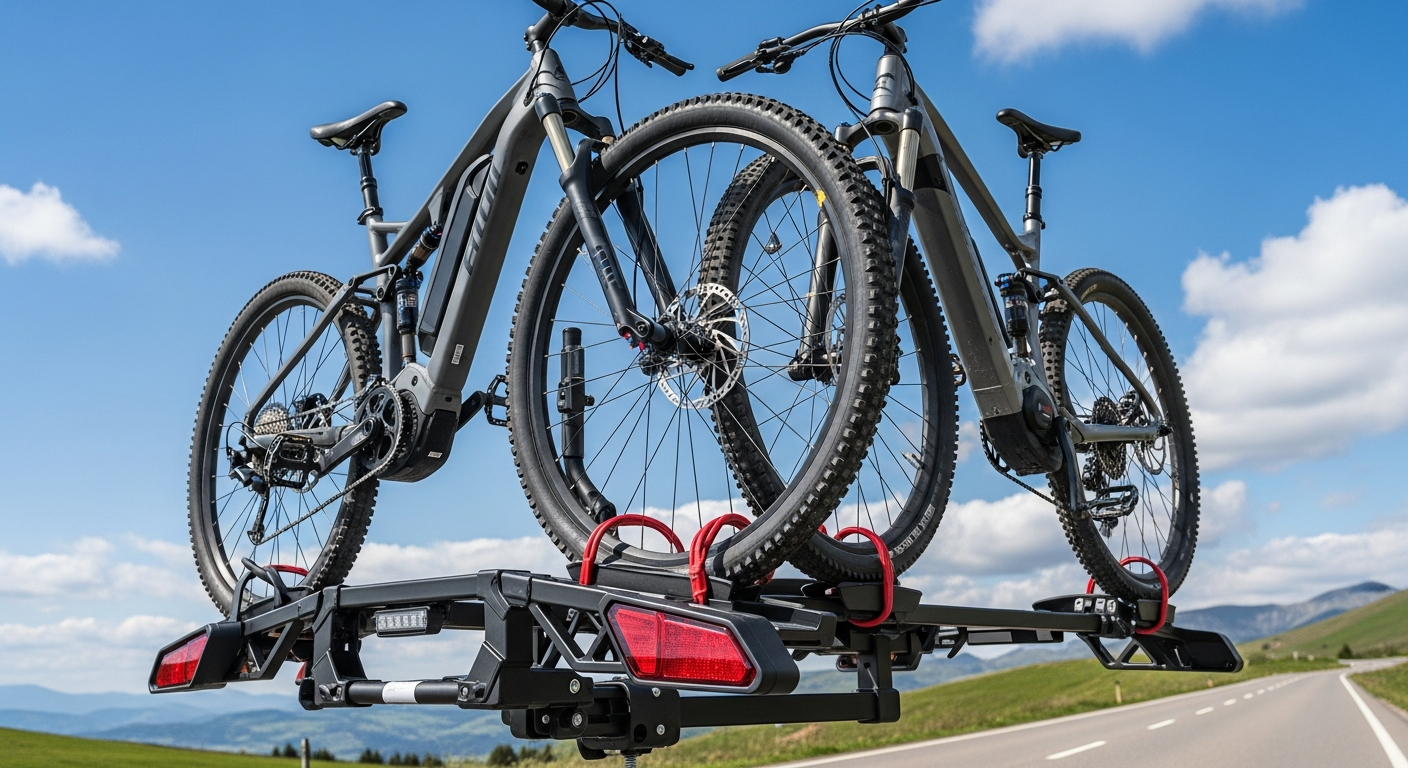
Discover how the OutfitR 2-Bike Hitch E-Bike Rack delivers 200-pound capacity with integrated ramp and tilt design. Read our complete guide to features, performance, and whether this e-bike rack is right for you.
Electric bikes have exploded in popularity—with e-bike sales hitting record highs—yet most vehicle owners struggle with one critical problem: how to safely transport two heavy e-bikes without risking back injury or damaging their vehicles. The average e-bike weighs 50-100 pounds, and that's where standard bike racks simply fall short.
The OutfitR 2-Bike Hitch E-Bike Rack has emerged as a game-changer for this exact challenge, engineered specifically for heavier electric bicycles with industrial-grade construction and thoughtful convenience features. This rack addresses the genuine pain points that e-bike owners face when attempting to transport their valuable, heavy machines.
This guide breaks down everything you need to know about this best-selling rack—from its innovative loading ramp and fold-and-tilt mechanics to real-world performance considerations and honest trade-offs. You'll learn whether the OutfitR's 200-pound capacity, durable construction, and competitive pricing align with your adventure needs.
Discover the OutfitR 2-Bike Hitch E-Bike Rack and transform how you transport your e-bikes today.
Why E-Bike Owners Are Switching to Purpose-Built Hitch Racks
The weight problem: standard bike racks weren't designed for heavy e-bikes
Traditional bike racks engineered decades ago simply didn't anticipate the e-bike revolution. Standard trunk-mounted and roof-mounted racks max out at around 75-85 pounds total capacity—barely enough for one modern e-bike, let alone two. This mismatch between rack design and e-bike weight creates a precarious situation that demands a better solution.
Safety concerns with roof and trunk-mounted alternatives
Mounting a 50-100 pound e-bike on your vehicle's roof invites structural problems. The elevated weight distribution stresses your roof rails and increases your vehicle's center of gravity, affecting handling and fuel efficiency. Trunk-mounted racks press heavy bikes against your vehicle's rear bumper, creating leverage forces that can damage paint, bend brackets, and compromise structural integrity over time.
The physical toll of lifting heavy e-bikes
Every time you load or unload an e-bike onto a standard rack, you're performing a heavy deadlift with inadequate leverage. Back injuries, shoulder strains, and wrist sprains become occupational hazards for e-bike enthusiasts. For riders over 50, or those with existing back concerns, this physical demand transforms from inconvenience to genuine health risk.
Growing demand for hitch-mounted solutions
Hitch receivers represent the strongest attachment point on modern vehicles—designed to handle far greater loads than roof rails or trunk attachment points. The e-bike industry recognized this structural advantage, and purpose-built hitch racks emerged to capitalize on it. These solutions address both safety and capacity concerns simultaneously.
How dedicated e-bike racks protect your bikes and vehicle
A properly engineered e-bike hitch rack distributes weight evenly across your vehicle's frame, minimizing stress concentration. The bikes sit at a comfortable height for loading, reducing leverage forces on attachment points. Your e-bikes stay secure through bumps and turns, arriving at your destination in pristine condition rather than rattling and bouncing against cheaper racks.
The convenience factor that transforms multi-bike trips
Struggling with bike racks transforms outdoor adventures into logistical ordeals. You arrive at trailheads exhausted from loading, or skip trips entirely because the physical demand seems too great. Purpose-built e-bike racks eliminate this friction—making it genuinely easy to bring two bikes anywhere, turning spontaneity back into adventure.
Breaking Down the OutfitR's Heavy-Duty Construction and Specifications
200-pound capacity and structural engineering
The OutfitR accommodates 100 pounds per bike slot with a 200-pound total capacity. This specification wasn't arbitrary—it was engineered specifically for the weight distribution of modern e-bikes, including heavier cargo or fat-tire models. The rack maintains structural integrity throughout this entire range without flexing or degradation.
Alloy steel and aluminum frame construction
OutfitR's combination of alloy steel and aluminum represents a deliberate materials choice. Alloy steel provides the tensile strength needed to handle dynamic loading forces during acceleration, braking, and cornering. Aluminum components keep overall weight manageable while resisting corrosion from road salt and moisture exposure.
58-pound rack weight and stability implications
The OutfitR itself weighs 58 pounds—a substantial frame that feels solid when you touch it. This weight works in your favor, providing stability during loading and preventing unwanted movement or wobbling. The heavy construction means the rack won't flex or rattle, regardless of road conditions or vehicle dynamics.
2-inch hitch receiver compatibility
Most modern vehicles come equipped with 2-inch hitch receivers, making the OutfitR compatible with trucks, SUVs, wagons, and crossovers. Before purchasing, verify your hitch receiver size—it's stamped inside the receiver tube. A quick measurement ensures you're buying the right fit.
Anti-wobble and anti-falloff engineering
The OutfitR incorporates redundant safety features that keep your bikes exactly where you load them. Anti-wobble systems minimize side-to-side movement during cornering. Anti-falloff mechanisms prevent bikes from sliding or shifting during hard acceleration or emergency braking. These aren't afterthoughts—they're core design elements that directly impact road safety and peace of mind.
Weather-resistant materials for outdoor durability
Alloy steel and aluminum naturally resist rust and corrosion better than bare steel. The OutfitR's material selection assumes year-round use in variable weather. Whether you're navigating coastal salt air, humid swamps, or snowy mountain passes, the rack's materials stand up to environmental stress without degradation.
Structural design that minimizes hitch system strain
The OutfitR distributes bike weight directly over the hitch receiver tube, avoiding leverage forces that create bending moments. This direct load path means your vehicle's hitch system experiences minimal stress—comparable to towing a small trailer rather than supporting cantilevered weight at the vehicle's rear edge.
The Game-Changing Integrated Loading Ramp: No More Heavy Lifting
How the built-in ramp eliminates manual lifting
The integrated loading ramp represents the OutfitR's most transformative feature. Instead of manually lifting a 100-pound e-bike waist-high to place it on the rack, you roll it smoothly up the ramp—converting a dangerous deadlift into a controlled, assisted movement. This single feature justifies the entire purchase for many users.
Ergonomic design that reduces physical strain
The ramp angle was specifically calculated for e-bike geometry and rider capability. Too steep and you'll struggle; too shallow and the ramp becomes unwieldy. OutfitR's engineers optimized the angle to make loading feel effortless, even for older riders or those with limited upper body strength. This ergonomic precision separates purpose-built equipment from generic alternatives.
Smooth loading angle for various tire dimensions
The ramp accommodates fat-tire e-bikes up to 5 inches wide without catching or binding. Tire sidewalls don't scrape against ramp edges, and the angle allows wide tires to roll smoothly without deflection. Standard tires travel up the ramp with minimal friction—you're genuinely rolling your bike up, not fighting with geometry mismatch.
Manual ramp storage and practical management
After loading, the ramp must be stored—typically attached to the side of the rack or stored inside your vehicle. This requires a few seconds of additional effort compared to racks with integrated, always-present ramps. For frequent users, establishing a loading routine makes this a non-issue. The trade-off for a storable ramp is significantly improved compactness when the rack is folded.
Time savings compared to traditional struggles
Loading an e-bike onto a traditional rack might consume 3-5 minutes of wrestling and repositioning. The OutfitR ramp reduces this to 30-45 seconds of controlled rolling. Across dozens of loading cycles per year, this time savings accumulates—plus you arrive at trailheads energized rather than fatigued.
Accessibility benefits for users with limitations
Riders with arthritis, shoulder injuries, limited strength, or mobility concerns face genuine barriers with traditional racks. The OutfitR ramp removes these barriers entirely. Older riders, post-recovery athletes, and anyone with physical limitations can now independently load and transport their e-bikes—restoring autonomy and expanding who can participate in e-bike adventures.
Real-world user feedback on ramp impact
Verified customer reviews consistently highlight the ramp as a game-changer. Users report transforming their relationship with multi-bike transport—what felt like a chore becomes automatic. Parents loading multiple e-bikes for family outings praise the time savings. Riders recovering from injuries express gratitude for finally being able to transport their bikes independently. This pattern repeats across hundreds of reviews.
Fold-and-Tilt Functionality: Access Your Cargo Without Removing Bikes
EZ-Fold Handle operation and intuitive design
The OutfitR's EZ-Fold Handle operates via a simple lever mechanism—no tools required. You unlock the handle, push slightly, and the entire rack folds against your vehicle. The operation feels smooth and intuitive, not requiring strength or dexterity. Most users master the motion on their first attempt.
Tilt mechanism providing rear cargo access
Beyond folding, the OutfitR tilts backward on its pivot point, swinging away from your vehicle's rear. This tilt action reveals your trunk or tailgate without requiring you to unload your bikes. You can access emergency supplies, groceries, or camping gear while your loaded bikes remain secured to the tilt-away frame.
Space-saving benefits when parked or stored
A fully folded and secured OutfitR compresses to a remarkably compact profile. Your vehicle's rear clearance transforms from obstructed to passable. Parking in tight spaces becomes feasible again. For home storage, the folded rack occupies minimal garage space—you're not dedicating a wall-sized footprint to equipment storage.
Compact folding for vehicles with limited clearance
Some vehicles approach their rear bumpers with tight angles, and extended racks create visibility and ground-clearance problems. Folding the OutfitR eliminates this issue entirely. You gain back the space the extended rack previously occupied, reducing your overall vehicle footprint.
Eliminating the need to unload bikes for trunk access
Picture this scenario: you arrive at a trailhead with snacks, water, and other supplies loaded in your trunk. With a traditional rack, accessing those supplies requires fully unloading both e-bikes. The OutfitR's tilt feature lets you simply swing the loaded bikes aside, retrieve what you need, and refocus on your adventure. This convenience compounds across dozens of annual uses.
Smooth operation after initial assembly
First-time users sometimes report slight resistance in the tilt mechanism during initial use. This typically resolves with light lubrication on pivot points. After this minor maintenance, the tilt operates silky-smooth—users report feeling confident manipulating the mechanism even in challenging lighting conditions or while wearing gloves.
Practical scenarios where fold-and-tilt saves time
Scenarios where these features prove invaluable include: accessing your trunk while bikes remain loaded, fitting your vehicle into tight parking spaces, driving through car washes that require rear-clearance, storing your vehicle in garages with height or depth restrictions, and simply making your vehicle feel less awkwardly oversized when the rack folds away.
Universal Bike Compatibility: From Fat-Tire to Standard E-Bikes
Wide tire holder accommodation up to 5-inch fat-tire bikes
Fat-tire e-bikes represent the extreme of modern e-bike geometry—tires measuring 4-5 inches wide demand different rack geometry than traditional bikes. The OutfitR's wide tire holders accommodate this range without modification. Your fat-tire bike sits as securely as a standard-tire model, whether you're running 4-inch snow tires or a 5-inch sand-specific setup.
Adjustable cradles for various frame geometries
Modern e-bikes feature wildly different frame geometries—some hardtail, some full-suspension, some with step-through designs. Rather than requiring adapter purchases or workarounds, the OutfitR's adjustable cradles accommodate frame tubes ranging from conventional downtube geometry to modern sloped and curved designs. You adjust once, load repeatedly.
Wheelbase compatibility up to 50 inches
Longer wheelbases—common on cargo e-bikes and full-suspension models—demand more rack length. The OutfitR accommodates wheelbases up to 50 inches, covering virtually all contemporary e-bikes. Your particular model, whether it's a 20-inch folding e-bike or a 29-inch trail-focused machine, fits within these parameters.
Universal mounting system working with different frame styles
Whether your frame features aluminum, carbon, or steel construction, the OutfitR's frame-contact design secures it effectively. Hardtail, full-suspension, step-through, and high-step frames all mount using the same universal system. You're not juggling compatibility concerns—the rack simply works across e-bike categories.
Secure hold for hardtail and full-suspension models
Suspension systems introduce flex and movement during loading that rigid frames don't have. The OutfitR's design accounts for this—suspension bikes feel just as secure and stable as hardtail models. The cradles hold the frame without compressing the suspension unnecessarily, preserving your suspension geometry.
Tire width flexibility without adapter purchases
Budget racks force you to purchase adapter brackets if your tire width falls outside their specific range. The OutfitR's wide holders eliminate this expense—your tires fit directly in the designed holders without purchasing compatibility adapters or workarounds. This design approach keeps your total investment lean while maintaining genuine versatility.
Limitations with ultra-lightweight carbon fiber frames
Carbon fiber frames are delicate—concentrated pressure points can crack composite material. Some carbon-frame owners prefer wheel-only racks that never contact their frames. The OutfitR uses frame-contact design for security, which some ultralight bike owners view as incompatible with their equipment. If you own expensive carbon frames and prioritize never-contact support, research wheel-only alternatives specifically designed for your situation.
Assembly, Setup, and Initial Maintenance Considerations
Step-by-step assembly process and typical timeline
OutfitR assembly typically requires 45-90 minutes for someone with basic mechanical skills. The process involves securing the hitch receiver, bolting frame components together, and adjusting cradles for your specific bikes. The instruction manual provides clear, step-by-step guidance with diagrams. Most users complete assembly in their driveway without professional help.
Hitch receiver compatibility checks before purchasing
Before ordering, verify three specifications: your hitch receiver diameter (2-inch is standard but confirm), available clearance behind your vehicle, and whether you already have a hitch receiver installed. If your vehicle lacks a hitch receiver, factor installation cost into your budget—receiver installation typically runs $150-300 at a professional shop.
Tightening and lubricating components for reliability
Out of the box, some hardware arrives finger-tight to prevent shipping damage. Your first maintenance step involves systematically tightening all bolts, nuts, and fasteners with appropriate tools. Subsequently, applying light silicone lubricant to pivot points and fold mechanisms ensures smooth operation throughout the year. This 15-minute investment prevents rattling and squeaking that annoy users within weeks.
Initial adjustments for optimal rack stability
After loading your bikes for the first time, drive slowly around your neighborhood and feel for movement or vibration. Return home and retighten any components that have settled. This "break-in" process is normal—metal components compress slightly under load. One round of retightening typically resolves any issues, and subsequent rides feel solid.
Ongoing maintenance requirements for longevity
Annual maintenance involves inspecting fasteners for corrosion or looseness, reapplying lubricant to pivot points, and checking cradle positioning. The OutfitR's durable materials mean you're not replacing worn-out components—you're simply maintaining hardware that lasts for years. Budget 30 minutes annually for this maintenance, and your investment yields a decade of reliable service.
Common assembly mistakes and prevention
Frequent mistakes include over-tightening fasteners (which can strip threads or bend components), neglecting to lubricate pivot points (which causes squeaking and stiffness), and failing to adjust cradles for specific bike geometry (which results in loose fits). Follow the instruction manual precisely, go slow, and don't assume tighter automatically means better. When uncertain, consult the manufacturer's support resources before over-torquing fasteners.
Professional installation options for non-DIY users
If assembly seems intimidating, many bicycle shops and vehicle accessory retailers offer professional installation. Expect to pay $100-200 for expert assembly and initial adjustment. For some users, this investment provides peace of mind—you know the installation is correct and covered by professional warranty. Evaluate whether DIY comfort or professional assurance better serves your confidence level.
Real-World Performance: Stability, Noise, and Road Behavior
Highway speeds and rough terrain handling
Users report that the OutfitR maintains stability at highway speeds with minimal movement. The loaded bikes don't sway or bounce excessively during normal driving. Rough terrain—gravel roads, washboard surfaces—creates minor vibration transmitted through the hitch connection, which is normal for this type of equipment. The anti-wobble engineering prevents the characteristic side-to-side rocking that cheaper racks exhibit.
Vibration and noise levels compared to competitors
The OutfitR's weight and construction quality result in less vibration and noise than budget alternatives. Users note that the rack feels locked in place, with minimal creaking or rattling. High-quality fasteners and proper lubrication virtually eliminate noise that becomes apparent on longer trips. Compared to cheaper racks that develop annoying squeaks within months, the OutfitR remains quiet for years.
Vehicle clearance and proximity to rear bumper
The OutfitR does sit relatively close to some vehicle rear bumpers—closer than some roof-mounted alternatives. Verify clearance with your specific vehicle before purchasing. The fold-and-tilt mechanism partially addresses this concern, allowing you to swing the loaded rack away when parked. For most modern vehicles, clearance proves adequate, though vehicles with aggressive rear spoilers or tow hooks may require custom positioning.
Brake light and license plate visibility
Properly mounted, the OutfitR doesn't obstruct brake lights or license plates. The width of loaded bikes may create some visual blockage from directly behind, which is normal for any 2-bike rack. Ensure your bikes are mounted at standard heights rather than tilted abnormally. Check your setup before your first long road trip—visibility is non-negotiable for safety.
Swaying and movement on winding roads
Cornering at highway speeds introduces lateral forces that test rack stability. The OutfitR's anti-wobble engineering minimizes swaying—you might perceive minor movement that's imperceptible compared to lightweight racks. The loaded bikes stay in place, and the entire assembly feels planted and confident. Users regularly report that they forget the bikes are loaded, which indicates genuine stability.
Long-distance trip reliability and confidence ratings
Users who've completed multi-day road trips hauling their e-bikes consistently praise the OutfitR's reliability. Bikes arrive at destinations exactly as they were loaded—no shifting, no damage, no surprises. This reliability builds confidence that lets riders focus on enjoying their adventure rather than worrying about equipment safety.
Performance across different vehicle types and hitch quality
The OutfitR performs consistently across trucks, SUVs, wagons, and crossovers. Performance quality depends partially on hitch receiver condition—a worn or loose hitch receiver transfers vibration more readily than a tight one. If your hitch connection feels loose, addressing that before blaming the rack is wise. Most performance inconsistency comes from vehicle-side factors rather than OutfitR engineering.
Comparing Price Points: Value Assessment Across the E-Bike Rack Market
Typical pricing range and sale availability
The OutfitR typically retails between $300-700 depending on timing and availability. This range reflects seasonal fluctuation and promotional pricing. Vendors frequently offer sales, particularly during spring and fall cycling seasons. Patient shoppers can capture the same rack at $300-400 that might cost $600 during peak demand. Monitoring prices across multiple retailers yields meaningful savings.
Feature-to-price ratio compared to premium alternatives
Premium brands charging $700+ often add luxury features like integrated anti-theft cables or exotic materials with marginal practical benefit. The OutfitR delivers 85% of premium functionality at 40-50% of premium pricing. You gain the essential features—loading ramp, fold-and-tilt, robust construction—without premium pricing. This ratio represents exceptional value for serious users.
Budget alternatives and their compromises
Racks priced below $300 typically omit features like integrated ramps or sacrifice weight capacity. They may handle one e-bike adequately but struggle with two loaded simultaneously. Budget racks create trade-offs where you're choosing between weight capacity, ease of use, or durability. The OutfitR's mid-range pricing avoids these compromises.
Long-term value amortized across years
An OutfitR rack purchased at $400 and used for 10 years costs $40 annually. That investment yields multiple weekly adventures, potentially hundreds of trips. When divided across actual use, the per-trip investment becomes negligible—essentially free equipment if you're genuinely using it for transportation rather than occasional storage.
Warranty coverage and customer support
OutfitR provides warranty coverage against manufacturing defects, though terms vary by region and retailer. Customer support proves responsive and helpful based on user reviews. Some competing brands excel at warranty service while others prove frustrating. Verify warranty specifics with your chosen retailer before purchasing, as this impacts long-term peace of mind.
Investment justification for enthusiasts and adventure seekers
If you're hauling e-bikes monthly or weekly, the OutfitR becomes practically mandatory—it's the difference between comfortable loading and physical stress, between convenient adventures and logistical nightmares. The investment pays dividends in convenience, safety, and expanded adventure capability. Enthusiasts recognize the value immediately.
Seasonal sales patterns and optimal purchasing timing
E-bike racks experience peak demand during spring and fall cycling seasons, when prices climb. Winter and late summer typically bring deeper discounts. If your adventure timeline permits, purchasing in November-December or January-February yields the most competitive pricing. Conversely, purchasing during March-April peak season costs substantially more for identical equipment.
Honest Trade-Offs: Who This Rack Serves Best (and Who Should Look Elsewhere)
Frame-contact design security versus wheel-only preference
The OutfitR secures bikes via frame-contact cradles—the most mechanically secure approach for heavy e-bikes. Some cyclists, particularly carbon fiber frame owners, prefer wheel-only designs that never contact their frames. This represents a genuine philosophical difference rather than a product flaw. Wheel-only alternatives exist if this concern dominates your preference.
Long strap management and occasional arm obstruction
Long attachment straps can be awkward to manage, especially if you frequently adjust bike positioning. The arm mechanism occasionally requires repositioning to avoid contact with your bike tires. These represent minor inconveniences rather than significant flaws, but users who value simplicity might find them annoying. Most users adapt after a few loading cycles.
Lack of integrated anti-theft cable
Unlike some premium racks, the OutfitR doesn't include a cable locking system. Your bikes remain secured to the rack mechanically but aren't locked against theft. If you frequently park at unsecured locations, this omission matters significantly. Budget for an additional cable lock if anti-theft security is critical to your use case.
Proximity to vehicle rear and clearance limitations
Some vehicles experience tight clearance between the loaded OutfitR and their rear bumper or spoiler. The fold-and-tilt feature partially mitigates this concern, but it's worth verifying compatibility before purchasing. Measure your vehicle's rear overhang and compare against OutfitR dimensions if clearance seems marginal.
Best suited for: adventure riders and heavy e-bike owners
The OutfitR excels for riders who regularly transport two e-bikes, appreciate convenience features, prioritize safety during loading, and value durable equipment that lasts. Multi-bike families, outdoor clubs, and traveling adventurers consistently report satisfaction. Riders who appreciate engineering thoughtfulness recognize the value immediately.
Consider alternatives if: you own delicate carbon frames, need anti-theft, prefer minimalist designs
If carbon fiber frames represent your priority, wheel-only racks minimize frame contact. If anti-theft capability is essential, examine racks with integrated locking systems. If you prefer minimal equipment with zero bells and whistles, simpler racks exist—though they compromise on convenience and weight capacity. Your specific priorities determine whether OutfitR's feature set aligns with your needs.
Budget constraints versus premium feature expectations
The OutfitR occupies the "smart value" category—not the cheapest option, not the most expensive, but the most thoughtfully engineered at mid-range pricing. If your budget requires the absolute cheapest option available, you'll sacrifice features. If you demand every luxury feature regardless of cost, premium alternatives offer marginal additions. Most buyers find the OutfitR's price-to-feature ratio practically optimal.
Installation Tips and Troubleshooting Common Issues
Pre-installation vehicle compatibility verification
Before assembly, confirm three items: your vehicle has a 2-inch hitch receiver installed, the receiver is rated for at least 200 pounds tongue weight, and adequate clearance exists behind your vehicle. Measure twice, purchase once—installing a hitch receiver if your vehicle lacks one adds $200-300 to your total investment. Verify compatibility with your vehicle's manual or contact the dealership.
Step-by-step hitch receiver installation and safety
If you need a hitch receiver installed, either visit a professional shop or follow your vehicle's specific installation instructions meticulously. Hitch receiver installation involves removing bumper components, securing brackets with specified fasteners, and torquing everything to manufacturer specifications. This isn't complicated for mechanically inclined users, but professional installation provides warranty assurance if you're uncertain.
Torque specifications for secure fastening
The instruction manual provides specific torque specifications for critical fasteners—don't skip this. Over-torquing can strip threads or bend components; under-torquing creates looseness that develops during use. Invest in a basic torque wrench if you don't own one—the $30-50 investment prevents expensive mistakes. Tighten fasteners in a star pattern if multiple bolts secure a component, ensuring even pressure distribution.
Addressing looseness and rattling after initial use
Some fasteners settle under load within the first few uses. If you notice rattling or movement after your initial trip, perform a complete fastener inspection and retightening. Light lubrication on pivot points simultaneously reduces squeaking. This break-in maintenance typically resolves issues permanently—your rack then provides years of reliable, quiet operation.
Lubrication points for smooth fold-and-tilt operation
Apply light silicone lubricant to the fold mechanism pivot points, tilt mechanism hinges, and any moving joints. Avoid excessive lubrication, which attracts dirt. Annual reapplication maintains smooth operation despite exposure to weather. A well-lubricated rack feels premium to operate—smooth, confident mechanical action rather than stiff resistance.
Seasonal maintenance for weather resistance
Annual spring maintenance involves inspecting all fasteners for corrosion, reapplying lubricant, and checking for any cracks or damage from winter storage. Fall maintenance before winter storage includes thorough cleaning to remove road salt and moisture before months of inactivity. This preventive approach preserves the alloy steel and aluminum materials that resist corrosion if properly maintained.
When to seek professional help
If assembly feels overwhelming, fasteners consistently loosen despite repeated tightening, or you notice unusual vibration or movement during use, seek professional help. Many bicycle shops and vehicle accessory retailers provide maintenance services. The investment in professional support prevents botched DIY attempts that compromise safety or damage components.
Making Your Decision: Is the OutfitR Right for Your Adventure Setup?
Assessing your e-bike weight and quantity requirements
Honestly evaluate how many e-bikes you transport simultaneously and their combined weight. If you're consistently hauling two 70+ pound e-bikes, the OutfitR's 200-pound capacity and engineering create genuine value. If you're transporting single bikes sporadically, less robust solutions might suffice. Overbuying capacity you don't need leaves money on the table; underbuying capacity creates stress and safety concerns.
Vehicle compatibility and hitch receiver specifications
Verify your vehicle has a 2-inch hitch receiver rated for 200+ pounds tongue weight. Confirm your hitch is properly installed and secured. Check for adequate clearance behind your vehicle—unusual spoilers or tow hooks might require creative positioning. These verification steps consume 15 minutes but prevent costly incompatibility discoveries after purchasing.
Frequency of use and expected annual transport miles
Are you transporting bikes weekly or quarterly? The OutfitR justifies its cost through frequent use. Occasional transporters might find cheaper solutions adequate. Conversely, frequent users recognize that convenience features like the loading ramp justify premium pricing—they save time and physical effort across dozens of annual trips.
Budget alignment with feature set and build quality
Determine your budget ceiling honestly. If you're comfortable spending $300-500, the OutfitR likely delivers excellent value at various price points throughout its typical range. If budget constraints require keeping spending under $250, explore alternatives even though you'll sacrifice convenience features. If price is essentially irrelevant, compare the OutfitR against premium alternatives to determine whether additional cost yields proportional benefits.
Comparing your specific needs against OutfitR's strengths and limitations
Create a simple list: your essential requirements (e.g., two-bike capacity, integrated ramp) and nice-to-have features (e.g., anti-theft cable, ultra-compact fold). Compare your list against OutfitR's specifications. If OutfitR checks most boxes, it's likely a strong fit. If significant mismatches exist, explore alternatives that better match your specific priorities.
Reading verified customer reviews from similar use cases
Seek reviews from users with comparable vehicles, bike types, and usage patterns. Someone transporting two fat-tire e-bikes weekly offers more relevant perspective than someone occasionally hauling a single standard e-bike. Filter reviews by verified purchases to eliminate potentially biased opinions. Patterns that repeat across dozens of reviews often reflect genuine characteristics rather than individual outliers.
Testing compatibility before committing to purchase
If possible, examine an OutfitR in person before purchasing. Visit a bike shop or accessory retailer that stocks the model. Physically manipulate the fold-and-tilt mechanism, feel the construction quality, and test the integrated ramp angle. This hands-on evaluation often reveals whether the product matches your expectations and comfort level.
Your E-Bike Transport Solution Awaits
The OutfitR 2-Bike Hitch E-Bike Rack delivers genuine innovation for a real problem that e-bike owners face every day. Its 200-pound capacity, integrated loading ramp, and fold-and-tilt convenience features combine to create a transport solution that actually makes sense for serious riders. The robust alloy steel and aluminum construction means you're investing in durability, not just a seasonal purchase.
That said, this rack isn't universally perfect. Carbon fiber bike owners, anti-theft cable seekers, and minimalist designers might find better fits elsewhere. But if you're hauling heavy e-bikes regularly, value your physical health during loading, and appreciate thoughtful engineering at competitive prices, the OutfitR stands out as a genuinely solid choice.
The real question isn't whether this rack works—thousands of satisfied users prove it does. The question is whether its specific strengths align with your adventure plans and vehicle setup. If they do, you've found a reliable partner for years of outdoor exploration. Your transporting frustrations transform into seamless loading routines; your back survives years of multi-bike adventures; your e-bikes arrive at trailheads exactly as you loaded them.