
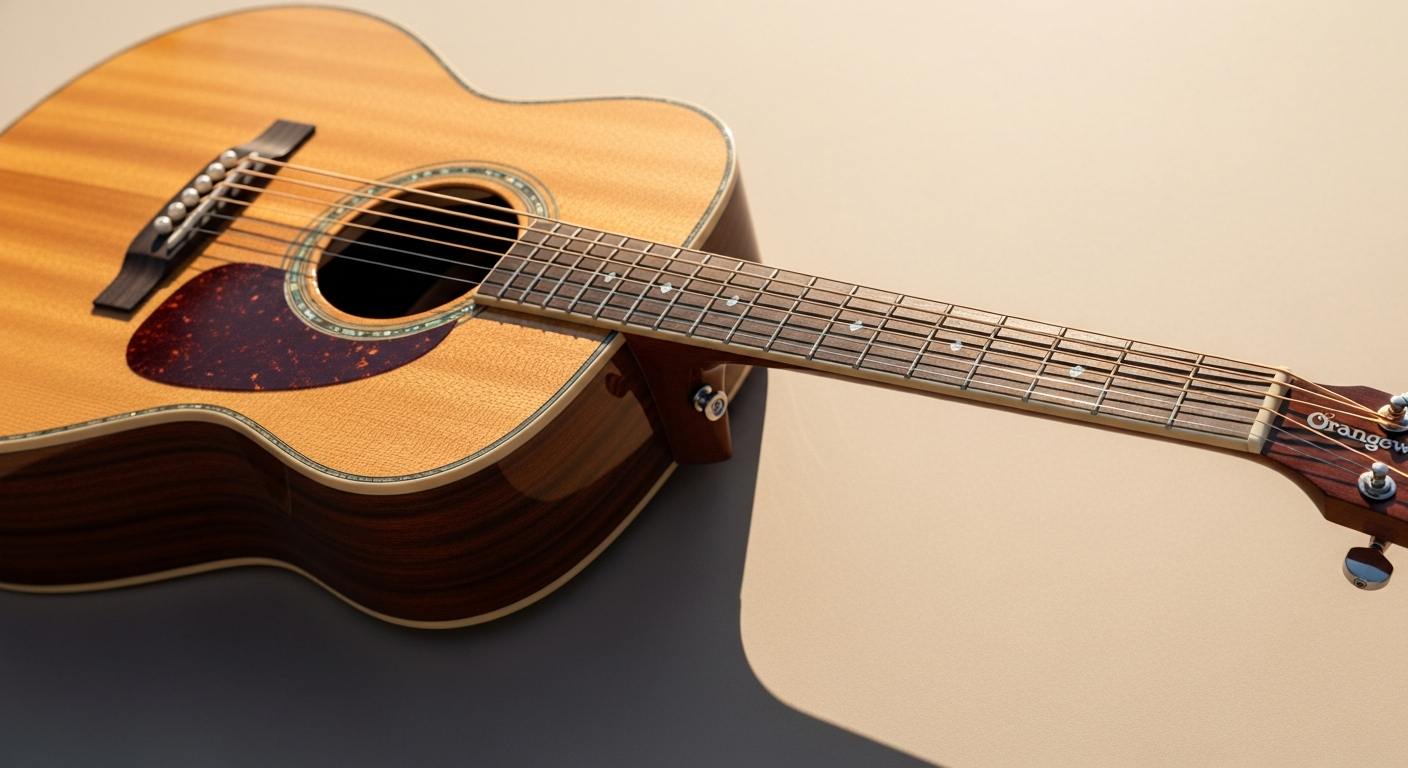
Discover why the Orangewood Oliver Mahogany Acoustic Guitar is a game-changer for beginners and budget-conscious players. Explore its warm tone, solid construction, and exceptional value in our comprehensive review.
The solid mahogany top is where the Orangewood Oliver starts building its case for value dominance. This isn’t a laminate compromise—it’s genuine solid wood that produces a warm, balanced tone far exceeding what you’d expect at this price point. The mahogany resonates naturally, creating sustain and character that often rivals guitars costing two or three times more.
Layered mahogany and sapele back and sides amplify this tonal advantage. These materials work together to enhance natural resonance, allowing sound waves to develop and project with impressive clarity. The scalloped X-bracing pattern inside the body isn’t decorative—it’s engineered to optimize vibration patterns and acoustic projection, ensuring every note carries weight and definition.
What makes this construction approach remarkable is how it improves with time. Unlike laminate-topped guitars that remain acoustically static, a solid mahogany top develops richer character as the wood ages and settles, rewarding long-term players with an instrument that genuinely improves.
Build Quality and Pre-Delivery Setup Standards
Every single Oliver guitar travels to Los Angeles before reaching your hands. Orangewood’s in-house technicians perform professional setup on each instrument, checking action height, fret alignment, and playability. This isn’t a cost-cutting shortcut—it’s a quality assurance step that prevents the frustration many beginners face with poorly prepared budget guitars.
The low-action setup that arrives at your doorstep eliminates common beginner complaints. No fret buzz. No dead notes. No finger-exhausting struggle that discourages new players during crucial early practice sessions. The C-shaped mahogany neck profile compounds this advantage, offering natural ergonomics that accommodate both novices and experienced guitarists comfortably.
This pre-delivery attention means you can unbox the Oliver and play immediately. Most budget guitars require setup adjustments from a local technician—an extra $50-$100 expense that makes their true cost significantly higher than advertised.
Acoustic vs. Live: Choosing Your Oliver Configuration
The standard acoustic model ($195-$225) targets players focused on practice, home recording, and casual playing. Pure acoustic performance without electronic complications. This version delivers the full mahogany experience with zero electronics interference—ideal for bedroom players and songwriters working with microphones during recording.
The Oliver Live version ($275-$295) integrates a Fishman Sonitone EQ pickup system, transforming acoustic performance into stage-ready capability. This isn’t a cheap piezo pickup that colors tone—the Fishman electronics preserve the guitar’s acoustic character while enabling amplification control and EQ shaping.
Choosing between them depends on immediate needs. Planning to perform live or play alongside amplified instruments? The Live version’s modest $70-$80 premium pays for itself immediately. Content with acoustic-only playing? The standard model delivers identical tonal quality at genuinely entry-level pricing.
Real-World Playability for Different Skill Levels
Beginners immediately notice the forgiving nature of the Oliver’s design. The C-shaped neck sits naturally in smaller hands without requiring finger stretching or contortion. The pre-optimized action—typically set around 2mm at the 12th fret—allows clean fretting without excessive pressure. This matters enormously during the critical first weeks when finger strength is still developing.
The warm mahogany tone provides encouraging acoustic feedback that builds confidence. New players hear their fingers improving, their technique developing. There’s nothing discouraging about a thin, brittle tone that obscures skill progression. Instead, the Oliver’s resonant character rewards developing technique with perceptible tonal quality.
Comfortable playability directly reduces finger fatigue during practice sessions. Beginners can practice longer without hand cramping, accelerating skill development. Experienced players picking up the Oliver for a second instrument or travel companion find the same ergonomic advantages—no compromises, just functional design that respects how humans hold and play guitars.
Strengths That Justify the Hype
The value proposition remains the Oliver’s defining strength. Finding solid mahogany construction, rosewood fretboard, bone nut and saddle, professional setup, and included gig bag under $225 is genuinely remarkable. Comparable quality typically inhabits the $400-$500 territory at major retailers.
The warm, balanced tone rivals guitars costing 2-3 times the price. This isn’t hyperbole based on brand reputation—it’s consistent feedback from players across skill levels. The mahogany’s natural resonance, the bone appointments’ tonal clarity, and the solid top’s responsive dynamics combine into an acoustic voice that punches dramatically above its price point.
Solid top construction ensures long-term value. As the mahogany ages, the guitar improves—developing deeper character and richer tone. You’re not buying a static instrument; you’re buying an investment that rewards patience and regular playing.
Limitations and Honest Trade-Offs
The tuning machines function reliably but feel less robust than premium counterparts. They turn smoothly and hold tuning adequately for practice sessions, but they lack the substantial feel of guitars costing 2-3 times more. Tuning stability is sufficient for home playing but may require slightly more frequent adjustments than higher-end instruments.
The Oliver Live version experiences feedback issues when positioned too close to amplifiers. This isn’t a dealbreaker for stage performance—proper mic/amp placement eliminates the problem—but it requires awareness. Close-range amplification works better with solid-body electrics designed for that application.
The satin finish, while beautiful and tonally superior to glossy alternatives, demands more care. It’s prone to scratches and fingerprints. Minor finish imperfections have occasionally shipped on individual units, though Orangewood handles warranty claims professionally.
Oliver vs. Competitors in the Budget Segment
The Yamaha FG800 ($200-$230) competes directly on price and offers solid spruce construction and reliable playability. However, it lacks the tonal character the Oliver delivers. The FG800 sounds competent but unremarkable—functional rather than inspiring.
The Fender FA-100 ($200-$220) provides decent playability but skimps on appointments. No bone nut or saddle. The laminate top limits tonal development. Build quality feels adequate but uninspiring compared to the Oliver’s intentional construction choices.
The Oliver’s solid mahogany top distinguishes it fundamentally from laminate-top competitors. Laminate guitars remain tonally static regardless of age or playing—they’re consistent but limited. A solid top develops character, improves with time, and rewards dedicated players with increasingly superior tone.
Real-World Performance: Studio and Stage Applications
The warm mahogany tone records beautifully with minimal processing required. Recording engineers consistently note how the Oliver captures rich acoustic character without excessive EQ manipulation. The responsive dynamics handle fingerpicking nuance and strumming intensity equally well, translating player touch into captured sound effectively.
Fingerpicking clarity stands out in studio applications. The mahogany’s warm foundation provides bass presence while maintaining treble articulation. Strummed passages develop natural compression that avoids harsh high-end peaks. The bone nut and saddle contribute measurable clarity to note definition across the frequency spectrum.
Stage performance shines with the Oliver Live’s Fishman electronics and EQ control. The pickup captures the guitar’s acoustic character faithfully, preserving the tonal identity while enabling volume control. The integrated EQ allows on-the-fly tone shaping for different venues and performance contexts without compromising the fundamental mahogany warmth.
The Bottom Line
The Orangewood Oliver Mahogany Acoustic Guitar represents a genuine breakthrough in budget-conscious guitar purchasing. Solid mahogany construction, bone nut and saddle appointments, and professional pre-delivery setup at this price point feel almost unfair to competitors. Whether launching an acoustic journey or seeking an affordable workhorse for songwriting, the Oliver consistently outperforms expectations.
The trade-offs are minimal and manageable. Tuning stability requires slightly more attention than premium instruments, and the satin finish demands care against scratches. These compromises feel trivial when weighed against the exceptional value delivered. For beginners hesitant to invest heavily in their first guitar, the Oliver removes the financial barrier without sacrificing playability or tone. For experienced players wanting a reliable backup or travel instrument, it delivers remarkable bang for your buck.
Start your acoustic guitar journey with the Orangewood Oliver Mahogany Acoustic Guitar today.