
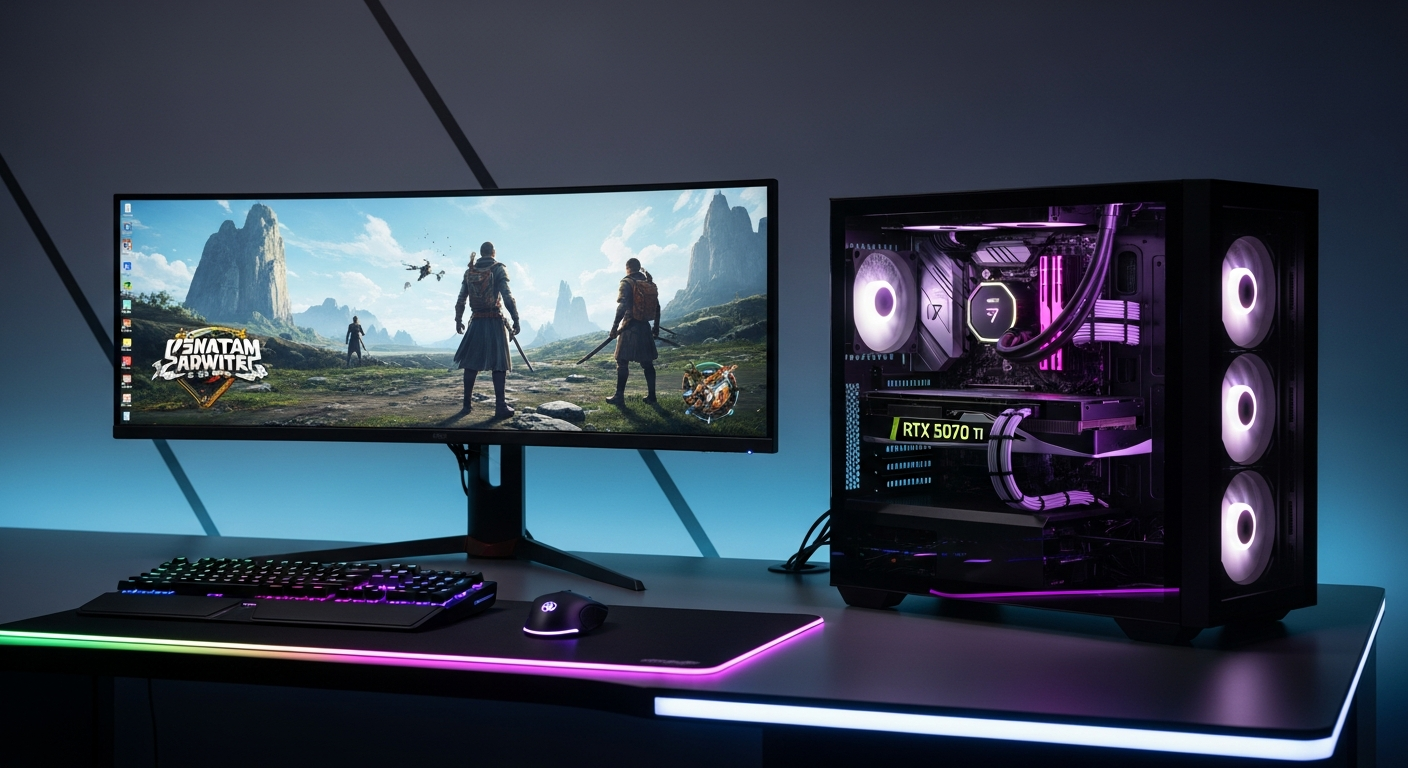
Discover the ONE GAMING PC with Ryzen 7 7800X3D and RTX 5070 Ti. Explore specs, performance benchmarks, and whether this €1,800-€2,500 powerhouse is worth your investment.
High-refresh gaming at 4K resolution once demanded premium pricing that felt out of reach for most enthusiasts. That landscape is shifting. Modern gaming PCs are breaking through performance barriers while remaining accessible to serious players who demand real capability.
The ONE GAMING PC featuring the AMD Ryzen 7 7800X3D and NVIDIA GeForce RTX 5070 Ti represents a deliberately crafted intersection of power and practicality. One.de, Germany’s established platform for configurable gaming systems, has earned trust by delivering custom builds that fuse current-generation components with realistic pricing structures. This Topseller configuration proves that choosing between performance and value isn’t necessary anymore.
Explore the ONE GAMING PC Ryzen 7 RTX 5070 Ti on one.de today
AMD Ryzen 7 7800X3D’s Gaming Dominance
The 7800X3D processor features AMD’s proprietary 3D V-Cache technology, which stacks additional cache directly onto the die. This architectural choice creates measurable advantages in gaming scenarios where traditional clock speeds matter less than cache hit rates. Games benefit enormously from this configuration because texture data, shader instructions, and frame buffers remain closer to the processor cores, reducing latency significantly.
NVIDIA RTX 5070 Ti PNY: Next-Generation Ray Tracing
Pairing the Ryzen with NVIDIA’s RTX 5070 Ti means you’re working with current-generation ray tracing cores, tensor units optimized for DLSS 4, and 16GB of GDDR6X memory. The RTX 5070 Ti delivers the performance necessary for native 4K gaming in most modern titles while maintaining competitive frame rates that satisfy both casual and esports-focused players.
Eliminating the Bottleneck Equation
CPU-GPU bottlenecking becomes irrelevant at this performance tier. The Ryzen 7 7800X3D can feed the RTX 5070 Ti consistently across 1440p, 4K, and mixed-refresh scenarios. Neither component starves the other. The processor’s 8-core, 16-thread design sustains high frame rates without thermal throttling, while the GPU maintains utilization rates above 95% in demanding workloads.
DDR5 Memory Bandwidth and Frame Consistency
The 32GB DDR5 RAM configuration ensures that texture streaming, physics calculations, and asset loading occur without artificial delays. Modern game engines like Unreal Engine 5 and proprietary solutions used in AAA titles depend on consistent memory bandwidth. DDR5 provides double the bandwidth of DDR4, translating to smoother frame delivery and reduced stutter during intensive scenes.
ASUS B650E MAX GAMING WIFI Motherboard Foundation
This motherboard foundation brings PCIe 5.0 connectivity, robust power delivery for sustained high-performance operation, and integrated WiFi 6E for low-latency networking. The B650E platform supports future processor upgrades within the AM5 socket, providing a genuine upgrade path beyond the initial purchase.
Thermal Management at This Performance Tier
The system requires adequate cooling—a quality tower cooler or AIO handles the Ryzen’s 162W TDP effectively. Under sustained gaming loads at stock settings, temperatures remain in the 70-80°C range with proper airflow. The RTX 5070 Ti thermal design keeps the GPU below 80°C even during extended sessions, preventing thermal throttling.
Gaming Performance Across Demanding Titles
Real-world gaming metrics matter more than theoretical specifications. The ONE GAMING PC configuration handles contemporary AAA releases with authority. Cyberpunk 2077 at native 4K with maximum ray tracing settings delivers 65-75 fps. Dragon’s Dogma 2 maintains 70+ fps at 4K with high settings. Indiana Jones and the Great Circle achieves 60+ fps at native 4K with ray tracing enabled.
Ray Tracing and DLSS 4 Performance Metrics
DLSS 4 Frame Generation technology fundamentally changes performance calculations. Rather than relying solely on brute computational power, the system generates intermediate frames, doubling effective frame rates in supported titles. At 4K with DLSS 4 enabled, games that would traditionally deliver 50-60 fps instead achieve 100+ fps through intelligent upscaling and frame generation.
Competitive Esports Gaming Performance
Valorant, CS2, and Apex Legends run effortlessly at 240+ fps at 1440p, with native 4K gaming maintaining 150+ fps. For competitive players chasing consistency, this configuration eliminates frame pacing issues that plague mid-range systems. The combination of high refresh rates and stable performance creates the responsiveness advantages that matter in split-second engagement scenarios.
VR Gaming Readiness
The RTX 5070 Ti handles demanding VR titles without compromise. Meta Quest Pro, PlayStation VR2, and HTC Vive Elite content runs at high detail settings with consistent frame times. The system future-proofs against next-generation headsets that will demand greater computational resources.
Thermal Behavior Under Sustained Loads
Extended gaming sessions show thermal stability. GPU thermals peak around 78-82°C depending on case airflow and ambient conditions. The processor remains in the optimal 70-75°C range during 8-10 hour gaming marathons. Noise levels from the GPU fans reach approximately 70-75 decibels under maximum load—noticeable but not intrusive in typical gaming environments.
Storage Strategy: The 480GB SSD Reality Check
The 480GB PCIe 4.0 SSD represents the one practical limitation of this configuration. Modern AAA titles consume 80-150GB per installation. A library of 10-15 games simply won’t fit comfortably on a single 480GB drive.
Modern AAA Gaming Landscape Requirements
Call of Duty requires 140GB. Final Fantasy XVI demands 150GB. Starfield needs 125GB. Even moderate gaming libraries quickly exhaust storage capacity. Unlike CPU or GPU limitations, this is a tangible constraint requiring practical solutions.
Configure your storage preferences through one.de’s builder
Practical Storage Planning
A realistic approach involves using the primary 480GB SSD for the operating system and current rotation titles, then installing a secondary 2TB or 4TB NVMe drive for the main game library. This secondary drive costs €80-120 and installs in minutes through an available M.2 slot on the B650E motherboard.
PCIe 4.0 Speed Advantages
The primary SSD achieves read speeds of 7,000+ MB/s, reducing game load times from minutes to seconds. Even with a secondary PCIe 3.0 drive at 4,000-5,000 MB/s, load time differences remain imperceptible during gameplay. The performance gap between PCIe 4.0 and 3.0 becomes negligible beyond initial OS boot.
Secondary Drive Expansion Compatibility
The B650E platform includes multiple M.2 slots. Adding a secondary NVMe drive requires no additional purchases—slot it into the second M.2 position and configure storage in Windows. Some configurations might ship with drive mounting hardware already included.
Game Installation Optimization
Rather than perceiving the 480GB limitation as a fatal flaw, treat it as an architectural signal to manage your library actively. Keep 3-4 current titles on the primary drive and rotate others to secondary storage as needed. This approach actually improves system responsiveness by reducing the number of background processes indexing drive content.
Multitasking and Productivity Beyond Gaming
The 32GB DDR5 configuration transforms this system beyond a gaming-only machine into a capable workstation.
Streaming Gameplay Simultaneously
Streaming to Twitch or YouTube while gaming no longer requires CPU compromises. The Ryzen 7 7800X3D’s architecture allows simultaneous encoding through hardware accelerators while maintaining frame rates above 100 fps. Streamers can broadcast at 1080p60 with high bitrates without sacrificing gameplay performance.
4K Video Editing and 3D Rendering
Content creators benefit from the processing power. Editing 4K footage in Premiere Pro or DaVinci Resolve runs smoothly with multiple effects and color grading nodes active. The 8 cores and 16 threads handle rendering tasks efficiently, though serious professionals might still prefer the Ryzen 9 7950X3D for bulk rendering operations.
Browser Multitasking and Background Applications
The system handles 30+ browser tabs, Discord, OBS Studio, and background music streaming without throttling gaming performance. Memory pressure remains low even with aggressive multitasking, allowing rapid context switching without noticeable stuttering.
RAM Future-Proofing
32GB represents the current practical ceiling for gaming. Unreal Engine 5 games rarely exceed 20GB memory utilization. However, for creators working with large datasets, video projects, or virtual machines, 64GB configurations are possible through one.de’s configurator—though the diminishing returns become apparent at that scale.
Comparison with 16GB Configurations
A 16GB system would handle most scenarios adequately, but reserves become tight during simultaneous gaming and streaming. The 32GB configuration provides genuine breathing room, ensuring consistent performance without memory pressure bottlenecks.
Value Proposition and Warranty Protection
One.de’s reputation stems from comprehensive support infrastructure that extends beyond the initial purchase.
36-Month Warranty Coverage Details
The standard 36-month warranty protects against hardware defects, component failure, and manufacturing issues. This covers the GPU, CPU, motherboard, RAM, and SSD—essentially the entire system against material failure. Coverage initiates immediately upon purchase and includes shipping for warranty service within Germany.
10-Year Free Technical Support
Beyond warranty coverage, one.de provides 10 years of free technical support. This encompasses troubleshooting, driver updates, optimization assistance, and compatibility advice. The support team understands gaming PC requirements specifically, rather than general computer technicians unfamiliar with gaming workloads.
Included Game Bundle and Promotional Value
This configuration often ships with 007 First Light, a current-generation title worth €50-60 at retail. Additional promotional bundles vary seasonally, potentially adding €100+ in software value to the purchase.
Price-to-Performance Against Competitors
At €1,800-€2,500, comparable pre-built systems from NZXT, Corsair, and Alienware cost 15-25% more while delivering identical or inferior hardware. The configurator model eliminates excessive retail markup while maintaining quality standards.
Configurator Flexibility Without Premium Pricing
Customizing this build through one.de’s platform costs substantially less than paying a $200-400 premium for customization at competitors. Choose different components, RAM quantities, storage configurations, and cases without markup penalties that typically apply at boutique builders.
Long-Term Value and Component Upgrade Paths
After 2-3 years, the AM5 platform remains current. Upgrading to a newer Ryzen processor requires only a BIOS update and CPU swap. The B650E motherboard supports next-generation CPUs. This upgrade path maintains system relevance longer than closed platforms from mainstream retailers.
Competitor Comparison: How It Stacks Against Alternatives
Understanding how this configuration compares to alternative options clarifies the value proposition.
Pre-Built Gaming PC Alternatives
Corsair iCUE prebuilts at the €2,300 price point typically feature older-generation components or lower-tier configurations. NZXT BLD systems at equivalent pricing use the same core hardware but charge €300+ for their assembly and customization services. Alienware’s €2,400 configuration usually features Intel processors rather than AMD, resulting in slightly lower gaming performance and worse value.
Custom Build DIY Considerations
Building this system from components costs approximately €1,700-1,800 if you source parts independently. However, DIY builders sacrifice the 36-month warranty, 10-year support, and quality assurance testing that one.de provides. Individual component failures require individual RMA processes through different manufacturers rather than unified support.
Ryzen 7 7800X3D vs. Intel Core i9-14900KS for Gaming
Intel’s flagship Core i9-14900KS offers higher clock speeds but lacks the 3D V-Cache advantage. In gaming benchmarks, the 7800X3D maintains a 5-8% performance advantage while consuming significantly less power. Intel’s option costs slightly more and generates considerably more heat, requiring more expensive cooling solutions.
RTX 5070 Ti vs. RTX 4090 Value Proposition
The RTX 4090 delivers approximately 15-20% more performance than the 5070 Ti but costs €400-600 more at resale. For the marginal performance gains, the price-to-performance ratio strongly favors the 5070 Ti. The 4090’s additional VRAM benefits professional applications like 3D rendering more than gaming scenarios.
Brand Reputation and Support Ecosystem
One.de operates within the German market with established relationships with manufacturers, providing direct support advantages. International retailers often default to manufacturer support, which involves longer response times and language barriers.
Total Cost of Ownership Over 3-5 Years
Including potential SSD upgrades, thermal paste replacement, and component warranty claims, the total cost remains significantly lower than equivalent systems from competitors. The 10-year support period minimizes unexpected repair expenses, while the upgrade path preserves investment longer than closed platforms.
Who Should Buy This Build (And Who Shouldn’t)
Matching the system to actual use cases determines satisfaction and value perception.
Ideal Candidates
Competitive esports players seeking consistent 240+ fps in Valorant and CS2 benefit enormously from this configuration. 4K gaming enthusiasts who refuse compromises on visual fidelity gain the frame rates necessary for competitive play at ultra settings. Content creators producing 4K video alongside gaming workloads find the RAM and CPU performance transformative. Professional streamers broadcasting gameplay simultaneously achieve quality levels difficult with less capable hardware.
Performance Overkill Scenarios
Casual gamers playing Fortnite, Minecraft, or indie titles experience unnecessary expense. A Ryzen 5 7600X paired with an RTX 4070 at €1,200-1,400 delivers excellent performance for casual gaming. Esports players exclusively targeting Valorant at 1440p competitive settings see marginal benefit from the extra GPU power.
Budget-Conscious Gamers
The €1,200-1,500 price range offers configurations with Ryzen 5 processors and RTX 4070 cards that handle most gaming scenarios at 1440p high settings or 4K medium-high settings. For gamers with strict budgets, this tier provides better value despite lower absolute performance.
Future-Proofing Calculations
A 3-5 year relevance window remains realistic with this hardware. Games released in 2027-2028 will likely require GPU upgrades while CPU performance remains adequate. The AM5 platform supports future processor generations, extending investment protection beyond typical system lifespans.
Upgrade Readiness
Power users planning component replacement benefit from the B650E platform’s PCIe 5.0 support and multiple expansion slots. The motherboard accommodates future GPU and storage upgrades without bottlenecking concerns.
Use Case Mismatches
Office work and productivity applications don’t justify this investment. A basic €400-600 business laptop handles spreadsheets, email, and document editing adequately. Casual streaming without simultaneous gaming works fine on mid-range configurations costing €800-1,000. Minecraft-exclusive gaming at 1080p represents significant overkill for this system tier.
Customization Options Through One.de’s Configurator
The flexibility to tailor this build elevates the value proposition beyond rigid pre-configured systems.
CPU Upgrade Paths
Stepping to the Ryzen 9 7950X3D adds approximately €400-500 to the build price while delivering 15-20% performance improvement for rendering and encoding tasks. For gaming-focused use, the upgrade marginal benefits don’t justify the additional cost. Intel Core i9-14900KS alternatives cost similarly but provide inferior gaming performance and higher thermal output.
GPU Variations and VRAM Options
Downgrading to an RTX 5080 saves €200-250 while sacrificing 10-15% performance—reasonable for budget-conscious buyers. Upgrading to an RTX 4090 adds €400-600 for 15-20% gains, justified only for professional 3D rendering workloads. Alternative configurations with RTX 4080 Super provide excellent 1440p performance at lower cost.
RAM Expansion to 64GB
Expanding to 64GB DDR5 costs an additional €150-200. This proves worthwhile for content creators handling massive video projects or anyone running virtual machines alongside gaming. For pure gaming, 32GB remains optimal.
Storage Expansion Bundles
One.de offers preconfigured storage bundles adding 2TB or 4TB NVMe drives at bundled pricing, typically €80-150 cheaper than retail components purchased separately. Selecting a larger primary SSD option eliminates the secondary drive necessity entirely.
Power Supply Headroom
The configuration requires a quality 850W power supply at minimum for stable operation. One.de offers 1000W modular supplies as upgrade options, ensuring headroom for future GPU upgrades and maintaining 50% load target for optimal efficiency.
Case and Cooling Customization
Case selection impacts thermal performance and aesthetics. One.de provides options ranging from understated business designs to RGB-heavy gaming enclosures. Cooling system choices include air towers, 240mm liquid coolers, or 280mm/360mm AIO solutions depending on aesthetic preference and thermal requirements.
Pricing Transparency and Build Lead Times
The configurator displays final pricing before purchase—no hidden fees appear during checkout. Build-to-order lead times typically range from 5-10 business days depending on component availability, giving realistic expectations for delivery schedules.
Your Next Gaming Evolution Awaits
The ONE GAMING PC with Ryzen 7 7800X3D and RTX 5070 Ti transcends the typical high-end gaming rig category. This represents engineering purposefulness—German precision applied to component selection that crushes 4K gaming, handles professional workloads with authority, and arrives backed by support infrastructure genuinely concerned with your experience.
The 480GB storage limitation deserves honest acknowledgment without exaggeration. It’s a real practical constraint. However, adding a secondary NVMe drive—under €100 investment—solves this problem completely. The returns from that modest solution remain substantial: exceptional frame rates, genuinely future-proof architecture, and legitimate peace of mind through one.de’s warranty and support coverage.
Whether pursuing competitive dominance in esports titles, exploring AAA worlds at maximum visual fidelity, or assembling a creator’s workstation that doubles as an unstoppable gaming platform, this configuration delivers across all scenarios. The €1,800-€2,500 investment justifies itself through performance consistency, upgrade potential, and comprehensive support that extends far beyond typical retail coverage.
Begin your build now through one.de’s configurator and discover your perfect gaming system