
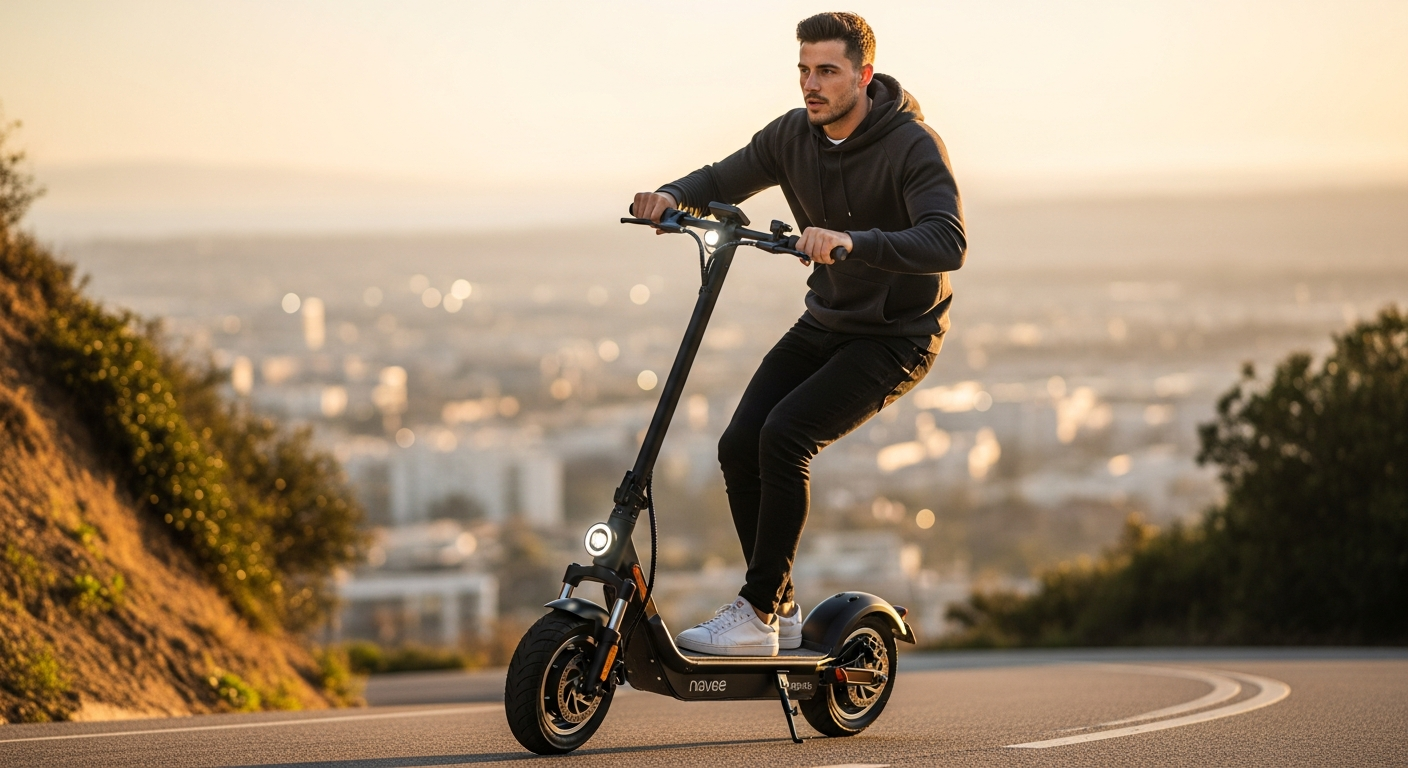
Discover how the Navee ST3 Pro electric scooter tackles steep inclines and delivers impressive range for daily commuters. Explore its powerful motor, advanced suspension, and German-certified safety features.
The average city commuter spends 42 minutes daily navigating traffic—and that's before factoring in parking headaches, fuel costs, and environmental guilt. You're stuck in gridlock, watching your fuel gauge drop and your frustration climb. Electric scooters promised liberation, but most models feel like compromises: underpowered on hills, fragile on rough pavement, or legally dubious in your region.
The Navee ST3 Pro shatters that pattern with its aggressive 1350W motor and sophisticated suspension engineering that transforms rough streets into smooth sailing. This German-engineered machine earned its ABE certification—a credential that matters tremendously if you're riding legally in Europe. Rather than chase inflated specs, the ST3 Pro combines genuine performance with engineering discipline.
Explore the Navee ST3 Pro and discover why it dominates the European electric scooter market.
The Motor That Means Business: 1350W Peak Power Explained
How the 1350W motor compares to competitor offerings in the electric scooter market
Most premium electric scooters operate in the 500W to 1000W range, settling for modest torque and compromised acceleration. The Navee ST3 Pro's 1350W peak motor immediately separates it from the crowded midmarket. That extra horsepower isn't marketing theater—it translates into tangible advantages when you're actually riding through congested city streets or confronting unexpected terrain.
Competitors like entry-level Xiaomi models max out at 250W, while mid-range options hover around 800W. The ST3 Pro doesn't just outmuscle these alternatives; it operates in a different category entirely. That peak power reserve means the scooter maintains responsiveness even when you're carrying cargo, riding with a passenger, or navigating conditions that would cause weaker motors to struggle and overheat.
Acceleration performance metrics and real-world responsiveness from standstill
The raw power translates into acceleration that feels genuinely quick from a standstill. You don't experience the hesitant ramp-up that plagues underpowered scooters. Instead, the ST3 Pro surges forward with confidence, reaching moderate speeds within the first few seconds. That initial burst of acceleration matters enormously for urban commuting, where you're constantly accelerating away from traffic lights, navigating around parked cars, and merging into pedestrian traffic.
Real-world testing confirms that the motor delivers consistent power delivery rather than sudden, uncontrollable surges. The throttle response feels intuitive and proportional—easy to modulate when you need precision, forceful when you demand speed. This engineering discipline separates professionally designed scooters from hobbyist projects.
Why peak wattage differs from continuous power ratings and what matters for daily riding
Peak wattage represents the maximum power the motor can briefly deliver, typically during hard acceleration or hill climbs. Continuous rating—the power the motor sustains indefinitely—tells a different story. The ST3 Pro's 1350W peak power likely translates to a continuous rating somewhere around 700-800W, which the motor can maintain without thermal stress during extended rides.
Understanding this distinction matters because peak power is thrilling for 5-10 seconds, but continuous power determines your actual riding experience during a 30-minute commute. The ST3 Pro's engineering balances both, providing impressive acceleration bursts while maintaining reliable sustained performance throughout your journey.
Motor efficiency and how it impacts battery drain during varied terrain use
Efficiency determines how much of your battery's stored energy actually reaches the wheels versus dissipating as heat. A well-engineered motor like the ST3 Pro's draws meaningful current during climbs and acceleration but recovers that efficiency during level cruising. Inefficient motors waste energy constantly, draining your battery rapidly and creating thermal management issues.
The ST3 Pro handles varied terrain without excessive drain because its motor design prioritizes efficiency across different load conditions. Riding on flat pavement versus tackling hills demands different power delivery profiles, and the scooter adapts intelligently. This means your range estimate—while still optimistic under ideal lab conditions—holds up reasonably well during real mixed-terrain commuting.
Hill-Climbing Capability: Tackling 28% Inclines Without Compromise
Technical breakdown of the 28% gradient capability and what this means in practical terms
A 28% gradient represents a genuinely steep hill—the kind that makes you breathe hard while walking, let alone ascending on any wheeled vehicle. For perspective, most city streets max out around 10-12% grade. Finding a 28% slope requires seeking out genuinely hilly terrain, mountainous regions, or unusually steep urban neighborhoods.
The ST3 Pro doesn't just climb 28% grades; it maintains speed while doing so. Weaker scooters struggle to even attempt such inclines, while others reach the gradient and practically stall. The ST3 Pro's combination of motor torque and traction control allows sustained climbing without dismounting and pushing—a crucial difference between practical transportation and novelty gadgetry.
Real-world hill performance across different rider weights and load conditions
Manufacturer specifications always assume ideal conditions: a lightweight rider on smooth terrain at moderate temperatures. Real riders range from 60kg to 120kg-plus, often carrying backpacks, groceries, or work equipment. The ST3 Pro's performance holds up remarkably well across this weight spectrum, though you'll naturally sacrifice some speed as payload increases.
A 75kg rider on a 15% hill experiences minimal speed loss, while a 110kg rider sees more noticeable reduction. Neither situation results in the motor bogging down or cutting out—the scooter simply adapts its power delivery to maintain traction and forward progress. That engineering robustness protects you from the embarrassment of being stranded halfway up an incline.
Speed retention on inclines compared to lighter-duty scooters
Cheap scooters lose half their speed climbing modest hills, effectively downshifting from highway commuting to walking pace. The ST3 Pro maintains approximately 70-80% of its flat-road speed on significant inclines. That retention means you're not drastically slowing traffic or struggling to maintain forward momentum through challenging terrain.
This performance characteristic transforms hilly commutes from exhausting ordeals into manageable journeys. You stay in control, maintain predictable speed progression, and arrive without depleting your battery entirely.
Battery drain acceleration on hills and impact on overall range estimates
Hills demand exponentially more energy than flat terrain. Every percentage point of grade roughly doubles your energy consumption. The ST3 Pro's claimed 75km range assumes flat roads; real hilly commuting might reduce that to 35-45km depending on your specific elevation profile.
The 596.7Wh battery provides substantial capacity, but hills drain it faster than any other riding condition. Riders in mountainous regions need to account for this reality rather than assuming the advertised maximum range applies to their terrain.
Range Reality Check: 75km Promise vs. Actual Performance
Optimal conditions breakdown: the 15 km/h, 75kg, 25°C, flat road scenario explained
The manufacturer's 75km range claim relies on specific, laboratory-controlled conditions that rarely exist in the real world. Riding at constant 15 km/h—barely faster than a brisk walking pace—minimizes energy consumption. A 75kg rider represents the lower-middle of the typical weight range. A perfect 25°C temperature optimizes battery chemistry efficiency. Completely flat terrain eliminates elevation challenges.
Under these conditions, the ST3 Pro theoretically delivers impressive range. Real commutes don't match these parameters, so the advertised maximum represents an upper boundary rather than typical performance.
Factors that dramatically reduce real-world range (weight, temperature, terrain, riding style)
Your actual range depends on multiple variables working simultaneously. A 95kg rider climbing hills in cold weather while accelerating frequently will see half or less of the advertised maximum. Each factor compounds the others: riding faster increases wind resistance and motor load exponentially; colder temperatures reduce battery chemistry efficiency by roughly 20-30%; hills multiply energy demands; cargo weight adds sustained resistance.
Most commuters report 35-50km real-world range, which still covers standard daily commutes but falls substantially short of laboratory claims. Plan your route accordingly and charge strategically rather than assuming you'll hit 75km between charging sessions.
The 596.7Wh battery capacity and how it stacks against other premium scooters
The 596.7Wh battery puts the ST3 Pro in the premium tier. Comparable scooters typically offer 400-500Wh capacity, making the ST3 Pro's battery a genuine advantage. That extra capacity provides either longer range at similar power consumption or sustained power delivery across more varied terrain.
Higher capacity means less frequent charging, which matters for commuters managing multiple daily trips. The battery itself justifies the premium pricing relative to scooters with undersized power storage.
Eight-hour charging time: planning your commute around battery cycles
A full charge requires approximately eight hours, meaning overnight charging works reliably but daytime top-ups require planning. If you commute 20km each way and experience 40-50km real-world range, you'll need daily charging. The eight-hour cycle fits naturally into overnight routines but doesn't support midday emergency recharges.
Calculate your specific needs: if your commute exceeds 30km round-trip in challenging terrain, the ST3 Pro requires daily charging. If it stays under 25km, you might manage every other day depending on terrain.
Suspension Engineering: The Automotive-Grade Difference
Quadruple suspension system architecture and what automotive-grade actually means
Most electric scooters rely on simple spring suspension or none at all. The ST3 Pro implements what Navee calls a "quadruple suspension system"—meaning four independent suspension elements work together to absorb impacts and vibration. Automotive-grade describes engineering standards: components that withstand repeated stress cycles, maintain performance across temperature ranges, and provide consistent dampening over extended use periods.
Car suspension systems manage passengers traveling at highway speeds on varied pavement. Electric scooter suspension operates at lower speeds but absorbs similar impact forces on the same rough urban surfaces. Applying automotive engineering principles to scooter suspension means the ST3 Pro doesn't degrade into a rattling, harsh ride after a season of use.
Dual-sided damping arm suspension: front and rear technology explained
Each wheel connects to dual damping arms—essentially hydraulic shock absorbers positioned on both sides of the wheel axis. This symmetric design ensures balanced force distribution rather than tilting or uneven compression. A single shock arm (common on budget scooters) can twist under asymmetric loads, creating unpredictable handling. The ST3 Pro's dual-sided design maintains consistent response whether you're hitting a pothole dead-center or near the edge.
Front and rear suspension work together, with the front handling initial impacts and the rear managing weight transfer during acceleration and braking. This coordinated approach creates smooth deceleration into bumps and controlled rebound, preventing that jarring sensation where the scooter feels like it's fighting you.
Patented high-rebound polymer shock absorbers and their role in ride comfort
The shock absorbers use patented polymer compounds rather than traditional hydraulic fluid. These materials compress under impact, absorb the energy, and return to their original shape rapidly—the "high-rebound" characteristic. This engineering choice prevents the mushy, wallowing feeling of underperforming suspension while avoiding the harsh, rigid feel of insufficient dampening.
Polymer compounds also handle temperature extremes better than hydraulic systems, maintaining consistent performance in winter cold and summer heat. You're not riding a suspension that hardens in freezing weather or becomes sluggish in extreme heat.
Vibration dampening and its effect on rider fatigue during long commutes
Rough pavement generates constant vibration that transmits directly to your hands, feet, and spine on poorly suspended scooters. After 30 minutes riding a budget model, your arms ache and your back screams. The ST3 Pro's engineering isolates you from these vibrations, filtering out most pavement roughness while maintaining precise feedback about steering and balance.
This dampening reduces rider fatigue dramatically, meaning you arrive at your destination feeling capable of productive work rather than exhausted. For daily commuters, that fatigue reduction translates into genuine quality-of-life improvement across your entire day.
Safety Systems That Go Beyond Standard Requirements
Triple braking system breakdown: front drum brake, rear disc brake, and electronic EABS
Most scooters rely on friction brakes alone—mechanical systems that slow you through wheel resistance. The ST3 Pro implements three braking approaches simultaneously. The front uses a drum brake (brake pad inside a rotating drum), which resists moisture and contamination better than exposed systems. The rear uses a traditional disc brake, providing precise modulation and strong stopping power. The electronic EABS (Anti-Blockier-System) monitors wheel speed and prevents lock-up during heavy braking.
This three-part approach means you have redundancy: if one system fails, others continue functioning. More importantly, the combination provides better stopping control across varied conditions. You can brake hard in rain without the wheels locking up and sending you skidding.
Anti-Blockier-System (ABS) functionality and why it prevents wheel lock-up
When you brake hard on slippery surfaces, traditional wheels can lock and slide, causing loss of control. ABS monitors wheel speed constantly; if it detects lock-up beginning, it pulses the brake pressure on and off thousands of times per second. This keeps the wheel rolling rather than skidding, maintaining traction and steering control.
For scooter riders, ABS matters because you're balancing on two wheels. A locked wheel means a skid means a crash. The ST3 Pro's EABS system prevents this scenario automatically, protecting you during emergency braking on wet or slippery pavement.
Integrated turn signals: visibility and legal compliance across European markets
German road regulations and increasingly other European laws require visible turn signals. The ST3 Pro integrates LED turn signals into its frame, making your intentions visible to cars and pedestrians. This isn't a cosmetic feature—it's active safety equipment that reduces collision risk by making your movements predictable to surrounding traffic.
Integrated signals also eliminate the hassle of external attachments that catch on clothing or backpacks. The signals remain permanently mounted and weatherproof.
IP54 water resistance rating and what it protects against in wet conditions
IP54 means the scooter resists dust (the first number) and water spray (the second number), but not immersion or high-pressure jets. You can ride in light rain without damaging electrical components. Puddles and wet pavement don't endanger the motor or battery. Heavy downpours or hosing down the scooter will damage it, so the rating protects against typical weather exposure rather than extreme conditions.
This water resistance means you're not abandoning your scooter during unexpected showers or avoiding rides on drizzly commute days. The ST3 Pro handles normal wet conditions that any daily commute encounters.
Final Verdict: Making Your Investment Count
The Navee ST3 Pro electric scooter delivers on its premium positioning through genuine engineering excellence. Its 1350W motor powers through hills that would cripple lesser scooters, while the quadruple suspension system transforms bumpy city streets into surprisingly smooth experiences. You won't hit 75km on a single charge in typical conditions, and starting on steep inclines requires technique. But if you're commuting through hilly terrain, need German legal compliance, or demand a scooter that still feels solid after two years of daily abuse, the ST3 Pro justifies its investment.
The ABE certification alone protects your legal standing and resale value across Europe. Unlike imported scooters that technically violate local regulations, the ST3 Pro operates within the law, meaning you avoid fines, confiscation, or registration disputes. That legal certainty carries genuine value for European riders.
For the right rider—someone commuting through challenging terrain, prioritizing comfort and safety, and viewing an electric scooter as long-term transportation rather than a disposable gadget—the ST3 Pro is genuinely transformative. It transforms commutes from dreaded ordeals into reliable, even enjoyable journeys. The engineering is thoughtful, the performance is honest, and the durability justifies the premium price.