
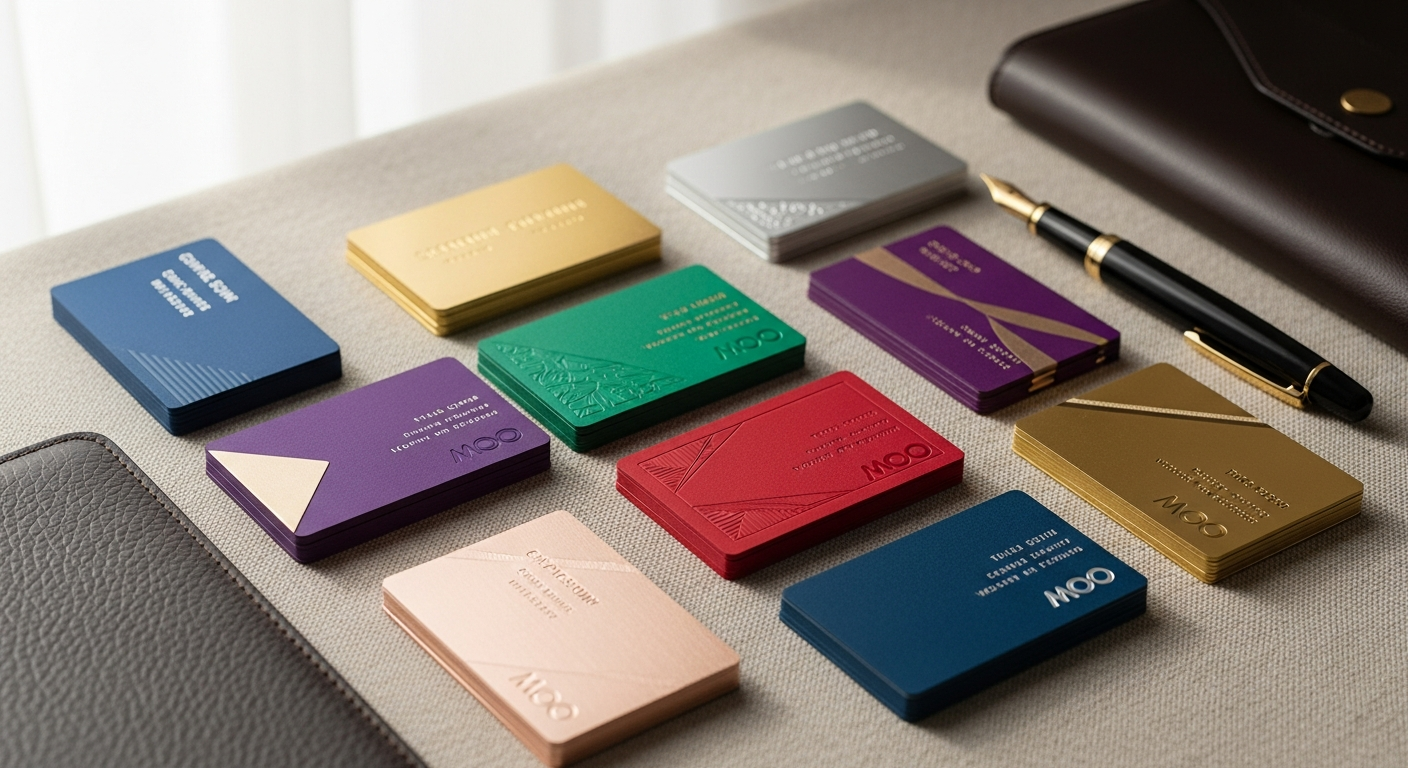
Discover how MOO Premium Custom Business Cards combine luxe paper stocks, innovative Printfinity technology, and advanced finishes to elevate your brand. Explore materials, pricing, and design options.
According to recent networking studies, 88% of business cards are thrown away within a week—yet premium cards with distinctive tactile qualities are kept for months. That statistic alone reveals a fundamental truth: most business cards fail before they even leave the wallet. MOO has carved out a reputation as the gold standard in custom print materials, and their business cards are the crown jewel of their product lineup.
The company doesn't just print cards; they engineer memorable brand experiences through meticulously selected paper stocks, innovative finishing techniques, and technology like Printfinity that allows you to create dozens of unique designs in a single order. What sets MOO apart isn't simply their access to premium materials—it's their obsessive attention to how those materials feel in hand, how they catch light, and how they position your brand in the minds of the people who receive them.
Discover how MOO's premium business cards can transform your networking strategy today.
The Paper Stock Hierarchy: Understanding MOO's Material Options
Original Stock (16pt/298gsm): The Foundation of Quality
MOO's Original stock is already thicker than industry standard, providing an immediate tactile advantage that signals quality to anyone who holds it. At 16pt thickness, it outperforms the thin, flimsy cards that dominate the market. The psychological impact is instantaneous—when someone picks up an Original stock card, they unconsciously register that this person or business invests in quality.
Super Stock: Luxury Feel for Discerning Brands
The Super stock delivers a soft, premium feel that appeals particularly to luxury brands and creative industries. This material bridges the gap between standard and ultra-premium options, offering a noticeable upgrade in tactile experience without the maximum price tag of Luxe. Designers, consultants, and high-end service providers often gravitate toward Super stock because it communicates sophistication without screaming for attention.
Cotton Stock: The Eco-Conscious Choice
For businesses that prioritize environmental responsibility, Cotton stock made from recycled materials provides an ideal solution. This option appeals to sustainable-focused brands that want their materials to reflect their values. The environmental benefits extend beyond just the paper itself—it's a statement about your company's commitment to the planet that resonates with increasingly conscious consumers.
Luxe Stock (32pt/600gsm Mohawk Superfine): The Ultimate Premium Tier
Luxe cards represent the pinnacle of MOO's offerings. At 32pt thickness using Mohawk Superfine paper, these cards are roughly two to three times thicker than traditional business cards. Holding a Luxe card is a completely different experience—it feels substantial, weighty, important. This is the material for maximum impact when you need your cards to make an undeniable impression.
Comparative Thickness and Feel: The Tactile Difference
Each paper stock performs differently in hand. Original cards provide noticeable weight improvement over standard options. Super stock adds a softness that makes recipients want to hold them longer. Luxe cards dominate—they demand attention through sheer substance. The psychological impact varies accordingly: Original signals competence, Super suggests sophistication, and Luxe commands respect.
Durability Considerations: Materials That Last
Thicker materials withstand frequent handling and wallet storage better than thin alternatives. Luxe stock resists bending and creasing dramatically better than Original stock. If your cards spend months in pockets and business wallets, the premium materials justify their cost through longevity alone.
Sustainability Credentials: Environmental Impact of Material Choice
Cotton stock's recycled materials provide clear environmental benefits for brands that want to align their marketing materials with their sustainability messaging. This choice works particularly well for businesses in industries already focused on environmental responsibility—nonprofits, eco-conscious fashion brands, sustainable consultancies, and green technology companies benefit from communicating their values through material selection.
Finishes That Transform: Premium Techniques Beyond Standard Printing
Matte and Gloss Basics: Choosing Your Foundation
Matte finishes provide a sophisticated, subdued appearance that works well for professional services, minimalist design aesthetics, and situations where readability needs to remain sharp and clear. Gloss finishes catch light and create visual pop, ideal for creative industries, hospitality, and brands that want their cards to stand out visually. The choice between them depends entirely on your brand aesthetic and the impression you want to create.
Gold Foil and Silver Foil Accents: Luxury Visual Appeal
Foil accents create visual luxury that immediately elevates card perception. Gold foil catches light warmly during networking events and creates an undeniable sense of premium positioning. Silver foil offers a cooler, more contemporary luxury feel. Both techniques work particularly well for luxury service providers, high-end hospitality, jewelry brands, and upscale consultancies where the visual signal matters as much as the functional card itself.
Spot Gloss Application: Strategic Dimensional Effects
Spot gloss allows you to highlight specific design elements—your logo, important text, or a key visual element—with a glossy finish while keeping the rest of the card matte. This technique creates dimensional depth and draws the eye exactly where you want it. It's a sophisticated way to direct attention without overwhelming the design.
Letterpress Printing: Embossed Tactile Sophistication
Letterpress creates an embossed tactile effect with physical depth and vintage sophistication. The slightly recessed or raised design elements feel distinctly different from standard printing. This technique appeals to luxury brands, creative professionals, and anyone who wants their cards to feel like crafted objects rather than mass-produced commodities.
Embossing Techniques: Raised Design Elements
Embossing adds texture and premium feel through raised design elements. Whether it's your company logo or key text, embossed elements create a tangible difference that recipients notice immediately. Combined with premium paper stocks, embossing signals that no detail was overlooked in your card design.
Finish Combinations: Layering for Maximum Differentiation
The real power emerges when you layer multiple techniques. Combining Luxe stock with gold foil accents and spot gloss creates a card experience that's virtually impossible to forget. A matte base with embossed logo and silver foil accents offers sophisticated complexity. Experiment with combinations that align with your brand positioning.
Industry-Specific Finish Recommendations
Finance and wealth management benefit from matte finishes with subtle embossing—professional without pretension. Creative industries leverage spot gloss, embossing, and even letterpress to showcase their design sophistication. Hospitality and luxury services use foil accents and gloss finishes to create visual warmth and approachability. Tech startups often combine minimalist design with unexpected finishes like copper foil or embossing to signal innovation within professionalism.
Printfinity Technology: The Game-Changer for Creative Professionals
What Printfinity Actually Does
Printfinity allows you to print a completely different design on the back of each card within a single order at zero additional cost. While most printing services charge extra for custom back designs, MOO includes this capability in their standard pricing. This single feature fundamentally changes what's possible with business cards.
Mini-Portfolio Strategy: Showcasing Your Best Work
Photographers can print different portfolio pieces on each card's back. Designers can display different project examples. Illustrators can showcase their range. This transforms a business card from a static contact method into a dynamic portfolio delivery system. Recipients don't just get your contact information—they get a curated sample of your work.
Use Cases for Creatives: Maximum Flexibility
Photographers hand out cards with different image samples, allowing recipients to remember them through their best work. Designers create cards that showcase design variety and capability. Artists use unique back designs to demonstrate their range and versatility. Consultants who offer multiple services can highlight different service offerings on different cards.
Networking Flexibility: Tailored Cards for Specific Conversations
Imagine handing someone a business card customized to the exact conversation you just had. You discussed branding? Hand them a card with your branding work on the back. You discussed web design? Hand them a card showcasing web design projects. This level of personalization during networking creates stronger impressions and more memorable interactions.
Brand Storytelling: Cohesive Narrative Across Your Card Deck
Rather than simply repeating the same design, Printfinity enables you to tell your brand story across multiple card variations. Cards one through ten might progress through your design evolution. Cards could highlight different team members or different service offerings. The deck becomes a narrative tool rather than a static reference.
Personalization at Scale: Individual Cards for Team Members
Larger organizations can create individualized cards for each team member without ordering separate batches for each person. A sales team can have personalized back designs. A creative agency can give each designer their own unique card variation. Personalization at this scale would be prohibitively expensive with traditional printing—Printfinity makes it cost-neutral.
Competitive Advantage: How Printfinity Differentiates MOO
This single feature creates a substantial competitive moat. Most printing services offer standard cards with the same design repeated across the deck. MOO's Printfinity technology fundamentally changes the business card equation for creatives. It's difficult to overstate how valuable this capability becomes when you're trying to stand out in creative industries.
Design Customization & Template Options
Pre-Designed Template Library: Professional Starting Points
MOO offers hundreds of professionally created templates across industries and aesthetic preferences. Whether you're starting a consultancy, running a creative agency, launching a nonprofit, or managing luxury hospitality, templates exist that align with your industry and brand aesthetic. These aren't generic placeholders—they're genuinely well-designed starting points created by professional designers.
Custom Upload Capabilities: Full Design Control
For brands with established design systems or specific vision requirements, full custom upload capability provides complete control. You design exactly what you want, and MOO prints it. This flexibility serves businesses that have invested in professional branding or designers who want their work printed exactly as intended.
Design Tool Interface: User-Friendly Platform
MOO's design tool has earned consistent praise for intuitive navigation and visual editing capability. The interface doesn't require graphic design experience. You can adjust colors, swap images, modify text, and experiment with layouts without feeling lost in complicated software. This accessibility makes it feasible for business owners to create professional-looking cards without hiring a designer.
Size Variations: Options Beyond Standard
Beyond traditional rectangular cards, MOO offers square cards and mini cards, all in full color on both sides. Rounded corners add sophisticated polish. These size variations appeal to different industries and use cases—square cards command more attention, mini cards fit in tight wallets, and rounded corners signal premium craftsmanship across all formats.
Both-Sides Printing: Full-Color Standard
Full-color printing on front and back is standard with MOO, not an upgrade. This might seem obvious, but many competitors still charge extra for back-side printing. MOO's standard approach means Printfinity's varied back designs don't trigger additional costs.
Design Limitations: When Customization Might Feel Restrictive
While MOO's design tools are intuitive, they may offer less latitude than some competitors' advanced editors. If you're accustomed to professional design software, MOO's online editor might feel limiting. For basic modifications and template adjustments, the tool excels. For highly specialized or unusual design requirements, you might need to upload a pre-designed file.
Support Resources: Design Assistance and Customer Service
MOO provides design assistance and customer service support for template customization questions. This support layer becomes valuable when you're trying to modify templates or troubleshoot design challenges. The availability of human support distinguishes MOO from purely self-service competitors.
Pricing Strategy: Evaluating the Premium Investment
Entry-Level Pricing: Starting Points for Different Formats
Standard cards begin at $19.99 for 50 cards. Square cards start at $23.99 for 50 cards. Mini cards cost $18.64 for 100 cards. These entry-level prices are still higher than budget competitors, but they establish the starting point for MOO's premium positioning.
Luxe Card Economics: The Premium Tier Investment
Luxe cards represent a substantially different price point. Two hundred Luxe cards cost approximately $119, which breaks down to roughly 60 cents per card—a significant difference from standard cards. This pricing reflects the material cost and production complexity of ultra-thick, premium-grade paper.
Price Comparison to Competitors: Understanding the Premium
MOO's higher pricing reflects genuinely different materials and capabilities. Budget competitors offer cards at $10-15 for 100. Mid-tier competitors hover around $15-25 for 100. MOO's premium positioning at $20-60 for 100 reflects real material and feature differences. The question isn't whether MOO is more expensive—it's whether the premium justifies the investment for your specific situation.
Volume Discounts and Bulk Ordering: Potential Savings
Larger quantities typically offer better per-unit pricing. If you order 500 standard cards instead of 50, the per-card cost decreases. For businesses that distribute high volumes of cards at events or through sales teams, bulk ordering creates economies of scale.
Cost-Per-Impression Analysis: Calculating Real ROI
A standard card might cost 10 cents but generates one impression. A MOO premium card might cost 50 cents but generates three impressions because recipients keep it longer, look at it multiple times, and actually remember who you are. When a single premium card leads to one additional client interaction that a cheap card wouldn't, the ROI becomes straightforward.
Budget Considerations for Startups vs. Established Brands
Startups with limited marketing budgets might find MOO's premium pricing challenging initially. However, if your entire marketing strategy relies on networking and first impressions—as many startups' do—premium cards become proportionally more important. Established brands with existing reputation might justify premium cards more easily because they're already known; the premium card becomes a reinforcement rather than a primary brand introduction.
When Premium Pricing Justifies the Investment
Premium pricing makes sense when your business model depends on in-person networking, when your industry values tactile brand experiences, when you work with high-ticket items or services, or when differentiation through quality perception is strategic to your positioning. It makes less sense for high-volume, low-margin businesses or situations where cards serve purely functional purposes.
Real-World Applications: Who Benefits Most from MOO Premium Cards
Creative Professionals: Leveraging Printfinity for Portfolio Showcasing
Photographers, graphic designers, illustrators, and creative consultants benefit enormously from Printfinity's capability to display different work on each card. A photographer's card with a stunning landscape on the back makes a different impression than a fashion portfolio sample. Creative professionals use MOO cards as active portfolio delivery mechanisms, not just contact methods.
Luxury Service Providers: Tactile Excellence for High-End Markets
Wealth advisors, premium consultants, luxury brand representatives, and high-end service providers operate in markets where perceived quality directly influences business decisions. Premium MOO cards communicate that you understand quality and attention to detail—values that directly parallel the services you offer.
Networking-Focused Entrepreneurs: Card Quality as Competitive Advantage
Sales professionals, business development specialists, and entrepreneurs for whom networking represents their primary business development channel benefit from cards that recipients actually keep. When your job involves handing out dozens of cards weekly, the quality and memorability of each card becomes strategically significant.
Eco-Conscious Businesses: Sustainability as Brand Message
Environmental nonprofits, sustainable product companies, eco-focused consultancies, and green technology firms use Cotton stock cards as tangible proof of their environmental commitment. The card itself becomes part of your marketing message rather than merely delivering information.
Corporate Executives: Premium Cards as Status and Relationship Tools
C-suite professionals often use premium cards as status symbols and relationship builders. A CEO handing out a substantial, beautifully finished card signals importance and attention to relationships. These cards often remain on recipients' desks longer than standard cards.
Hospitality and Lifestyle Brands: Tactile Experience as Brand Extension
Hotels, restaurants, luxury spas, and lifestyle brands benefit from premium cards that extend the sensory experience of their brand. A luxury hotel's card with Luxe stock and embossed logo creates a brief tactile experience consistent with guests' expectations.
Tech Startups: Innovation Through Premium Materials and Features
Tech companies frequently use premium cards with unexpected finishes or Printfinity's varied designs to signal innovation within professionalism. A startup's Printfinity-enabled cards with different back designs can showcase different product offerings or different team member specializations.
Quality Assurance & Packaging: The Unboxing Experience
Printing Quality Standards: Consistency and Accuracy
MOO maintains rigorous standards for full-color reproduction and color accuracy. Edge quality remains consistent across cards. The company's reputation for consistent excellence across orders directly reflects their quality control processes. When you order MOO cards, you can expect the cards to match your expectations—not occasionally, but reliably.
Sophisticated Packaging: Premium Presentation
MOO recognizes that the unboxing experience matters. Cards arrive in premium packaging that reflects the product quality inside. This isn't just protective—it's experiential. Opening a box of MOO cards feels different from opening commodity card packaging.
Protective Shipping: Cards Arrive in Pristine Condition
Professional packaging ensures cards arrive in pristine condition without bending, creasing, or damage. This attention to shipping reflects understanding that damaged cards undermine the entire premium positioning.
Unboxing Experience: Creating Shareable Moments
The premium unboxing experience contributes to brand perception and even social sharing. Customers photograph their MOO cards arriving and share the experience. This creates organic marketing value that budget competitors can't match.
Quality Control Processes: Consistency Across Orders
MOO's reputation for consistent excellence reflects quality control at every stage. Paper sourcing, printing precision, finishing application, and packaging all maintain standards. This consistency means your tenth order matches your first order.
Customer Service Responsiveness: Premium Support
MOO's customer service responsiveness and satisfaction with premium support distinguish them from competitors. When issues arise—which they occasionally do with any printing service—MOO's support team addresses them effectively, protecting the premium brand positioning.
Sustainability & Environmental Considerations
Cotton Stock Sourcing: Recycled Materials
Cotton stock utilizes recycled materials, reducing environmental impact compared to virgin fiber paper. This sourcing reflects MOO's commitment to environmental responsibility as a print company.
Eco-Friendly Printing Practices: Sustainable Production Methods
MOO's commitment to sustainable production methods extends beyond just material sourcing. Their printing processes incorporate environmental considerations, though specific details around water usage, emissions, and waste management vary based on their production facilities.
Packaging Materials: Recyclable and Minimal Waste
Packaging materials themselves reflect sustainability commitments through recyclable materials and minimal waste approaches. When your premium cards arrive in sustainable packaging, the entire experience aligns with environmental values.
Brand Messaging Around Sustainability: Communicating Values
For businesses emphasizing environmental responsibility, MOO's Cotton stock option provides material proof of sustainability commitment. The card itself becomes a vehicle for communicating your brand's values to recipients.
Certifications and Standards: Industry Recognition
MOO has pursued certifications and standards recognizing sustainable practices, though the specific certifications vary by region and product line. These certifications provide third-party validation of environmental claims.
Balancing Premium Quality with Environmental Responsibility
The challenge in premium printing involves balancing quality and environmental responsibility. MOO's approach attempts this balance by offering premium materials that are still produced sustainably. The Luxe stock represents a quality choice; the Cotton stock represents an environmental choice. You can prioritize one or seek balance between them.
Comparing MOO to Alternative Card Providers
Quality Tier Positioning: Premium vs. Budget vs. Mid-Range
MOO positions itself firmly in the premium tier. Budget competitors like Vistaprint or GotPrint offer functional cards at lower prices but with fewer customization options and less distinctive materials. Mid-range competitors offer better quality than budget options while keeping prices lower than MOO. MOO's positioning accepts higher prices in exchange for superior materials and unique features.
Feature Differentiation: Printfinity and Advanced Finishes
Printfinity represents MOO's signature feature—the ability to print different back designs within a single order without additional cost. Few competitors offer this capability. Advanced finishes like letterpress, foil accents, and embossing are more limited with competitors. These differentiators justify MOO's premium positioning for users who need them.
Pricing Transparency: Understanding Where Premium Pricing Comes From
MOO's premium pricing comes from material sourcing, advanced printing techniques, innovative features like Printfinity, and design tool sophistication. This isn't mystery pricing—it reflects real cost differences from competitors who use cheaper materials or simpler production processes.
Design Tool Sophistication: Interface and Customization
MOO's design interface earns consistent praise for intuitiveness. Some competitors offer more advanced customization for users comfortable with design software; others offer simpler interfaces. MOO balances accessibility with sufficient capability for non-designers.
Customer Service Reputation: Support Quality
MOO's customer service reputation for responsiveness and problem resolution outperforms many competitors. This service layer provides value beyond just the cards themselves—it represents insurance that issues get resolved effectively.
Material Selection Breadth: Options and Variety
MOO's range of paper stocks—Original, Super, Cotton, and Luxe—provides meaningful options at different price points. Some competitors limit material options to a few standard choices. The breadth available at MOO gives users genuine strategic choices.
When to Choose MOO vs. Alternatives
Choose MOO when you need premium materials, when Printfinity's capabilities matter for your use case, when advanced finishes align with your brand, or when you prioritize design tool ease-of-use. Choose budget alternatives if you simply need functional contact cards and cost is the primary driver. Choose mid-tier alternatives if you want modest quality improvements at lower prices than MOO.
Maximizing Your MOO Card Investment
Strategic Design Choices: Aligning with Brand Positioning
Strategic design choices start with selecting finishes and materials aligned with your brand positioning. A luxury consultant should seriously consider Luxe stock and foil accents. A startup emphasizing sustainability should explore Cotton stock. A creative professional should absolutely leverage Printfinity. Your choices should reflect your brand's values and the impression you want to create.
Printfinity Optimization: Planning Diverse Back Designs
If you're using Printfinity, plan diverse back designs strategically. Don't simply vary designs randomly—make each variation serve a purpose. Showcase different work samples, highlight different service offerings, or communicate different brand messages. Optimization means each card variation creates specific strategic value.
Distribution Strategy: Reaching the Right Networking Audiences
Premium cards deserve premium distribution strategy. Handing them out indiscriminately wastes their potential. Reserve them for high-value networking situations, client meetings, and situations where first impressions matter disproportionately. Strategic distribution amplifies the ROI of your premium investment.
Tracking Impact: Measuring Business Outcomes
Attempt to measure how premium card quality translates to business opportunities. Ask new clients how they found you. Track how many leads mention receiving your card. Understanding the conversion path from card to business helps justify premium card investments and informs future card strategy.
Refresh Cycles: Updating Designs Periodically
Business and brand evolution means your cards should refresh periodically. Maintaining brand consistency while allowing design evolution keeps cards feeling current. Most businesses update card designs annually or every 18 months—often coinciding with other branding updates.
Team Coordination: Managing Cards for Multi-Stakeholder Organizations
Larger organizations should establish clear processes for card ordering, distribution, and design updates. When multiple team members or departments need cards, coordination prevents chaos. Clarify who approves designs, who manages inventory, and who determines card allocation.
Integration with Marketing: Positioning Cards in Broader Strategy
Premium cards work best when positioned as part of broader marketing strategy rather than as isolated promotional tools. They reinforce brand messaging from other channels. A luxury brand's premium cards align with premium website design and luxury positioning elsewhere. Cards become one touchpoint in a cohesive brand strategy.
The Bottom Line on Premium Card Excellence
MOO Premium Custom Business Cards represent far more than a printing service—they're a deliberate investment in how your brand shows up in the world. The combination of luxe paper stocks like that jaw-dropping 600gsm Luxe option, advanced finishes that catch light and create texture, and the innovative Printfinity technology creates a card experience that lingers in recipients' minds long after the handshake ends.
Yes, you'll pay more than you would for standard business cards, sometimes significantly more. But when a single card can be the difference between being remembered or forgotten, between landing a client or losing them to a competitor, that premium positioning becomes strategic rather than extravagant.
The research showing that premium cards are kept for months while commodity cards are discarded within a week isn't just interesting data—it's the core business case for MOO's pricing. You're not paying for cardstock; you're paying for memorability, for the psychological impact of quality, and for the tangible difference between a card that reaches the trash and a card that reaches someone's desk.
For creative professionals, luxury service providers, networkers who live or die by first impressions, and brands that have positioned themselves in premium markets, MOO's offerings represent genuinely strategic investments. For startups testing market fit, high-volume operations seeking cost efficiency, or situations where cards serve purely functional purposes, MOO's premium pricing might overshoot practical needs.
The ultimate decision comes down to this: what role do business cards play in your specific business strategy, and what impression do they need to create? If that impression is strategically important, MOO's premium positioning justifies the investment. If it's secondary, alternatives might serve you better. Most professionals and businesses seeking to create lasting impressions, however, find that MOO cards more than pay for themselves through enhanced business development and brand positioning.