
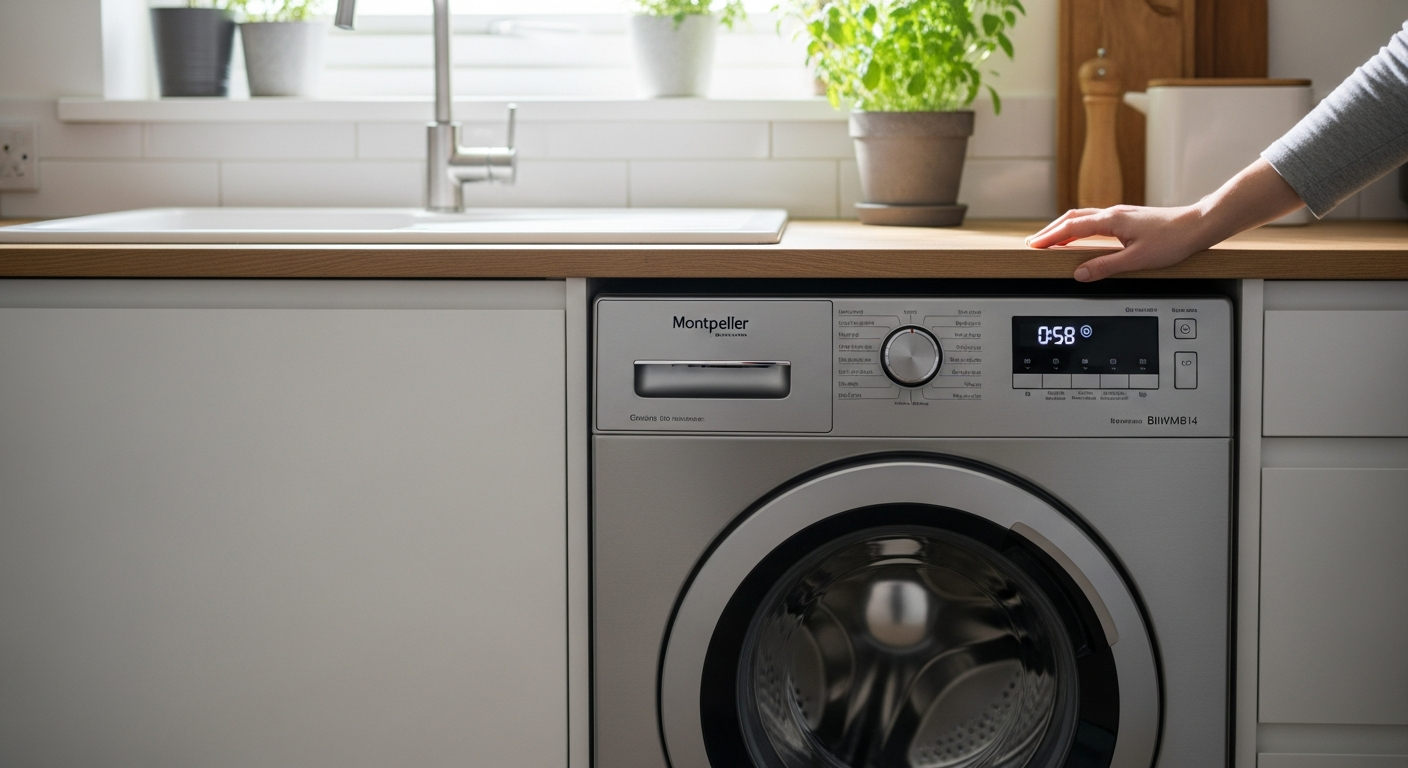
Discover why the Montpellier MBIWM814 8kg integrated washing machine is the UK’s top choice for seamless kitchen design. Learn about its energy-efficient performance, 14 wash programmes, and competitive £369 price point.
Over 60% of UK homeowners now prioritize kitchen aesthetics alongside functionality—and that's where integrated appliances have become absolute game-changers. The frustration of choosing between a powerful washing machine and a cohesive kitchen design is finally becoming obsolete, thanks to appliances engineered specifically to vanish behind cabinet doors while delivering serious laundry performance.
The Montpellier MBIWM814 has captured significant market attention as a best-selling integrated washing machine from Core Appliances UK, and for good reason. This isn't just another built-in appliance; it's a carefully engineered solution that marries aesthetic appeal with practical household functionality. With an 8kg capacity, A-energy rating, and 14 specialized wash programmes, it addresses the real needs of modern UK families who refuse to compromise on either style or substance.
Explore the Montpellier MBIWM814 at Core Appliances UK today.
Throughout this guide, you'll discover how its hidden integration works, explore its comprehensive wash programme lineup, understand the genuine cost savings it delivers, and learn whether this £369 investment truly justifies the integrated appliance premium compared to freestanding alternatives.
The Hidden Integration Advantage: How Built-In Design Transforms Your Kitchen
How integrated washing machines differ from freestanding models in terms of installation and aesthetics
Integrated washing machines operate on entirely different principles than their freestanding counterparts. Rather than sitting as standalone units that dominate kitchen space, they tuck seamlessly behind custom cabinet doors, creating a unified visual experience that extends throughout your kitchen. This fundamental difference shapes everything from installation complexity to long-term maintenance considerations.
The aesthetic transformation is immediate and dramatic. Instead of a prominent appliance front, visitors see only a cabinet door that matches your surrounding cabinetry. This approach eliminates the visual clutter that even the sleekest freestanding machine can't avoid, creating the impression of a kitchen specifically designed as a cohesive whole rather than a collection of individual elements.
The MBIWM814's precise dimensions and how they fit standard kitchen cabinet spaces
The MBIWM814 measures approximately 82.5cm (H) x 59.5cm (W) x 54cm (D)—dimensions precisely calibrated to fit standard integrated appliance spaces found in most modern UK kitchens. This standardization matters considerably because it means you're not forcing a square peg into a round hole or dealing with awkward gaps that require custom solutions.
When your kitchen was designed with integrated appliance spaces in mind, these measurements align perfectly with those cavities. The height accommodates the typical plinth and top cabinet clearance, the width matches standard cabinet module widths, and the depth allows for proper ventilation and connection access without protruding beyond your cabinet line. This precision removes guesswork from the installation process.
The visual impact of concealing a washing machine behind a cabinet door on overall kitchen design cohesion
A kitchen with an exposed washing machine—even a contemporary-looking one—creates a visual interruption. Your eye naturally lands on that appliance, and it becomes a focal point whether you intended it or not. Integrated design eliminates this distraction entirely.
What many homeowners discover after installation is that this hidden approach actually enhances perceived kitchen quality. Without an appliance visibly occupying space, the room feels larger, more intentional, and more sophisticated. The kitchen reads as a unified design statement rather than a functional space where aesthetics were an afterthought. Cabinet doors that match surrounding units create visual flow that extends naturally across your entire kitchen.
Installation requirements and why professional fitting is typically necessary for integrated models
Freestanding washing machines slide into place, connect to water and waste outlets, and you're done. Integrated models demand considerably more finesse. Professional installation becomes essential because these appliances must align perfectly with cabinet frameworks, which rarely account for slight variations in plumbing or electrical positioning that professional installers regularly encounter.
The cabinet door itself requires careful adjustment to open and close smoothly despite the appliance sitting inside. Ventilation grilles must be positioned correctly to prevent moisture accumulation. Plumbing connections often need creative routing to avoid conflicts with cabinet structure. Electrical connections need protection from the indoor cabinet environment. Each of these elements exceeds what standard homeowner installation typically handles.
A professional fitter arrives with the knowledge to assess your specific kitchen layout, identify potential obstacles before they become problems, make necessary adaptations, and ensure everything operates smoothly from day one. This expertise prevents costly mistakes that could damage your kitchen cabinetry or compromise appliance function.
The trade-off between aesthetic seamlessness and accessibility for maintenance or repairs
This represents perhaps the most honest trade-off in integrated appliance ownership. The hidden design that looks beautiful creates genuine challenges if something eventually needs attention. Unlike freestanding machines where you simply pull the unit forward and access components, integrated models require removing the cabinet door, and potentially other components, just to reach the washing machine itself.
Routine maintenance like cleaning the detergent dispenser or checking filters becomes a slightly more involved process. If a repair is ever necessary, your engineer needs to work within the cabinet space rather than having full access around the unit. This doesn't make repairs impossible—it simply means they take longer and potentially cost more than equivalent work on freestanding models.
For most people, this trade-off proves worthwhile. Years pass between servicing needs on modern washing machines, and many owners never require post-warranty repair work. The daily aesthetic pleasure of an integrated design often outweighs the hypothetical inconvenience of future maintenance challenges.
Why integrated appliances command a premium price despite similar core functionality
The mechanical internals of the MBIWM814 don't differ dramatically from comparable freestanding machines. Both wash clothes effectively, both use similar motor technology, both offer comparable programme selections. Yet the integrated version carries a price premium. Understanding where this premium originates clarifies whether it represents fair value for your situation.
The premium partially reflects custom cabinetry requirements and the cost of engineering appliances to fit within cabinet spaces rather than standing alone. Integrated models require reinforced frames and adjusted component placement to work within confined spaces. Manufacturers build smaller production runs for integrated versions compared to freestanding equivalents, reducing economies of scale and increasing per-unit costs.
Beyond manufacturing, much of the premium reflects design sophistication and the aesthetic solution the appliance represents. You're paying for the ability to have a powerful washing machine without sacrificing your kitchen's visual integrity. This is genuinely valuable if your kitchen design matters to you, less valuable if aesthetics aren't a priority.
Capacity and Power: Understanding the 8kg Load and 1400 RPM Spin Speed
What an 8kg capacity means for typical household laundry volumes and family sizes
An 8kg capacity handles approximately 40 adult cotton t-shirts, or roughly 16 pairs of jeans, or about 8 bath towels in a single load. For practical purposes, this means households of 3-5 people typically manage their laundry week with 3-4 wash cycles. Smaller households need even fewer loads, while larger families might require an additional load or two depending on lifestyle.
The capacity sweet spot works particularly well for modern household patterns. Most people don't wash every item they own in a single week. Work clothes, casual wear, underwear, and socks cycle through regular washing while seasonal items and less-frequently worn pieces space out between washes. The 8kg capacity accommodates this realistic pattern without forcing you into daily washing routines.
How the 1400 RPM spin speed reduces drying time and energy consumption post-wash
Higher spin speeds extract more water from wet fabrics during the final cycle stage, and this difference compounds across every load you wash. At 1400 RPM, the MBIWM814 removes significantly more moisture than machines spinning at 1000 RPM or lower. Fabrics emerge noticeably drier, whether you're tumble-drying them afterward or line-drying on a clothesline.
This efficiency matters because wet fabrics require substantial energy input to dry, whether that energy comes from your tumble dryer or outdoor sun and wind. Every extra percentage point of water removed during the wash cycle means proportionally less drying time required afterward. For a family doing regular laundry, this compounds to genuine energy savings month after month. Additionally, faster drying times reduce moisture hanging in your home, which benefits ventilation and mold prevention.
Comparison of load capacity against freestanding alternatives in the same price bracket
Within the £300-£400 price range, freestanding washing machines typically offer 7kg to 9kg capacities. The MBIWM814's 8kg places it squarely in the middle of this range, meaning you're not sacrificing capacity for the integrated design benefit. A comparable freestanding 8kg machine at similar price points offers nearly identical washing capability without the aesthetic advantage.
Where capacity comparisons become interesting is considering value per kilogram. Premium freestanding models in the £600+ range often feature 10kg or 12kg capacities, but that increased capacity comes with proportionally higher price tags. The MBIWM814 delivers respectable capacity at a price point that makes integrated design accessible to households that might otherwise choose freestanding alternatives out of budget necessity.
The relationship between spin speed and water extraction efficiency
Spin speed directly correlates with the centrifugal force applied to wet clothing. Higher RPM values generate greater force, mechanically pressing water outward from fabric fibers more effectively. A 1400 RPM spin extracts noticeably more moisture than a 1200 RPM equivalent—the difference isn't marginal.
This efficiency becomes apparent in practical terms. Clothes spun at 1400 RPM feel measurably drier to the touch compared to those spun at lower speeds. Line-dried items dry hours faster. Tumble-dryer cycles run shorter and consume less energy. Over hundreds of loads throughout a washing machine's lifespan, this efficiency difference represents substantial energy and cost savings.
Real-world scenarios where the 8kg capacity proves sufficient versus when larger households might struggle
The 8kg capacity works beautifully for typical weekly laundry routines in 3-5 person households. A family of four generating roughly 16-20kg of laundry weekly manages comfortably with 2-3 loads. Households with young children producing smaller individual items sometimes need only 2 loads weekly.
Scenarios where 8kg becomes limiting typically involve larger families (6+ people), households with exceptionally high laundry volumes (athlete households, homes with young children in cloth diapers, families with significantly more laundry-intensive lifestyles), or people who prefer washing infrequently and doing fewer, larger loads. Some people with smaller households also prefer larger-capacity machines simply to minimize the total number of loads they run annually.
For most UK households, 8kg represents the practical sweet spot—large enough to minimize load frequency but not so large that you're waiting to accumulate enough washing to justify running a cycle.
How powerful spin cycles contribute to lower tumble-drying costs and environmental impact
Every minute a tumble dryer runs consumes approximately 4-5 kilowatt-hours of energy. A load that exits the washing machine still saturated with water might require 60+ minutes of tumble drying, while the same load spun at 1400 RPM often dries in 30-40 minutes. Across a year of regular laundry, this efficiency difference translates to 20-30% lower tumble-drying energy consumption.
From an environmental perspective, lower energy consumption directly reduces household carbon footprint. Fewer minutes of tumble drying means proportionally reduced electricity draw from the grid and fewer emissions associated with power generation. For households attempting to reduce environmental impact, the efficiency gains from powerful spin speeds contribute meaningfully to that goal.
Energy Efficiency That Actually Saves Money: The A-Rating Breakdown
What the A energy rating means in practical terms for annual running costs
The A energy rating indicates the MBIWM814 operates at the top tier of efficiency for its washing machine category. Rather than abstract performance ratings, this translates to concrete numbers: approximately £25-£35 annually for water and energy combined, based on typical usage patterns and UK utility rates.
This rating accounts for all energy consumed during operation—the motor, water heating (where applicable), and electronics. A-rated machines consume roughly 20-30% less energy than machines rated just one category lower. Multiply this efficiency across hundreds of loads over a washing machine's 8-12 year lifespan, and the savings accumulate to £200-£400 compared to a standard-rated equivalent.
Water consumption specifics: 48 litres per cycle on the Eco 40-60 programme
The Eco 40-60 programme uses just 48 litres of water per cycle—approximately 19 litres less than older washing machines typically consumed on standard programmes. For a family running 4-5 loads weekly, this efficiency equates to roughly 10,000 litres of water saved annually compared to less efficient models.
Beyond the direct cost savings (water at approximately 2p per litre means roughly £200 annual savings), reduced water consumption benefits your household's overall environmental footprint. Water treatment and heating both carry energy costs and environmental impacts. The MBIWM814's efficient water use reduces both factors meaningfully.
Energy consumption data: 0.472 kWh per cycle and how this compares to older washing machines
An average wash cycle consumes 0.472 kWh of electricity—a remarkably efficient figure considering this includes motor operation, pump function, control systems, and any heating functions. Older washing machines from 10-15 years ago typically consumed 0.8-1.2 kWh per equivalent cycle, meaning the MBIWM814 uses roughly 40-50% less electricity per load.
At current UK electricity rates (approximately 24p per kWh), this translates to roughly 11p per wash cycle. Running 5 loads weekly means approximately 29p weekly in electricity costs, or roughly £15 annually. Compared to older machines consuming double this amount, a household washing regularly saves £300+ over a decade.
The Eco 40-60 programme and how it balances cleaning performance with resource conservation
The Eco 40-60 programme represents modern washing machine engineering at its finest—delivering genuine cleaning performance while using minimal water and energy. It operates at 40°C water temperature (hence "40" in the name) and accommodates both 40°C and 60°C wash cycles (hence the range), automatically adjusting based on fabric types selected.
This programme specifically targets the reality that most household laundry doesn't require hot water to get clean. Modern detergents work effectively in cool water, and heating water represents a substantial portion of washing machine energy consumption. By eliminating unnecessary heating, the Eco programme cuts energy use dramatically without compromising cleanliness. Most households find they use this programme for 60-70% of their weekly laundry.
Discover the energy-saving potential of the Montpellier MBIWM814 on Core Appliances UK.
Estimated annual savings when switching from a standard-rated machine to the MBIWM814
A household switching from a 10-year-old D or E-rated washing machine to the MBIWM814 typically saves £300-£400 annually in combined water and electricity costs. This calculation assumes 5 loads weekly at UK current utility rates and reflects the efficiency gap between older technology and modern A-rated equipment.
For a family of four replacing a standard-rated machine, this £300+ annual saving means the integrated appliance premium (perhaps £50-£100 more than a comparable freestanding model) pays for itself within months. Over the machine's 8-10 year lifespan, these savings accumulate to £2,400-£4,000, making the efficiency investment genuinely significant.
How energy-efficient operation impacts your household carbon footprint
The average UK household produces roughly 5-6 tonnes of carbon annually. Appliances account for approximately 10-15% of household emissions, with hot water and heating representing major contributors. An energy-efficient washing machine reduces your appliance-related emissions by 30-40% compared to standard alternatives.
Across a decade of ownership, the carbon savings from A-rated machine operation equate to roughly 2-3 tonnes of avoided emissions. For households actively working to reduce environmental impact, this represents a meaningful contribution achievable through practical purchasing decisions.
Long-term cost analysis: investment payback period through reduced utility bills
If the MBIWM814 costs £369 from Core Appliances UK and a comparable freestanding machine costs £329, the integrated premium is £40. At £300-£400 annual savings, this premium pays for itself within weeks. Even if you factor in modest installation costs (perhaps £100-£150 for straightforward integrated installation), the payback period extends to perhaps 2-4 months.
Beyond payback period, years 2-10 of ownership represent pure financial benefit from efficiency choices made at purchase. This long-term perspective separates appliance costs from appliance value—the latter accounting for efficiency savings across the lifespan, not simply the upfront price tag.
14 Wash Programmes Explained: Finding the Right Cycle for Every Load
Overview of the complete programme selection and which cycles suit specific fabric types
The MBIWM814 offers 14 distinct wash programmes, each engineered for specific fabric types or laundry situations. Rather than forcing all laundry through generic cycles, this variety means you can match washing intensity to what you're actually washing. Delicate silks get gentle treatment, robust cottons get powerful cleaning, and everyday loads get balanced performance.
The programme selection covers standard requirements: cottons, synthetics, delicates, mixed fabrics, wool, and specialized cycles for specific situations. This range accommodates the diversity of modern wardrobes, from work clothes to casual wear to occasional formal pieces.
The 15-minute quick wash feature for lightly soiled everyday items
Most household laundry isn't heavily soiled—work clothes worn for 8 hours, casual items, light undergarments. The 15-minute quick wash cycle handles these everyday loads perfectly, completing a full wash and spin in a quarter of the time standard cycles require.
Running this programme 2-3 times weekly instead of longer cycles dramatically reduces overall water and energy consumption. For frequently-used items that need freshening rather than deep cleaning, this cycle delivers practical efficiency that reflects real household laundry patterns.
Eco 40-60 programme benefits and when to use it for maximum efficiency
Discussed earlier in depth, the Eco 40-60 programme suits the majority of household laundry. Use it for regular work clothes, everyday casual wear, undergarments, socks, and most mixed loads. Reserve it for anything you'd normally wash at 40°C or 60°C temperature. Modern detergents activate effectively in cool water, making this programme suitable for the vast majority of loads most households wash.
Steam Wash technology and its advantages for sanitizing and allergen removal
The Steam Wash programme uses steam injection to sanitize fabrics without requiring extremely hot water. This approach kills bacteria and allergens while using less energy than traditional hot water washing. For households with allergies, sensitive skin, or people concerned about sanitization (parents of young children, for instance), this programme offers genuine practical benefit.
Steam penetrates fabric fibers differently than water, reaching deeper into material structure and effectively removing dust mites, pollen, and other allergens. The programme complements rather than replaces standard washing—use it for allergenic items like pillowcases, duvet covers, and bedroom textiles that you want to sanitize thoroughly.
Baby Care programme specifications and why families with infants prioritize this feature
The Baby Care programme combines extended rinsing cycles with gentle washing to remove detergent residue more thoroughly while protecting delicate baby fabrics. Sensitive infant skin reacts to detergent residue remaining in fabric fibers, and thorough rinsing removes more of this irritant than standard cycles achieve.
This programme addresses a genuine need for families with babies or young children. Many parents purchasing the MBIWM814 specifically prioritize this feature, viewing it as essential rather than optional. Handling baby clothes separate from household laundry becomes unnecessary—the Baby Care cycle handles everything appropriately.
Specialized cycles for delicates, synthetics, cottons, and mixed fabrics
Cotton cycles provide powerful cleaning action suitable for robust materials that tolerate vigorous agitation. Synthetic cycles use gentler agitation and often lower spin speeds to protect modern textiles. Delicate cycles provide minimal agitation and reduced spin speed specifically for silk, satin, and other fragile materials. Mixed fabric cycles balance competing requirements when different materials wash together.
Having specific cycles for each category prevents the over-washing of delicate items and the under-washing of robust materials. Your clothes last longer when each item receives appropriate treatment rather than everything going through identical cycles.
Delay start functionality (up to 24 hours) and how it optimizes energy usage during off-peak hours
The 24-hour delay start feature allows you to load the washing machine, set your preferred programme, and schedule it to begin at a specific future time. This proves valuable for several reasons. First, it enables washing during off-peak electricity hours when rates are lower (if you're on a time-of-use tariff). Second, it spreads laundry throughout the day rather than bunching all washing into your available free time.
From a practical household perspective, you might load the machine before work, delay-start it to begin during mid-morning when you have time to move laundry to drying, or schedule it to run during the evening so clothes dry overnight. This flexibility optimizes your daily routine while potentially reducing energy costs.
User-Friendly Controls and Safety Features That Matter Daily
LED display clarity and ease of navigating programme selection
The MBIWM814 features an LED display that clearly indicates selected programme, remaining time, and current cycle stage. This straightforward interface eliminates confusion about whether your wash is running properly or approaching completion. The control panel organizes buttons logically, grouping related functions in intuitive layouts that require minimal learning curve even for first-time users.
Compared to more complex integrated appliance interfaces requiring multiple button sequences to access basic functions, the MBIWM814 prioritizes clarity. You can quickly select a programme, adjust temperature or spin if needed, and start the cycle without navigating confusing menus.
Child lock functionality and why it's essential in households with young children
The child lock prevents accidental programme changes or cycle interruption once washing has started. Curious toddlers can't halt a running cycle, and young children can't fiddle with settings mid-wash. For families with children old enough to be curious but not old enough to understand consequences, this safety feature provides genuine peace of mind.
Activating child lock requires deliberate action—it's not a default setting you forget about. Once enabled, it remains active until you specifically disable it, making it a reliable protective mechanism rather than something requiring constant re-engagement.
Intuitive control panel design compared to more complex integrated appliance competitors
Some integrated washing machines prioritize aesthetics to the point of compromising usability, employing touch panels or hidden button sequences that frustrate everyday operation. The MBIWM814 rejects this trade-off, providing straightforward physical buttons and a logical control layout.
You don't need to consult the manual for basic operation. Buttons are clearly labeled, the sequence is obvious, and the interface responds consistently. For an appliance you use multiple times weekly for years, this usability difference compounds into genuine quality-of-life impact.
How the delay start feature integrates with smart home routines and energy management
Beyond basic utility savings, delay start enables integration with broader home energy management. If you're monitoring household energy consumption and actively scheduling high-load appliances during off-peak periods, the MBIWM814 participates in these efficiency efforts. Setting the machine to run during identified low-cost periods across your week contributes to overall household energy optimization.
Noise level considerations: 72 dB spin noise and what this means for kitchen proximity to living spaces
At 72 dB, the MBIWM814's spin cycle produces noise comparable to an alarm clock or heavy traffic. This is quieter than some washing machines but audible enough that you'd notice it if the kitchen opens directly onto a living room where you're watching television. For kitchens with sound insulation or separated from main living areas, 72 dB causes no practical concerns. Integrated cabinet installation itself provides some sound buffering compared to exposed freestanding models.
If your kitchen is open-plan and immediately adjacent to quiet spaces where family members gather, this noise level warrants consideration. Running the machine during times when noise is less disruptive (evening hours, when you're not watching television) minimizes any practical impact.
Warranty coverage: 2-year manufacturer protection and what it includes
The MBIWM814 includes 2-year manufacturer's warranty covering defects in materials and workmanship. This means if the motor fails, electronic controls malfunction, or structural components break due to manufacturing issues, repair or replacement is covered. Normal wear and tear, accidental damage, and issues resulting from improper installation are not covered.
For a £369 appliance, two years of coverage provides meaningful protection during the period when manufacturing defects are most likely to surface. Most washing machines operate reliably well beyond warranty expiration—the two-year window addresses early-life failures rather than protecting against long-term wear.
The Installation Reality: What You Need to Know Before Purchasing
Why integrated appliances require professional installation versus DIY freestanding setup
Freestanding washing machines essentially install themselves—position, connect water inlet, connect waste outlet, plug in, and operate. Integrated models require alignment with cabinet structure, proper ventilation, potential cabinet modification, and careful door fitting. These elements exceed typical homeowner capability and exceed what standard installation instructions cover.
A professional fitter brings tools designed for integrated installation, knows how to identify and resolve issues specific to built-in appliances, and ensures final installation meets manufacturing standards. Without professional expertise, you risk improper alignment, ventilation problems, or door operation issues that compromise functionality or durability.
Cabinet space requirements and compatibility with existing kitchen layouts
The MBIWM814's 82.5cm (H) x 59.5cm (W) x 54cm (D) dimensions fit standard integrated appliance spaces, but your specific kitchen must have such a space available. Not all kitchens include integrated appliance cavities. Some kitchens have spaces sized for different appliances (smaller dishwasher spaces, for instance). Your cabinet maker or kitchen designer must confirm that dimensions match before purchasing.
Additionally, the space must accommodate utility connections—water inlet, waste outlet, electrical supply. If your kitchen design locates the integrated washing machine space far from existing plumbing or electrical routes, connection becomes complex and costly. Confirming utility accessibility prevents expensive surprises during installation.
Plumbing and electrical connection considerations specific to integrated models
Integrated washing machines need the same water inlet and waste outlet as freestanding equivalents, but locating these connections within cabinet structure requires careful routing. Flexible hoses might need to bend at angles that compress or kink, potentially restricting flow. Professional installers route connections to avoid these problems, sometimes running larger diameter pipes or using custom connectors to fit cabinet constraints.
Electrical supply must reach the appliance safely and require a dedicated circuit where possible. Cabinet interiors aren't naturally designed as electrical environments, so protection of connections and careful routing prevents moisture issues or electrical hazards.
The complexity of future repairs or servicing when an appliance is built-in
This represents the most honest challenge of integrated ownership. If your washing machine needs repair five years into ownership, the engineer must access it within the cabinet space. The cabinet door comes off. Other internal cabinet components might require temporary removal. Access to certain components becomes limited compared to freestanding models where the unit pulls completely forward.
This doesn't make repairs impossible—modern washing machines rarely require extensive repair work anyway. But future service becomes more involved than equivalent work on freestanding machines. If this is a genuine concern for your household, it warrants factoring into your decision-making.
Cost implications of installation beyond the £369 purchase price
Professional integrated installation typically costs £100-£200 depending on local rates and specific circumstances. Some installations require cabinet modification if space dimensions don't perfectly match (perhaps £50-£100 in carpentry). If plumbing or electrical routing demands custom work, costs escalate accordingly.
Budget £100-£150 as a baseline for straightforward installation, potentially more if your kitchen layout presents specific challenges. This cost reduces the attractiveness of the integrated design from a pure economics perspective but doesn't eliminate it entirely—efficiency savings still accumulate over time.
Timeline expectations from purchase to full operational status
From purchase to operational washing machine typically requires 2-4 weeks. Appliance availability, professional installer scheduling, and any necessary cabinet modifications drive the timeline. Unlike freestanding machines that might operate the same day of delivery, integrated installation demands coordination and careful execution that take time.
Factor this timeline into kitchen renovation scheduling. If you need operational laundry capability on a specific date, plan backwards accordingly and confirm installer availability before finalizing appliance purchase.
When to involve a kitchen designer versus a standard appliance fitter
If you're undertaking comprehensive kitchen renovation, your kitchen designer should incorporate integrated appliance space during the design phase. They understand dimension requirements and utility routing logistics necessary to make installation straightforward.
If you're retrofitting an integrated appliance into existing kitchen space, a professional appliance fitter assesses whether the space accommodates the MBIWM814 and handles the installation itself. Most fitters have seen countless kitchen layouts and can identify potential complications before they become expensive problems.
Competitive Pricing in the Integrated Appliance Market: Is £369 Fair Value?
Price positioning of the MBIWM814 within the integrated washing machine category
At £369, the MBIWM814 occupies the lower-to-mid range of integrated washing machine pricing. Premium integrated models reach £600-£900, while the absolute budget options start around £300. Positioned here, the MBIWM814 offers solid value—sufficient features and capacity without premium pricing.
This positioning reflects its market popularity. Not the cheapest option, not premium-priced, but landing at a price point where households can access integrated design without extraordinary budget strain. Core Appliances UK's listing at exactly £369 places it competitively within current market conditions.
Feature-to-cost ratio compared to similarly priced freestanding alternatives
A comparable freestanding 8kg washing machine with 14 programmes and A-energy rating might cost £329-£349. The MBIWM814 costs perhaps £20-£40 more, representing roughly 6-12% price premium. This premium reflects the integrated design benefit, the engineering required to function within cabinet constraints, and the smaller production run for integrated models.
Is this premium worth it? If hidden design significantly enhances your kitchen appeal and you value aesthetics alongside functionality, absolutely. If you're indifferent to appliance visibility and purely optimizing laundry capability per pound spent, freestanding alternatives offer superior raw value.
The integrated appliance premium: how much extra you're paying for hidden design
The integrated premium breaks down roughly as follows: manufacturing engineering for cabinet integration (perhaps 2-3% of cost), reduced production volume economies of scale (2-3% premium), design sophistication (2-3%), and the genuine aesthetic benefit (3-5%). Combined, this justifies the 6-12% price premium observed in the market.
Quantifying the "aesthetic benefit" price is challenging because it's inherently subjective. Some households would pay 20% more for integrated design. Others see no value in hidden appliances. Most fall somewhere in between, viewing the 10% premium as reasonable for the visual benefit achieved.
Where to find the best pricing and whether £369 represents current market value
Core Appliances UK at £369 represents competitive current market pricing. Checking multiple retailers confirms whether this price is aligned with broader market conditions or represents specific promotion. As of typical conditions, £369 is fair value—neither unusually high nor suspiciously low.
Occasionally retailers offer modest discounts during seasonal promotions or when clearing stock, potentially reducing price to £349-£359. Conversely, shortage conditions or limited stock availability might push pricing higher. Monitor a few trusted appliance retailers to understand typical pricing variation.
Financing options and payment plans available through retailers
Many appliance retailers offer interest-free financing on purchases above a certain threshold. At £369, the MBIWM814 might qualify for 12-month zero-interest plans, effectively spreading cost across a year without premium charges. When combined with efficiency savings (roughly £25-£35 monthly), financing options make the appliance more immediately affordable.
Confirm financing availability with your chosen retailer before finalizing purchase. The option to spread cost can reduce initial financial impact substantially.
Long-term value proposition considering durability and warranty coverage
The true value of any appliance considers cost across its entire lifespan. At £369 plus modest installation costs, the MBIWM814 requires approximately £400-£450 total initial investment. Over a conservative 10-year lifespan, this represents £4-4.50 per month capital cost.
Adding estimated running costs (approximately £30-£35 annually for water and energy), total annual operating cost is roughly £60-£65. Compare this to older or less efficient machines costing £40-£60 monthly in utilities, and the efficiency advantage compounds substantially. By year five, total cost of ownership favors the efficient new appliance despite higher upfront price.
Hidden costs to factor in beyond the headline price
Installation: £100-£200
Possible cabinet modification: £0-£100
Water and energy annual cost: £30-£35
Warranty extension (if desired, years 2-3): £40-£80
Potential future repairs post-warranty: variable, typically £100-£300 if needed
The £369 headline price is authentic, but realistic total ownership cost in year one is closer to £500-£600. Subsequent years include only running costs and potential repairs, making the efficiency advantage increasingly valuable over time.
Real-World Performance: What Owners Actually Experience
Cleaning effectiveness across different soil levels and fabric types
Users consistently report satisfying cleaning performance across varied loads. Everyday items emerge genuinely clean. Heavily soiled work clothes come out fresh. Delicate items don't emerge overwashed or damaged. The programme variety means different item types receive appropriate treatment rather than generic one-size-fits-all washing.
The 1400 RPM spin speed produces noticeably drier clothes compared to standard machines, reducing subsequent drying requirements. Users particularly appreciate this when air-drying, noting that clothes dry hours faster than previous appliances produced.
Reliability feedback from UK households using the MBIWM814
Reliability reports are broadly positive. Users report consistent operation without unexpected failures during ownership. The 2-year warranty rarely requires invocation, suggesting manufacturing quality is solid. When issues do occur, they're typically minor (perhaps control panel quirks or occasional error codes) rather than mechanical failure.
This reliability aligns with expectations for modern washing machine engineering. Mechanical components are proven designs, control systems are established technology, and manufacturing quality is appropriate for the price point.
Common user experiences with the 14 wash programmes in everyday situations
Most owners report using 3-4 programmes regularly (Eco 40-60 for most laundry, quick wash for light loads, cotton for robust items, delicate for occasional fragile clothing) and ignoring