
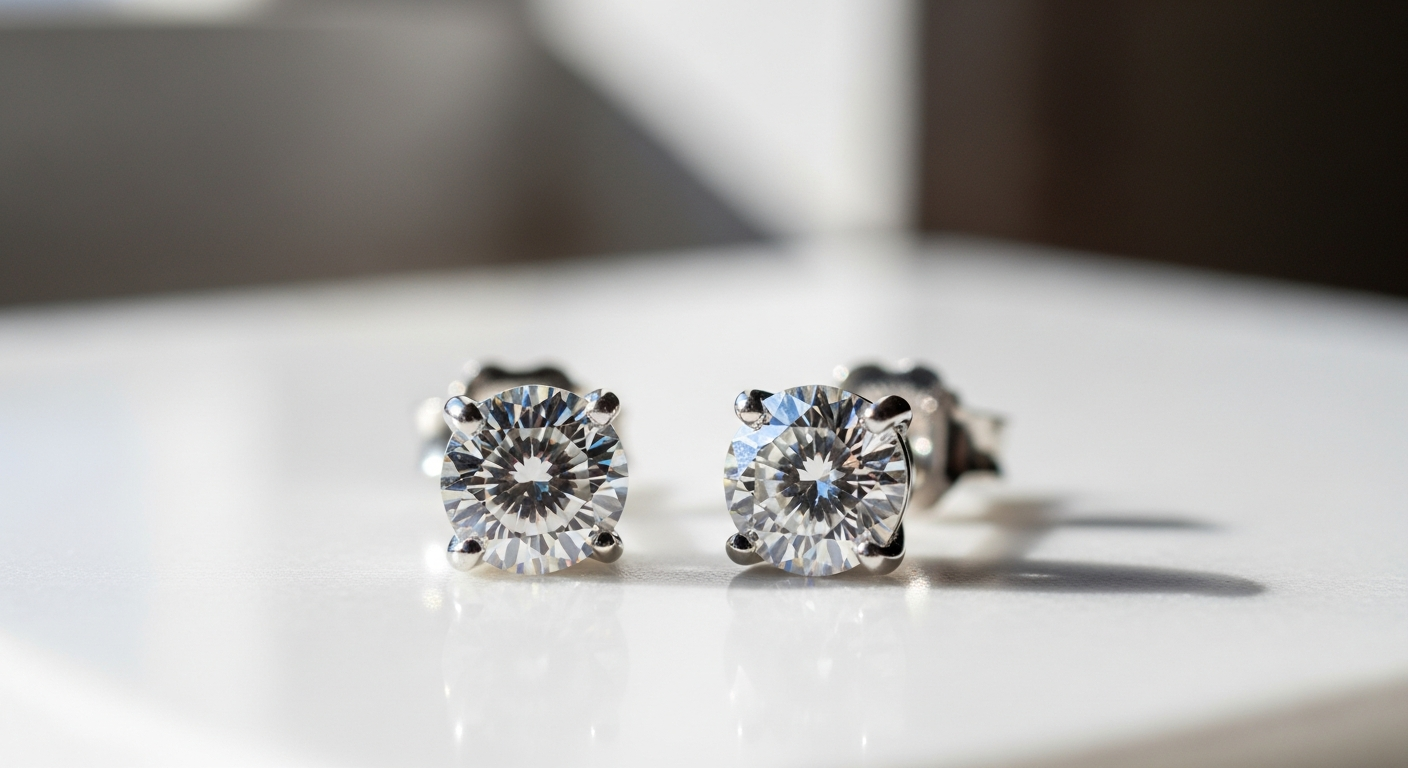
Discover authentic moissanite stud earrings in sterling silver with 80%+ savings through auction bidding. Learn what makes these affordable luxury pieces worth your investment—plus insider tips for smart shopping.
Moissanite has revolutionized the jewelry market, democratizing access to stunning gemstones that once belonged exclusively to luxury-brand customers. What was once an unattainable dream—owning a brilliant pair of stud earrings for under $60 instead of dropping $350 or more at traditional retailers—is now within reach for anyone willing to shop smart.
The transformation hinges on a simple but powerful shift: lab-created moissanite paired with durable sterling silver delivers the sparkle, brilliance, and elegance of fine jewelry without the astronomical price tag. These aren't costume pieces or compromises on quality; they're genuine gemstones engineered to last a lifetime, offering optical properties that rival their traditional counterparts at a fraction of the cost.
Discover how moissanite stud earrings can transform your jewelry collection affordably.
What Makes Moissanite Different from Diamond Stud Earrings
Optical brilliance comparison: How moissanite's refractive index creates a distinctive sparkle
Moissanite owes its breathtaking sparkle to its refractive index—the degree to which light bends as it passes through the stone. With a refractive index of 2.65, moissanite actually exceeds diamond's 2.42, creating a distinctive optical signature. This manifests as exceptional brilliance and fire, producing that coveted rainbow sparkle under bright light. Some prefer this distinctive flash as a personal signature; others appreciate it as proof of authenticity without requiring certification documents. The visual difference depends largely on lighting conditions and personal taste, but moissanite consistently commands attention.
Durability and hardness: Moissanite ranks 9.25 on the Mohs scale—nearly as hard as diamond (10)
Hardness directly translates to longevity and scratch resistance. Moissanite rates 9.25 on the Mohs hardness scale, placing it just below diamond at 10. For practical purposes, this means your earrings can withstand daily wear without losing their polished finish. Scratches and dullness that plague softer gemstones simply won't occur with moissanite, making these studs suitable for active lifestyles, work environments, or anyone who refuses to baby their jewelry.
Cost differential: Why moissanite costs 70-80% less while maintaining similar aesthetic appeal
The price gap exists because moissanite is lab-created rather than mined. Natural diamonds require extensive mining operations, complex supply chains, and significant environmental impact, all factored into retail pricing. Moissanite production occurs in controlled laboratory settings, reducing overhead and eliminating scarcity markup. The result: you pay for the material's genuine properties—hardness, brilliance, durability—without subsidizing mining infrastructure or artificial scarcity premiums. That 70-80% savings represents honest value, not corner-cutting.
Sterling Silver Settings: Quality, Care, and Value Considerations
Sterling silver purity standards: Why .925 sterling silver is the industry benchmark for fine jewelry
Sterling silver must contain at least 92.5% pure silver, with the remaining 7.5% comprising other metals (typically copper) that enhance durability. This .925 standard exists because pure silver alone is too soft for jewelry. The copper alloy strengthens the metal without compromising its lustrous appearance or hypoallergenic properties. Quality earrings feature this .925 hallmark stamped or engraved into the setting—a small but crucial indicator of authentic fine jewelry rather than plated or costume pieces.
Tarnish prevention and maintenance: Practical tips for keeping your earrings looking pristine
Sterling silver tarnishes when exposed to sulfur compounds in air and moisture. Prevention beats correction: store earrings in airtight containers, anti-tarnish pouches, or sealed plastic bags. Remove earrings before showering, swimming, or applying lotions and perfumes. For light tarnish, a soft microfiber cloth restores shine instantly. For heavier buildup, soak earrings in a mixture of baking soda and water, then gently scrub with a soft brush. Avoid commercial silver dips on moissanite, as the harsh chemicals can damage certain setting finishes.
Durability for everyday wear: How sterling silver performs compared to gold or platinum
Sterling silver performs admirably for stud earrings because posts and backs endure minimal stress compared to rings or bracelets. While sterling silver is softer than gold or platinum, studs don't experience the flexing and pressure that would accelerate wear. Many owners wear sterling silver studs daily for years without notable damage. Gold and platinum offer enhanced durability but at significantly higher costs—a worthwhile trade-off only if you prefer those metals' aesthetic or have specific allergies to silver. For value-conscious shoppers, sterling silver delivers excellent longevity.
Understanding Carat Weight and Size Options for Studs
Carat weight range: Available options from 1.00 carat to 3.20 carat total weight
Moissanite carat weight measures mass similarly to diamonds, though moissanite is slightly less dense, meaning a 1.5-carat moissanite appears marginally larger than a 1.5-carat diamond of identical cut. Available options span from modest 1.00-carat pairs to substantial 3.20-carat statements. Each weight category serves distinct purposes: smaller carats suit professional environments or minimalist aesthetics, mid-range options (1.5-2.0 carats) balance presence with subtlety, while 2.5+ carats command immediate attention.
Visual size differences: How carat weight translates to actual diameter and presence on the ear
Translating carat weight to visible size requires understanding how weight distributes across the stone's diameter. A 1.0-carat moissanite round stud typically measures approximately 6.4mm in diameter—noticeable but refined. A 2.0-carat stone reaches roughly 8.2mm, appearing significantly larger while remaining elegant. The 3.20-carat option pushes toward 10mm, creating undeniable presence. On ears, these differences feel substantial. Smaller stones suit understated wearers; moderate weights provide visibility without ostentation; larger carats make statements that spark conversations and compliments.
Personal preference factors: Choosing between subtle elegance and statement-making sparkle
Your choice hinges on lifestyle, personal style, and how jewelry figures into your identity. Those favoring minimalist aesthetics or professional dress codes gravitate toward 1.0-1.5 carats. Social butterflies, creative professionals, and personality-forward individuals often prefer 2.0-2.5 carats. Beyond that, you're embracing boldness intentionally. Consider your daily activities: active professionals might prefer smaller studs for less distraction, while those seeking confidence boosts choose more prominent sizes. There's no wrong answer—only your authentic preference expressed through jewelry selection.
The Auction Model vs. Traditional Retail: Where the Savings Really Come From
Bids.com auction mechanics: How the bidding process works and when buy now options activate
Bids.com operates as a hybrid platform combining traditional auctions with fixed-price "buy now" options. During auctions, users place incremental bids competing for items; the highest bidder wins at auction close. Buy now options bypass bidding entirely, offering immediate purchase at a set price. Moissanite stud earrings frequently appear in both formats. Understanding the distinction matters: auctions potentially yield lower final prices through competitive pressure, while buy now options provide certainty but at preset markups. Savvy shoppers monitor both channels, selecting whichever offers superior value for their target item.
Discount percentages explained: Breaking down the 80% off retail claims and what they actually mean
Bids.com advertises discounts as percentages off stated retail values—often claiming "over 80% off." This phrasing requires scrutiny. The actual savings depend entirely on the retail baseline used for comparison. If a moissanite stud earring pair carries a $351 retail valuation, an $59 final price genuinely represents 83% savings. However, some critics argue that manufacturer-suggested retail prices are inflated to make discounts appear more dramatic. Evaluate offers by comparing across multiple listings and considering absolute price rather than percentage claims. A $59 pair remains an excellent value regardless of whether the discount truly equals 80% or 75%.
Competitive bidding strategy: Tips for winning auctions without overpaying
Winning auctions at favorable prices requires strategic patience. Research comparable listings to establish your target price—the amount representing genuine value rather than just the lowest possible number. Enter auctions in their final minutes when fewer bidders remain active; early bidding often inflates prices through competitive escalation. Set your maximum bid and resist incremental increases driven by auction momentum. Consider timing: auctions ending during off-peak hours (weekday mornings, early mornings) attract fewer participants, potentially lowering final prices. Above all, walk away when bidding exceeds your predetermined limit—the next auction will offer another opportunity.
Start your search for authentic moissanite studs at unbeatable prices today.
Evaluating Authenticity and Quality Before You Bid
Certification and documentation: What paperwork should accompany genuine moissanite earrings
Authentic moissanite earrings should arrive with documentation confirming the gemstone's origin and characteristics. Reputable sellers provide certificates from gemological laboratories detailing stone specifications: carat weight, dimensions, and confirming moissanite origin. While not every piece requires elaborate documentation, the absence of any paperwork raises questions, particularly for higher carat weights. Sterling silver settings should include .925 hallmarks, though not all pieces bear visible stamps. Request documentation before purchase; sellers confident in their products readily supply it. Vague responses about certification suggest proceeding cautiously.
Seller verification: How to assess Bids.com's credibility and track record
Bids.com maintains an established presence in online retail with years of operational history. Research the platform's reputation through independent reviews, Better Business Bureau ratings, and consumer feedback forums. Individual seller ratings on Bids.com provide crucial insights: look for sellers with lengthy positive histories and substantial transaction volumes. Read recent buyer comments specifically mentioning jewelry quality and accuracy. Consistent complaints about inflated retail values, inconsistent quality, or customer service issues warrant caution. Cross-reference seller information and check for any pattern of complaints regarding similar products. A single negative review means little; patterns indicate systemic issues.
Red flags in product listings: Warning signs that suggest overpriced or misrepresented items
Suspect listings display several warning indicators. Dramatically inflated retail values compared to industry standards signal aggressive discount marketing rather than genuine value. Vague descriptions lacking specific measurements, stone specifications, or weight details obscure quality. Low-resolution photos or missing side-view images prevent proper assessment. Excessive promotional language ("INCREDIBLE DEAL," "WON'T LAST LONG") often masks mediocre value. Sellers with spotty histories or defensive responses to questions deserve skepticism. Finally, prices significantly undercut comparable listings without explanation (damage, flaws, returns) suggest hidden problems. Trust your instincts—if something feels off about a listing, hundreds of alternatives exist.
Smart Shopping Strategies for Maximum Value
Timing your bids: When to enter auctions for better odds of lower final prices
Auction timing profoundly impacts competitive dynamics. Auctions ending during business hours attract concentrated bidding as users check listings during work breaks, driving prices upward. Conversely, auctions closing at 3 AM or during holiday periods see fewer participants, often resulting in lower final bids. Geographic timing matters too: auctions ending during non-peak hours in major markets face less competition. Research Bids.com's user traffic patterns and bid accordingly. Additionally, auctions running longer (7-10 days) allow more natural bidder distribution, while 1-2 day auctions compress competition into brief windows. Patience and strategic timing often yield better results than impulsive bidding.
Setting bid limits: Establishing your maximum price before emotions take over
Auction fever clouds judgment. Before viewing any listing, determine your absolute maximum price—the amount beyond which the purchase no longer represents good value. Write this number down and commit to it. During auctions, bidding wars activate competitive instincts, often pushing final prices beyond rational limits. By pre-establishing your ceiling, you remove emotional decision-making. Stick to your limit religiously. Losing an auction to your predetermined maximum means you've exercised discipline; exceeding it means you've paid more than intended for roughly equivalent alternatives. The psychological benefit of winning an auction doesn't justify overpaying.
Comparing across listings: Evaluating multiple similar earrings to identify the best deal
Never bid on the first moissanite stud earrings you encounter. Spend time examining 10-20 comparable listings: same carat weight, similar dimensions, sterling silver settings. Note the carat weight, diameter, retail valuations, and final prices across these listings. Calculate the actual discount percentages and identify which sellers consistently underprice their products. Examine which listings include detailed photos, specifications, and documentation. Patterns emerge: certain sellers regularly offer superior value, while others inflate comparatives. This research transforms you from casual buyer to informed shopper capable of recognizing genuine deals. The time invested pays dividends through smarter purchasing decisions.
Caring for Your Moissanite Sterling Silver Earrings Long-Term
Daily cleaning routine: Simple methods to maintain sparkle without harsh chemicals
Regular cleaning prevents buildup that dulls brilliance. A soft microfiber cloth (included with quality jewelry) restores shine during seconds daily. For deeper cleaning, create a solution of warm water and mild dish soap. Soak earrings for 5-10 minutes, then gently brush around settings with an old toothbrush (soft bristles only). Rinse thoroughly under clean running water and pat dry immediately with your microfiber cloth. Avoid harsh chemicals, bleach, and commercial jewelry cleaners, which can damage certain setting finishes or underlying metals. This simple routine, performed weekly, maintains pristine appearance without requiring professional intervention. The minimal effort yields maximum longevity.
Storage best practices: Protecting earrings from tarnish and physical damage
Proper storage prevents both tarnish and physical damage. After wearing, place earrings immediately into anti-tarnish pouches or airtight containers rather than leaving them exposed. Avoid humid bathrooms where moisture accelerates tarnishing. Store sterling silver separately from other metals, as certain combinations can accelerate corrosion. Use padded jewelry boxes that cushion studs against impact. Keep earrings away from direct sunlight, which can fade certain gemstone treatments (though moissanite itself resists fading). Label storage containers clearly so you find earrings without rummaging through multiple boxes. Organization prevents oxidation and ensures your pieces remain accessible and well-protected.
Professional cleaning: When to seek jeweler services versus at-home care
Home care handles most maintenance needs. However, occasional professional cleaning proves beneficial—typically once annually for regularly worn earrings. Professional jewelers possess ultrasonic cleaners and specialized solutions that remove stubborn buildup inaccessible through home methods. They can also inspect settings for loose stones or damaged prongs, catching problems before they become serious. Professional polishing restores luster to tarnished silver more effectively than home methods. Budget approximately $20-40 per professional cleaning—worthwhile insurance for jewelry you plan to wear for decades. Schedule professional services whenever you notice significant tarnishing or if earrings haven't been professionally cleaned in over a year.
Your Path to Affordable Luxury Starts Here
Moissanite stud earrings in sterling silver represent a genuine opportunity to own beautiful, durable jewelry without traditional luxury price tags. Lab-created moissanite delivers optical brilliance rivaling diamonds at a fraction of the cost, while sterling silver provides timeless elegance and excellent durability for everyday wear. The auction-driven pricing model on platforms like Bids.com democratizes access further, allowing you to secure exceptional pieces for $50-60 that would cost $300+ elsewhere.
Armed with knowledge about gemstone properties, setting quality, authentication markers, and smart shopping strategies, you navigate potential pitfalls and recognize genuine value. You understand moissanite's distinctive sparkle, sterling silver's care requirements, and how carat weight translates to visible presence. You recognize inflated retail comparisons and spot red flags in suspicious listings. You bid strategically, set firm limits, and compare across multiple options before committing.
The best deal ultimately measures success not by final price alone, but by the genuine satisfaction your earrings deliver. A $52 purchase brings joy only if the pieces sparkle brilliantly, fit your aesthetic perfectly, and arrive authentic and undamaged. Price becomes secondary to authenticity, quality, and personal happiness. You'll know you've succeeded when you put on your new moissanite studs, catch your reflection, and smile—thrilled with both the savings and the beauty adorning your ears.
Explore moissanite stud earrings and find your perfect pair today.