
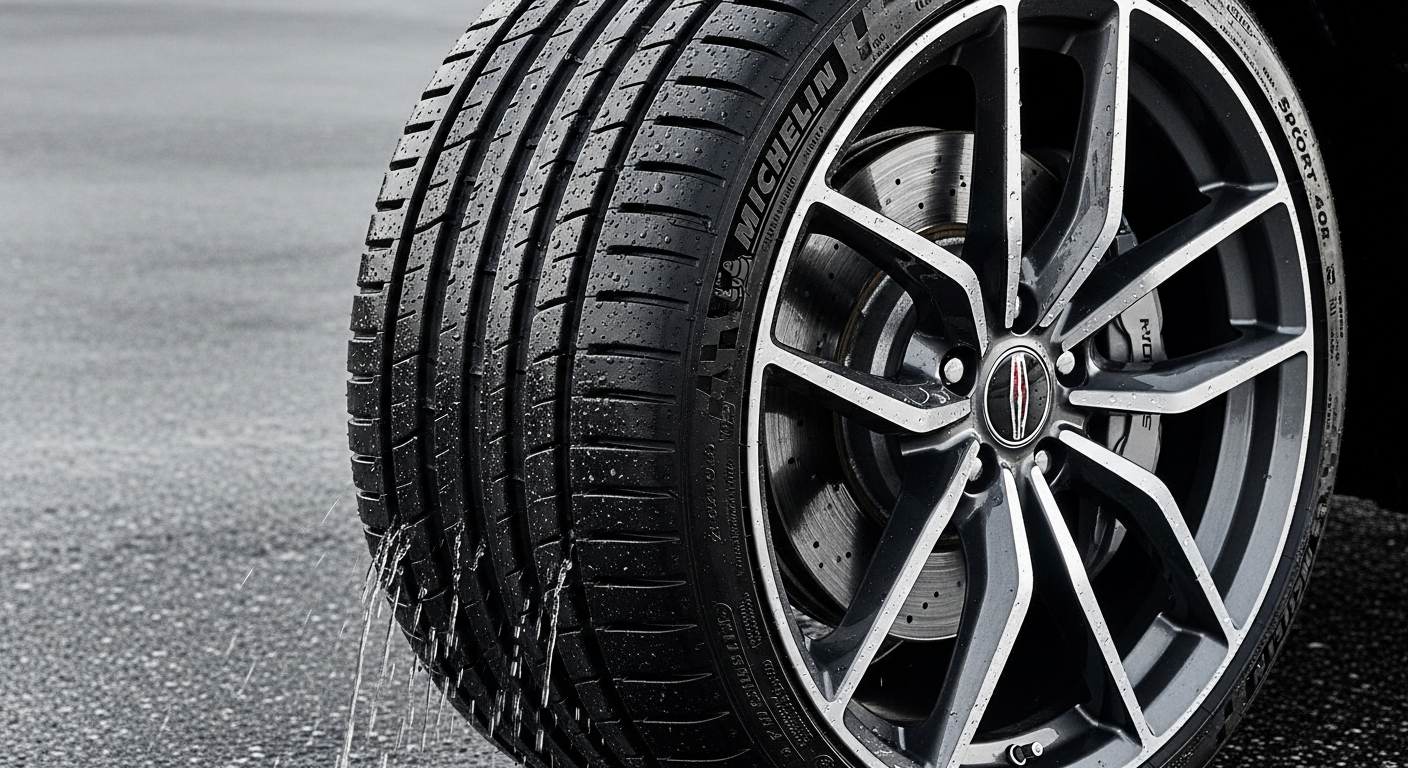
Discover why wet-weather grip matters more than you think. Learn how Michelin Pilot Sport 4S tires deliver championship-level braking and cornering in rain—plus real-world performance data from independent tests.
The Michelin Pilot Sport 4S: Why Wet-Weather Performance Matters More Than Horsepower
Rain doesn't care about your horsepower. When visibility drops and roads glisten, even the most powerful sports car becomes a liability without the right tires. The Michelin Pilot Sport 4S has earned its reputation as an ultra-high-performance summer tire, but its wet-weather credentials are what truly set it apart from competitors. Unlike entry-level performance tires that sacrifice rain performance for dry grip, this tire uses a dual-compound tread system specifically engineered to handle both conditions.
The challenge facing high-performance drivers is real: choosing a tire that delivers the grip and responsiveness expected from a premium vehicle while maintaining the safety margins that rain demands. Standard performance tires often force a compromise, excelling on dry pavement while leaving drivers vulnerable when weather turns treacherous. The Pilot Sport 4S refuses this trade-off, instead engineering a solution that addresses both scenarios through technological innovation rather than compromise.
Discover the Michelin Pilot Sport 4S at Pneus FR and experience premium wet-weather performance.
The Wet-Weather Engineering Behind Michelin's Multi-Compound Design
The brilliance of the Pilot Sport 4S lies in its refusal to use a single rubber compound across the entire tread. Instead, Michelin engineered an inner tread featuring silica and functional elastomer technology specifically designed to enhance hydroplaning resistance and wet braking performance. This compound excels at maintaining grip when water sits between tire and road—the exact moment when traditional tires lose contact and drivers lose control.
The outer tread employs a different approach entirely. A novel hybrid elastomer construction optimizes dry grip while maintaining surprisingly effective wet traction. This strategic separation means that the tire's outer shoulders, which handle cornering loads, maintain their confidence-inspiring dry-weather grip even as the inner tread specializes in water management.
The two-part tread system distributes water evacuation differently across inner and outer shoulders. During heavy rain, the inner grooves and sipes channel water away from the contact patch with greater efficiency than conventional designs. Simultaneously, the outer tread's geometry maintains the structural rigidity needed for responsive cornering. This isn't accidental—it's the result of extensive testing and refinement.
Sipe density and groove geometry were engineered specifically for rain channeling and water displacement. The pattern creates multiple small channels that work together to move water laterally away from the tire's center, preventing the hydroplaning condition where a layer of water causes complete loss of traction. Every groove angle, every sipe length, every edge matters in this calculation.
Dynamic Response Technology and Steering Precision in Wet Conditions
The tire's structural performance matters just as much as its rubber composition. The Pilot Sport 4S incorporates Dynamic Response Technology—a hybrid aramid and nylon ply construction—that ensures optimal transmission of steering input to the road. This engineering choice has profound implications for wet-weather safety.
Responsive steering input translates directly to safer cornering on slick surfaces. When a driver turns the wheel on rain-soaked pavement, the tire must communicate that intention to the road instantly. Any lag, any flex, any hesitation introduces dangerous uncertainty. The Pilot Sport 4S minimizes this gap, giving drivers the immediate feedback they need to make micro-adjustments without second-guessing their inputs.
The relationship between tire rigidity and driver confidence during wet-weather maneuvers is measurable. Tires that flex excessively feel disconnected, encouraging over-correction. The Pilot Sport 4S's construction maintains structural integrity without feeling harsh, creating a feedback loop where drivers instinctively make smaller, more precise corrections. This translates into genuinely safer driving behavior.
Communicative feedback prevents over-correction and reduces hydroplaning risk through a mechanism that's almost psychological. When a driver receives clear information about what the tire is doing, they make measured decisions. When feedback is muted or delayed, drivers tend to make large, panicked inputs that can trigger exactly the kind of loss of control they're trying to prevent. The Pilot Sport 4S prioritizes this communication.
Find your size and secure competitive pricing on Michelin Pilot Sport 4S tires at Pneus FR.
Independent Test Results and Real-World Wet-Weather Performance Data
Performance claims mean nothing without independent validation. The Pilot Sport 4S carries a traction rating of AA, which represents the tire's wet-braking capability relative to a government-controlled reference tire. An AA rating places it in the highest category, indicating wet-braking performance that exceeds 85% of the reference standard. This isn't marketing language—it's a standardized measurement that translates directly to shorter stopping distances in rain.
Comparative wet-braking distances tested against competing ultra-high-performance tires consistently favor the Pilot Sport 4S. Independent evaluations by major tire testing organizations show that when comparing similar tire sizes and construction, the Pilot Sport 4S stops measurably shorter on wet pavement than competitors priced in similar ranges. For a vehicle traveling at highway speeds, these differences translate into car lengths of stopping distance—the margin between control and collision.
Hydroplaning resistance metrics and threshold speeds in independent evaluations demonstrate the tire's engineering advantage. The speed at which a tire begins to lose contact with water-covered pavement is a critical performance indicator. The Pilot Sport 4S shows higher hydroplaning thresholds than competing summer performance tires, meaning drivers can maintain traction at speeds and water depths where other tires would lose grip entirely.
Wet cornering grip measurements and lateral acceleration data reveal another dimension of the tire's engineering. During cornering on wet pavement, the Pilot Sport 4S maintains lateral grip that competitors struggle to match. This capability enables faster, more confident cornering in challenging conditions without sacrificing safety.
Price-to-Performance Ratio and Value Proposition for Different Driver Profiles
The Michelin Pilot Sport 4S typically falls into a higher price bracket, ranging from approximately €180 to over €400 per tire depending on size and retailer. Pneus FR, known for competitive pricing, aims to offer these tires at attractive rates, but the investment remains substantial compared to standard or even mid-tier performance tires. Understanding where this cost fits into your driving reality requires honest assessment.
Durability expectations and treadwear rating (300) factor heavily into the actual cost of ownership. A treadwear rating of 300 indicates that the Pilot Sport 4S lasts roughly three times longer than the government reference tire. For drivers who push their vehicles hard, this rating translates into genuine longevity. When calculating cost-per-mile, the Pilot Sport 4S becomes more affordable than lower-priced alternatives that require replacement sooner.
ROI analysis for performance enthusiasts versus casual drivers yields different conclusions. A driver who tracks their vehicle regularly or frequently navigates mountain roads in wet conditions receives measurable safety and performance advantages that justify premium pricing. A driver who uses their vehicle primarily for highway commuting in moderate climates may find mid-tier performance tires adequate. The key is matching the tire's capabilities to your actual driving patterns and risk tolerance.
Long-term value extends beyond the tire itself. The Pilot Sport 4S's reputation impacts vehicle resale appeal. Buyers of used performance vehicles recognize this tire as a marker of responsible ownership and maintenance. The tire's presence in a vehicle's service history carries subtle but real market value.
The Wet-Weather Advantage That Justifies the Investment
When rain falls, the Michelin Pilot Sport 4S separates itself from the competition through engineering that prioritizes safety without sacrificing the exhilarating performance expected from a premium tire. The dual-compound tread system, Dynamic Response Technology, and proven wet-braking capabilities deliver measurable advantages that independent testing consistently validates. The price tag demands serious consideration—but for drivers who regularly push their vehicles through challenging conditions, the confidence and control this tire provides becomes invaluable.
If you're navigating rain-soaked roads in a high-powered vehicle, the answer is almost certainly yes. Your safety and the safety of others on the road depend on decisions made in seconds, often when conditions leave no margin for error. The engineering that separates the Pilot Sport 4S from competitors exists for precisely these moments.