
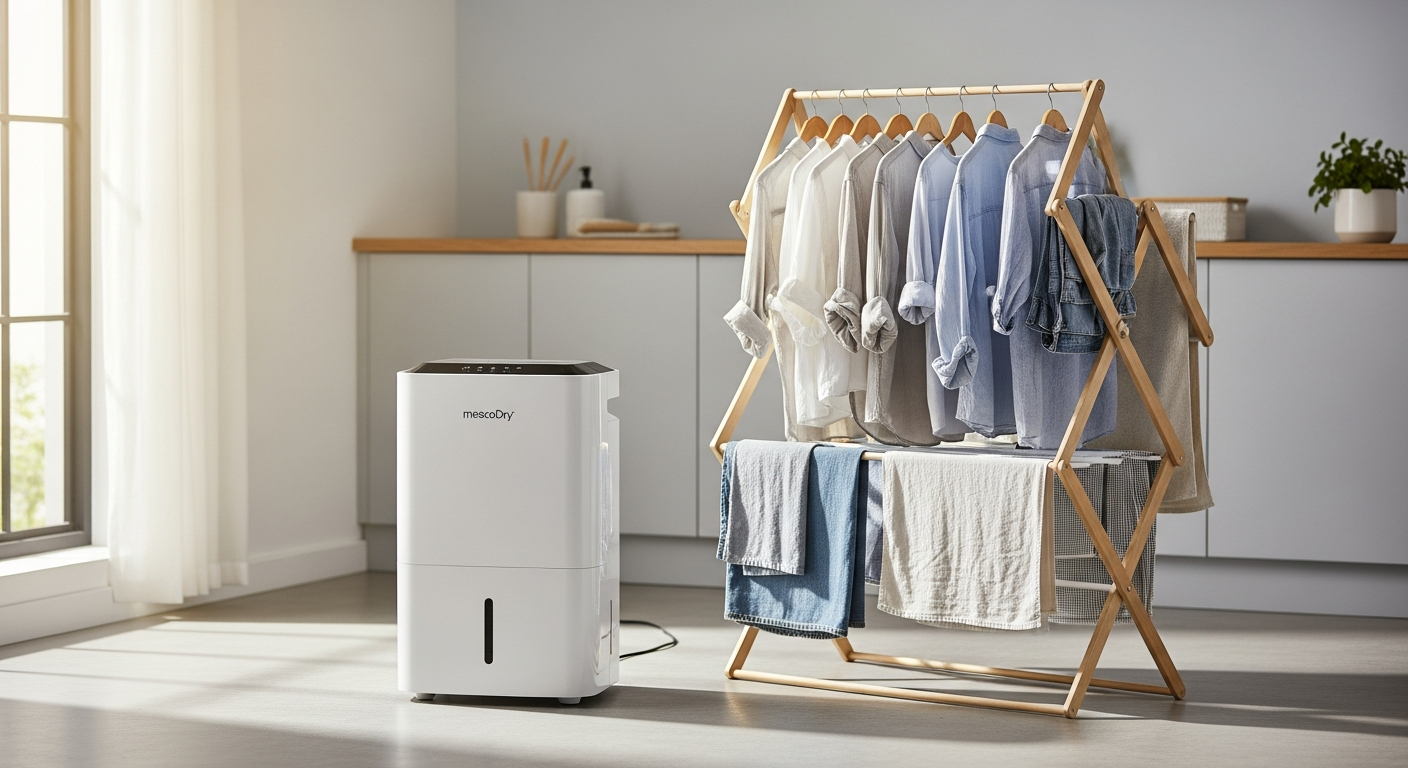
Research MeacoDry Arete One models, extraction capacity, HEPA filtration, noise levels, drainage, energy use, and key features before choosing a unit.
The MeacoDry Arete One is designed for households dealing with excess humidity, condensation, damp conditions, indoor laundry, and airborne particles.
Rather than functioning solely as a home dehumidifier, the range combines compressor-based moisture removal with air filtration. That combination can make it worth researching if you want one appliance capable of handling two household air-care tasks.
The current Arete One collection includes 6L, 10L, 12L, 20L, and 25L models. Meaco positions different capacities for different property sizes and moisture-control needs.
What Is the MeacoDry Arete One and How Does It Work?
The MeacoDry Arete One is a dehumidifier and air purifier range developed for residential use. The main function is removing moisture from indoor air, while the supplied filtration system can capture airborne particles as air passes through the appliance.
Meaco states that the range was developed over five years with feedback from around 2,000 customers. Current models use compressor technology and include a washable dust filter plus an H13 HEPA filter.
This setup gives you two primary functions:
- Dehumidification for controlling excess indoor moisture
- Air purification using the installed HEPA filter
The appliance can also run in a dedicated air-purification setting without operating the dehumidification function. Meaco notes that a dedicated purifier can still be preferable when air purification is your primary requirement.
Which MeacoDry Arete One Capacity Should You Choose?
Capacity is one of the first details to assess. A larger extraction rating does not automatically make a model the right purchase. Your property size, moisture levels, laundry habits, available floor space, and preferred tank capacity all matter.
The current manufacturer lineup includes:
| Model | Manufacturer-listed capacity | Typical buying scenario |
|---|---|---|
| Arete One 6L | 6 litres | Compact spaces and lighter moisture-control needs |
| Arete One 10L | 10 litres | Smaller residential spaces |
| Arete One 12L | 12 litres | Flats, apartments and smaller properties |
| Arete One 20L | 20 litres | Larger residential spaces |
| Arete One 25L | 25 litres | Higher-capacity household moisture control |
Meaco currently describes the 12L model as suitable for houses and flats up to three bedrooms and the 20L version for larger houses up to four bedrooms. These are manufacturer recommendations rather than universal sizing rules. Actual extraction depends heavily on temperature and relative humidity.
Why Rated Capacity Needs Context
The number attached to a dehumidifier represents extraction under specified test conditions. Real household performance can be lower.
For example, Meaco publishes an extraction figure of 12.18 litres per day for the 12L model at 30°C and 80% relative humidity. At 20°C and 60% relative humidity, its published figure is 5.23 litres per day.
The 20L version is listed at 14.02 litres per day at 20°C and 80% relative humidity and 8.5 litres at 20°C and 60% relative humidity.
Those figures demonstrate why shoppers should compare performance under realistic room conditions rather than relying solely on the capacity printed in a product name.
Air Filtration Adds a Second Household Function
Each current model in the range includes an H13 HEPA filter, turning the appliance into a HEPA air purifier when the filtration setting is used.
According to Meaco, its H13 replacement filters retain 99.95% of particles measuring 0.3 micrometres in diameter. That figure is a manufacturer-published filter specification and should not be interpreted as a guarantee that the appliance will remove every contaminant from a room.
An optional charcoal filter is available separately for shoppers interested in filtration aimed at odours and gases.
If air cleaning is your main priority and humidity control is secondary, comparing this combination appliance against a dedicated purifier can help you decide which configuration better suits your home.
Noise Levels Matter in Frequently Used Rooms
Noise becomes especially relevant when an appliance may operate for several hours near bedrooms, living rooms, home offices, or study areas.
The 12L Arete One is listed at 35 and 38 dB(A), depending on fan speed. The 20L version is listed at 38 and 40 dB(A).
That makes the manufacturer specifications worth checking if a quiet dehumidifier is high on your shopping criteria.
Remember that published decibel figures provide a useful comparison point, yet your perception of sound can change with room acoustics, distance from the appliance, fan setting, and surrounding background noise.
Laundry Mode Can Be Useful for Indoor Drying
Drying wet clothing indoors releases moisture into the surrounding air. A laundry mode dehumidifier can help remove that moisture while clothes dry.
Laundry Mode is included on the 12L and 20L Arete One specification sheets, alongside two fan speeds.
For households that regularly use drying racks indoors, this feature may have greater practical value than simply buying the highest-capacity machine.
Placement still matters. Air needs space to circulate around both the appliance and clothing, so follow the manufacturer’s operating and clearance instructions.
Tank Capacity and Drainage Can Affect Daily Convenience
Manual emptying frequency depends on how much water the appliance collects and the capacity of its reservoir.
The Arete One 12L has a manufacturer-listed 2.5-litre tank, while the 20L uses a 4.8-litre tank. Both support continuous drainage using a compatible 12.5 mm garden hose, although the hose is not included.
A continuous drainage dehumidifier setup may suit locations where frequent manual emptying would be inconvenient. You will need an appropriate drainage arrangement and should follow the installation guidance supplied with the appliance.
Castors are included on the 12L and 20L versions, making repositioning easier within the home.
Power Consumption Should Be Compared Under Similar Conditions
Energy use varies by model and operating conditions.
At 20°C and 60% relative humidity, Meaco lists power consumption of:
- 12L: 151 watts
- 20L: 216 watts
The manufacturer also publishes extraction and wattage figures at several combinations of temperature and humidity, which gives shoppers a better basis for comparison than a single headline capacity figure.
Key Features to Check Before Buying
Before selecting a model, review these practical points:
Property size: Check the manufacturer’s recommended property size, then factor in actual damp conditions.
Extraction performance: Look at published figures under temperatures and humidity levels resembling your home.
Tank size: Larger tanks may reduce how frequently you need to empty collected water.
Noise: Compare published dB(A) figures if you plan to operate the unit close to living or sleeping areas.
Drainage: Continuous drainage can simplify extended operation when a suitable drain location is available.
Air filtration: The supplied HEPA filter gives the appliance an additional air-cleaning function.
Indoor laundry: Laundry Mode may be particularly useful for homes where clothes frequently dry indoors.
Operating temperature: Both the 12L and 20L specification sheets list an operating range of 5°C to 35°C.
MeacoDry Arete One vs. Arete Two
Shoppers researching the Arete One may encounter the newer Arete Two series.
For the 12L versions, Meaco’s comparison shows that Arete One uses an AC motor and two fan speeds, while Arete Two uses a DC motor and three fan speeds. The Arete Two also adds features including app connectivity, a louvre, timer controls, and additional display functions.
That does not automatically make either version appropriate for every buyer. If app controls and added settings matter to you, the newer series deserves comparison.
If your priorities center on humidity control, filtration, laundry drying, and straightforward controls, the Arete One feature set may cover what you need.
Common Questions About the MeacoDry Arete One
Can it run solely as an air purifier?
Yes. Meaco states that the appliance has a dedicated Air Purification mode, allowing the fan and filtration system to operate without dehumidification.
Does it include a HEPA filter?
Yes. Current Arete One models are supplied with an H13 HEPA filter according to Meaco’s product information.
Can you connect a drainage hose?
Yes. The 12L and 20L models support continuous drainage using a compatible 12.5 mm garden hose. The hose is not supplied with these models.
Does it have a child lock?
Yes. Child lock is listed among the features of both the 12L and 20L models.
What warranty does Meaco provide?
Meaco currently lists a five-year warranty for the Arete One range on its UK site. Warranty terms can vary by market and seller, so check the applicable conditions before purchase.
Is the MeacoDry Arete One Right for Your Home?
The MeacoDry Arete One makes the strongest case for shoppers who need humidity control and value integrated air filtration, indoor-laundry settings, selectable humidity control, and optional continuous drainage.
Model selection deserves particular attention. A smaller unit may suit lighter moisture problems and compact properties, while a higher-capacity version may fit larger spaces or heavier moisture loads.
You can check the current MeacoDry Arete One models and manufacturer specifications on Meaco’s official site before deciding which capacity fits your intended space.