
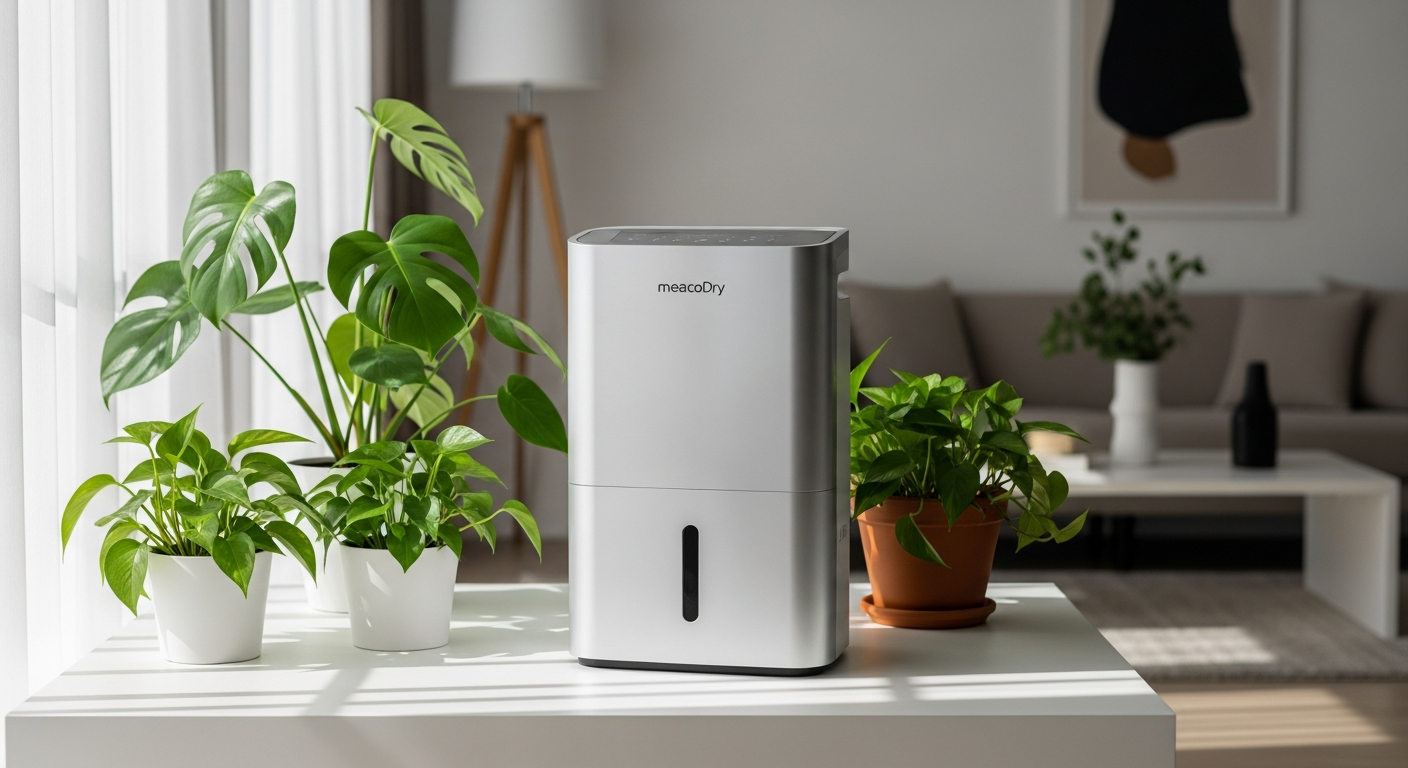
Learn how MeacoDry Arete One handles humidity, condensation, laundry drying, and air filtration, plus what to check when choosing the right.
Excess moisture can lead to condensation, musty rooms, and conditions that encourage mould growth.
The MeacoDry Arete One is designed to help manage indoor humidity while providing air filtration in the same appliance. Available in several extraction capacities, it gives you options based on room size and moisture levels.
If you are comparing models before buying, factors such as extraction capacity, tank size, operating noise, laundry settings, filtration, and energy consumption can help you decide if this range suits your home.
What Does the MeacoDry Arete One Do?
The MeacoDry Arete One is a compressor-based home dehumidifier designed to extract excess moisture from indoor air. Depending on the model, the range can be used in flats, houses, utility rooms, garages, and other indoor areas where humidity may become an issue.
The range combines dehumidification with air filtration. A washable dust filter and HEPA filter are included, while compatible charcoal filters are available separately for selected models.
This setup allows the appliance to operate as an air purifier and dehumidifier, giving you two functions without requiring separate machines.
Different Capacities for Different Homes
One factor to check before purchasing is extraction capacity. Meaco currently lists Arete One models in 6L, 10L, 12L, 20L, and 25L versions. The number refers to the rated daily extraction capacity under specified test conditions rather than the amount you should expect the appliance to collect every day in typical household conditions.
Actual extraction varies with temperature and relative humidity. For example, Meaco reports that the 12L model extracts about 5.23 litres per day at 20°C and 60% relative humidity, compared with its higher extraction figure under warmer, wetter test conditions.
This distinction matters when comparing a dehumidifier for home use. A larger capacity may make sense for bigger properties or persistent moisture problems, while a smaller unit may be adequate for compact spaces.
How Smart Humidity Control Works
Constantly running a dehumidifier when it is unnecessary can consume extra electricity. The Arete One includes humidity controls that allow you to set a target relative humidity.
The 12L model, for example, has an adjustable humidistat covering 40% to 70% relative humidity. Its controls allow the machine to respond to changing indoor moisture conditions rather than requiring constant manual adjustment.
For buyers searching for an energy efficient dehumidifier, power consumption is worth comparing alongside extraction performance. The 12L version consumes 151 watts at 20°C and 60% relative humidity according to Meaco’s technical data, while the 20L model is rated at 216 watts under the same conditions.
Your actual electricity cost will depend on your model, local electricity tariff, indoor temperature, humidity, target setting, and operating time.
Can It Help With Condensation and Damp?
A dehumidifier for condensation can help lower moisture levels in rooms where water frequently forms on windows and other cold surfaces.
Indoor condensation occurs when moisture in the air meets a sufficiently cold surface. Reducing relative humidity can lower the amount of moisture available to condense.
A dehumidifier can therefore be useful when everyday activities such as showering, cooking, and drying clothes indoors contribute to elevated humidity.
However, persistent damp may have another cause, such as leaks, water ingress, or building defects. Those issues require the underlying source to be addressed rather than relying solely on a dehumidifier.
What Is Laundry Mode?
Indoor clothes drying can release considerable moisture into the surrounding air. The Arete One includes a dedicated laundry setting designed to run the machine aggressively while clothes dry nearby.
According to Meaco, Smart Laundry Mode sets a 35% relative humidity target and runs at high fan speed for up to six hours. The compressor can stop if humidity drops sufficiently and restart if the level rises again during that period.
Using a dehumidifier for drying clothes may be particularly practical during wet or cold weather when outdoor drying is inconvenient. For best results, clothes should still be properly spaced on a drying rack so air can circulate around the fabric.
Heavier items can require extra drying time, so the six-hour operating cycle should not be treated as a guarantee that every laundry load will be fully dry.
How Quiet Is the MeacoDry Arete One?
Noise can matter if you plan to place a dehumidifier near a bedroom, living area, or home office.
Noise varies by model and fan setting. The current 12L Arete One is rated at 35 and 38 dB(A), while the 20L version is rated at 38 and 40 dB(A).
These figures give you a useful reference when comparing machines, though perceived noise can change according to fan speed, room acoustics, flooring, and how close you sit to the appliance.
HEPA Filtration Adds Another Function
Humidity management is the primary reason many people buy a dehumidifier, yet filtration may add practical value.
The Arete One range includes a HEPA filter alongside its washable dust filter. On the 20L model, Meaco states that the supplied H13 HEPA filter can operate during dehumidification and in a standalone air-purification mode.
Keep in mind that filters require maintenance and eventual replacement. Replacement-filter costs should therefore form part of your long-term ownership comparison.
Water Tank or Continuous Drainage?
Collected water normally enters the internal tank. Tank capacity depends on the machine you choose. The 12L model has a 2.5-litre tank, while the 20L model uses a 4.8-litre tank.
Continuous drainage is supported as well. This can be useful if you plan to operate the machine for extended periods and have a suitable drainage point.
Check what accessories are included before purchasing. For example, Meaco specifies that the required drainage hose is not included with the 12L model.
Arete One vs Arete Two: Which Features Differ?
Another purchasing question is how the Arete One compares with the newer Arete Two.
The differences depend somewhat on capacity, though the 12L comparison provides a useful example. Both versions share the same basic dimensions and a five-year warranty, yet the Arete Two adds features including a DC motor, three fan speeds, an LCD display, adjustable louvre, timer controls, and app connectivity.
The Arete One has simpler controls and lacks app connectivity. If you mainly want moisture extraction, filtration, and laundry functionality, those additional controls may not be necessary. If remote operation, extra fan control, or timer functions matter to you, comparing the two generations before purchasing makes sense.
What Should You Check Before Buying?
Start by matching the capacity to your property and typical moisture conditions. Then compare practical ownership details:
- Rated extraction capacity and real-condition extraction data
- Water tank capacity
- Noise at available fan settings
- Power consumption
- Laundry functionality
- HEPA filter replacement requirements
- Continuous drainage compatibility
- Appliance dimensions and weight
- Warranty coverage
Checking these factors can help prevent buying a machine that is unnecessarily large or too small for the intended space.
Who May Find the MeacoDry Arete One Suitable?
The range may suit you if your main concerns include condensation, elevated indoor humidity, damp-feeling rooms, or moisture released by indoor laundry.
It may also make sense if you value combined dehumidification and HEPA filtration.
However, buyers seeking Wi-Fi controls, app operation, additional fan speeds, or expanded timer settings may prefer to compare the Arete One directly with the Arete Two before deciding.
Is the MeacoDry Arete One Worth Comparing?
The MeacoDry Arete One combines moisture extraction, automatic humidity management, laundry functionality, and air filtration in one household appliance. Its different capacity options allow you to select a model according to the size and moisture demands of your space.
Before buying, pay particular attention to extraction performance under realistic temperature and humidity conditions rather than relying solely on the capacity number printed on the model. Noise, tank capacity, power use, filter costs, and drainage arrangements are equally relevant.