
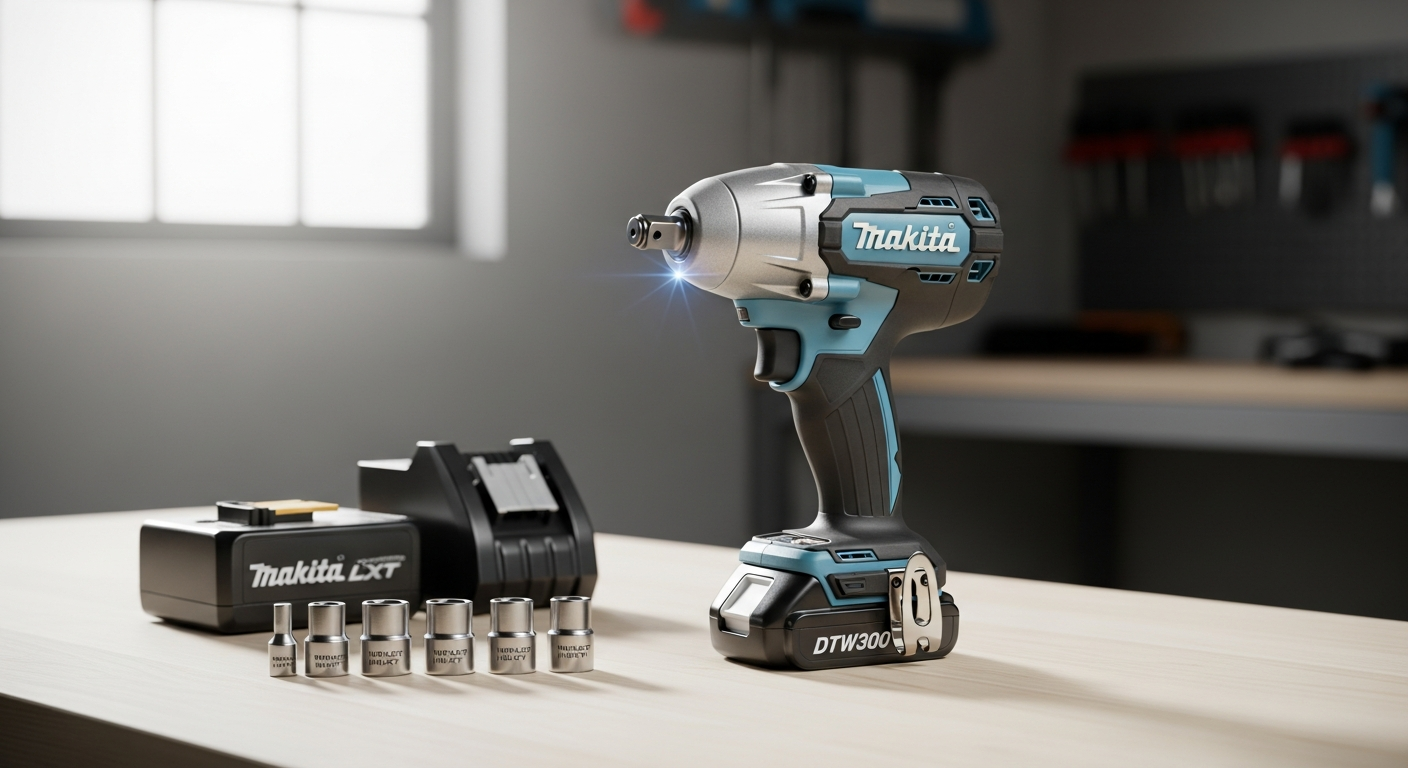
Discover why the Makita DTW300 18V brushless cordless impact wrench dominates automotive shops. Explore 330 Nm torque, compact design, and professional-grade features that save time on vehicle repairs.
Automotive technicians spend roughly a quarter of their workday on fastening and loosening tasks—yet most still rely on pneumatic tools that chain them to air hoses and compressors. The Makita DTW300 18V brushless cordless impact wrench breaks this constraint entirely, delivering professional-grade power without cables. The automotive industry demands tools that merge raw torque with precision and speed, and the DTW300 represents the evolution of cordless technology that has genuinely caught up with—and frequently surpassed—compressed-air alternatives.
This tool signals a fundamental shift in how modern shops approach fastening work. Where pneumatic systems require dedicated infrastructure, constant maintenance, and significant energy consumption, the DTW300 operates independently while maintaining consistent power delivery from start to finish. The brushless motor technology, compact 144 mm frame, and intelligent torque control combine to create something that traditional tools simply cannot match. Shops transitioning to this platform report faster service cycles, reduced fastener damage, and lower operational costs within the first year.
I’ve assembled a comprehensive breakdown of everything automotive professionals need to know about the DTW300: how its brushless motor outperforms traditional designs, why its compact frame transforms tight engine bays into accessible work zones, and how its intelligent torque control prevents costly over-tightening mistakes. You’ll also discover real-world applications, battery ecosystem advantages, and concrete evidence of whether this tool justifies its investment for your operation.
Explore the DTW300 and upgrade your shop today.
Why Automotive Shops Are Switching from Pneumatic to the DTW300 Brushless Design
Mobility Advantage: Freedom from Air Hose Management
Cordless operation eliminates air hose management entirely, allowing technicians to move freely around vehicles without tangled cables or compressed air line restrictions. A technician working on a vehicle’s undercarriage no longer needs to manage hose routing around other equipment or worry about kinks reducing air pressure. This freedom translates directly into faster work cycles—technicians spend less time repositioning hoses and more time actually fastening.
Noise Reduction Creates a Healthier Shop Environment
Brushless motors operate significantly quieter than pneumatic tools, transforming the acoustic environment of your shop. Where pneumatic impact wrenches produce sustained high-frequency noise that requires hearing protection and creates fatigue, the DTW300 operates at levels that reduce hearing protection requirements substantially. This matters not just for compliance but for technician comfort and communication—team members can hear each other without shouting.
Consistent Power Delivery Throughout the Work Day
Unlike pneumatic tools that lose torque as air pressure drops in the system, the DTW300 maintains consistent output throughout the battery’s charge cycle. A compressor-dependent system experiences voltage drops and pressure fluctuations that affect fastening accuracy. The DTW300 eliminates this variability—your 330 Nm fastening torque remains stable from the first bolt to the last, ensuring precision that matters for safety-critical applications.
No Compressor Dependency: Eliminating Hidden Costs
The decision to go cordless extends beyond individual tool purchases. Eliminating compressor dependency removes an entire category of maintenance, upkeep costs, and energy consumption that most shops don’t fully quantify until they’ve made the transition. Compressor maintenance, oil changes, filter replacements, and the electrical consumption of running air systems all day represents substantial annual expense that vanishes with cordless adoption.
Torque Specifications That Matter: 330 Nm vs. Pneumatic Competitors
330 Nm Fastening Torque: Sufficient for Most Automotive Applications
The DTW300 delivers 330 Nm of fastening torque—a specification that covers wheel bolt tightening, suspension work, and engine component assembly across most vehicle platforms. This torque level aligns with OEM specifications for the majority of automotive fastening tasks. Technicians can tighten lug nuts to specification without over-driving, and suspension work proceeds at the pace required by the application rather than the limitations of the tool.
580 Nm Nut-Busting Torque for Seized Fasteners
Where fastening torque handles new assembly, nut-busting torque addresses the real-world challenge: corroded bolts, seized lug nuts, and fasteners that have weathered years of road salt and thermal cycling. The DTW300’s 580 Nm reverse power removes these stubborn fasteners without stripping heads or damaging surrounding components. This capability means fewer broken bolts, fewer stripped threads, and fewer service calls that extend job times.
Four-Stage Impact Power Selection: Tailoring Power to the Task
Electronic power selection allows technicians to dial in precise torque levels for specific applications. Delicate work on aluminum components or plastic fasteners requires different settings than heavy transmission assembly. The four distinct stages mean you’re not choosing between “too light” and “too hard”—you’re matching tool performance directly to fastener requirements and material sensitivity.
Electronic Torque Limiting: Protecting Sensitive Components
The DTW300 incorporates electronic torque limiting that prevents over-tightening on aluminum components, plastic fasteners, and sensitive engine parts requiring careful handling. Fuel system work, sensor brackets, and intake manifold fasteners all benefit from this protection. Technicians work faster knowing the tool won’t over-drive sensitive fasteners, eliminating the need for manual calculation and caution that slows traditional approaches.
Compact Design: How 144 mm Changes Everything in Tight Engine Bays
Minimal Length Advantage: Access Where Full-Size Tools Cannot Reach
At just 144 mm overall length, the DTW300 fits into confined spaces where full-size pneumatic tools simply cannot operate. Engine bays, undercarriage areas, and suspension components demand tools small enough to reach without requiring complete component disassembly. The compact frame isn’t a compromise—it’s a capability that directly reduces job time by eliminating teardown and reassembly steps.
Lightweight Construction: Reducing Arm Fatigue During Overhead Work
At 1.5–1.8 kg, the DTW300 weighs significantly less than equivalent pneumatic tools, which matters tremendously during overhead work on suspension components, engine mounts, and undercarriage fasteners. Technicians holding any tool overhead experience rapid arm fatigue that affects both speed and safety. The lightweight design means technicians can work efficiently for longer periods without the muscular exhaustion that slows work toward the end of a shift.
1/2″ Square Drive Compatibility: Leveraging Your Existing Socket Collection
Standard socket interface means technicians can leverage their existing socket collections without purchasing proprietary adapters or additional equipment. Your current sockets work directly with the DTW300, eliminating the equipment investment barrier that sometimes accompanies tool transitions. This compatibility also means technicians can move between different tools without managing multiple socket systems.
LED Job Light Integration: Eliminating Shadowed Work Areas
The integrated LED job light illuminates work areas in shadowed engine bays, eliminating the need for separate work lights or flashlights. Technicians see fasteners clearly, reducing mistakes and speeding work. The light positions exactly where the technician needs it—pointing at the fastening point rather than creating shadows from an external source.
The 18V LXT Platform: Building Your Automotive Shop Ecosystem
Battery Interchangeability: Flexibility Across Your Tool Lineup
The DTW300 works with Makita’s entire 18V LXT battery lineup, enabling technicians to share batteries across multiple tools. Your shop isn’t locked into a single-use battery system—you’re building a platform where batteries move between tools as needed. This flexibility proves invaluable in busy shops where different technicians need different tools simultaneously.
Lithium-Ion Efficiency: Consistent Power Delivery When Performance Matters
Modern LXT batteries deliver consistent power delivery with minimal voltage sag, crucial for maintaining torque during demanding fastening tasks. Where older battery technology experienced performance degradation as charge depleted, lithium-ion maintains voltage until the final moments of discharge. Your 330 Nm torque specification holds steady, not declining as the battery discharges.
Ecosystem Expansion: Scaling Cordless Technology Across Your Shop
Investing in the DTW300 positions your shop to gradually transition other pneumatic tools to cordless alternatives using the same battery platform. You’re not limited to impact wrenches—the LXT platform extends to drills, grinders, saws, and numerous other tools. Each addition strengthens the ecosystem value, making battery investment more productive.
Warranty and Support: Extensive Service Networks Across Europe
Makita’s established LXT ecosystem includes extensive service networks and replacement parts availability across Europe. Support isn’t regional or limited—you have access to genuine parts, certified technicians, and warranty service wherever your operations extend. This infrastructure matters when tools require service during critical work periods.
Discover the complete DTW300 ecosystem and optimize your shop’s efficiency.
Variable Speed Control and Precision Features for Delicate Automotive Work
0–3,200 RPM Variable Speed: Matching Tool Speed to Application
Variable speed control from 0–3,200 RPM enables technicians to match tool speed to fastener type, material, and application requirements. Different materials and fastener sizes respond differently to rotational speeds. The variable control means you’re not compromising between applications—you’re optimizing each task specifically.
0–4,000 IPM Impact Rate Adjustment: Protecting Sensitive Components
Lower impact settings protect sensitive components like plastic intake manifolds, sensor brackets, and aluminum valve covers from damage. High-impact force works well for removing seized fasteners but can fracture plastic components or crack aluminum around fastening points. The adjustable impact rate means you choose the minimum force needed for each specific task.
Quick Trigger Mode: Instantly Delivering Full-Speed Operation
Quick Trigger mode instantly delivers full-speed operation for rapid fastening without requiring full trigger compression. This feature reduces hand fatigue during repetitive work—the technician doesn’t need to maintain constant trigger pressure to sustain performance. The tool delivers maximum speed on demand, reducing the muscular effort required for continuous work.
Electronic Power Selection: Customizing Performance for Every Fastening Scenario
Four distinct power stages allow technicians to customize performance for everything from delicate fuel system work to heavy transmission assembly. Rather than managing trigger pressure and technique to control power, the stages provide preset configurations matched to common automotive tasks. Technicians work faster knowing the tool is preset correctly for the application.
Real-World Automotive Applications Where DTW300 Excels
Wheel and Tire Service: Matching OEM Specifications Consistently
The 330 Nm fastening torque matches OEM specifications for lug nut tightening across most vehicle platforms. Tire shops benefit from consistent torque delivery that prevents both under-tightening (wheel wobble) and over-tightening (stripped threads). Technicians complete wheel service faster while meeting safety specifications that manufacturers require.
Suspension and Steering Work: Accessing Confined Fastening Points
The compact size enables access to control arm bolts, tie-rod ends, and shock absorber fasteners in tight undercarriage locations. Where traditional tools require vehicle hoisting at unusual angles or partial disassembly to reach fasteners, the DTW300’s small frame reaches points directly. Suspension technicians complete jobs faster with fewer positioning adjustments.
Engine and Transmission Assembly: Precise Torque Control Plus High Reverse Power
Precise torque control prevents over-tightening on critical engine fasteners while the high reverse torque handles seized bolts that resist removal. Engine and transmission assembly demands both capabilities—new fasteners need careful torque control while maintenance work often encounters corroded bolts. The DTW300 handles both scenarios effectively.
Brake System Service: Controlled Power Delivery for Safety-Critical Work
Caliper bolts, rotor fasteners, and brake line connections benefit from the tool’s controlled power delivery. Brake work involves both strong fasteners that require significant torque and delicate connections where over-tightening causes leaks or damage. The variable torque control matches these diverse requirements within a single service session.
Brushless Motor Technology: Why It Matters for Shop Durability
Extended Runtime: More Work Per Battery Charge
Brushless motors operate more efficiently than brushed alternatives, delivering more work per battery charge. Efficiency directly translates to technicians completing more fastening tasks before battery swaps become necessary. For shops running multiple impact wrenches simultaneously, extended runtime means fewer batteries required to maintain continuous workflow.
Reduced Maintenance: Eliminating Carbon Brush Wear
Elimination of carbon brushes means fewer moving parts to wear out, translating to longer tool lifespan and lower replacement costs. Brushed motors require periodic brush replacement—an additional maintenance task that brushless design eliminates entirely. Tools maintain consistent performance without scheduled maintenance interventions.
Heat Management: Running Cool During Extended Use
Brushless designs generate less internal friction, running cooler during extended use and protecting internal electronics. Heat accelerates component degradation and affects performance during continuous work. The cooler operation profile extends component lifespan and ensures performance remains consistent even during back-to-back fastening sessions.
Power Consistency: Stable Torque Output Throughout Tool Service Life
No brush wear means torque output remains stable throughout the tool’s service life, critical for maintaining fastening accuracy. Where brushed motors gradually lose power as brushes wear, brushless designs maintain their original specifications indefinitely. Your torque specifications today match your torque specifications in five years.
Investment Analysis: Cost Considerations for Shop Adoption
Tool-Only Pricing: €150–€300 for the Bare Unit
The tool-only option costs €150–€300, allowing shops that already own Makita 18V LXT batteries to add the DTW300 without duplicating battery investment. This pricing model acknowledges that established shops already possess compatible batteries, making the entry cost substantially lower than complete kit pricing.
Complete Kit Pricing: Higher Cost Includes Everything Needed
Complete kits including batteries and charger command higher prices but suit shops building cordless ecosystems from scratch. The all-in-one approach eliminates separate purchasing and delivery logistics, simplifying procurement for shops without existing Makita infrastructure.
Battery Ecosystem Costs: Initial Investment Amortizes Across Multiple Tools
Initial investment in 2–3 LXT batteries and dual chargers ranges €200–€400 but amortizes across multiple tools. Each additional LXT-compatible tool reduces the per-tool battery cost, eventually making the ecosystem highly economical. Shops that adopt multiple cordless tools recover battery investment rapidly through reduced compressor operating costs.
Compressor Cost Elimination: Annual Savings Add Up Quickly
Shops transitioning to cordless tools eliminate €2,000–€5,000 in compressor maintenance and energy costs annually. Compressed air systems require ongoing maintenance, oil changes, filter replacements, and substantial electrical consumption. These hidden costs often surprise shops when they calculate their true compressed air system expense.
Powering Your Automotive Shop Forward: The DTW300 Decision
The Makita DTW300 18V brushless cordless impact wrench represents a genuine inflection point for automotive professionals tired of pneumatic tool constraints. The specifications demonstrate clear superiority—330 Nm of fastening torque, 580 Nm of nut-busting power, and a compact 144 mm frame that accesses confined spaces traditional tools cannot reach. The brushless motor technology ensures longevity, the LXT battery compatibility eliminates tool silos, and the variable speed control protects expensive components from damage.
What makes this tool genuinely valuable extends beyond raw specifications. The ecosystem thinking behind the DTW300 transforms how you approach shop infrastructure. Investing in the DTW300 positions your operation to gradually transition away from compressor dependency while building a cordless platform that scales across multiple tools. Shops that have made this transition report faster service cycles, reduced fastener damage, and lower long-term maintenance costs that justify the initial investment within the first year.
The initial investment requires thoughtful planning, particularly if you’re building your Makita ecosystem from scratch. However, the long-term economics favor cordless adoption strongly. Energy consumption decreases, maintenance overhead vanishes, and technician productivity increases measurably. The DTW300 isn’t a luxury upgrade—it’s a strategic tool that pays dividends through improved operational efficiency and reduced friction across your fastening workflows.
If you’re ready to modernize your shop’s fastening capabilities and eliminate the constraints of compressed air systems, the DTW300 warrants serious consideration in your equipment budget.
Get your DTW300 today and transform your automotive shop’s capabilities.