
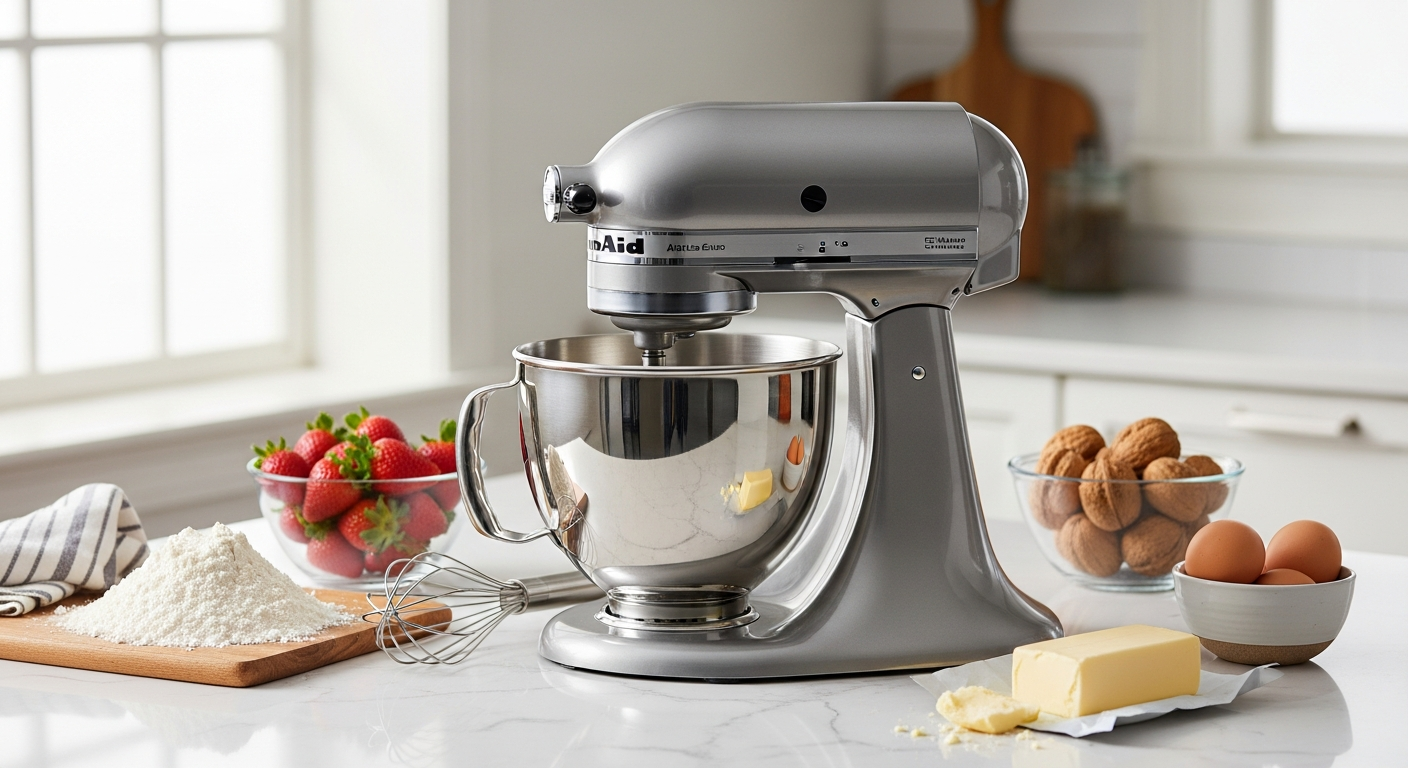
Discover how the KitchenAid Artisan 5-Quart Stand Mixer goes beyond baking with 10+ attachments and accessories. Explore its versatility, durability, and kitchen transformation potential in our detailed guide.
Imagine opening your kitchen cabinet and pulling out a single appliance that replaces your food processor, meat grinder, pasta maker, and three other specialty gadgets you've been storing in that awkward corner. The KitchenAid Artisan 5-Quart Stand Mixer isn't just another countertop device—it's a culinary powerhouse that's earned its reputation as a kitchen staple for a reason. With over 45 color options and a compatibility system supporting 10+ attachments, this mixer transforms how you approach everyday cooking and baking tasks.
Most people think of stand mixers as single-purpose tools for whipping cream or kneading dough. That perspective misses the entire point of the Artisan Series. This particular mixer becomes a meat grinder, pasta maker, food processor, and countless other implements, all thanks to its ingenious attachment hub system. The planetary mixing action ensures flawless ingredient incorporation, while its 300-watt motor delivers consistent power across 10 distinct speeds.
This guide breaks down exactly what makes the Artisan Series worth the investment—from its planetary mixing technology to its expandable ecosystem of accessories that genuinely transform your culinary toolkit. Check the current pricing and availability on ShopAppliances.
The Attachment Ecosystem That Changes Everything
Overview of the 10+ Optional Accessories Available for the Artisan Series
The true power of the Artisan Series lies not in what comes standard, but in what you can add to it. While the mixer arrives with a coated flat beater, dough hook, and wire whisk, these three tools barely scratch the surface of its potential. The proprietary attachment hub opens access to over 10 optional accessories, each designed to expand the mixer's capabilities in meaningful ways.
Meat Grinder Attachment for Fresh Ground Beef, Poultry, and Specialty Proteins
Fresh ground meat tastes fundamentally different from pre-packaged versions. The meat grinder attachment transforms your Artisan into a processor that handles beef, poultry, pork, and game meats with consistent texture and control. You know exactly what went into your ground meat—no mystery fillers or oxidized edges from sitting in a display case. This attachment alone justifies the mixer's presence for anyone who takes burger night or meatloaf seriously.
Pasta Maker and Extruder for Homemade Fresh Pasta Production
Homemade pasta reaches a texture that dried, boxed versions simply cannot match. The pasta maker and extruder attachment allows you to create fettuccine, penne, rigatoni, and other shapes from your own dough. The Artisan's mixing power develops the dough correctly, and then the attachment handles the extrusion work without requiring separate equipment or significant manual effort.
Food Grinder for Creating Nut Butters, Spice Blends, and Specialty Flours
Beyond meat, the food grinder attachment processes nuts into creamy butters, grinds whole spices into powders, and pulverizes grains into flour. This opens entirely new categories of homemade cooking—almond flour that tastes fresher than anything commercial, spice blends mixed to your exact preferences, and specialty flours ground from grains you select yourself.
Mastering the 300-Watt Motor and 10-Speed Control System
Understanding Planetary Mixing Action and How It Ensures Thorough Ingredient Incorporation
The Artisan's 300-watt motor drives a planetary mixing system—the beater spirals through multiple contact points inside the bowl simultaneously. This isn't like a basic hand mixer that stirs ingredients in one spot. Instead, the planetary action touches nearly every part of the bowl at once, ensuring that butter gets fully creamed, flour gets evenly distributed, and batter achieves consistent texture throughout. No more dry pockets of flour hiding under the beaters or butter that stays lumpy in one section.
The 10 Distinct Speed Settings: From Gentle Fold (Speed 1) to Rapid Whip (Speed 10)
Precision matters in baking and cooking. Speed 1 offers a gentle stir perfect for folding delicate whipped egg whites into chocolate mousse without deflating them. Speed 2 handles slow mixing tasks like combining dry ingredients. Speeds 3-4 work for creaming butter and sugar together. Speeds 5-7 manage standard mixing tasks like blending cake batter. Speeds 8-10 handle the heavy work—whipping cream to peaks, kneading stiff bread doughs, and aerating meringues.
Optimal Speed Recommendations for Different Mixing Tasks (Creaming, Whipping, Kneading, Folding)
Creaming butter and sugar benefits from speeds 2-4, taking about 3-5 minutes until the mixture becomes pale and fluffy. Whipping egg whites or cream requires speeds 6-8 to incorporate air effectively, typically 3-5 minutes depending on desired peaks. Kneading bread dough uses speeds 2-4 for 8-10 minutes, letting the planetary action develop gluten structure without the physical effort. Folding delicate ingredients happens best at Speed 1, using a spatula to guide the beater manually through a few passes.
Capacity Meets Practicality: The 5-Quart Stainless Steel Bowl
5-Quart (4.8L) Capacity Specifications and Batch Size Capabilities
The stainless steel bowl holds 5 quarts (4.8 liters) of ingredients, which translates to genuine batch-making capacity. For bakers, this means creating larger quantities without running multiple batches. The bowl construction is durable, dishwasher-safe, and lightweight enough to remove easily when you need to pour batter into pans or prepare the mixer for a second batch.
Making Up to 9 Dozen Cookies in a Single Batch—What That Actually Means for Home Bakers
Nine dozen cookies represents approximately 108 cookies from one batch. Depending on your recipe, that might mean 2-3 hours of baking time as you fill sheets and rotate them through your oven. For holiday baking marathons, this capacity eliminates the need to make four separate batches of dough. The mixer can handle the creaming, mixing, and preparation while you simply scoop and bake.
Bread Dough Capacity and Maximum Load Limits for Different Dough Types
The Artisan comfortably handles dough recipes up to 6 cups of flour for standard bread formulas. Dense doughs like whole wheat can max out around 4-5 cups of flour before you reach the motor's upper capacity. Enriched doughs with eggs, butter, and sugar have different density profiles, so a brioche batch might max out lower than a lean French bread dough. Staying within these limits ensures your motor runs efficiently without strain.
Design, Durability, and the Color Palette Question
All-Metal Construction Benefits for Long-Term Reliability and Performance
Unlike plastic-bodied mixers that crack or flex over time, the Artisan's all-metal construction means moving parts stay aligned. The metal gearing system handles repeated use without wearing excessively. This durability is why these mixers often outlast their owners—stories of 20-year-old Artisans still running strong aren't uncommon. That investment pays dividends over decades of use.
Coated Flat Beater, Dough Hook, and Wire Whisk Included with Purchase
The three standard attachments arrive coated to protect your bowl from scratching. The flat beater handles general mixing tasks. The dough hook kneads bread doughs efficiently. The wire whisk incorporates air for whipped cream and egg white applications. These three tools cover roughly 80% of home baking and mixing needs, with optional attachments expanding from there.
The 45+ Color Options: Aesthetic Appeal Versus Resale Value
Forty-five color choices mean your mixer matches your kitchen aesthetic—from classic white or stainless to bold reds, soft blues, and metallic finishes. This is genuinely appealing for a countertop appliance you'll see daily. However, resale value leans toward neutral colors. Niche colors like sage green or champagne gold appeal to current owners but might limit future buyers. If you plan to keep this mixer for years, choose the color that makes you happy. If you anticipate selling or moving, consider neutral shades as a safer investment.
When the Artisan Series Shines (and When It Doesn't)
Ideal Use Cases: Home Bakers, Meal Preppers, and Culinary Enthusiasts
The Artisan Series excels in kitchens where variety matters. Home bakers making weekly batches of bread or cookies benefit from the capacity and power. Meal preppers grinding their own sausage, mixing large batches of meatballs, or preparing dough for the week ahead find tremendous utility. Culinary enthusiasts exploring pasta-making, nut butter creation, or specialized cooking techniques unlock the mixer's full potential through its attachment ecosystem.
Perfect Scenarios for the 5-Quart Capacity and 300-Watt Motor
Large family meal prep, holiday baking marathons, bread-baking hobbies, and entertaining situations where you're preparing food for groups all favor the Artisan. Making 8 dozen cookies, kneading 3 loaves of bread dough simultaneously, or grinding 2 pounds of fresh sausage represents typical scenarios where the 5-quart bowl and 300-watt motor truly shine.
Limitations for Extremely Large Batches or Commercial-Scale Production
If you're running a small bakery or producing food at commercial volumes, the Artisan reaches its limits. It's designed for home kitchens, not professional bakeries. Batches larger than 6 cups of flour or sustained, heavy-duty use beyond what home bakers demand require KitchenAid's Professional Series with its bowl-lift design and more powerful motor. For home use, these limitations rarely come into play.
Maximizing Your Investment: Attachment Strategies and Accessories
Building a Prioritized Attachment Collection Based on Cooking Style
Start with attachments matching your current cooking habits. If you grind meat regularly, prioritize the meat grinder. If pasta-making interests you, get the pasta maker. If you make nut butters, grab the food grinder. This approach means each attachment gets regular use, justifying its cost and drawer space.
Essential First Attachments to Purchase Beyond the Standard Three
The meat grinder attachment delivers immediate practical value for most home cooks. Alternatively, the food grinder offers versatility for grinding nuts, spices, and creating specialty flours. The pasta maker appeals to those exploring homemade pasta. Start with one additional attachment that matches your strongest cooking interest before expanding further.
Budget-Friendly Ways to Expand Functionality Gradually
Attachments cost between $30 and $100 depending on complexity. Rather than purchasing everything simultaneously, buy one attachment every few months as your budget allows. This staged approach prevents overwhelming your storage space and lets you learn each attachment thoroughly before adding another. Browse the full attachment range and compatible accessories at ShopAppliances.
The Price-to-Value Proposition at $499.99
Mid-to-High-Range Pricing Breakdown and Market Positioning
At $499.99, the Artisan sits squarely in the mid-to-high-range for stand mixers. Entry-level mixers cost $200-$300 but lack the motor power and attachment compatibility. Professional-grade stand mixers exceed $700 and target commercial or serious production environments. The Artisan occupies the sweet spot—serious enough for genuine culinary pursuits without the commercial price tag.
Comparing Cost Per Functionality Against Standalone Specialty Appliances
A dedicated meat grinder costs $80-$150. A pasta maker runs $100-$200. A food processor ranges from $60-$300. A high-powered blender costs $200-$500. A stand mixer alone at basic quality runs $250-$350. Purchasing each of these separately totals $690-$1,600. The Artisan at $499.99 plus 2-3 attachments ($150-$250) delivers all these functions for $650-$750 total, saving money while freeing counter and storage space.
Long-Term Value Calculation When Replacing Multiple Single-Purpose Devices
If the Artisan replaces 4 single-purpose appliances you'd otherwise purchase, and it lasts 15+ years (realistic for all-metal construction), the effective cost per year drops to roughly $33. Over that timeframe, you've consolidated your kitchen, simplified your workflow, and maintained consistent performance without worrying whether different appliances handle the same task identically.
Real-World Performance Across Different Cooking Scenarios
Bread Baking: Dough Development, Kneading Power, and Consistency
The 300-watt motor handles bread doughs efficiently. A typical bread recipe develops gluten in 8-10 minutes on Speed 2-3. The planetary mixing action creates even dough structure without the labor of hand kneading. Repeated batches develop consistent texture—each loaf rises and bakes similarly because the mixer treats the dough identically every time.
Pastry Work: Whipping Egg Whites, Creaming Butter, Folding Delicate Ingredients
Whipping egg whites to stiff peaks takes about 5 minutes on Speed 8. Creaming butter and sugar achieves the desired pale, fluffy texture in 3-4 minutes on Speed 3. For delicate folding—like incorporating whipped whites into chocolate mousse—you use Speed 1 and manually guide the beater, letting the mixer do the gentle work while you maintain control.
Meat Grinding: Texture Quality, Safety Features, and Processing Speed
The meat grinder attachment produces consistent texture for burgers, sausage, and ground meat applications. Processing speed is steady rather than rushed—feeding meat gradually through the grinder ensures even grinding without jamming. Safety features include a pusher that keeps your hands away from moving parts, and the grinding can pause anytime if you need to adjust ingredient flow.
Maintenance, Troubleshooting, and Long-Term Care
Daily Cleaning Routines for the Bowl and Standard Attachments
After each use, remove the bowl and rinse it under warm water, then wash with soapy water and dry immediately. The flat beater, dough hook, and wire whisk wash similarly—they're dishwasher safe or hand washable. Most users hand wash these items to extend their lifespan. This 2-minute routine prevents dried batter from hardening on surfaces.
Deep Cleaning Protocols for the Motor Housing and Base
Once monthly, wipe the motor housing and base with a slightly damp cloth to remove flour dust and spills. Never submerge the base or allow water to enter the motor housing. The tilt-head design allows access to areas around the bowl attachment, which you can gently wipe clean. Avoid spraying water directly on the motor or electrical connections.
Lubrication Points and Maintenance Schedules
The Artisan requires minimal maintenance beyond cleaning. The motor housing contains sealed bearings that rarely need attention. If the mixer ever runs hot or sounds unusual, contact KitchenAid support rather than attempting to lubricate internal components yourself. For typical home use, this mixer operates reliably for years without special maintenance beyond regular cleaning.
The Bottom Line: Is the Artisan Series Your Kitchen's Missing Piece?
The KitchenAid Artisan 5-Quart Stand Mixer delivers on its promise of versatility. Whether you're grinding fresh meat, extruding homemade pasta, or whipping meringue to stiff peaks, this machine handles it all with the kind of reliability that justifies its $499.99 price tag. The 10+ attachment ecosystem transforms what could be a one-trick pony into a genuine kitchen workhorse capable of replacing multiple single-purpose appliances.
That said, it's not a universal solution. If you're working with minimal counter space or you primarily need a basic mixer for occasional baking, the Artisan might be overkill. The footprint is substantial, and the investment is real. But for anyone serious about cooking and baking—someone who wants to reduce their kitchen's appliance clutter while expanding their culinary capabilities—this mixer represents genuine value that compounds over years of use.
Your next step depends on measuring your available counter space and thinking honestly about which attachments would genuinely change your cooking routine. Consider whether the investment pays for itself by replacing 3-4 single-purpose appliances you'd otherwise purchase separately. If the answer is yes, the Artisan Series deserves a spot in your kitchen. Start exploring the KitchenAid Artisan Series at ShopAppliances today.