
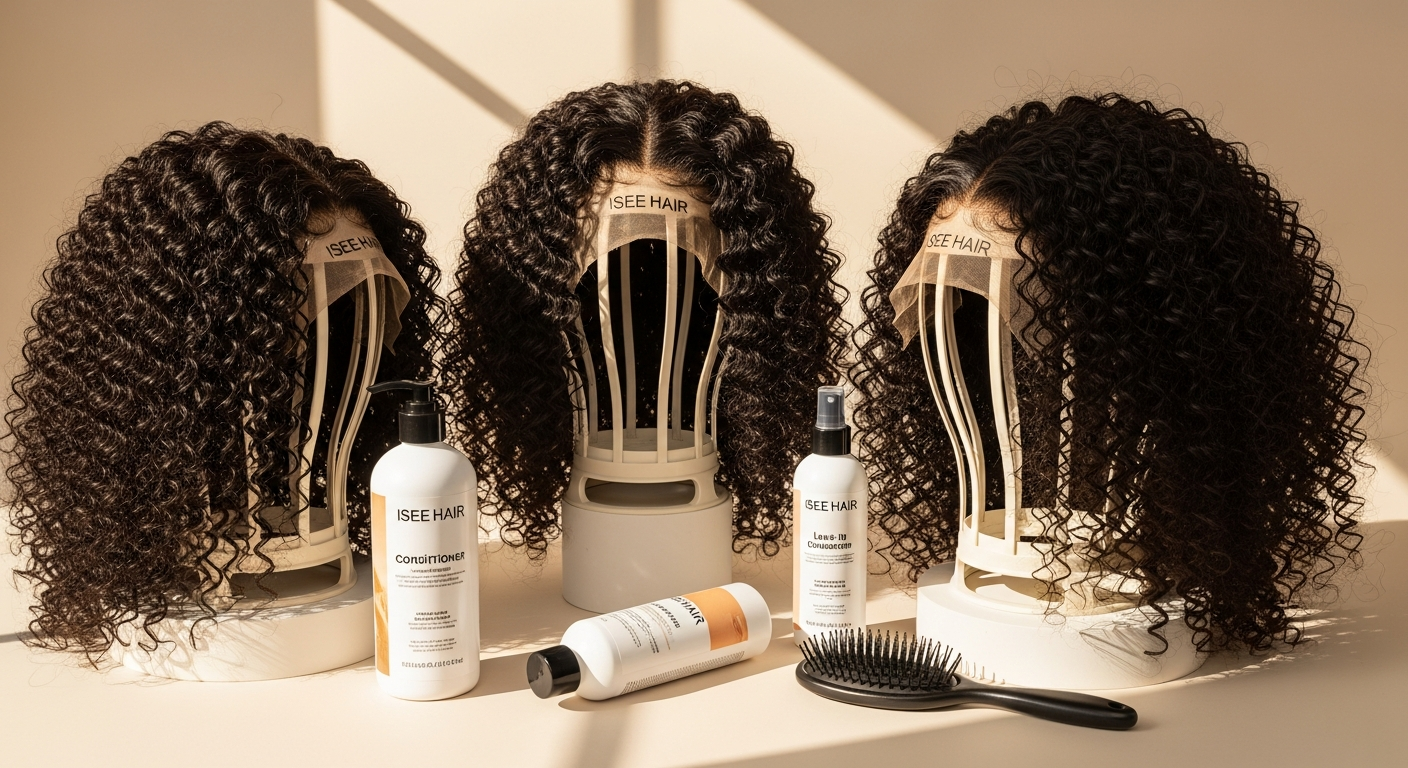
Master kinky curly wig maintenance with our complete ISEE HAIR Wear & Go Glueless HD Lace Wig care guide. Learn styling tips, detangling techniques, and product recommendations to keep your wig looking fresh and frizz-free.
Over 70% of wig wearers struggle with maintaining their kinky curly styles between washes, watching their perfectly defined curls gradually lose shape and succumb to frizz. The constant battle against environmental moisture and product buildup can turn a salon-quality wig into a tangled, lifeless mess within weeks. Yet the ISEE HAIR Wear & Go Kinky Curly Glueless HD Lace Wig has become a game-changer for texture-loving wearers precisely because it delivers that coveted natural, authentic look without the commitment of glue or extensive installation.
What makes this wig special is its 100% human Remy hair construction and realistic HD lace that blends seamlessly with natural skin tones. The glueless design with adjustable straps and combs means you can slip it on, adjust it, and remove it within seconds—a convenience that appeals to both beginners and seasoned wig wearers. However, that beautiful kinky curly texture requires intentional daily care to maintain its curl definition and prevent the frizz that creeps in, especially in humid climates.
This guide covers the real-world strategies that keep your investment looking incredible, from daily maintenance routines to product selection and troubleshooting techniques. You'll learn why kinky curly wigs demand different care than other textures, how to master detangling without breakage, and which products actually work for this specific hair type. Whether you're navigating humidity challenges or trying to extend your wig's lifespan, these practical approaches will transform maintenance from frustrating to manageable.
Why Kinky Curly Wigs Demand Different Care Than Other Textures
The structural differences between kinky curly, wavy, and straight hair and how texture affects moisture retention
Kinky curly hair has a fundamentally different structure than wavy or straight textures. The tight spiral pattern of kinky curls creates more surface area along each strand, which sounds beneficial until you realize it also means more opportunities for moisture to escape. Straight hair lies flat against the scalp, allowing natural oils to travel down the hair shaft easily. Kinky curls, by contrast, create natural "pockets" where moisture gets trapped or lost depending on how you care for the wig.
This structural reality means your ISEE HAIR kinky curly wig won't respond the same way to products designed for straight or wavy textures. What works beautifully on a loose wave might leave your kinky curls looking dull and weighed down. Understanding this fundamental difference shapes every decision you make about maintenance.
Why humidity impacts curly wigs more dramatically than other styles
Humidity is the silent enemy of kinky curly wigs. When moisture in the air penetrates the hair shaft, it disrupts the curl pattern you've worked so hard to define. Your carefully styled curls begin to expand and lose their shape, frizz emerges along the hair strands, and that gorgeous definition flattens into undefined waves or limp curls.
Straight and wavy wigs experience humidity too, but the effect is less dramatic because the hair structure doesn't have as many angles for moisture to distort. Kinky curly texture, with its tight spirals, reacts immediately and visibly to moisture changes. This is why people living in humid climates or dealing with summer weather often report more maintenance challenges with kinky curly wigs.
How the natural curl pattern in kinky textures makes them prone to frizz without proper sealing techniques
Frizz in kinky curly hair isn't random—it's a sign that the outer layer of your hair cuticles is lifting and allowing moisture to penetrate. The cure isn't fighting your texture; it's sealing it properly. When you apply mousse, leave-in conditioner, or finishing products, you're creating a protective layer that tells moisture to stay out while keeping hydration locked in.
Without this sealing step, your beautiful kinky curls sit vulnerable to every environmental change. A walk outside, a shift in humidity levels, or even running water from a nearby sink can trigger frizz development. Proper sealing techniques—which you'll learn in the daily styling section—are non-negotiable for maintaining curl definition.
The role of porosity in kinky curly hair and why this matters for product selection
Porosity describes how well your hair absorbs and retains moisture. High porosity hair has open cuticles and absorbs moisture quickly but also loses it rapidly. Low porosity hair has tightly sealed cuticles and resists moisture absorption but can become over-conditioned. Most kinky curly hair leans toward high porosity, which is why you often see recommendations for lightweight products rather than heavy creams.
Your ISEE HAIR wig likely has high porosity characteristics, especially if it's been colored, bleached for the HD lace, or processed in any way. This means you need products that hydrate deeply but don't sit on top of the hair, creating buildup. Testing your wig's porosity early—by observing how it responds to different products—saves you time and money.
Common misconceptions about low-maintenance kinky curly wigs and what the reality looks like
The "Wear & Go" label on this wig can be misleading. Yes, you can wear it and go without adhesive application and removal. No, this doesn't mean the kinky curly texture is low-maintenance. The glueless construction simplifies installation, but the texture itself still demands intentional daily care.
Reality looks like: morning refreshes with water and mousse, regular detangling sessions, weekly deep conditioning treatments, and consistent attention to humidity management. It's not high-maintenance compared to natural hair care or glued wigs, but it's also not wash-and-go easy. Understanding this distinction prevents frustration and helps you approach maintenance with realistic expectations.
How the ISEE HAIR HD lace construction influences your daily care routine
The pre-cut, pre-plucked, and pre-bleached HD lace on your ISEE HAIR wig is designed to look invisible against your skin. This quality construction means you can style the wig more freely and wear it in ways that show off the hairline. However, that delicate lace requires careful handling during detangling and styling to prevent damage.
When you're detangling near the lace, you need a gentler approach than you might use on the hair further back. When you're applying products, excessive rubbing near the hairline can weaken the lace. The beauty of this construction comes with the responsibility to protect it during your daily maintenance routine.
The Essential Daily Styling Routine for Kinky Curly Wigs
Morning refresh techniques that reactivate curls without full-wig washing
You don't need to wash your wig every day to refresh the curls. A morning refresh using water and styling products brings kinky curls back to life while extending the time between full washes. The key is understanding that water alone activates the curl pattern, but without product reinforcement, those curls won't hold throughout the day.
Start by lightly misting your wig with water from a spray bottle. Focus on sections where curls have flattened overnight or where frizz has developed. Use a light touch—you're not drenching the wig, just awakening the curl pattern. Then move directly into your mousse application while the hair is still damp.
Water-based mousse application methods that define curls without crunchiness
Mousse is your secret weapon for kinky curly wig maintenance. It defines curls, provides lightweight hold, and washes out easily without buildup. However, the application method matters tremendously. Heavy-handed mousse application leaves your curls crunchy and stiff, defeating the purpose of having soft, natural-looking texture.
Apply mousse by working it through damp sections with your fingers, scrunching upward to encourage curl formation. Use about a quarter-sized amount per section, working in layers rather than dumping product on one area. The goal is even distribution that enhances your natural curl pattern without coating the hair in visible product residue.
The praying hands and scrunching techniques for setting curl patterns
The "praying hands" technique involves placing a section of damp hair between your palms and gently pressing upward. This encourages the curl to form while distributing product evenly. You're not rubbing or twisting; you're pressing and holding to guide the hair into its natural curl shape.
Scrunching complements this by using your fingers to gently squeeze sections of hair upward, encouraging curl formation while the hair is still wet. Both techniques work together to set your curl pattern without the frizz that comes from aggressive manipulation. The gentler your approach, the better your curls respond.
Finger-coiling sections to enhance individual curl definition
For days when your curls need extra definition, finger-coiling specific sections takes your curl pattern from good to exceptional. This technique involves wrapping a section of damp hair around your finger to create a coil, then releasing it to form a defined curl.
Start with smaller sections near your face or crown where you want maximum definition. Apply a tiny amount of mousse to each section before coiling. This technique is time-intensive, so reserve it for special occasions or when you know you'll be wearing your wig in situations where you want your best curl definition on display.
How to use a microfiber towel or t-shirt to remove excess moisture without disrupting curls
Traditional towels disrupt curl patterns and cause frizz through friction. Microfiber towels and soft t-shirts absorb moisture gently, allowing curls to set without damage. After applying your styling products, gently gather sections of your wig into a microfiber towel or t-shirt and hold for 10-15 seconds, allowing the fabric to absorb excess water.
Never wring, squeeze forcefully, or rub your wig with the towel. The goal is blotting, not drying. Your curls should still feel damp after this step—that's when they're primed to set into their best shape during air-drying.
Timing your daily routine for maximum hold and longevity throughout the day
The order of your morning routine matters. Water first, then mousse, then microfiber blotting, then air-drying creates the optimal sequence for curl formation and hold. Rushing this process or reversing steps leads to disappointing results.
Timing also includes knowing when to do your refresh routine. Doing it right before you leave home means your curls dry while you're going about your day, with the natural movement of your body helping set the pattern. Doing it hours before you need to look your best means the hold degrades before you step out the door.
Product layering strategies that build definition without product buildup
Layering lightweight products creates better results than using one heavy product. A light mousse base plus a water-based leave-in conditioner plus a sealing oil or light serum builds definition while maintaining the texture's softness. Each layer serves a specific purpose: hydration, definition, and sealing.
The key to avoiding buildup is using appropriate amounts at each layer and choosing products designed to work together. Don't layer mousse with heavy cream or combine silicone-based products with water-based products. Understand how each product interacts with the others.
Detangling Mastery: Preventing Breakage and Matting
When to detangle your wig (dry versus damp) and why timing matters
Kinky curly hair detangles most easily when it's damp, not soaking wet and not completely dry. Damp hair has enough moisture for slip while still maintaining enough structure to support the hair during detangling. Completely wet hair becomes too fragile, and completely dry hair offers no slip, making detangling painful and prone to breakage.
The best time to detangle is after you've applied a leave-in conditioner to damp hair. The product provides slip, making the detangling process smoother. Avoid detangling dry hair as part of your daily routine; reserve that for when you absolutely must address matting or tangles.
Wide-tooth comb versus detangling brush selection for kinky curly textures
Wide-tooth combs are your best friend for kinky curly hair. The space between teeth allows curls to pass through without snagging or breaking. Fine-tooth combs, paddle brushes, and round brushes create unnecessary friction and breakage risk.
Some people prefer detangling brushes specifically designed for curly textures, which offer wider spacing and softer bristles than traditional brushes. Experiment with both a quality wide-tooth comb and a curl-specific brush to see which feels more comfortable in your hands and produces better results on your wig.
Section-by-section detangling methodology to minimize stress on strands
Don't attempt to detangle your entire wig at once. Divide it into manageable sections—typically 4 to 8 depending on wig density—and work through one section completely before moving to the next. This approach prevents re-tangling sections you've already worked through and allows you to focus your attention on one area.
Within each section, start at the bottom and work upward, addressing tangles as you encounter them. Never pull your comb through a tangle; instead, gently work around it, loosening it from multiple angles until it releases without resistance.
How to identify matting early and address it before it becomes permanent damage
Matting occurs when hair fibers bond together, creating a felt-like texture that can become permanent if left too long. Early matting appears as slightly fused sections where curls have knitted together. Catching matting at this stage allows you to reverse it through patient detangling and conditioning.
If you wait until matting becomes severe, you may need to cut out the affected section, causing permanent damage to your wig's style. Weekly detangling sessions help you identify early matting and address it immediately. High-friction areas like the nape and crown require special attention.
The importance of working from ends to roots rather than top to bottom
Start detangling at the ends of your hair and work upward toward the roots. This prevents pushing tangles deeper into the hair shaft, which can create matting. When you start at the roots and work down, you're essentially driving tangles deeper, making them harder to untangle and more likely to cause breakage.
This technique requires patience, especially with longer wigs, but it's the difference between a successful detangling session and one that leaves your hair damaged and matted.
Detangling frequency recommendations based on wear schedule and climate
If you wear your wig daily, plan for a thorough detangling session at least once weekly. In humid climates, twice weekly might be necessary. If you wear your wig occasionally, detangle before each wear and as needed if you notice tangling developing.
Pay attention to how your specific wig responds. Some people find that their ISEE HAIR kinky curly wig barely tangles with consistent care, while others in different climates or with different wear patterns experience more frequent tangling. Let your wig's behavior guide your detangling schedule.
Signs that your wig needs a deep conditioning treatment versus a simple refresh
A simple refresh with water and mousse works for daily styling needs. Deep conditioning becomes necessary when your wig feels dry, tangles more easily than usual, or looks dull despite proper styling. You'll also need deep conditioning if you've recently styled or colored your wig, as processing can dry out hair.
Listen to your wig. If daily refreshes aren't bringing curls back to life, if tangles appear despite careful handling, or if the texture feels rough rather than soft, your wig is signaling that it needs intensive moisture. That's when you move beyond your daily routine to deeper treatments.
Product Selection: What Actually Works for ISEE HAIR Kinky Curly Wigs
Lightweight mousse formulas that define without flaking or crunchiness
The ideal mousse for kinky curly wigs holds curls without visible residue or crunchiness. Brands designed specifically for curly hair textures tend to work better than generic volumizing mousses. Look for formulas that list water as the first ingredient and avoid products containing alcohol, which dries out hair.
Test mousse on a small section before applying it to your entire wig. You want a product that feels soft once dry, not stiff or crunchy. If you notice visible flaking or residue on your curls after the mousse dries, that's a sign the formula isn't ideal for your hair type.
Water-based versus silicone-based products and their effects on curl longevity
Water-based products hydrate and nourish without creating heavy buildup. They wash out easily and work well for daily use. Silicone-based products provide shine and smoothness but can accumulate on the hair shaft over time, eventually creating a dull, weighed-down appearance.
For kinky curly wigs, water-based products are generally superior for daily maintenance. Reserve silicone-based serums and finishing sprays for occasional use or special occasions when you want extra shine without worrying about buildup.
Leave-in conditioners that hydrate without weighing down kinky curls
Leave-in conditioners provide ongoing hydration without the rinse-out requirement of traditional conditioners. The best formulas for kinky curly wigs are lightweight and designed for curly textures. They should absorb into the hair rather than sitting on top, creating a greasy appearance.
Apply leave-in conditioner to damp hair in small amounts, focusing on mid-lengths and ends. Avoid applying directly to the roots, which can make your curls look limp. Your leave-in conditioner should enhance your curl pattern, not flatten it.
Oils and serums that seal moisture while maintaining texture definition
Oils and serums provide the final sealing layer that locks moisture into your hair and prevents frizz. However, not all oils work equally on kinky curly hair. Heavy oils like coconut oil can sit on the hair and create buildup. Lighter oils like jojoba, argan, or almond oil offer better results for most kinky curly wigs.
Apply oils sparingly—a few drops on your palms, then lightly smooth over your curls while they're still damp. The goal is a subtle shine and smooth texture, not greasy, shiny hair. If your curls look wet or limp, you've used too much oil.
Avoiding heavy butters and creams that can cause product buildup
Heavy butters and creams designed for natural hair can suffocate kinky curly wigs, creating buildup that dulls shine and makes curls look dull and lifeless. These products are often formulated for scalp-to-ends hydration on natural hair, which has different needs than a wig.
Stick to lightweight formulas designed for wigs or curly extensions. Your curls will look better, your maintenance routine will be simpler, and you'll avoid the frustration of product buildup that requires clarifying treatments to remove.
Budget-friendly product alternatives that deliver salon-quality results
Professional wig products are excellent but expensive. Many drugstore products work surprisingly well for kinky curly wigs. Affordable mousses from brands focused on curly hair, inexpensive leave-in conditioners, and budget-friendly oils deliver results comparable to premium options.
The key is reading labels and understanding what your hair needs rather than paying for brand prestige. An affordable mousse with similar ingredients to a professional version likely performs similarly. Experiment with budget options, note what works, and build your routine around products that deliver results at your preferred price point.
How to test new products on a small section before full application
Never apply a new product to your entire wig without testing it first. Isolate a small section in the back where it won't be visible, apply the product using your normal method, let it dry, and evaluate the results. Does it enhance your curl definition? Does it cause crunchiness or flaking? Does it create buildup?
Testing prevents wasting time and money on products that don't work for your hair while also protecting your wig from potentially damaging experiments. Give each product a fair test—use the amount you'd normally use and follow your standard application technique.
Managing Humidity and Environmental Challenges
Why humid climates accelerate frizz development in kinky curly wigs
Humidity forces moisture into the hair shaft, disrupting your carefully styled curl pattern. The higher the humidity, the more aggressively moisture penetrates, and the faster your defined curls become undefined frizz. This is why people in humid climates often report more maintenance challenges despite following the same care routine as those in drier areas.
Understanding this reality helps you accept that managing humidity isn't about eliminating frizz entirely—it's about minimizing it and having strategies to address it when it appears.
Protective styling techniques for high-humidity environments
In high-humidity situations, protective styling reduces frizz exposure. Styles that keep curls compressed and sealed—like braided or twisted styles, buns, or half-up styles—minimize the surface area exposed to humidity. Your curls are less vulnerable when they're not spread out and fully exposed to moist air.
When you know you'll be in a humid environment, consider whether a protective style serves you better than wearing your wig in a fully open style.
The role of sealants and finishing sprays in combating moisture penetration
Anti-frizz sprays and sealants create a protective barrier that tells moisture to stay out. Products containing silicones or wax-based ingredients work by coating the hair surface, making it harder for humidity to penetrate. In humid climates, finishing spray becomes an essential part of your daily routine rather than an occasional product.
Apply finishing spray once your curls are set and dry. The spray works best as a preventative measure—applying it to dry, finished curls rather than trying to use it to revive frizz that's already developed.
Indoor versus outdoor wear strategies during different seasons
Air-conditioned indoor environments are your friend during hot, humid seasons. The cool, dry air of indoor spaces slows frizz development dramatically. If you'll be moving between indoor air conditioning and humid outdoor environments, plan your styling and product application accordingly.
During cooler, less humid seasons, you may find your wig responds differently and requires less anti-frizz intervention. Adjust your routine seasonally rather than using the same approach year-round.
How air conditioning and heating systems affect wig moisture levels
Heating and air conditioning systems reduce ambient humidity, which benefits your curls. However, constant exposure to conditioned air can also dry out your wig. The balance is maintaining adequate moisture through conditioning while not overcompensating with heavy products that create buildup.
If you spend most of your time in air-conditioned spaces, focus on hydration but stay lighter on sealants and finishing sprays. If you alternate between conditioned indoor air and humid outdoor air, use finishing sprays strategically for the outdoor portions of your day.
Quick fixes for unexpected frizz throughout the day
Despite your best efforts, frizz sometimes appears unexpectedly. Carrying a small bottle of finishing spray or a light hairspray allows you to quickly address frizz during the day. A light mist followed by smoothing with your hand helps control frizz without requiring a full refresh.
Some people find that lightly dampening their fingers and smoothing frizzy sections addresses the problem without products. Test this approach to see if it works for you and your specific wig.
Long-term storage solutions that prevent humidity-related damage
Store your wig in a cool, dry place away from direct sunlight. A wig head on a stand allows air circulation and prevents the wig from being compressed. Avoid storing your wig in plastic bags or containers that trap humidity; instead, use breathable storage solutions.
During humid seasons, consider storing your wig in a sealed container with silica gel packets to control moisture levels. Check your wig periodically during storage to ensure it's not developing mold or mildew from excess humidity.
Washing and Deep Conditioning Without Compromising Curl Pattern
Recommended washing frequency for kinky curly wigs based on wear intensity
Daily wear wigs generally need washing every two weeks, while wigs worn occasionally can go longer. The more you wear your wig, the more product, sweat, and environmental debris accumulates, necessitating more frequent washing. However, washing too frequently dries out curls and accelerates wear.
Observe your wig to determine the right frequency. If curls look dull or product buildup appears visible despite daily refreshing, your wig needs washing. If curls still look great and feel soft, you can extend the time between washes.
Gentle cleansing methods that remove product buildup without stripping moisture
Use a gentle shampoo designed for curly or human hair, not clarifying shampoo unless you specifically need to remove heavy buildup. Fill a basin with cool water, add shampoo, and submerge your wig. Gently squeeze the soapy water through the hair without rubbing or agitation.
Pay special attention to the scalp area and roots where product buildup tends to concentrate. For the rest of the wig, the shampoo solution flowing through the hair during rinsing provides sufficient cleansing without aggressive manipulation.
Temperature considerations for water and how they affect curl integrity
Cool to lukewarm water is ideal for kinky curly wigs. Hot water opens the hair cuticle and can dry out curls, cause color fading, and potentially damage the lace and hair attachment points. Cold water closes the cuticle, helping to seal in moisture and maintain curl definition.
Start your wash with warm water for comfort and cleansing, but finish with a cool rinse. Your curls will look shinier and feel softer with the cool-water finish.
Deep conditioning protocols that restore softness and elasticity
Deep conditioning treatments restore moisture and elasticity to dried-out curls. Apply deep conditioner generously to damp hair, focusing on mid-lengths and ends. Let it sit for at least 15-30 minutes—longer is fine if your wig is particularly dry.
For extra-intensive conditioning, apply deep conditioner, wrap your wig in a shower cap, and let it sit for an hour or even overnight. The enclosed environment allows the conditioner to penetrate more deeply.
The plopping method for drying kinky curly wigs to minimize frizz
After conditioning, wrap your wet wig in a microfiber towel or t-shirt for 10-15 minutes, allowing the fabric to absorb excess water. This "plopping" method removes excess moisture while keeping curls intact. Never squeeze, wring, or vigorously rub your wig.
After plopping, gently detangle any knots with a wide-tooth comb while the hair is still damp. Then proceed to air-drying or heat-drying based on your preference.
Air-drying versus heat-drying and the impact on curl definition
Air-drying produces the most defined curls with the least damage. After plopping, allow your wig to dry naturally on a wig stand. Placing a fan nearby (not directly on the wig) helps speed the process without disrupting curls.
Heat-drying with a diffuser attachment can also work, using the lowest heat setting and pulsing air rather than constant heat. However, heat always carries some risk of damage, so reserve it for when you need your wig dry quickly.
How to prevent over-washing while maintaining hygiene and freshness
Over-washing dries out curls and accelerates wig deterioration. To extend time between washes, use dry shampoo or dry texture sprays to absorb excess oils and refresh the wig without full washing. These products add texture and freshness without the stripping effects of water and shampoo.
Between full washes, your daily refresh routine with water and mousse keeps curls looking fresh and styled. This approach maintains hygiene while protecting your wig's moisture balance.
Protective Styling: Extending Wig Life While Protecting Natural Hair
Why protective styling matters when wearing kinky curly wigs regularly
Protective styling protects both your wig and your natural hair underneath. Constantly wearing your hair down exposes your curls to friction, environmental damage, and regular manipulation. Protective styles—like braids, twists, buns, or half-up styles—reduce this exposure while still allowing you to style your wig in varied ways.
For your natural hair underneath the wig, protective styling keeps it out of the way, reducing friction and tension from the wig's adjustable straps and combs. This is crucial if you're wearing the wig regularly and hoping to maintain healthy natural hair growth.
Low-manipulation styling options that reduce stress on both wig and natural hair
Braids, twists, and buns are low-manipulation styles that keep your wig curls protected. These styles also showcase your texture while reducing daily manipulation that can lead to breakage and frizz. A bun or twist protects curls while still looking polished and intentional.
Experiment with different protective styles to find options that work with your wig's length and density while matching your lifestyle and aesthetic preferences.
Scalp care routines that prevent irritation during extended wig wear
Wearing a wig for extended periods can irritate your scalp, especially if you're not allowing it to breathe between wears. Maintain scalp health by moisturizing your natural hair regularly, keeping your scalp clean, and taking breaks from wig wearing.
Use a moisturizing oil or leave-in conditioner on your natural hair and scalp at least once weekly. This prevents dryness and itching, which can become intense under a wig. Your scalp health directly impacts your willingness to wear the wig consistently and your ability to grow healthy natural hair.
Breathable wig cap selection for comfort and scalp health
Quality wig caps allow air circulation, reducing sweat buildup and scalp irritation. Look for caps made from breathable materials like mesh or cotton blends. Some people prefer going without a cap, while others find caps essential for comfort and a secure fit.
If you use a wig cap, ensure it's clean and breathable. A sweaty, damp wig cap against your scalp creates an environment for irritation and fungal issues.
Moisture retention strategies for natural hair underneath glueless wigs
Your natural hair underneath the wig needs moisture, even when covered. Apply leave-in conditioner or moisturizing oil to your hair before putting the wig on. Focus on the hair that will be covered and compressed, as these areas tend to dry out more quickly.
Every few days, remove your wig and moisturize your natural hair. This keeps it hydrated and healthy while preventing the dryness that often accompanies extended wig wearing.
When to take breaks from wig wearing and how long those breaks should be
Even with excellent care, your scalp benefits from regular breaks from wig wearing. Aim for at least one full day per week without wearing your wig. This gives your scalp a chance to breathe, reduces friction on your natural hair, and prevents the buildup of sweat and product residue.
If you wear your wig daily for work or other commitments, taking weekends off or designating specific days as wig-free days helps maintain scalp health and natural hair condition.
Combining wig wear with natural hair growth goals
You can absolutely wear wigs regularly while growing healthy natural hair underneath. The key is protecting your natural hair with low-manipulation styles, maintaining moisture, taking regular breaks from the wig, and being gentle during installation and removal.
Think of your wig as a protective style rather than a hair-damaging practice. Approached with intention, regular wig wear actually protects natural hair from environmental damage and manipulation.
Comparing ISEE HAIR's Glueless Design to Glued Alternatives: Maintenance Implications
How glueless construction simplifies daily care routines
Glueless wigs with adjustable straps, combs, and drawstrings eliminate the installation and removal complications of glued wigs. You slip on your wig, adjust the straps and combs for a secure fit, and you're done—no waiting for adhesive to dry, no special removal solutions needed. This simplicity extends to daily maintenance because you're not managing adhesive buildup or worrying about lace damage from adhesive removal.
The ease of removal also means you can take your wig off anytime you need to, allowing your scalp to breathe and making protective styling changes simple.
Adjustable strap and comb maintenance for secure, comfortable fit
Glueless wigs rely on adjustable straps and combs to stay secure. Inspect these components regularly to ensure they're functioning properly. Straps should adjust smoothly, and combs should be clean and free from debris.
Over time, straps can loosen or fray, and combs can accumulate lint and product residue. Gently cleaning combs with a soft brush and checking straps regularly ensures your wig stays secure without requiring readjustment multiple times daily.
Avoiding adhesive residue buildup that can damage lace and hair
Glueless construction eliminates this concern entirely. You're not dealing with adhesive residue that accumulates on the lace, doesn't wash out completely, or causes lace deterioration. This is one major advantage of the glueless design, particularly for someone maintaining the delicate HD lace on your ISEE HAIR wig.
The flexibility advantage of glueless wigs for varied styling and texture manipulation
Glueless wigs can be removed and repositioned if you want to change your hairstyle or try a different look. You're not committed to one installation for weeks. This flexibility is particularly valuable for kinky curly wigs, where you might want to wear your hair down one day and in a protective style the next.
You can also manipulate and style the lace more freely knowing you can adjust the wig if needed rather than being locked into one position by adhesive.
Cost savings on adhesive products and removal solutions
Eliminating glue from your wig care routine saves money on adhesive products, removal solutions, and any associated tools. Over the life of your wig, these savings add up, making glueless wigs more economical despite potentially higher upfront costs.
When glueless versus glued might be better based on lifestyle and wear patterns
Glueless wigs work best for people who remove their wig regularly, have active lifestyles, or want simplicity in their maintenance routine. Glued wigs work better for people with very active lifestyles where the wig might shift with movement, or those who prefer not removing their wig frequently.
For most kinky curly wig wearers, the glueless design of your ISEE HAIR wig offers advantages that align perfectly with daily maintenance routines.
Longevity differences between glueless and glued wig care practices
Glueless wigs can last just as long as glued wigs with proper care, and some argue they last longer because there's no adhesive stress on the lace and hair. Your maintenance routine protects the wig's longevity regardless of construction type, but glueless construction does eliminate one potential source of damage.