
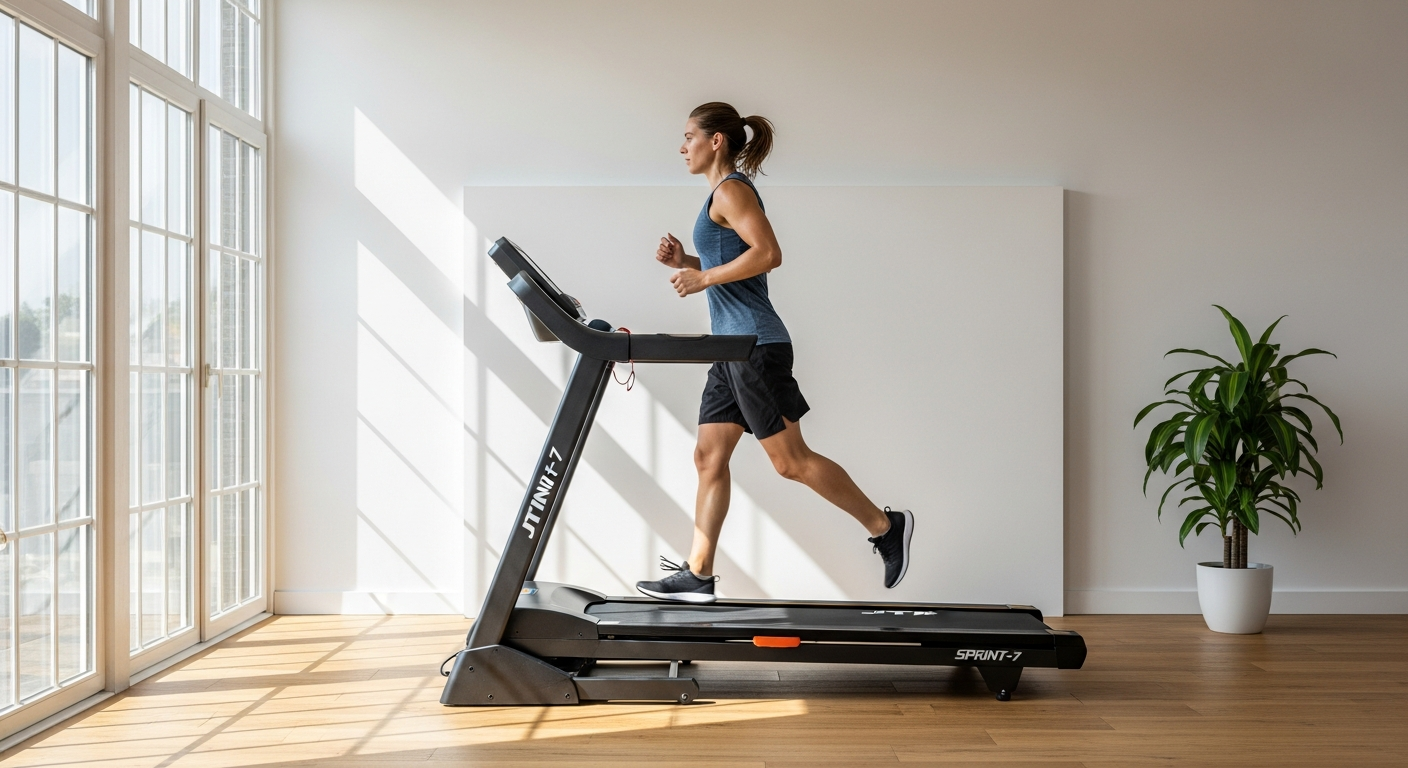
Discover whether the JTX Sprint-7 Folding Home Treadmill delivers the performance serious runners need. Explore motor power, incline training, and long-distance capabilities for dedicated fitness enthusiasts.
Most home treadmill buyers abandon their machines within six months because they're either too flimsy for serious running or too limited in features. If you're someone who logs 30+ miles per week or dreams of building marathon endurance from home, you've probably felt the frustration of shopping for a machine that won't let you down halfway through your training plan. The fitness equipment market is flooded with machines designed for casual walkers, not runners.
The JTX Sprint-7 has quietly become the go-to choice for runners who refuse to compromise. Unlike entry-level treadmills marketed toward general fitness, this machine was engineered with genuine runners in mind—those who demand durability, performance, and features that actually support serious training. It consistently ranks as JTX Fitness's best-selling model and is frequently cited as the "best overall home treadmill" across reviews and user communities.
Discover the JTX Sprint-7 and start your distance running journey today.
Motor Power and Speed — What 2.5 CHP Really Means for Distance Runners
Explanation of CHP versus peak horsepower and why the distinction matters
Understanding motor specifications separates smart buyers from those who get frustrated with their machines six months in. Continuous Horsepower (CHP) measures what a motor can sustain over extended periods, whereas peak horsepower is a momentary spike. A 2.5 CHP motor in the Sprint-7 means the machine maintains that power level throughout your entire workout—whether you're finishing mile 8 of a 10-mile run or pushing through the final sprint of a tempo session. Many budget treadmills advertise impressive peak numbers while delivering weak continuous performance. The difference becomes painfully obvious during sustained efforts when lesser machines slow down or struggle to maintain speed under load.
How the 2.5 CHP motor sustains performance during extended running sessions
The Sprint-7's motor engineering prioritizes endurance athletes specifically. When you're running for 45 minutes to an hour, the motor faces constant demand. A weaker motor compensates by reducing belt speed slightly, which means your pace drops unintentionally—something that completely derails tempo runs and long runs requiring specific pace maintenance. The 2.5 CHP rating ensures consistent belt speed regardless of session length. You set your pace, and the machine maintains it. This consistency is non-negotiable for anyone building a structured training plan where hitting target paces matters for aerobic development.
Top speed of 20 kph and its relevance for interval training and tempo runs
Twenty kilometers per hour translates to approximately 12.4 mph, which covers the needs of most runners. If you're training for marathons, your tempo runs likely sit around 10-11 kph, giving you comfortable headroom above your working pace. The extra speed ceiling matters more than it initially seems. That headroom allows for interval work where you need sharp speed bursts—3-minute repeats at race pace or faster, with controlled recovery jogs between efforts. Many entry-level treadmills max out at 16-18 kph, forcing you to choose between compromised intervals or accepting slower workout sessions.
Comparison of motor durability for runners training 5+ days per week
Heavy weekly mileage tests motor durability aggressively. A runner logging 40-50 miles per week is stressing the motor system consistently. The Sprint-7's engineering reflects this reality—it's built for users who show up regularly, not casually. Its heavier construction and robust motor design mean it doesn't fatigue as quickly as lighter machines. Users who train 5-6 days weekly report consistent performance year after year, whereas lighter, cheaper treadmills often develop performance issues within 12-18 months of serious use.
Incline Training Without Leaving Your Living Room
The 12% powered incline and its equivalence to outdoor hill grades
The 12% powered incline represents a significant training advantage often overlooked by casual shoppers. In outdoor running terms, a 12% gradient is genuinely steep—think of the nastiest hill in your typical running route and you've probably encountered something around 6-8%. The ability to consistently train on 12% grades is something most runners never experience outdoors regularly. Hill training doesn't just build strength; it reshapes how your body distributes force and improves running economy. The powered incline on the Sprint-7 lets you program specific hill sessions whenever you choose, regardless of weather or daylight.
How incline work strengthens glutes, quads, and calves for injury prevention
Running uphill recruits muscle groups differently than flat running. Your glutes and quads activate more intensely, and your calves work harder to drive propulsion. This varied stimulus strengthens muscles that flat running doesn't stress equally, creating more balanced muscular development. Stronger glutes and quads mean better knee stability, reduced patellar tracking issues, and fewer overuse injuries. Runners who incorporate consistent hill work report fewer injuries because their supporting muscles develop the strength needed to handle race-day demands and fatigue.
Programming hill repeats and tempo climbs on the Sprint-7
The Sprint-7's incline control responsiveness allows you to program structured hill workouts. A typical hill repeat session might involve warming up on flat or slight incline, then executing 6-8 repeats of 3-5 minutes at 8-10% incline at your tempo pace, with active recovery jogs at lower incline between efforts. Tempo climbs involve sustaining 10-12% incline for 15-25 minutes at a controlled effort. You can adjust incline mid-run seamlessly, something essential for executing the varied workouts that produce real adaptations. The machine's incline adjustment speed matters here—sluggish controls break your workout rhythm and focus.
Cardiovascular adaptations from consistent hill work on a home treadmill
Your cardiovascular system responds dramatically to hill training. Running uphill demands higher oxygen consumption and places greater stress on your aerobic system than flat running at equivalent speeds. Over 8-12 weeks of consistent hill work, your heart becomes more efficient at delivering oxygen to working muscles, your lactate threshold increases, and your overall aerobic capacity expands. These adaptations directly translate to faster flat running because your body has adapted to handle greater metabolic stress. The Sprint-7 enables you to build these adaptations systematically without depending on outdoor hill availability.
Running Deck Size and Biomechanics for Longer Distances
The 145 x 51 cm deck dimensions and what they mean for your stride
Deck dimensions matter far more than marketing typically suggests. The Sprint-7's 145 cm length provides ample space for a genuine running stride. Shorter decks (120 cm or less) force runners into shorter, quicker cadences or require adjusting stride mechanics unnaturally. A 145 cm deck accommodates runners of various heights—from shorter runners maintaining natural stride mechanics to taller runners (6'2"+) without feeling confined. The 51 cm width provides lateral stability, reducing the likelihood of accidentally stepping off-track during fatigue or when adjusting form during longer efforts.
Why deck length matters for runners training for half-marathons and marathons
Distance training demands running at steady, natural paces for extended periods. A cramped deck forces compensatory mechanics—shortened stride or elevated cadence—that feel unnatural and eventually cause fatigue or discomfort. The Sprint-7's generous dimensions let you settle into your natural running rhythm and maintain it for the full duration. For a 90-minute long run, this matters significantly. You're not fighting the machine's dimensions; you're simply running.
Impact of adequate running surface on joint stress and injury risk
Running on too-small decks increases injury risk. Unnatural stride mechanics place stress on joints in ways they're not designed to handle. Knees experience lateral shear forces they normally wouldn't, ankles adjust alignment unnaturally, and hips compensate for shortened stride. Over dozens of runs, these mechanical compromises accumulate into injury risk. A spacious deck like the Sprint-7's reduces this risk by allowing your body to move the way it evolved to move.
Comfort factor during 60+ minute running sessions
Long runs demand comfort. A cramped deck becomes psychologically limiting when you're deep in a 60-minute effort. The Sprint-7's dimensions feel generous and supportive, not restrictive. This mental comfort—not fighting your training environment—supports mental resilience during difficult sessions.
Build Quality and Weight Capacity for Demanding Training Cycles
The 160 kg maximum user weight and what it indicates about frame construction
A 160 kg weight capacity signals robust frame engineering. Most home treadmills max out at 120-130 kg. That 160 kg rating means JTX reinforced the structural components—deck support, motor mounts, and frame welds—to handle significant load. This heavier-duty construction carries benefits beyond just accommodating larger users. It means the machine can handle the dynamic forces generated by high-intensity running without flexing excessively. When you're running intervals at high speed, your body generates impact forces several times your body weight. A machine rated for 160 kg has structural reserves that keep everything rigid and stable.
Traditional upright fold design and its contribution to overall stability
The Sprint-7 uses a traditional upright fold rather than flat-folding mechanism. This design choice prioritizes stability over space savings. When the machine is unfolded for running, the upright fold design keeps the frame more rigid and less prone to flex during intense efforts. Flat-folding designs are more compact when stored but often sacrifice some structural rigidity because the frame engineering must accommodate the flatter profile. Serious runners consistently choose the Sprint-7 over flat-folding competitors specifically because they value that stability during demanding workouts.
Machine stability during high-intensity interval workouts
High-intensity running generates significant forces. When you're running 20 kph intervals with aggressive incline increases, the treadmill experiences substantial stress. A machine with marginal stability feels unstable during these moments—you can feel the deck shifting or the frame flexing. The Sprint-7's heavier construction and traditional fold design eliminate this sensation. The machine feels planted and stable regardless of your workout intensity, which supports both physical safety and mental confidence during demanding sessions.
Durability expectations for runners logging 40+ miles weekly
A runner logging 40-50 miles per week is putting the Sprint-7 through genuine endurance testing. The machine needs to handle this consistently without performance degradation. The Sprint-7's build quality supports this level of use. Users who run 40+ miles weekly report consistent performance across multiple years, whereas lighter machines often develop issues within 18-24 months of heavy use. The heavier construction and robust components mean the machine matures gracefully rather than failing prematurely.
Explore the Sprint-7's build quality and durability specifications on the JTX Fitness website.
Smart Training Features That Support Progressive Running Plans
Pre-programmed workout options for different training phases
The Sprint-7 includes pre-set workouts tailored to different training phases. These aren't gimmicky fat-burning sequences marketed to casual users; they're structured protocols supporting distance running development. You have hill-focused workouts, interval packages, and tempo runs programmed in. For runners building structured training plans, these pre-sets provide a foundation you can modify or use as-is depending on your focus. The programming flexibility supports periodized training where your workouts change focus across macrocycles.
Heart rate monitoring capabilities and their accuracy for zone-based training
The Sprint-7's heart rate monitoring allows you to train in specific zones—crucial for building aerobic capacity without overtraining. Zone-based training prevents the common mistake of running every moderate run at moderate-hard effort, which flattens performance gains. Instead, you run easy runs genuinely easy, allowing recovery, while harder efforts get genuine intensity. The heart rate monitoring provides immediate biofeedback allowing you to adjust effort and verify you're hitting your target zones. Accuracy matters here—chest strap monitoring is more reliable than handlebar sensors.
Speed and incline control responsiveness for interval work
Interval training demands crisp speed and incline adjustments. If the machine sluggishly responds to speed changes, your interval timing suffers and workout quality deteriorates. The Sprint-7's control responsiveness supports rapid transitions between work and recovery intervals. You can move from 12 kph easy jog to 14 kph tempo effort to 16 kph fast repeat seamlessly, without the machine lagging or overshooting. This responsiveness becomes noticeable when you're executing complex workouts with varied intensities.
Compatibility with running training apps and progression tracking
Modern running training benefits from data tracking across sessions. The Sprint-7 integrates with training apps allowing you to log your workouts, track progression, and review performance data over time. This integration supports the methodical approach distance runners need—understanding whether your training is producing desired adaptations, identifying when to advance workouts, and spotting patterns in fatigue or performance dips.
Space Considerations and the Upright Fold Trade-Off
Traditional upright folding mechanism versus flat-folding designs
The trade-off between stability and space savings comes down to your priorities. Upright folding positions the machine vertically when not in use, reducing floor footprint but requiring vertical space. Flat-folding designs fold horizontally, reducing height but requiring more floor space. The Sprint-7's upright design suits most home gyms with standard ceiling heights, but if your space is severely constrained horizontally, flat-folding might be more practical. That said, stability-focused runners typically accept the space trade-off for the structural advantages upright folding provides.
Footprint when folded and unfolded for different home gym setups
When unfolded, the Sprint-7 occupies roughly 2 meters long by 1 meter wide—standard dimensions for a serious treadmill. When folded vertically, the footprint reduces to approximately 1 meter by 0.5 meters, though the height increases significantly. If you have ceiling height around 2.5 meters or more, this vertical storage works fine. In a typical basement or garage, you can fold it against a wall or in a corner. The key is confirming your space can accommodate either the unfolded running dimensions or the folded vertical profile depending on your setup.
Weight of the machine and implications for permanent placement
The Sprint-7 is heavier than most home treadmills—a direct result of its robust construction. This weight means it's not convenient to move frequently. Most users position it semi-permanently in their home gym space. If you're renting or might move the machine regularly, the weight becomes a practical consideration. That said, serious runners typically prefer permanent placement because it supports a dedicated training mindset. You're less likely to skip workouts if your treadmill is always ready rather than stored away and requiring setup.
Stability benefits of the heavier, upright-fold design
That weight isn't dead weight—it's structural material contributing to stability and durability. Heavier machines have less vibration during running, feel more stable when you're running hard, and handle impact forces more gracefully. If you've run on flimsy treadmills that vibrate and flex, you understand why weight matters. The Sprint-7 feels planted and solid, supporting both physical confidence and actual safety during intense efforts.
Investment Analysis — Is the Sprint-7 Worth It for Endurance Athletes?
Price range of £899–£979 relative to performance specifications
The Sprint-7 sits in the mid-premium home treadmill range. For comparison, entry-level machines run £400-600, while premium commercial-grade models exceed £2,000. At £899-979, you're investing significantly but not excessively. The question becomes whether the specifications justify the cost. A 2.5 CHP motor, 20 kph speed, 12% incline, 160 kg weight capacity, and spacious deck—these are features that would cost considerably more if purchased separately or found on cheaper machines. For someone committed to distance running, the specifications justify the price.
Direct-to-consumer pricing model and cost savings versus retail channels
JTX Fitness sells directly to customers, eliminating retail markups and middleman costs. This direct model keeps prices competitive compared to name brands sold through fitness retailers. You're not paying for showroom overhead or retailer margins. The savings mean you get more machine for your money than buying comparable specifications from retail channels. Additionally, JTX's customer support and in-home warranty coverage are reportedly strong, reducing risk in your investment.
Value comparison to commercial gym memberships over 3–5 years
A gym membership typically costs £30-80 monthly, totaling £1,080-2,880 over 3 years. The Sprint-7 costs £900-980 upfront. After 3 years, you've paid more for membership fees than the treadmill cost. Beyond cost, home training offers convenience—no commute, no weather-dependent days where the gym is closed, training whenever your schedule allows. For runners committed to consistent training, the home treadmill becomes more economical and practical than membership-based gym access within 2-3 years.
Return on investment for runners committed to home-based training
If you're someone who will consistently use the treadmill 4-6 days weekly for 18+ months, the investment makes sense. The cost per use decreases rapidly with consistent training. After 200 training sessions (roughly 6-8 months of serious training), your per-session cost drops below £5. After a year, you're at roughly £2-3 per session. For serious runners, that's exceptional value. If you're uncertain about your commitment level, the investment becomes riskier.
Real Training Scenarios — Marathon Prep and Beyond
Building a 16-week marathon training plan on the Sprint-7
A 16-week marathon training plan typically includes long runs, tempo workouts, interval sessions, and easy recovery runs. The Sprint-7 handles each component effectively. Long runs can be performed entirely on the treadmill—the spacious deck and smooth belt support 90+ minute efforts without discomfort. Tempo runs benefit from the responsive speed controls and ability to maintain consistent pace for 20-30 minutes. Intervals work perfectly using the speed and incline adjustments. Recovery runs are straightforward. The machine supports the complete training spectrum needed for marathon preparation.
Long run simulation and how the machine handles sustained efforts
Sustained 60-90 minute efforts test treadmill endurance. The Sprint-7's consistent motor performance means your pace doesn't drift despite the extended duration. The spacious deck lets you maintain natural biomechanics throughout. Heart rate monitoring allows you to verify you're running at appropriate easy-run intensity, not unconsciously pushing harder as fatigue accumulates. The belt quality supports extended running without degradation in feel or performance. Users report completing full marathon-distance training runs on the Sprint-7 without issues.
Cross-training integration with the treadmill as your primary tool
While runners benefit from cross-training (cycling, strength work, swimming), the treadmill can serve as your primary tool for most of your aerobic development. The varied incline capabilities and interval options let you build diverse fitness adaptations. Strength work done separately, combined with treadmill training, creates comprehensive marathon preparation. The Sprint-7 provides the treadmill component reliably.
Weather independence and training consistency advantages
Distance running consistency matters more than any single workout quality. Missing training days due to weather, darkness, or safety concerns undermines long-term progression. A home treadmill removes these barriers. You can train at 5:30 AM in your home regardless of weather. You don't skip workouts because wind, rain, or darkness makes outdoor running undesirable. This consistency—executing your training plan regardless of external conditions—accelerates fitness progression and supports the mental discipline that distance running demands.
Potential Limitations and Honest Trade-Offs
Upright fold design may not suit minimalist or compact home gym spaces
If your home gym space is severely limited, the Sprint-7's vertical footprint when folded might create challenges. Flat-folding models take up less vertical space but require more floor space. If your ceiling height is under 2.2 meters or your space genuinely doesn't accommodate vertical storage, this might be a limiting factor. Some runners work around this by keeping the machine unfolded permanently—a practical solution if space allows.
Machine weight and difficulty of repositioning compared to lighter models
The Sprint-7's robust construction means it's heavier than light, flat-folding alternatives. Moving it requires effort and typically two people. If you need to reposition it frequently or live in a situation where you might move homes regularly, the weight becomes impractical. For permanent or semi-permanent placement in a dedicated home gym, this isn't an issue.
Noise levels during high-speed running and early morning training
All treadmills generate some noise—the belt, motor, and impact sound. The Sprint-7's heavier construction actually works in your favor here; the structural rigidity reduces vibration-induced noise compared to lighter machines. However, early morning or late-night running on any treadmill creates noise that might disturb household members. If noise is a significant concern, a treadmill running mat underneath can dampen sound.
Belt maintenance requirements and long-term care
Treadmill belts require occasional maintenance—cleaning and occasional lubrication depending on use and belt type. The Sprint-7's belt is durable and doesn't require excessive maintenance, but like any machine, proper care extends lifespan. Understanding basic maintenance (cleaning the belt and motor area, checking for belt alignment) ensures years of reliable performance. Neglecting maintenance voids warranties and accelerates wear.
Your Endurance Training Starts Here
The JTX Sprint-7 isn't a compromise machine—it's a genuine training tool built for runners who take their fitness seriously. With its powerful 2.5 CHP motor, substantial 12% incline capability, and spacious running deck, this treadmill delivers the stability and performance you need to execute real training plans without stepping outside. Yes, it's heavier than some competitors and the upright fold won't save as much space as flat-folding alternatives, but serious runners consistently choose this machine because it performs. At £899–£979, you're getting gym-quality specifications at a price that won't devastate your budget. If your running ambitions extend beyond casual jogging and you're committed to logging consistent miles regardless of weather, this is worth your serious consideration.
Start your marathon training journey with the JTX Sprint-7 today.