
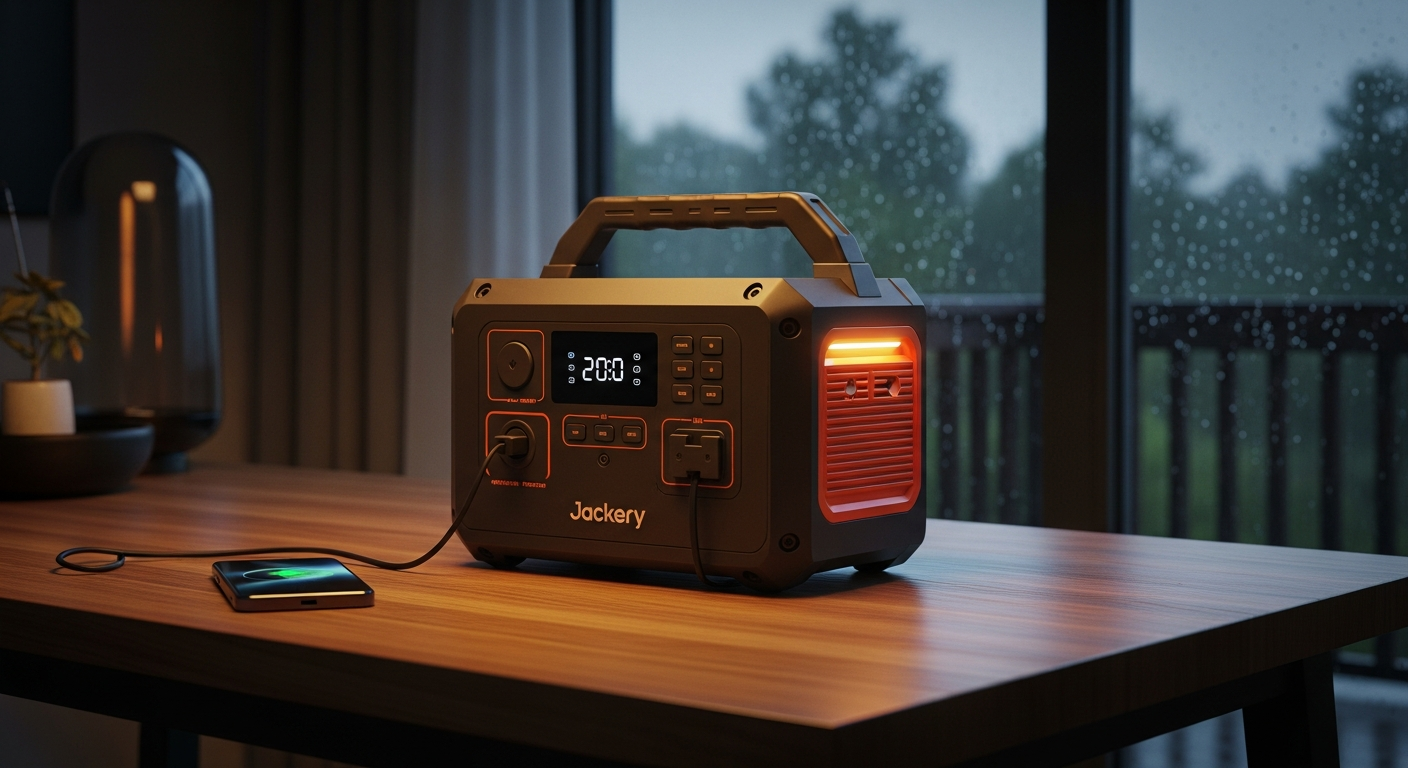
Discover how the Jackery Explorer 2000 Plus portable power station provides reliable home backup during emergencies. Learn about its 2042Wh capacity, expandable design, and why families trust it for power outages.
Power outages strike without warning. When the grid goes down, families face spoiled food, lost heating or cooling, and a cascade of complications that can last hours—or days. The question isn't whether your family will face an emergency blackout, but how prepared you'll be when it happens.
The Jackery Explorer 2000 Plus Portable Power Station has emerged as the go-to solution for homeowners who refuse to be caught unprepared. With its massive 2042Wh capacity, LiFePO4 battery technology, and ability to expand up to 24kWh, this power station transforms how families approach home energy resilience. It's not just another gadget—it's the difference between a manageable inconvenience and a genuine crisis.
Discover the Jackery Explorer 2000 Plus and secure your family's backup power today.
Why Home Backup Power Matters More Than Ever
Grid failures are no longer occasional anomalies. Extreme weather events—hurricanes, ice storms, wildfires—increasingly push aging infrastructure to its breaking point. When the power dies, the consequences ripple through your entire household within minutes.
Your refrigerator begins warming. Frozen foods spoil within hours. If you have burst-prone pipes in cold climates, the lack of heating can trigger thousands of dollars in water damage. Families with medical equipment face genuine danger: CPAP machines silent, oxygen concentrators offline, nebulizers powerless. Children without air conditioning suffer in summer heat. Elderly family members become vulnerable without climate control. Meanwhile, your ability to work from home evaporates, costing productivity and income.
Beyond the immediate chaos, there's the psychological weight. Uncertainty about how long the outage will last, whether supplies will run out, and whether your family will stay safe creates genuine stress. That anxiety compounds for households with medical dependencies or young children who need climate-controlled environments.
The financial impact cuts deep. Spoiled groceries represent real losses. Generator fuel burns money and produces noise and fumes. Hotels become necessary if conditions become unbearable. Over a lifetime, most homeowners will experience multiple outages—some lasting days or longer. The cumulative cost of being unprepared often exceeds the investment in a quality backup power system.
Real-World Runtime: What Can You Actually Power?
Numbers on a spec sheet mean nothing without context. The Jackery Explorer 2000 Plus delivers 2042Wh of usable capacity, but what does that actually translate to in your home?
A full-size refrigerator will run for over 14 hours on a single charge. That's enough to preserve your food through an entire night and most of the following day, protecting hundreds of dollars in groceries. This isn't theoretical—it's based on the actual power draw of standard household refrigerators.
The real versatility emerges when powering multiple devices simultaneously. You can run your lights, charge several phones and laptops, keep a fan or space heater operating, and even brew coffee—all at the same time. This hybrid approach is where backup power becomes genuinely livable rather than merely functional. Your family isn't rationing power; you're maintaining normal comfort during an emergency.
Medical equipment represents one of the most critical applications. CPAP machines drawing 60-100W can run for 15+ hours continuously. Oxygen concentrators consuming 300-500W operate for 4-6 hours without interruption. Nebulizers, home ventilators, and other life-sustaining devices function reliably. For families with chronically ill members or elderly relatives requiring medical support, this capability transforms a power outage from a minor inconvenience into a manageable situation.
Microwave cooking becomes possible—3000W continuous output handles full-power microwave operation. A microwave, coffee maker, and laptop charging simultaneously draw around 2000W, well within the Explorer 2000 Plus's capacity. You can toast bread, heat water, work remotely, and stay connected without depleting the battery excessively.
The Weight and Portability Factor
At 61.5 lbs, this isn't a portable power bank you casually move between rooms. Jackery addressed this reality by including integrated wheels and a telescopic handle—essentially designing it like luggage. For stationary home backup, weight becomes irrelevant; you position it once and leave it. If you need to relocate it during an emergency or transport it to another property, the wheels and handle make the task feasible for a single person, though maneuvering it up stairs requires assistance.
Charging Speed and Solar Integration for Continuous Backup
Standard AC outlet charging gets the battery from empty to full in approximately two hours. This speed matters enormously during the response phase of an outage. When the grid first fails, you have a narrow window—usually a few hours before widespread outage awareness triggers panic buying and fuel shortages. Rapid AC charging before an anticipated storm or while grid power remains intermittent means you move from vulnerable to secured quickly.
Solar integration elevates the Explorer 2000 Plus beyond a single-use emergency tool into a renewable energy system. The unit accepts up to 1200W of solar input, which means with quality solar panels, you can achieve a full recharge in approximately two hours under optimal midday conditions. This creates a genuinely sustainable backup strategy: solar charges the battery during normal conditions, and you maintain readiness indefinitely without depending on AC power.
Hybrid Charging Approaches
The most practical charging strategy combines both methods. On a clear day following an outage, you position solar panels while simultaneously plugging into a generator running on stored fuel, or tapping into restored grid power if it comes back partially. The hybrid approach distributes the charging load, accelerates recharge time, and reduces dependence on any single power source.
For homes with existing solar installations, the Explorer 2000 Plus becomes part of a comprehensive energy strategy. You're not starting from scratch; you're extending the capacity and flexibility of what you've already invested in. This modularity appeals to homeowners thinking in decades, not days.
Expandability Strategy: Growing Your Backup Power
Most backup power solutions are fixed: you buy a generator or battery and work within those constraints. The Jackery Explorer 2000 Plus introduces modularity. You can connect up to five additional battery packs to the base unit, scaling capacity from 2042Wh to an impressive 24kWh total.
The modular architecture matters strategically. First, you're not forced into an all-or-nothing purchase. Start with the base unit at 2042Wh—sufficient for most household emergencies lasting 12-24 hours. Test it through actual outages. Understand your real power consumption patterns. Then, if you determine you need extended backup capability or want to support more simultaneous appliances, add battery packs incrementally rather than committing to an enormous upfront investment.
This approach also hedges against advancing technology. Battery chemistry improves, prices drop, and new models emerge. By purchasing modular packs over time rather than one massive system initially, you benefit from technological advancement and cost reductions without feeling locked into yesterday's solution.
The Path to Whole-Home Backup
At 24kWh total capacity, the fully expanded system supports genuine whole-home backup. You're not just keeping the refrigerator alive—you're powering your heating or cooling system, maintaining multiple appliances simultaneously, and sustaining comfort for multiple days. This transforms emergency preparedness from survival mode into normalized living.
For homeowners with solar installations or generator backup, the 24kWh capacity acts as the bridge between intermittent renewable generation and consistent household demand. You're building true energy independence.
The Investment Breakdown: Is It Worth the Cost?
Explore current pricing and special offers for the Jackery Explorer 2000 Plus on Hinnovation IT.
The base unit carries a $2,199 price tag. Each additional battery pack costs approximately $1,599. These numbers are substantial, which is why the cost-benefit analysis matters.
Start with durability. The LiFePO4 battery is rated for 4,000+ charge cycles before degradation becomes noticeable. In practical terms, that means 10+ years of reliable service even if you cycle the battery multiple times weekly. Most homeowners experience only occasional outages—perhaps a few times yearly in outage-prone areas, or once every two to three years in stable regions. At that cycling rate, the battery will reliably serve your family for 15+ years, potentially longer.
Now calculate the annual cost of protection. A $2,199 investment over 10 years works out to roughly $220 annually, or about $18 monthly. For that expense, you're purchasing genuine security: peace of mind that your family's essential systems stay online, that your food doesn't spoil, that medical equipment continues running, and that your home remains habitable.
Compare this to alternatives. A quality generator burns fuel and requires maintenance, operating at $0.50-$1.00 per hour of runtime. A week-long outage with generator use costs $100-$150 in fuel alone, plus noise, emissions, and the need for safe fuel storage. The Jackery has no ongoing fuel costs, produces zero emissions, and operates silently. After three major outages requiring generator use, you've already exceeded the annual cost of the Jackery's protection.
For homeowners in areas with multiple annual outages—California's PSPS events, hurricane-prone regions, areas with aging grid infrastructure—the ROI becomes even more compelling. The device pays for itself through reduced spoilage, avoided hotel stays, and maintained productivity during the first genuine emergency.
Additional battery packs represent optional scaling. You don't need to commit to 24kWh immediately. Start with the base unit. If extended capacity becomes necessary after real-world experience, add packs over subsequent years as budget allows.
Your Family's Emergency Readiness Starts Here
The Jackery Explorer 2000 Plus Portable Power Station delivers genuine security for families who understand that power outages aren't a matter of if, but when. With its 2042Wh capacity, lightning-fast charging, and expandable design, it transforms your home from vulnerable to resilient. You can keep your refrigerator running through a week-long outage, maintain comfortable temperatures, and ensure medical devices stay operational—all without relying on a noisy, fuel-dependent generator.
Yes, the $2,199 price tag stings initially. But when you calculate the cost per year of protection and factor in that this battery will reliably serve your family for over a decade, the math shifts dramatically. For homeowners in areas prone to grid failures, families with health vulnerabilities, or anyone serious about energy independence, this investment pays dividends the moment the lights go out.
Start by assessing your household's actual power needs during an outage. Document which appliances and devices matter most for safety and comfort. Decide whether the base unit meets your requirements or if expandability aligns with your long-term vision. Then take action—because the best time to prepare for an outage is before it happens.
Secure your family's backup power with the Jackery Explorer 2000 Plus today.