
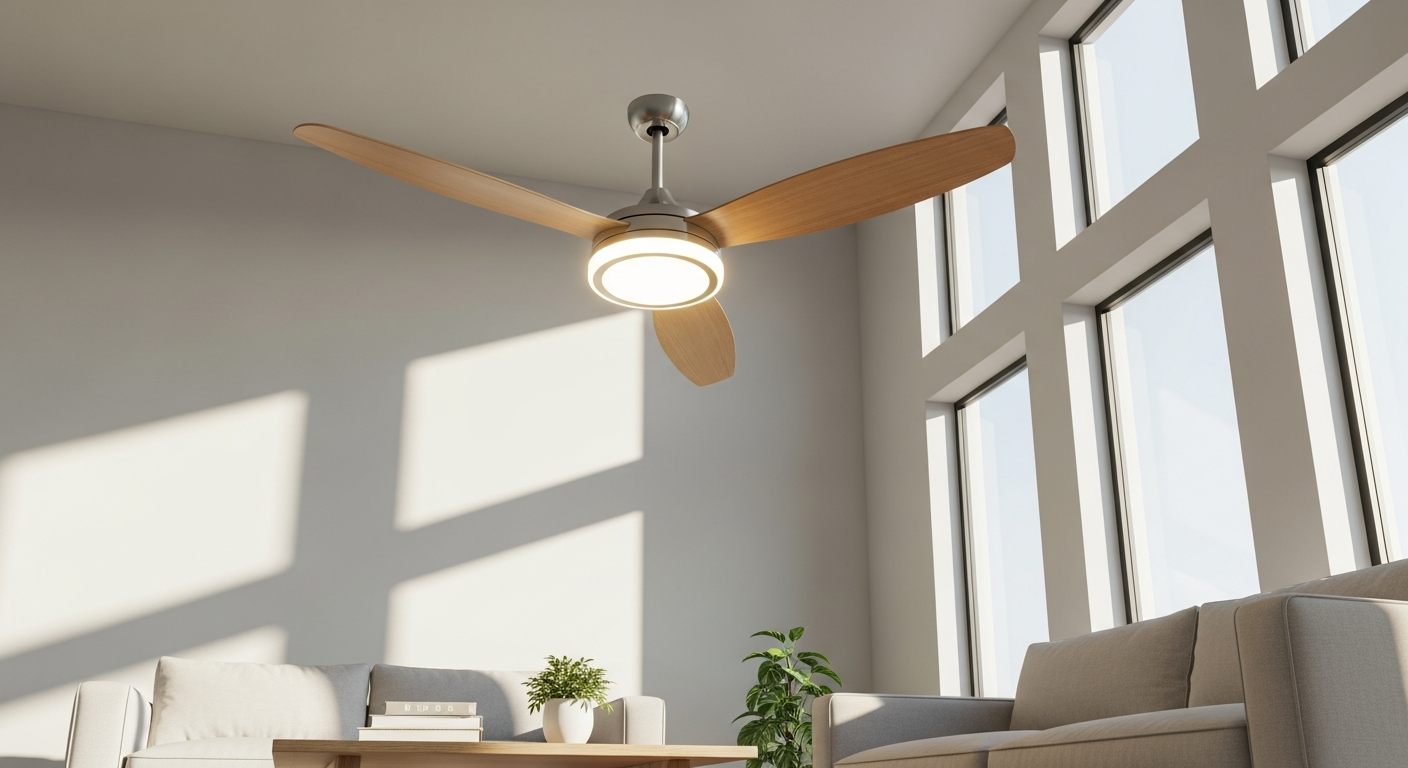
Discover how integrated ceiling fan lights combine illumination and air circulation for year-round comfort. Learn about energy efficiency, quiet operation, and design options from Lichtbox CH’s premium selection.
An Integrated Ceiling Fan Light can handle two everyday needs from one ceiling fixture: air circulation and room lighting.
Instead of installing a fan and a separate overhead fixture, you get both functions in one unit. That can make sense in bedrooms, living rooms, home offices, and other spaces where ceiling space matters.
Still, models can differ significantly in airflow, brightness, controls, mounting requirements, and maintenance.
Before buying, you should compare the specifications that affect daily use rather than choosing based on appearance alone.
What Is an Integrated Ceiling Fan Light?
An Integrated Ceiling Fan Light combines a ceiling fan with a built-in lighting system. Many current designs use an integrated LED module instead of standard replaceable bulbs.
The LED components sit inside the lighting assembly and work with a dedicated driver.
A ceiling fan with LED light can have a slimmer lighting section because it does not need conventional bulb sockets.
Integrated LEDs can also provide even illumination through a diffuser. The main drawback is serviceability.
With a standard bulb-based fixture, you can replace a failed bulb yourself. An integrated system may require a compatible LED module or driver, depending on the manufacturer and model.
Check replacement-part availability and warranty terms before purchasing.
Features Worth Comparing Before You Buy
LED Brightness
Do not judge an integrated fan light solely by LED wattage. Check its lumen rating because lumens indicate how much visible light the fixture produces.
Think about how you plan to use the fixture. If other lamps or recessed lights already provide illumination, the fan light may serve mainly as supplemental lighting.
If it will be your primary overhead fixture, stronger light output may be necessary.
You should also check the diffuser. A well-designed diffuser can distribute light across the room while reducing direct glare.
Adjustable Brightness
A dimmable ceiling fan gives you greater control over the room’s lighting. You can use brighter illumination while cleaning or working and lower it when watching television or getting ready for bed.
Check how dimming works before ordering.
Some integrated LED systems are designed to dim through their included remote, dedicated wall control, or app rather than a conventional household wall dimmer.
Using an incompatible dimmer may cause flickering, buzzing, or unreliable operation.
Color Temperature
Color temperature changes how the light looks in your room. It is measured in Kelvin.
Common settings include:
- 2700K–3000K: Warm white light suitable for bedrooms and relaxing spaces.
- Around 4000K: Neutral white suitable for general room lighting.
- Around 5000K: Cooler white suited to spaces where you prefer bright, crisp illumination.
Some fixtures let you switch between several color temperatures, giving you flexibility without changing the light source.
Remote Controls
A ceiling fan with remote control can be especially convenient in bedrooms and living rooms. Instead of getting up to adjust the fixture, you can change settings from your bed or sofa.
Depending on the model, a remote may control:
- Fan speed
- Light on/off
- Brightness
- Color temperature
- Timer settings
- Fan direction
- Separate fan and light operation
Check exactly which controls are included. Similar-looking models may have very different remote functions.
Check the Fan Performance Too
Lighting features can attract attention, yet airflow still matters. A fan that looks good and produces bright light may disappoint if it cannot circulate enough air for your room.
Look at the manufacturer’s published airflow information, fan diameter, motor design, speed settings, and recommended room size.
An energy efficient ceiling fan with a DC motor can be worth comparing if electricity consumption and quiet operation are priorities.
Still, do not rely on the motor label alone.
Actual efficiency and noise depend on the complete fan design, installation, balance, and operating speed.
Match Fan Size to Your Room
The correct blade span depends largely on the dimensions of your room. A fan that is too small may struggle to circulate air effectively across a larger space.
Before shopping, measure:
- Room length and width
- Ceiling height
- Available blade clearance
- Distance from nearby walls or cabinets
- Location of existing electrical wiring
Manufacturer sizing recommendations should take priority because fan designs and airflow performance differ.
Larger rooms generally require a larger blade span or greater airflow capacity. Smaller bedrooms and offices can often use a compact fan without sacrificing practical circulation.
Ceiling Height Can Change Your Best Choice
Your ceiling height affects the type of mounting system you should choose.
A low profile ceiling fan mounts close to the ceiling and can work well where vertical clearance is limited.
It reduces how far the fixture extends downward compared with a fan installed on a long downrod.
Rooms with taller ceilings may benefit from a downrod installation that positions the blades farther from the ceiling. Always follow the manufacturer’s required clearances and installation instructions.
You should also account for the light housing because the lowest part of an integrated fixture may sit below the fan blades.
Integrated LED vs. Replaceable Bulbs
Integrated LEDs and replaceable bulbs each have practical advantages.
An integrated LED design can provide:
- Slimmer fixture construction
- Even light distribution
- Built-in dimming on compatible models
- Fewer bulbs to purchase and replace
A replaceable-bulb design can provide:
Easier bulb replacement
Greater freedom to change bulb brightness
Easier changes to color temperature
Less dependence on model-specific LED replacement components
Your preference may depend on how much you value a streamlined fixture compared with straightforward long-term servicing.
Controls Can Affect Everyday Convenience
A modern ceiling fan with light may provide remote, wall, or app-based controls. Smart models may add scheduling or compatibility with supported home-control platforms.
Before paying extra for advanced controls, check how you actually plan to use the fan.
Independent fan and light operation is especially helpful. It allows you to run the fan without turning on the light or illuminate the room while leaving the fan off.
Memory functions can also be useful if you frequently use the same fan speed, brightness, or color-temperature setting.
Questions to Ask Before Ordering
Can the integrated LED be replaced?
It depends on the product. Some fixtures have replaceable LED modules or drivers, while others use lighting components that are harder to service. Check the manufacturer’s parts information before buying.
Can you use a regular wall dimmer?
Not automatically. Some integrated fan lights require their dedicated remote, wall controller, or app for dimming. Check the manufacturer’s electrical requirements before connecting the fixture to an existing dimmer.
Are integrated fan lights bright enough for bedrooms?
They can be, but brightness varies considerably. Check the published lumen output rather than assuming every integrated LED provides the same illumination.
Should you choose a flush-mount or downrod model?
Your ceiling height and the manufacturer’s clearance requirements should guide the decision. Close-to-ceiling designs are often practical where vertical clearance is limited, while taller ceilings may call for a downrod.
Is professional installation necessary?
If you are replacing an existing fan and have suitable wiring and mounting hardware, installation requirements depend on the fixture and local electrical rules.
If the wiring, ceiling box, or mounting support is uncertain, hiring a qualified electrician is the safer option.
What Should You Check Before Making Your Final Choice?
An Integrated Ceiling Fan Light can be a practical purchase when you want overhead lighting and air circulation from a single fixture.
The best model for your room depends on measurable specifications rather than appearance alone.
Check lumen output, color temperature, dimming controls, airflow performance, blade span, ceiling clearance, mounting requirements, warranty coverage, and replacement-part availability.
Taking a few minutes to compare these details can help you choose a fan that fits your room and your daily routine.