
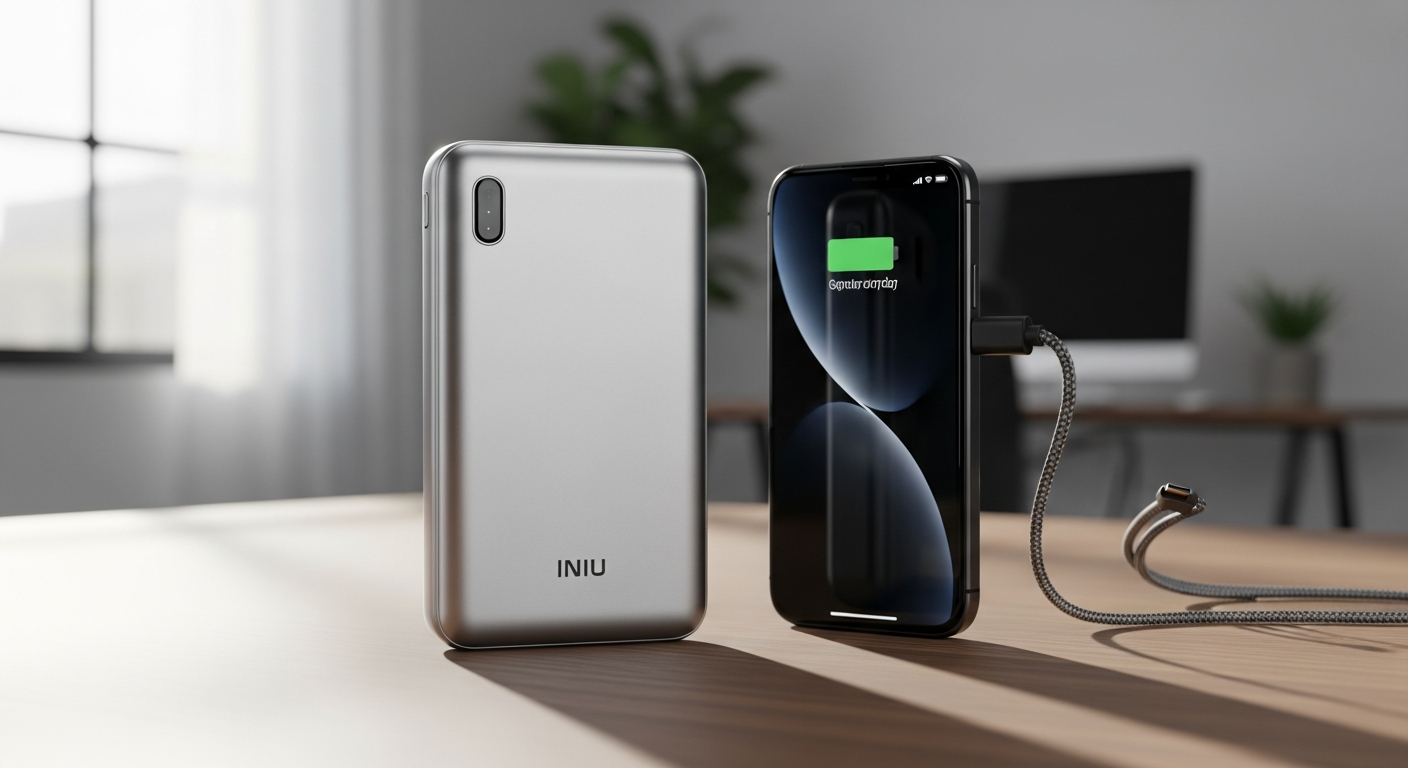
Discover why the INIU P512 20000mAh 22.5W portable power bank is the go-to choice for travelers and remote workers. Fast charging, dual USB-A + USB-C ports, and all-day battery for $25-$37.
Your phone dies at 2% while stuck in an airport, and your backup charger is somehow still at home. The frustration is real—that sinking feeling when you realize you're about to lose contact with the world. This scenario repeats itself countless times daily for millions of people who haven't yet discovered the right power bank for their lifestyle.
The INIU P512 20000mAh 22.5W portable power bank shatters this frustration with genuine capacity that delivers multiple full charges. INIU has built a reputation for creating power banks that refuse to compromise, and the P512 is their masterpiece. Whether you're a digital nomad juggling three devices, a parent managing a family's tech ecosystem, or simply tired of battery-dependent living, this power bank has become one of the most trusted names in the 20,000 mAh category.
Discover the INIU P512 and transform how you charge on the go.
Real-World Charging Capacity: How Many Charges Does 20,000 mAh Actually Deliver?
The 20,000 mAh capacity sounds impressive on paper, but what does it actually mean when your phone is sitting at zero? Understanding mAh ratings requires a quick breakdown: one mAh (milliamp-hour) represents the amount of current a battery can deliver over one hour. A 20,000 mAh power bank theoretically provides 20,000 milliamps of current for one hour—or proportionally less current for longer periods.
Understanding mAh ratings and what they mean for your specific devices
Your smartphone's battery capacity directly determines how many full charges you'll receive. An iPhone 15 Pro Max carries a 4,685 mAh battery, while a standard iPhone 15 has 3,349 mAh. Android flagships vary widely—the Samsung Galaxy S24 Ultra packs 5,000 mAh, and the Google Pixel 8 Pro contains 5,050 mAh. The P512's 20,000 mAh capacity can theoretically deliver four to six full charges to a standard smartphone, depending on the device and charging efficiency losses.
Realistic charge counts for iPhones, Android phones, tablets, and smartwatches
In practice, the INIU P512 delivers approximately four full charges to most modern iPhones. Android flagship users typically see three to four complete charges. Tablets drain the power bank faster due to larger batteries—expect two to three charges for an iPad Air or Samsung Galaxy Tab. Smartwatches barely make a dent, receiving ten or more charges from a single P512 charge. Real-world scenarios account for efficiency losses, which typically range from 15-25% when converting the power bank's stored energy to your device's usable power.
How the 20,000 mAh capacity compares to competing power banks in the mid-range segment
The 20,000 mAh category sits in the sweet spot between portability and capacity. Smaller 10,000 mAh power banks deliver only one to two smartphone charges and feel underwhelming for extended travel. Larger 30,000+ mAh units provide more charges but sacrifice portability—they're heavy enough to notice in a backpack. The P512 balances these trade-offs remarkably well, offering substantially more power than entry-level options while remaining lightweight enough for daily carry. Competing 20,000 mAh models often lack the digital display clarity or multiple fast-charging ports that the P512 includes.
Battery degradation over time and what to expect after 12-24 months of use
Lithium-ion batteries naturally degrade with each charge cycle. After 12 months of regular use, expect the P512 to retain approximately 85-90% of its original capacity. By 24 months, you'll likely see retention around 75-80% of original capacity. This degradation is normal and happens across all power banks regardless of brand. The INIU P512's quality construction and smart charging features actually slow degradation compared to budget alternatives. Users typically report the P512 remaining highly functional well beyond two years, making it a durable long-term investment.
Energy loss factors that reduce theoretical capacity in practical scenarios
Several factors prevent you from accessing the theoretical full 20,000 mAh. Voltage conversion losses occur when the power bank's internal voltage steps down to match your device's requirements—typically accounting for 10-15% loss. Cable quality affects efficiency; a damaged or low-quality cable can waste another 5-10% of energy. Temperature extremes reduce efficiency; charging in cold weather can cost you 10-20% additional loss. The P512's built-in protection circuits consume minimal energy but still represent a small loss. Combining these factors, real-world usable capacity typically reaches 75-85% of the rated 20,000 mAh, translating to approximately 15,000-17,000 mAh of actual device charging potential.
The 22.5W Fast-Charging Advantage: Speed Without the Compromise
Charging speed matters more than most people realize. The difference between a 5W and 22.5W charger isn't merely technical—it's the difference between waiting an hour and waiting 15 minutes. The P512's 22.5W output delivers meaningful speed improvements without thermal management nightmares that plague some competitors.
How 22.5W output stacks against standard 5W and 18W chargers
Standard 5W chargers represent the old baseline—they'll charge your device eventually, but "eventually" might mean two hours for a smartphone. An 18W charger cuts that roughly in half, reaching 60% charge in about 30 minutes on most phones. The P512's 22.5W output advances this further, achieving full charges significantly faster while maintaining safe operating temperatures. For comparison, premium flagship chargers from Samsung and Apple range from 25W to 65W, so the P512 sits respectably in the mid-to-upper-mid range without requiring exotic cooling systems.
Compatibility with popular fast-charging protocols like USB Power Delivery and Quick Charge
The P512 supports multiple fast-charging standards, ensuring compatibility across different device ecosystems. USB Power Delivery recognition allows it to work with modern iPhones, iPads, MacBooks, and Android devices that support PD charging. Quick Charge compatibility extends support to countless Samsung, Motorola, OnePlus, and other Android devices using Qualcomm's proprietary protocol. This multi-standard approach means your devices automatically negotiate optimal charging speeds without manual configuration.
Time-to-charge benchmarks for common devices and use cases
A standard iPhone 15 reaches 50% charge in approximately 25 minutes when connected to the P512, and full charge in roughly 50 minutes. Samsung Galaxy S24 owners experience similar speeds due to compatible Quick Charge protocols. iPad Air charging takes longer due to larger battery capacity—expect 90-100 minutes for a full charge. These benchmarks assume optimal conditions with a quality USB-C cable and room-temperature operation. Real-world usage in less-than-ideal circumstances might add 10-15% to these times.
Whether the P512 can simultaneously charge multiple devices at full speed
The dual USB-A and single USB-C configuration enables simultaneous charging, but power distribution becomes relevant when multiple devices connect. Using both USB-A ports together divides the available 22.5W between them, typically delivering around 11W to each device—still respectably fast but not full 22.5W speed. Using USB-C alone delivers full 22.5W output. Mixing USB-C with one USB-A port allows the USB-C connection to maintain near-maximum output while the USB-A connection receives secondary power. For optimal simultaneous charging of two devices requiring full speed, users should prioritize which device gets the USB-C connection.
Temperature management during high-speed charging sessions
The P512 incorporates intelligent thermal management to prevent overheating during sustained 22.5W output. Extended high-speed charging sessions generate heat, which the power bank's internal circuitry actively monitors. If temperature approaches unsafe levels, the P512 automatically reduces output to maintain safe operating conditions—a smart trade-off that prioritizes device longevity over raw speed. Users rarely experience significant throttling during typical use cases, though continuous charging of multiple large-capacity devices simultaneously in warm environments might trigger minor speed reductions.
Experience the P512's intelligent fast-charging technology today.
Smart Charging Features That Protect Your Devices
Raw power means nothing if your devices suffer damage in the process. The P512 prioritizes device safety through several intelligent features that work silently in the background, extending your devices' lifespan while delivering reliable charging.
Auto trickle charging technology and its impact on long-term battery health
Auto trickle charging represents one of the most underappreciated battery protection features. When your device reaches full charge, continuous 22.5W input would stress the battery unnecessarily, causing accelerated degradation. The P512's trickle charging system automatically reduces output as your device approaches full capacity, delivering minimal current during the final charging phase. This gentle approach significantly reduces heat stress on your device's battery, which is the primary aging factor for lithium-ion cells. Over a year of daily use, this feature can add months of effective battery lifespan to your devices.
Pass-through charging: charging your devices while the power bank charges itself
Pass-through charging eliminates a real-world frustration: the need to choose between charging your devices or the power bank when you're traveling with limited outlets. The P512 allows simultaneous operation—connect a wall charger to the power bank while devices charge from the power bank's ports. Power flows through efficiently to both the power bank and connected devices. This feature proves invaluable during hotel stays, flights, or any scenario with limited charging infrastructure. The efficiency remains strong during pass-through operation, though simultaneous charging of multiple devices plus the power bank itself might slightly reduce speed compared to isolated charging.
Digital display accuracy versus LED indicators and why it matters
Most budget power banks rely on LED indicators—typically four lights representing 25%, 50%, 75%, and 100% capacity. These crude indicators provide minimal information and leave significant uncertainty about remaining charge. The P512's digital display shows precise percentage readouts, eliminating guesswork. This clarity prevents the frustration of depleting your power bank with no warning, and helps you plan charging strategically. Accurate capacity information becomes particularly valuable during travel when managing multiple devices' charge levels simultaneously.
Built-in safety mechanisms including overcurrent, overvoltage, and short-circuit protection
The P512 incorporates multi-layered protection circuitry that guards against common charging hazards. Overcurrent protection prevents excessive current from flowing to connected devices if something goes wrong. Overvoltage protection ensures voltage remains within safe parameters for sensitive electronics. Short-circuit protection immediately disconnects power if a fault is detected, preventing damage to both the power bank and your device. These systems operate continuously and automatically, requiring no user action. The combination creates a protective envelope around your valuable devices, allowing confidence during charging regardless of external conditions.
How the P512 handles older devices with different power requirements
Not every device connects to modern fast-charging standards. Older smartphones, tablets, smartwatches, and specialty gadgets use varied charging protocols and voltage requirements. The P512's intelligent charging detection automatically identifies connected devices and adjusts output accordingly. Legacy devices that only support 5W input receive exactly that—no excessive voltage stressing their circuits. Newer devices that support higher wattages receive proportionally faster charging. This adaptive behavior means you can confidently connect nearly any device to the P512 without worrying about compatibility or damage.
Port Flexibility: Two USB-A Plus USB-C for Maximum Device Compatibility
The port configuration represents a crucial practical consideration that separates the P512 from single-port competitors. Three ports—two USB-A and one USB-C—create genuine flexibility for different usage patterns.
Detailed breakdown of the dual USB-A and single USB-C port configuration
USB-A ports represent the established standard, found on virtually every power adapter, charging cable, and peripheral device manufactured in the past decade. The P512 includes two USB-A ports, allowing simultaneous charging of two legacy devices. USB-C represents the emerging standard adopted across modern flagships, tablets, laptops, and accessories. A single USB-C port handles these newer devices. This three-port configuration covers the entire spectrum of devices most people own—smartphones, tablets, smartwatches, earbuds, and portable speakers. The mix of established and emerging standards ensures relevance for current devices while maintaining backward compatibility.
Which devices work best with each port type
Older iPhones (pre-iPhone 15), most Android phones released before 2020, and countless accessories still rely on USB-A connections. Wireless earbuds, smartwatches, and budget tablets typically use USB-A as well. Modern iPhones (15 and newer), recent flagship Android phones, iPad Pro models, and MacBooks increasingly standardize on USB-C. Gaming devices, portable speakers, and premium accessories increasingly adopt USB-C. Matching device-to-port capabilities ensures optimal charging speeds and compatibility without requiring adapter cables.
Simultaneous charging scenarios and power distribution across ports
Using only USB-A ports divides the P512's output between them, resulting in approximately 11W per port—still respectably fast for most devices. Using only the USB-C port delivers the full 22.5W output for maximum speed. Mixing USB-C with one USB-A port allows USB-C to maintain near-maximum output while the USB-A receives secondary power. Using all three ports simultaneously divides output among them, resulting in roughly 7-8W per port—slower than individual connections but still sufficient for basic device charging. Prioritizing which device gets the fastest port becomes a strategic choice based on charging urgency.
Cable compatibility and what's included versus what you'll need to purchase
The P512 typically ships with a USB-C to USB-C cable for charging the power bank itself and connecting USB-C devices. Users with USB-A devices need separate USB-A to USB-C or USB-A to Lightning cables depending on their specific devices. Most people already possess multiple USB-A cables from previous devices, minimizing additional purchase requirements. Having diverse cables on hand—USB-A to USB-C, USB-A to Lightning, and USB-A to proprietary connectors for specialty devices—creates maximum flexibility. The P512's port configuration ensures these common cables remain useful even as the tech ecosystem transitions toward USB-C.
Future-proofing your investment with USB-C adoption trends
The industry's trajectory clearly points toward USB-C dominance. Apple completed the transition with iPhone 15, major Android manufacturers continue adopting USB-C across their lineups, and regulations increasingly mandate the standard. The P512's inclusion of USB-C ensures relevance for the next several years of device purchases. The retained USB-A ports protect your investment in existing devices and cables, preventing immediate obsolescence. Purchasing the P512 represents a sensible middle ground—future-proof enough to serve emerging technology while practical enough for current device ecosystems.
Your Next Move: Making the P512 Work for You
The INIU P512 20000mAh 22.5W portable power bank isn't flashy or feature-bloated. Instead, it's refreshingly honest—a power bank that does exactly what you need without unnecessary complexity. The combination of genuine 20,000 mAh capacity, intelligent charging protection, and multi-port flexibility at this price point creates a rare value proposition that explains its best-seller status.
Whether you're a frequent flyer, remote worker, or someone who refuses to be tethered to a wall outlet, the P512 deserves serious consideration. Check current pricing on trusted retailers—discounts frequently drop it below $30, making it an even smarter investment. This power bank has earned its reputation through consistent performance, practical features, and genuine reliability across millions of users worldwide.
Your devices will thank you for the consistent, protected charging. Your stress levels will improve noticeably when you stop worrying about dead batteries derailing your plans. The P512 transforms portable power from a frustration into a non-issue—which, honestly, is exactly what you want from the technology supporting your daily life.
Get the INIU P512 now and reclaim your freedom from battery anxiety.