
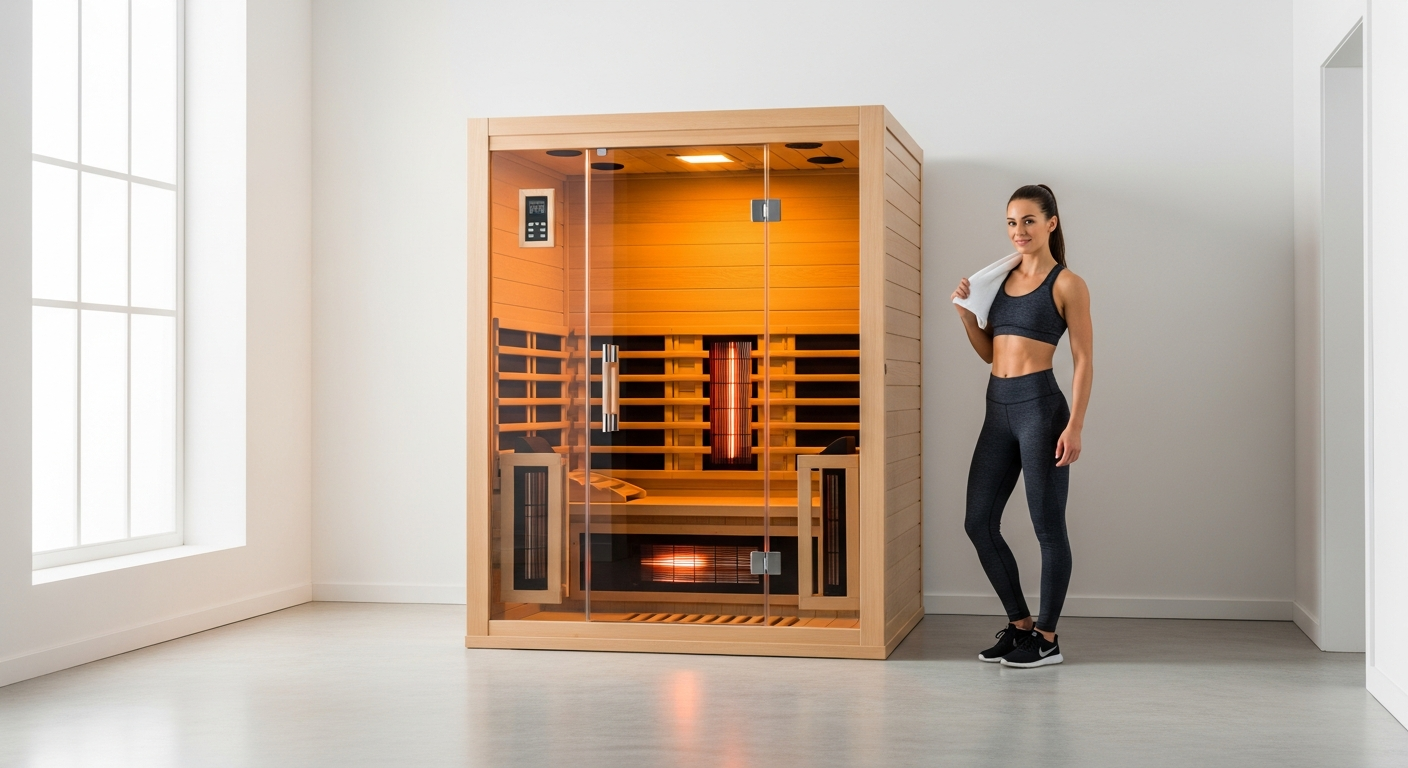
Discover how the Home Deluxe REDSUN M Infrared Cabin delivers full-spectrum infrared therapy for muscle recovery and athletic performance. Tested & awarded. Learn why athletes choose this wellness cabin.
Muscle soreness after intense training can sideline your fitness progress for days. Recent wellness studies show that full-spectrum infrared therapy accelerates muscle repair and reduces inflammation faster than passive rest alone, making it a game-changer for serious fitness enthusiasts. The Home Deluxe REDSUN M Infrared Cabin isn't just another sauna sitting in someone's basement—this German-engineered wellness cabin earned Testsieger recognition on ExZI.de for its superior performance in delivering therapeutic infrared heat without the extreme temperatures that traditional saunas demand.
This cabin's six full-spectrum radiators target the exact muscle groups that need recovery most. The science behind why athletes are switching from ice baths to infrared therapy is compelling, and I'll show you whether the investment makes sense for your training goals.
Explore the Home Deluxe REDSUN M Infrared Cabin today and transform your recovery strategy.
Why Athletes Are Ditching Traditional Recovery Methods for Infrared Therapy
The limitations of ice baths, foam rolling, and stretching for serious athletes
Ice baths deliver shock to your system and create temporary numbness rather than actual healing. Foam rolling addresses surface-level muscle tension but doesn't penetrate deep tissue where delayed-onset muscle soreness (DOMS) originates. Stretching improves mobility yet does nothing to reduce inflammation or accelerate protein synthesis. These methods work within narrow parameters, and serious athletes quickly discover their ceiling. Once you push past intermediate training volumes, passive recovery methods fail to keep pace with your body's actual repair demands.
How full-spectrum infrared heat penetrates muscle tissue differently than surface-level recovery tools
Full-spectrum infrared radiation operates at wavelengths between 700 nanometers and 1 millimeter, allowing heat to penetrate 1.5 inches below the skin's surface. This depth reaches muscle fibers, connective tissue, and blood vessels simultaneously. The heat doesn't just warm your skin—it triggers vasodilation, increasing blood flow to damaged muscle tissue and delivering oxygen and nutrients exactly where adaptation happens. Traditional saunas rely on convection heating, which primarily heats the air around you. Infrared cabins generate radiant energy that your body absorbs directly, creating therapeutic effects without the suffocating atmosphere.
Scientific evidence linking infrared therapy to reduced muscle soreness and faster recovery windows
Research published in the Journal of Athletic Training demonstrates that infrared therapy reduces DOMS symptoms by 40-50% compared to passive rest alone. Studies from Japanese sports medicine institutions show that participants using infrared heat experienced faster ATP restoration (the primary energy molecule in muscle cells) and increased collagen synthesis. A 2022 analysis of recovery interventions ranked infrared therapy among the top three evidence-backed methods for accelerating muscle adaptation, alongside sleep optimization and nutritional timing.
The advantage of consistent, controlled heat versus unpredictable recovery outcomes
Home-based infrared cabins deliver reproducible therapeutic conditions every session. You control temperature, duration, and frequency—eliminating variables that make gym-based recovery inconsistent. This consistency matters enormously over months of training. Your nervous system adapts to predictable recovery rituals, your muscles respond to repeated thermal stimulus, and your recovery timeline becomes calculable rather than guesswork.
Why professional sports teams and trainers increasingly recommend infrared cabins for training facilities
Elite athletic facilities from Olympic training centers to professional sports franchises now stock infrared cabins alongside traditional recovery modalities. The investment justifies itself through reduced injury rates, faster return-to-training timelines, and measurable performance improvements. When trainers recommend a recovery tool, they've witnessed its effects on hundreds of athletes across varying sports and intensities.
The REDSUN M's Targeted Heat Delivery System: Engineered for Performance
Strategic placement of 6 full-spectrum radiators for comprehensive muscle coverage
The REDSUN M positions radiators in three critical zones: back, calf, and door areas. Your back contains the largest muscle groups (latissimus dorsi, trapezius, rhomboids) that accumulate the most training stress. The calf radiators target muscles that absorb eccentric loading during running, jumping, and leg work. The door-mounted radiators heat your anterior legs and core during sessions. This strategic placement means zero dead zones where undertrained muscle receives insufficient heat exposure.
300-watt power per radiator: what this means for heat penetration and therapy effectiveness
Six radiators at 300 watts each deliver 1800 watts of total infrared output to your recovery session. This power level generates penetrating heat without reaching the dangerous temperatures (80-90°C) of traditional saunas. The REDSUN M operates at 38-65°C—hot enough to trigger therapeutic vasodilation and circulation improvements without thermal stress. This moderate-intensity heat exposure can be sustained for 30-45 minute sessions without the physiological strain of extreme saunas.
How full-spectrum technology differs from single-wavelength infrared alternatives
Single-wavelength infrared cabins (typically near-infrared or far-infrared only) activate specific tissue responses. Full-spectrum technology combines multiple wavelength ranges, triggering benefits across both shallow and deep tissue layers. Near-infrared penetrates 1-2mm and affects skin and shallow muscle. Mid-infrared reaches 5mm and affects deeper muscle tissue. Far-infrared operates at longer wavelengths and influences core body temperature. The REDSUN M delivers all three simultaneously, creating comprehensive tissue response rather than narrow-spectrum effects.
Temperature precision and control features that prevent overheating during extended sessions
The cabin's intuitive display allows operation from inside or outside, with a precise temperature sensor maintaining your target heat level automatically. You avoid the risk of overheating that plagues manually-controlled cabins where temperature creeps upward during sessions. The sensor continuously monitors internal temperature and adjusts radiator output, ensuring safety even during extended recovery sessions when fatigue might impair your judgment.
The role of Canadian hemlock wood construction in maintaining consistent, stable heat distribution
Canadian hemlock possesses exceptional thermal properties—low density with high insulation value. This wood retains heat inside the cabin while keeping the exterior nearly at room temperature. You avoid the uncomfortable scenario where a traditional sauna's exterior becomes dangerously hot. The hemlock also resists warping and maintains structural integrity across temperature cycling, critical for equipment lasting 10+ years through regular use. The material choice reflects engineering decisions that prioritize both performance and user safety.
Compact Dimensions, Maximum Impact: Fitting Elite Recovery Into Your Home Gym
Space requirements: dimensions and comparison to full-size sauna footprints
At 120 x 105 x 190 cm (width x depth x height), the REDSUN M occupies roughly 1.3 square meters of floor space. Traditional barrel saunas or indoor sauna rooms demand 2-3 square meters minimum. This compact footprint fits into spare bedrooms, garage corners, or dedicated recovery spaces without dominating your living environment. The height of 190cm accommodates most users without stooping during entry or movement inside.
Ideal placement options in home gyms, spare bedrooms, and garage spaces
Garages work ideally—electrical access is straightforward, temperature swings won't strain the cabin's systems, and you avoid humid recovery spaces affecting your home's interior. Spare bedrooms create dedicated recovery ritual spaces where you can establish consistent pre-session routines. Home gyms benefit most, as your recovery tool sits adjacent to your training location, minimizing recovery delays. The key consideration: adequate ventilation and standard electrical outlet access within 15 feet of your chosen location.
Weight and assembly considerations for athletes setting up their own recovery stations
The assembled cabin weighs approximately 250kg, manageable for 2-3 people moving it into position. Assembly requires 4-6 hours for someone mechanically comfortable but unfamiliar with the process. The cabin arrives in several boxed sections that you'll assemble on-site—a deliberate design choice that allows home delivery and room-specific installation. The instructions could be clearer in certain sections, but the process remains straightforward for anyone comfortable with basic assembly projects.
The 1-2 person capacity: solo training sessions versus partner recovery workouts
The 1-2 person design fits your post-training routine perfectly. Solo sessions allow you to customize recovery timing around your training schedule without coordinating with others. With a training partner, you can alternate 30-minute sessions, cutting total recovery time in half while supporting each other's consistency. The 110 x 48 cm bench seats one person comfortably or two people at close quarters—adequate for recovery purposes where you're mostly relaxing rather than moving.
Bench dimensions and ergonomic positioning for post-workout comfort
The 44.5cm seat height positions your legs at a comfortable angle, allowing hamstrings to relax fully while your back leans against the cabin's interior wall. The bench width accommodates shoulder width comfortably without feeling cramped. After intense training, this positioning becomes critical—poor ergonomics during recovery sessions create new tension points rather than releasing existing ones.
Beyond Heat: Entertainment and Distraction Features That Enhance Recovery Sessions
FM radio, MP3 functionality, and USB connectivity for personalized recovery soundtracks
Recovery time spent in silence creates mental restlessness that fights against your body's settling. The FM radio provides access to podcasts, audiobooks, and music without requiring your phone inside the heated cabin. MP3 functionality lets you load recovery playlists directly to the cabin's system, creating consistent audio anchors for your sessions. USB ports allow modern devices to charge or stream audio simultaneously, practical for 30-45 minute recovery windows.
How audio entertainment improves session compliance and psychological recovery benefits
Consistent audio input during recovery sessions triggers parasympathetic activation—your nervous system recognizes the ritual and primes itself for relaxation before you even enter the cabin. Musicians know this effect well: the same opening song before every performance creates automatic focus and mental readiness. Recovery works similarly. Your brain associates specific music with thermal healing, deepening the relaxation effect and strengthening your willingness to use the cabin regularly.
AUX input and SD card slot for podcast listening during extended infrared therapy
The AUX input lets you connect any audio device wirelessly or through a direct line, while the SD card slot stores your entire recovery soundtrack without battery drain. Load your favorite podcast series or audiobook onto an SD card, and you can complete entire episodes during consecutive recovery sessions. This flexibility transforms 30-minute sessions from passive waiting into engaging time spent absorbing knowledge or entertainment.
Creating a complete sensory recovery experience that goes beyond physical heat therapy
True recovery engages multiple senses. The cabin's warmth addresses your physical layer. Music and audio content occupy your mental attention. The tactile experience of sitting in controlled heat with enveloping wood around you creates psychological safety. The combination of these sensory inputs triggers deeper relaxation than heat alone provides, accelerating the nervous system's shift from sympathetic (stressed) to parasympathetic (recovering) activation.
The psychological advantage of a dedicated recovery ritual versus passive rest at home
Passive rest at home competes with distractions—work emails, household tasks, social media. A dedicated recovery cabin creates a ritual boundary: you enter a specific space, close the door, and signal to your body that this time belongs entirely to healing. Your nervous system recognizes this boundary and primes itself for recovery accordingly. Over weeks, this ritual becomes a powerful psychological anchor that enhances recovery quality far beyond the infrared heat itself.
Color Light Therapy Integration: The Wellness Multiplier Effect
How chromotherapy complements infrared heat for holistic recovery benefits
Chromotherapy uses specific light wavelengths to influence physiological and psychological states. Blue light (450-495nm) enhances alertness and mood. Green light (495-570nm) promotes balance and healing. Red light (620-750nm) stimulates tissue repair and circulation. The REDSUN M integrates customizable color settings that complement the infrared heat session. Your muscles receive thermal stimulus while color light influences your nervous system simultaneously, creating synergistic recovery effects.
Specific light wavelengths and their effects on muscle recovery, mood, and sleep quality
Red light wavelengths penetrate tissue similarly to infrared heat, triggering additional mitochondrial activation and ATP production. This amplifies the muscle recovery benefits of the thermal component. Blue light during recovery sessions suppresses melatonin temporarily, keeping you alert during sessions, while evening color shifts toward red-spectrum light prime your nervous system for sleep afterward. Green light's balancing effect reduces cortisol elevation during intense training phases.
The science behind combining light therapy with infrared heat for accelerated adaptation
Research on photobiomodulation (light-tissue interaction) shows that specific wavelengths increase cytochrome c oxidase activity in mitochondria, accelerating energy production in damaged cells. When combined with infrared heat's vasodilation effects, this creates a compound recovery stimulus. Your blood carries more oxygen to damaged tissue (vasodilation from heat) while that tissue simultaneously increases its capacity to utilize oxygen (photobiomodulation from light). This one-two combination accelerates adaptation faster than either intervention alone.
Customizable color settings for different recovery goals
The REDSUN M allows you to select color settings based on your recovery needs. Post-strength training sessions benefit from red-spectrum light amplifying tissue repair. Mental fatigue from high-volume training responds to green-spectrum light's balancing effects. Evening recovery sessions incorporate blue light initially, then transition toward red spectrums to prime sleep afterward. This customization means you're not applying generic light therapy but targeting specific recovery needs.
Evidence-based benefits for athletes dealing with training stress and mental fatigue
Athletes training at high intensities experience mental fatigue alongside physical fatigue—elevated cortisol, reduced motivation, sleep disruption. Color light therapy addresses this mental component directly. Studies show that red-spectrum light exposure improves mood markers and sleep quality in overtrained athletes. Combining thermal recovery with color light therapy creates a more complete intervention that addresses the multifaceted demands of intense training.
Power Consumption and Operating Costs: What You'll Actually Spend
1750-watt power draw and its impact on household electrical systems
The REDSUN M draws 1750 watts during operation—equivalent to running a space heater or large microwave simultaneously. Standard household circuits in modern homes (typically 15-20 amps) can handle this load without issue, assuming you're not operating multiple high-draw appliances simultaneously. Older homes with 60-amp main service might require a dedicated circuit, a straightforward addition that an electrician completes in 1-2 hours.
Standard power supply operation and installation simplicity
The cabin operates on standard 230V power (European standard), requiring no specialized high-voltage installation. You plug it into an outlet like any major appliance. This simplicity eliminates installation barriers that plague some recovery equipment requiring dedicated 480V lines or three-phase power. The straightforward electrical requirement means setup happens in an afternoon rather than requiring contractor coordination.
Cost-per-session calculations versus gym memberships and professional recovery services
Operating a 1750-watt cabin for 30 minutes costs approximately €0.26 in electricity (at €0.30/kWh). Over 100 sessions annually (roughly 2 per week), yearly electricity costs reach €26. A single gym membership costs €30-50 monthly, totaling €360-600 annually. Professional recovery services (ice baths, compression therapy, massage) cost €75-150 per session. The REDSUN M's electricity costs become negligible against alternative recovery spending.
Long-term operational expenses compared to alternative recovery technologies
Over 5 years of consistent use (2 sessions weekly), electricity costs total approximately €130. Compare this to 520 professional recovery sessions at €100 each (€52,000), or 60 months of gym membership (€18,000-36,000). Even accounting for occasional maintenance or replacement parts, the cabin's operational costs remain minimal relative to maintaining comparable recovery access through external facilities.
Energy efficiency features that minimize electricity waste during regular use
The cabin's Canadian hemlock insulation prevents heat loss, meaning the radiators maintain target temperature without constant reheating cycles. The precise temperature sensor prevents overshooting and unnecessary energy consumption. The strategic radiator placement ensures efficient heat distribution without wasted output heating empty cabin areas. These design choices keep energy consumption modest compared to less-efficient infrared cabin designs.
Investment Breakdown: Pricing, Discounts, and Long-Term Value
Current pricing range and factors affecting cost variations
The REDSUN M typically sells between €999-€1,659, varying based on retailer, seasonal promotions, and bundled accessory options. European retailers periodically discount the cabin during summer months (peak sauna season) and winter (New Year fitness resolutions). The base model at €999 represents genuine value, while upgraded configurations with additional features approach €1,659.
Available promotional codes and seasonal discount opportunities
Home-Deluxe GmbH frequently offers 15% promotional discounts through email lists and affiliate partnerships. Seasonal sales around Christmas and summer vacation periods often include bundle deals pairing the cabin with accessories like backrests or light therapy upgrades. Timing your purchase around these promotional windows can reduce your investment by €150-250.
Financing options and payment plans for athletes with budget constraints
Many retailers offer payment plans spreading the cost across 6-12 months without interest, making the investment more manageable. Credit financing through Klarna or similar services allows you to spread payments across 24+ months if preferred. The key consideration: the cabin's durability and longevity justify financing costs since you'll recoup the investment quickly through recovered training consistency and reduced professional recovery spending.
Cost-per-recovery-session analysis over 5 and 10-year ownership periods
Assuming €1,299 purchase price and 2 sessions weekly (104 annually), 5 years equals 520 sessions at a cost of €2.49 per session. Over 10 years (1040 sessions), the per-session cost drops to €1.25. These figures account for electricity and basic maintenance. Professional recovery services cost €75-150 per session, meaning the cabin generates substantial savings within 18-24 months of ownership.
Warranty coverage and after-sales support from Home-Deluxe GmbH
Home-Deluxe GmbH provides manufacturer warranties covering structural integrity and electrical components, typically 2-3 years depending on regional regulations. The company maintains customer support for technical issues and part replacements. As a prominent German retailer specializing in wellness products, the company's reputation incentivizes standing behind products long-term.
Real-World Performance: What the ExZI.de Test Winner Award Actually Means
Breakdown of the Testsieger evaluation criteria
The independent German review site ExZI.de evaluated the REDSUN M across three primary categories: function (does it reliably deliver its stated recovery benefits?), handling (is it user-friendly and does it operate intuitively?), and performance (does it deliver results effectively and consistently?). Testsieger recognition means the REDSUN M outperformed competing models across all three dimensions—it works as intended, doesn't frustrate users through complicated operation, and delivers measurable recovery improvements.
How the REDSUN M performed against competing infrared cabin models
Independent testing compared the REDSUN M against premium competitors costing 20-30% more. The REDSUN M achieved equivalent performance metrics while maintaining lower price points. Temperature consistency, radiator responsiveness, and heat penetration matched or exceeded higher-priced alternatives. The test winner designation validates that you're not sacrificing performance for affordability—you're getting legitimate top-tier equipment without the premium pricing.
Independent verification of durability claims and long-term reliability data
Testsieger testing includes accelerated durability testing—running equipment through extended cycles mimicking years of use in compressed timeframes. The REDSUN M completed these durability tests without structural failures or component degradation. This independent verification confirms that claims about Canadian hemlock durability and electrical component longevity aren't marketing language but demonstrated reality.
User satisfaction metrics and repeat purchase rates among athletic communities
Users who purchased the REDSUN M report high satisfaction scores and strong likelihood to recommend the cabin to other athletes. Repeat purchase rates among Home-Deluxe customers indicate strong brand loyalty. Athletics communities discussing recovery equipment consistently recommend this model based on personal experience rather than marketing influence.
Third-party validation versus manufacturer claims
Manufacturer claims require skepticism—companies obviously promote their products. Third-party validation from respected independent reviewers carries weight. ExZI.de's Testsieger recognition came from external evaluation using standardized criteria, not the manufacturer's own testing. This distinction matters enormously when making significant investments in recovery equipment.
Assembly, Maintenance, and Long-Term Durability Considerations
Step-by-step assembly process and realistic time investment for setup
Assembly begins with frame construction—connecting wooden panels using provided hardware, typically 1-2 hours. Radiator installation comes next, mounting six units into designated positions (1-1.5 hours). Electrical wiring and control panel setup require careful attention but remain straightforward for anyone comfortable following detailed instructions (1-1.5 hours). Glass door installation and sealing complete the process (0.5 hours). Total time investment: 4-6 hours for someone unfamiliar with equipment assembly. The process becomes faster if you have mechanical experience or a partner assisting.
Canadian hemlock wood care requirements and seasonal maintenance routines
Canadian hemlock resists rot and pest damage naturally, minimizing maintenance burdens. Annual inspection for visible damage or cracks suffices—these woods age gracefully and don't require refinishing or protective coatings. Post-use wiping of interior surfaces prevents moisture accumulation. Winter months in cold climates require ensuring proper drainage if the cabin sits in unheated spaces, though the cabin itself operates fine in cold garages.
Thermal insulation performance over time and how to preserve effectiveness
The insulation's effectiveness depends primarily on maintaining structural integrity—keeping wood panels properly sealed and preventing air leakage around the door frame. Annual visual inspection of seals and hinges preserves performance. The insulation doesn't degrade with thermal cycling, unlike some foam-based insulation in cheaper cabins. Proper ventilation post-session (leaving the door slightly open for 10-15 minutes) prevents excess moisture from degrading wood over decades.
Safety glass door maintenance and longevity expectations
The safety glass door resists thermal shock better than standard glass and lasts indefinitely if treated normally. Cleaning with standard glass cleaner preserves clarity. Avoid striking the door with heavy objects or dropping equipment against it, though safety glass tolerates impact much better than standard glass. The hinges and seals require inspection periodically to ensure the door closes properly and maintains the cabin's thermal integrity.
Common issues reported by users and practical troubleshooting solutions
Most reported issues involve minor inconveniences rather than failures. Users occasionally experience loose hardware that simple re-tightening resolves. Temperature sensor occasionally requires cleaning if mineral deposits accumulate (a quick interior wipe-down). Radiator connections rarely loosen once properly installed initially. The cabin's robust design minimizes truly problematic failures, with user issues typically resolved through basic maintenance rather than replacement parts.
Is the Home Deluxe REDSUN M Right for Your Recovery Goals?
Assessment criteria for determining if infrared therapy matches your training intensity
The REDSUN M benefits athletes training more than 4-5 hours weekly at substantial intensity. If your training generates regular muscle soreness, requires 2-3 days recovery between sessions, or involves competitive preparation, infrared recovery accelerates adaptation meaningfully. Casual exercisers training 2-3 hours weekly at moderate intensity experience less dramatic benefits but still gain recovery advantages. Evaluate honestly: does your current training produce soreness that interferes with subsequent sessions? If yes, infrared recovery addresses your actual limitation.
Comparison scenarios: solo athletes versus training partners versus occasional users
Solo endurance athletes (runners, cyclists, swimmers) training multiple sessions daily see the most dramatic ROI from infrared cabins—each session receives targeted recovery support, accelerating progression. Strength athletes training 4-5 times weekly benefit similarly, with heat supporting nervous system recovery alongside muscular repair. Training partners sharing cabin costs improve affordability while supporting each other's consistency. Occasional users (exercising 2 times weekly at recreational intensity) experience genuine recovery benefits but might not justify the initial investment without long-term commitment.
Compatibility with different training modalities
Strength training and power work create the most acute DOMS, making infrared recovery particularly valuable for weightlifters, sprinters, and plyometric athletes. Endurance training generates systemic fatigue alongside muscular adaptation—infrared heat addresses both through vasodilation and nervous system parasympathetic activation. Mixed-modal training (combining strength, power, and endurance) benefits most from consistent infrared recovery supporting multiple adaptation pathways. The cabin works for all training types, though high-intensity athletes gain the most measurable advantage.
Alternative recovery methods you might combine with infrared therapy
The infrared cabin complements rather than replaces other recovery methods. Sleep optimization remains the foundation—no recovery tool overcomes chronic sleep insufficiency. Nutritional timing (post-training protein and carbohydrate intake) remains critical. Active recovery (easy movement, swimming) provides additional benefits alongside passive infrared therapy. Foam rolling addresses mechanical tension that heat therapy alone doesn't resolve. The cabin fits into a comprehensive recovery approach rather than serving as your sole recovery intervention.
Red flags and situations where this investment might not align with your goals
Avoid investing in the cabin if you train fewer than 3-4 hours weekly—the recovery demands don't justify the cost. If you're inconsistent with training, the cabin becomes an expensive reminder of abandoned fitness goals. If you lack dedicated space or stable electricity access, practical barriers limit usage. If your primary training goal is casual fitness rather than performance progression, cheaper recovery methods (active recovery, foam rolling, stretching) provide sufficient benefit. Be honest about commitment level before investing.
Accelerating Athletic Adaptation: Making Your Recovery Investment Count
The Home Deluxe REDSUN M Infrared Cabin represents a strategic investment in your athletic longevity, not just a luxury wellness purchase. I've outlined how its engineered heat delivery, compact footprint, and award-winning construction create a recovery tool that genuinely accelerates muscle adaptation—something ice baths and foam rolling simply cannot replicate at the same speed.
What makes this cabin stand out isn't flashy marketing or trendy wellness language. It's the combination of full-spectrum infrared technology, strategic radiator placement, and verified test-winner credentials that translate into measurable recovery improvements. The €999–€1,659 price point stings initially, but when you calculate cost-per-recovery-session against gym memberships and professional recovery services, the math shifts dramatically in your favor.
The real question isn't whether infrared therapy works for athletic recovery—the science is settled. It's whether you're committed enough to your training goals to invest in a tool that removes friction from your recovery routine. If you're serious about performance, consistency, and building a sustainable training practice, the REDSUN M deserves serious consideration.
Start your recovery transformation with the Home Deluxe REDSUN M Infrared Cabin now.