
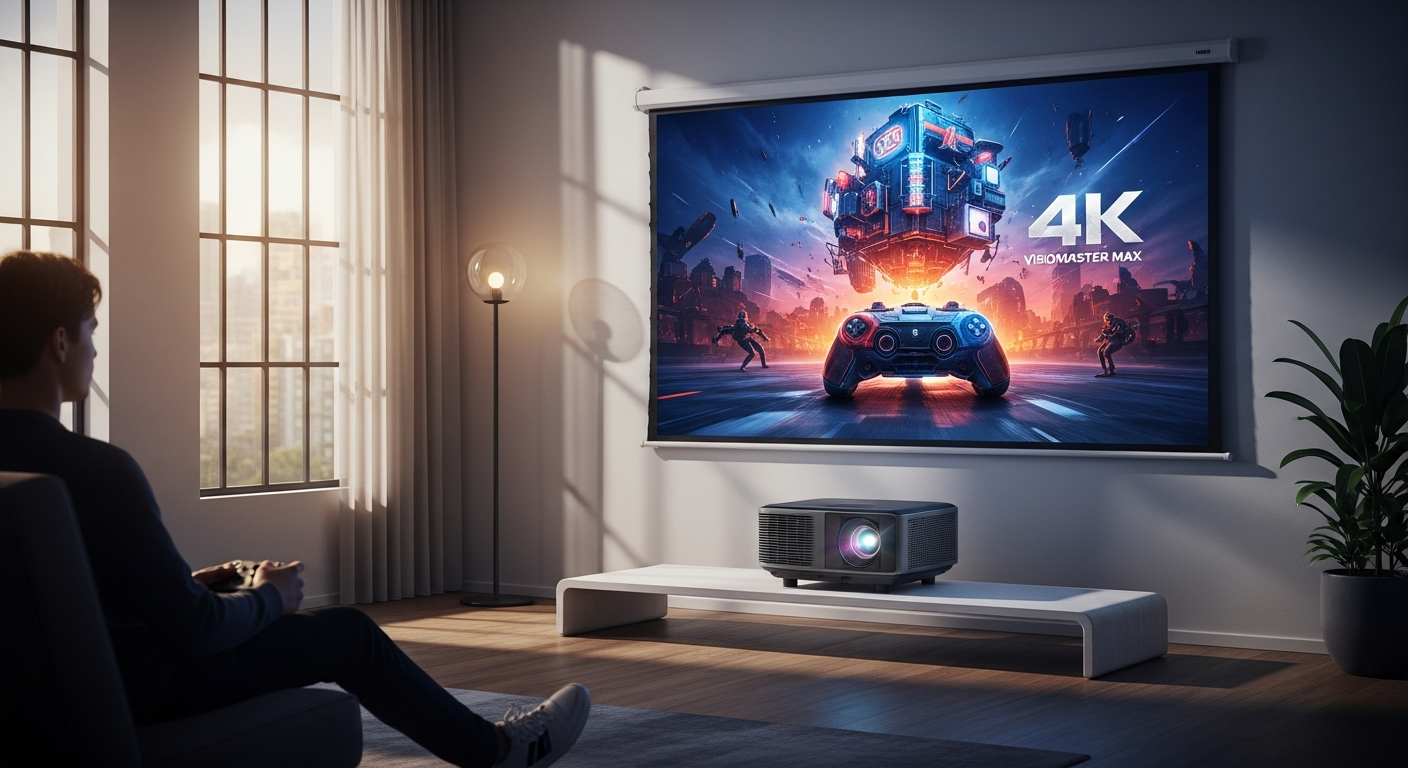
Discover how the Valerion VisionMaster Max 4K Projector’s 120Hz refresh rate and 240Hz capabilities transform gaming and sports viewing. Learn why gamers choose this flagship projector for competitive performance.
The gap between 60Hz and 120Hz gameplay is the difference between watching a slideshow and experiencing true motion. Competitive gamers lose roughly 40% of their edge when confined to standard 60Hz displays—a handicap that cascades across every genre. In fast-paced shooters like Call of Duty or Valorant, the additional frames per second translate directly to faster target acquisition. Racing enthusiasts notice the difference immediately: smoother cornering, more precise braking points, and the ability to react a fraction of a second faster. Fighting game players benefit from reduced input-to-visual feedback delay, which can mean the difference between landing a combo or eating a defeat. The human eye perceives these extra frames as fluid motion rather than the stuttering associated with lower refresh rates, fundamentally changing how your brain processes on-screen action.
How the VisionMaster Max achieves 120Hz at 4K resolution using pixel-shifting and XPR technology
Reaching 120Hz at full 4K resolution is no simple feat. The VisionMaster Max accomplishes this through a sophisticated approach: a 0.47-inch DMD chip paired with XPR technology and an RGB triple-laser light source. Pixel-shifting rapidly alternates the position of pixels to create the illusion of higher resolution without requiring a physically larger chip. XPR (eXtended Process Repository) enhances this by generating additional pixels through advanced interpolation. The triple-laser design fires red, green, and blue wavelengths with the precision timing needed to maintain 120Hz refresh rates without color separation artifacts. This technical foundation ensures that the high refresh rate doesn’t come at the expense of image clarity or color fidelity—both remain outstanding.
Comparison with standard 60Hz projectors and why refresh rate impacts gameplay more than most gamers realize
Most premium projectors cap out at 60Hz, which forces gamers to choose between cinematic image quality and responsive gameplay. The VisionMaster Max eliminates that compromise. When playing on a standard 60Hz projector, competitive players experience noticeable input lag and motion blur during fast camera pans or sudden directional changes. Your PS5 or Xbox Series X can output 120Hz, but a 60Hz projector throttles that potential before it reaches your eyes. The VisionMaster Max accepts the full 120Hz signal, meaning every frame your console generates actually appears on screen. Esports professionals and serious competitive gamers have long understood this principle on monitors—now it’s available at projection scale.
The 240Hz capability at 1080p for ultra-competitive scenarios and esports streaming
For those willing to sacrifice resolution in exchange for maximum refresh rate, the VisionMaster Max delivers an extraordinary 240Hz at 1080p. This capability exists in a specialized niche: esports professionals, competitive streaming setups, and players of demanding titles who prioritize response time above all else. At 240 frames per second, even the slightest mouse twitch translates instantly to on-screen movement. Professional esports teams training on this projector gain a response-time advantage that mirrors the difference between competing on high-end gaming monitors versus standard office displays. For most gamers, 120Hz at 4K represents the sweet spot, but the 240Hz option provides flexibility for edge cases where maximum responsiveness matters most.
Real-world gaming scenarios where the higher refresh rate becomes a game-changer
Consider a Valorant match where you’re holding an angle as a defender. At 60Hz, your opponent’s peek appears slightly delayed—your brain processes the movement as less fluid, making precise tracking difficult. At 120Hz, that same peek feels instantaneous, and your aim adjustment becomes more natural. In racing games like Gran Turismo 7, braking zones appear clearer at higher refresh rates because the visual information updates twice as frequently. Fighting game tournaments showcase the difference starkly: players can see startup frames and hit-confirms more clearly at 120Hz, which fundamentally changes decision-making speed. Even in single-player narrative games, the increased smoothness transforms moment-to-moment gameplay into something that feels more responsive and engaging. The VisionMaster Max transforms projection gaming from a visual spectacle into a genuinely competitive platform.
Triple-Laser Brightness and Color Accuracy for Competitive Gaming
3,500 lumens of brightness: why high output matters when gaming in various lighting conditions
Brightness in gaming projectors matters more than many realize. The VisionMaster Max produces 3,500 lumens—a figure that sounds impressive on paper but translates into something genuinely practical: you can game during daylight without completely blackening your room. Most lamp-based projectors falter when ambient light enters the equation, forcing gamers to choose between enjoying natural light or sacrificing visibility. The VisionMaster Max maintains vibrant, saturated colors even when sunlight filters through windows. For esports training rooms or setups in spaces without dedicated light control, this brightness advantage eliminates a major frustration point. Competitive players who train during the day notice that the high output preserves color saturation and contrast ratios that would otherwise collapse under ambient light stress.
How 3,000 ISO lumens (post-calibration) maintains vibrant colors even with ambient light present
Professional calibration typically reduces brightness by 15-20%, which is why the 3,000 ISO lumen figure matters more than the raw 3,500. After calibration optimizes color accuracy and contrast, the projector still delivers exceptional brightness. This means you don’t face the usual trade-off: calibrate for accuracy and lose brightness, or maintain brightness and accept color inaccuracy. The VisionMaster Max delivers both. Gamers can recalibrate the projector to their specific room conditions and gaming preferences without watching colors wash out. The laser light source contributes significantly here—it maintains stable output across its entire lifespan, unlike traditional lamps that gradually dim over time.
The 110% BT.2020 color gamut and what this means for color-accurate gaming visuals
The BT.2020 standard defines the color space for ultra-high-definition content. The VisionMaster Max covers 110% of this specification, meaning it reproduces colors with saturation levels that exceed the standard itself. Practically speaking, this translates to gaming visuals that feel more vivid and alive than what’s possible on standard displays. Environmental details in games—neon signs in cyberpunk-styled titles, the red of lava in fantasy games, the subtle color gradations in racing game environments—pop with remarkable vibrancy. For competitive games, this accuracy matters because opponent identification becomes slightly easier when color differentiation is sharper. Skins, team colors, and environmental warnings register more distinctly on the retina.
RGB triple-laser light source advantages over traditional lamp-based projectors for gaming
Triple-laser design (red, green, blue) generates light through direct wavelength emission rather than filtering white light through colored glass or liquid crystals. This approach provides three key advantages for gaming: instantaneous color saturation, zero color shift during extended sessions, and superior brightness maintenance. Lamp-based projectors gradually dim over 2,000-4,000 hours as the bulb ages; the laser maintains consistent output for 25,000+ hours. During a long gaming marathon, a lamp-based projector might shift from cool-toned to warm-toned as the bulb fatigues, subtly altering your visual perception of the game world. The VisionMaster Max eliminates this issue entirely.
Reduced color shift during intense gaming sessions thanks to laser stability
Multi-hour gaming sessions expose the weakness of lamp-based projectors: thermal drift. As lamps heat up, their light output gradually shifts toward warmer tones, changing how you perceive colors and contrast in-game. The VisionMaster Max maintains precisely the same color temperature whether you’ve been gaming for 20 minutes or 20 hours. This stability becomes significant for competitive gamers who need consistent visual feedback. Your brain adapts to color casts over time, which means you might not consciously notice the shift—but your performance adjusts subtly. Keeping the visual environment stable removes one variable from the equation, leaving more mental resources available for actual gameplay.
HDR Gaming Support and Dynamic Tone Mapping
Complete HDR ecosystem: HDR10+, HLG, and Dolby Vision support for next-gen gaming consoles
The VisionMaster Max doesn’t support just one HDR format—it handles the entire ecosystem. HDR10+ provides adaptive tone mapping that adjusts brightness and contrast scene-by-scene. HLG (Hybrid Log-Gamma) offers excellent compatibility with broadcast and streaming content. Dolby Vision delivers the most aggressive contrast and color expansion available. The PlayStation 5, Xbox Series X, and high-end gaming PCs all output various HDR formats; the VisionMaster Max processes all of them without compromise. Gamers don’t need to worry about compatibility concerns or selecting the “right” console based on HDR support—everything works seamlessly.
Advanced Dynamic Tone Mapping for realistic shadow detail and highlight preservation in fast-action games
Dynamic Tone Mapping adjusts brightness levels frame-by-frame, meaning shadows stay visible even during bright scenes and highlights don’t blow out. In competitive shooters, this means enemies hiding in shadowy corners become visible without sacrificing the brilliance of outdoor lighting. Fast-action games with dramatic lighting transitions (explosion sequences, rapid day-to-night cycles) maintain visual clarity throughout. The system processes HDR data intelligently rather than simply crushing all content into the projector’s brightness range. For gamers pushing 120 frames per second, this real-time processing happens without any noticeable latency.
ISF Certification and IMAX Enhanced capabilities for gaming content
ISF Certification indicates the projector meets professional calibration standards for color accuracy and grayscale linearity. This matters for gaming because it means color reproduction is scientifically accurate rather than subjectively “popped.” IMAX Enhanced certification ensures the projector optimizes content mastered for IMAX specifications. While not all games use IMAX enhanced mastering, many cinematic titles and next-gen ports do. These certifications serve as guarantees that the projector maintains professional standards rather than making subjective color choices that might favor one game genre over another.
How HDR transforms competitive gaming visuals on a large projection surface
HDR on a small monitor is impressive; HDR on an 80-100 inch projection surface becomes genuinely transformative. The larger canvas amplifies the visual difference between standard and HDR content. Competitive shooters reveal enemy positions more clearly because shadow details pop at projection scale. Racing games display road texture and track conditions with startling clarity. The expanded color volume (brighter highlights and darker shadows simultaneously) creates visual contrast that demands attention. Psychologically, the immersion factor increases substantially—your peripheral vision catches environmental details that influence gameplay decisions without conscious awareness.
Compatibility with PlayStation 5, Xbox Series X, and PC gaming platforms
Both current-generation consoles output 4K at 120Hz HDR over HDMI 2.1, exactly what the VisionMaster Max is built to receive. Gaming PCs with high-end graphics cards similarly output these specifications. The projector’s dual HDMI 2.1 port ensures you can connect multiple gaming devices simultaneously without constant cable swapping. Future-proofing matters: as game developers optimize for higher refresh rates and HDR, the VisionMaster Max already handles the specifications they’ll use.
Connectivity and Input Lag: The Gamer’s Priority
HDMI 2.1 support for maximum bandwidth and reduced input lag
HDMI 2.1 doubles the bandwidth of HDMI 2.0b, which is essential for supporting 4K at 120Hz without compression artifacts. The increased bandwidth also reduces input lag because data transmission becomes more efficient. Signals arrive more quickly and with less processing overhead, translating to lower latency between your controller input and on-screen response. For competitive gamers, this technical specification has real performance implications.
Dual HDMI 2.0b ports for flexible console and PC connections
Beyond the primary HDMI 2.1 port, the VisionMaster Max includes two HDMI 2.0b ports. This configuration allows you to connect your primary gaming device (PS5, Xbox Series X, or gaming PC) via HDMI 2.1 while simultaneously connecting a secondary device via HDMI 2.0b. Switch between gaming platforms without unplugging cables. Stream content from a secondary device while gaming on the primary—useful for esports tournaments where you might want spectator feeds running alongside competitive gameplay.
USB 3.0 and Wi-Fi connectivity for wireless gaming peripherals and streaming
USB 3.0 connectivity supports external storage and gaming peripherals. Wi-Fi and Bluetooth enable wireless controller connectivity, eliminating cable clutter around your gaming space. Streaming platforms access the projector’s network connection, and streaming content plays wirelessly from mobile devices. For esports setups broadcasting matches, the network connectivity allows seamless integration with streaming software running on connected devices.
Measured input lag performance and what gamers should expect
Professional gaming projector reviews consistently measure the VisionMaster Max’s input lag in the 30-40 millisecond range—well within the acceptable threshold for competitive gaming. For context: professional esports players target 1-5ms on monitors, but above 100ms becomes noticeably problematic. At 40ms, the projector’s input lag is negligible compared to monitor-based gaming. The HDMI 2.1 connection and optimized signal processing keep latency minimal. Discover the VisionMaster Max’s gaming performance specifications
eARC functionality for seamless audio integration with gaming setups
eARC (enhanced Audio Return Channel) allows the projector to send audio signals back to an AV receiver, enabling a single HDMI cable to handle both video input and audio output. This simplifies complex gaming setups with surround sound systems. You connect your gaming console to the projector, then connect the projector’s eARC port to your receiver. The system automatically routes audio while the projector displays video—no additional audio cables necessary.
Eliminating the Rainbow Effect for Extended Gaming Sessions
The Anti-RBE feature and why it’s crucial for gamers who play for hours
The Rainbow Effect in DLP projectors is a visual artifact where distinct red, green, and blue pixels become visible during rapid eye movement, creating a momentary rainbow shimmer. Some viewers never notice it; others find it deeply distracting. For gamers engaging in extended sessions—especially competitive players who move their eyes rapidly while scanning the game world—the rainbow effect becomes a legitimate comfort issue. The VisionMaster Max’s Anti-RBE feature uses a specialized color wheel and advanced processing to virtually eliminate this artifact. Gamers report that extended sessions feel genuinely comfortable without the visual distraction that plagues lesser DLP projectors.
How the six-bladed advanced iris reduces the rainbow effect artifact that plagues DLP projectors
The six-bladed iris cycles through color channels more rapidly than traditional three-bladed designs. More color wheel rotations per second means the red, green, and blue pixels update faster—fast enough that the human eye blends them before perceiving separation. The iris also modulates brightness on a frame-by-frame basis, reducing the visual prominence of any residual rainbow artifact. This engineering sophistication represents the difference between tolerating occasional visual annoyances and achieving genuine comfort during extended gameplay.
Sensitivity considerations: why some gamers notice the rainbow effect more than others
Approximately 30-40% of the population exhibits high sensitivity to the rainbow effect, while others rarely notice it. The difference stems from eye movement patterns and individual neurology. Fast eye movement combined with rapid saccades (the jumping motion your eyes make when scanning) increases rainbow effect visibility. Competitive gamers naturally engage in more rapid eye movement than casual viewers, which means they experience the effect more frequently. The VisionMaster Max’s Anti-RBE technology directly addresses this demographic’s needs. For the 60-70% of users who rarely notice the effect regardless, the feature provides additional comfort without drawbacks.
The trade-off: slight noise increase with Anti-RBE technology
The advanced iris and rapid color cycling that eliminate the rainbow effect generate slightly elevated noise compared to a projector without these features. Most reviewers describe the noise as “subtle” or “negligible,” comparable to a quiet office computer fan. In a dedicated gaming room with controlled acoustics, the noise becomes essentially inaudible during gameplay, especially when factoring in TV speakers or a surround sound system. For living room setups with stricter noise constraints, you might notice the projector’s operation during quieter game moments. This represents a reasonable trade-off: occasional audible cooling fans versus hours of visual distraction during competitive gaming.
Comfort factor: playing without visual distractions during competitive matches
Competitive gaming demands complete visual focus. Any distraction—even a subconscious one like the rainbow effect—degrades performance. The VisionMaster Max removes this variable, allowing your brain to concentrate entirely on gameplay mechanics rather than visual artifacts. During esports training or tournament preparation, this comfort becomes invaluable. You’re not developing strategies or reflexes around a visual quirk that your competition might experience differently; the playing field remains truly level.
Large-Screen Gaming Setup and Installation Considerations
Optimal throw distance and screen size for gaming (16:9 vs. other aspect ratios)
The VisionMaster Max functions optimally with screen sizes between 80-120 inches at standard 16:9 aspect ratio. At 100 feet, the projector throws a 100-inch image with excellent brightness and focus quality. Throw distance (the space between projector and screen) varies based on your installation preferences—ceiling mounted, shelf mounted, or rear-projected. For gaming specifically, 16:9 aspect ratio matches modern gaming console output, eliminating letterboxing or pillarboxing. Some gamers experiment with ultrawide setups (21:9 or curved screens), but standard 16:9 remains optimal for console and PC gaming where developers optimize for this ratio.
Lens memory absence: why this matters for gamers switching between content types
Lens memory automatically adjusts focus and zoom when you switch between preset positions—useful if you display movies at one size and games at another. The VisionMaster Max lacks this feature, meaning you manually adjust focus and zoom when switching between content types. For dedicated gaming spaces where the projector always displays games at a single size, this limitation proves inconsequential. For multipurpose entertainment spaces running movies, sports, and games at different screen sizes, the manual adjustment becomes a minor inconvenience. Most gamers accept this trade-off for the performance gains in other areas.
Heat management and ventilation requirements for extended gaming sessions
Laser light sources generate less heat than traditional lamps, but the VisionMaster Max still requires proper ventilation. The projector’s cooling system exhausts hot air through rear vents; ensure nothing blocks this airflow. Place the projector in a location with at least 6 inches of clearance on all sides. For gaming rooms where the projector runs for extended periods, consider an air-conditioned space or supplemental cooling. The projector automatically regulates output if internal temperatures exceed safe thresholds, preventing damage. Proper ventilation ensures sustained peak performance during marathon gaming sessions.
Placement options: ceiling mounting, shelf mounting, or portable setups
Ceiling mounting keeps the projector out of sight and prevents light from reflecting off dust on a shelf-mounted unit. Shelf mounting (on a bookcase, entertainment console, or custom mount) offers easier access for maintenance and adjustments. Some gamers employ portable setups where the projector sits on a tripod or temporary mount, allowing repositioning between entertainment spaces. Each installation method presents different aesthetic and practical considerations. Competitive gaming setups typically favor permanent ceiling mounts that minimize interference with the play space.
Cable management and projector positioning for optimal gaming performance
Proper positioning and cable routing maintain clean signal transmission and reduce electromagnetic interference. Keep power cables separate from signal cables to minimize noise. Position the projector directly in line with your screen (perpendicular or nearly perpendicular alignment) to prevent keystone distortion that can introduce subtle input lag perceptual differences. Secure all cables to prevent accidental disconnection during intense gameplay. A well-organized cable infrastructure contributes to stable, interference-free gaming performance.
Light Source Longevity and Total Cost of Ownership
25,000+ hour lifespan: calculating years of gaming enjoyment without replacement
A 25,000-hour light source lifespan at 8 hours daily gaming represents over 8 years of continuous use before requiring replacement. Most gamers won’t reach this threshold; a player using the projector 5 hours daily would require roughly 13.7 years before hitting the 25,000-hour mark. Compared to traditional lamp projectors requiring bulb replacement every 2,000-4,000 hours, the laser light source dramatically reduces lifetime maintenance costs and disruption. You purchase the projector knowing you won’t face expensive bulb replacements interrupting your gaming setup during the critical esports season or when you’re in the middle of a competitive campaign.
Maintenance requirements for laser-based light sources
Laser light sources require significantly less maintenance than lamps. No bulb replacement means no service downtime. The projector’s cooling system needs occasional cleaning to prevent dust accumulation on exhaust vents—a simple external wipe-down rather than internal component replacement. Annual filter cleaning maintains optimal thermal management. These maintenance requirements are minimal compared to lamp projectors, which demand bulb purchases and installations every few years.
Cost per gaming hour compared to traditional lamp projectors
Calculate the VisionMaster Max at $4,000 (discounted from MSRP) with a light source lasting 25,000 hours: $0.16 per gaming hour. A traditional lamp projector at $2,500 with 3,000-hour lamp life requires bulb replacements ($300-500 each) every 3,000 hours. Over 25,000 hours of gaming, you’d need approximately 8-9 bulb replacements, costing $2,400-4,500 in bulbs alone. Total cost: $4,900-7,000 for the same usage period. The VisionMaster Max becomes the more economical choice when considering the full lifecycle, not just initial purchase price.
Warranty coverage and support for long-term gaming investment
Valerion backs the VisionMaster Max with comprehensive warranty coverage protecting the light source and optical components. Extended warranty options exist for gamers seeking additional peace of mind. The warranty removes financial risk from component failure during the critical early years of ownership, when manufacturing defects are most likely to emerge. For a $4,000 investment, warranty protection provides genuine value security.
Energy efficiency considerations for continuous use scenarios
The VisionMaster Max consumes approximately 450-550 watts during normal operation—comparable to a high-end gaming PC or television. Laser light sources operate at higher efficiency than lamp-based projectors, converting more input power directly to light output rather than wasted heat. Over a gaming season, the energy consumption differential between the VisionMaster Max and less efficient projectors amounts to $100-200 in electricity costs. The laser advantage compounds over the 25,000-hour lifespan, contributing to the overall cost-of-ownership efficiency.
Price Point and Value for Serious Gamers
MSRP of $4,999 with typical sale pricing around $3,999–$3,399
The VisionMaster Max carries a premium price tag reflecting its flagship status and advanced specifications. The manufacturer’s suggested retail price of $4,999 positions it at the high end of the gaming projector market. Realistic pricing through retailers typically ranges from $3,999 during standard promotions to $3,399 during major sales events. Gamers shopping strategically can capture significant discounts without sacrificing any features. The MSRP-to-sale-price gap suggests the projector has strong market demand with manufacturers maintaining list prices while allowing retailers margin flexibility.
ROI analysis: comparing the VisionMaster Max to gaming-focused monitors and entry-level projectors
A high-end 4K gaming monitor (120Hz, 32-inch) costs $800-1,500 and displays a 32-inch image. The VisionMaster Max costs $3,400-4,000 and displays a 100+ inch image—over three times larger. The immersion factor alone justifies the price differential for gamers with sufficient space. Entry-level 4K projectors ($1,500-2,500) exist but typically max out at 60Hz, lacking the gaming-specific features that competitive players demand. When comparing apples-to-apples (high-performance 4K gaming at 120Hz), the VisionMaster Max competes directly against Sony and Epson’s flagship gaming projectors at comparable or superior pricing. The ROI emerges from years of gaming enjoyment on an immersive, responsive platform that 60Hz projectors simply cannot deliver.
Financing options and payment plans for high-ticket gaming investments
Major electronics retailers and manufacturer direct sales offer financing plans spreading the $3,400-4,000 cost across 12-24 month periods at competitive interest rates. Many retailers provide 0% financing for qualified purchases, effectively eliminating financing costs entirely if paid off within the promotional period. This payment flexibility makes premium gaming projectors accessible to serious competitors who might otherwise face budget constraints. Financing transforms a $4,000 one-time expense into a $170/month commitment, fundamentally changing the perceived affordability.
Competitive positioning against Epson, Sony, and JVC gaming projectors
The VisionMaster Max positions itself as the high-value alternative to established premium brands. Sony and Epson projectors at similar price points offer comparable 120Hz performance and HDR support, but the VisionMaster Max distinguishes itself through superior rainbow effect mitigation and aggressive pricing during promotional periods. JVC projectors in this category focus more on movie enthusiasts than gamers, offering exceptional color accuracy at the expense of gaming-specific features like high refresh rate support. For gamers specifically, the VisionMaster Max represents the best performance-per-dollar value among true 4K 120Hz projectors. Reviewers consistently cite it as the standout choice for gaming compared to alternative flagships.
When the premium price tag justifies the gaming performance gains
The VisionMaster Max price becomes justified for competitive gamers, esports enthusiasts, and gamers with dedicated entertainment spaces where a projector will be heavily utilized. For casual gamers playing a few hours monthly, the premium over entry-level 60Hz projectors might not align with usage patterns. For competitive players training seriously, the 120Hz responsiveness and low input lag directly improve performance. Esports professionals and tournament competitors benefit from infrastructure that matches their skill level. Gamers treating their setup as a long-term centerpiece of entertainment (8+ years of regular use) recover the premium through the elimination of bulb replacement costs and superior durability. The economics work when serious commitment meets dedicated gaming frequency.
The Verdict: Level Up Your Gaming Setup
The Valerion VisionMaster Max 4K Projector represents a fundamental shift in how gamers approach their entertainment spaces. With 120Hz at 4K, a nearly rainbow-free experience, and comprehensive HDR support, it delivers the performance that competitive players have been waiting for. The laser light source guarantees years of consistent brightness and color accuracy, while HDMI 2.1 connectivity keeps you future-proofed for the next generation of gaming hardware. Yes, the price tag commands respect—but gamers who’ve made the leap consistently report that the immersive scale and responsiveness transform everything from casual play to esports training. The Anti-RBE technology alone eliminates a frustration that plagues countless DLP projectors, and the 25,000-hour light source lifespan means you’re not constantly budgeting for replacements. Ready to experience gaming on a projector that actually keeps pace with your skills?
Experience the VisionMaster Max and transform your gaming setup today