
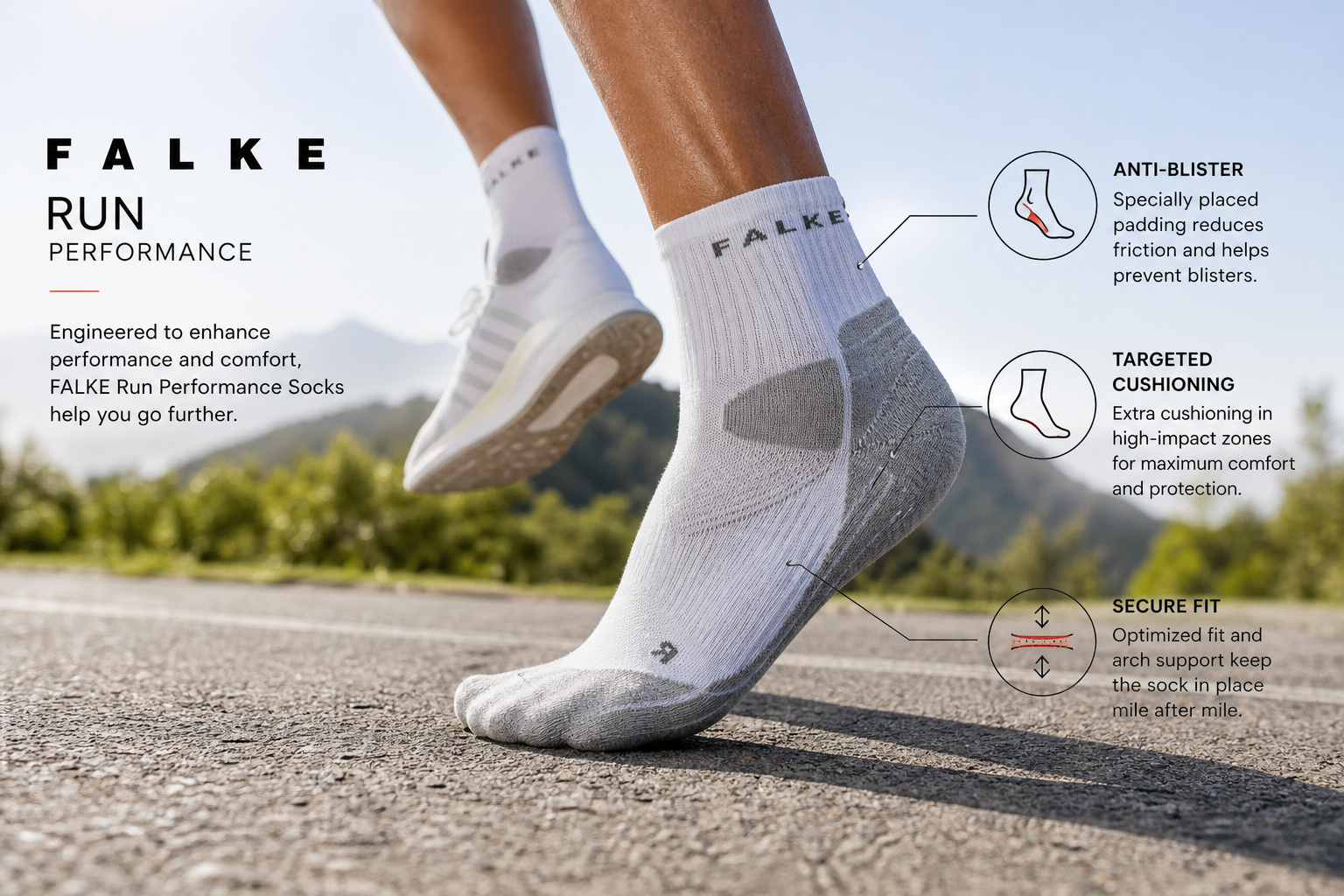
Discover how FALKE Run Performance Socks combine German engineering with anatomical design to eliminate blisters and boost running endurance. Learn why serious athletes choose premium performance socks.
Up to 60% of runners experience blisters during training or races. That single problem—friction, moisture, poor fit—can derail an entire training cycle. Most athletes don’t realize that the real culprit often lies beneath their shoes, in the sock choice they barely consider.
FALKE Run Performance Socks represent the intersection of German precision engineering and athletic innovation. Built on decades of hosiery expertise, these socks go far beyond basic foot coverage. They’re engineered with anatomical construction, targeted cushioning zones, and moisture-wicking technology that directly addresses the biomechanics of running—preventing blisters while enhancing comfort mile after mile.
Discover how FALKE Run Performance Socks can transform your running experience today.
How FALKE’s Anatomical Construction Prevents Common Running Injuries
Left/right foot-specific shaping
The human foot isn’t symmetrical. Each foot has unique pressure points and natural curves, yet most socks treat both feet identically. FALKE designs left and right foot-specific constructions that mirror your foot’s actual asymmetry. This precision engineering means the sock conforms to your foot rather than forcing your foot to adapt to the sock.
Targeted pressure zones
High-impact areas absorb tremendous force during running. The heel strikes the ground with two to three times your body weight. The ball of your foot handles propulsion and balance. Your toes endure constant friction inside the shoe. FALKE strategically places reinforced padding in these stress zones, reducing localized pressure and the friction that creates blisters.
Arch support engineering
A properly supported arch stabilizes your entire foot during the repetitive impact of running. Without adequate arch support, your foot compensates by rolling inward or outward, creating uneven pressure distribution and increasing injury risk. FALKE’s engineered arch support maintains neutral foot alignment, reducing strain on your plantar fascia, Achilles tendon, and tibial structures.
Reinforced stress zones and blister prevention
Blisters form at friction points where the sock shifts against your skin. The toe box, heel counter, and ball of the foot are particularly vulnerable. FALKE reinforces these zones with durable, densely woven material that resists movement while remaining flexible. This combination prevents the sliding motion that causes blisters during long runs.
Snug-but-flexible fit
The fit sits at the heart of sock performance. Too loose and your sock slides, creating friction. Too tight and your sock restricts blood flow and causes discomfort. FALKE’s design delivers a snug fit that eliminates internal sliding while maintaining flexibility for natural foot movement. The elastane blend allows your foot to expand slightly during running without the sock losing its position.
Injury risk reduction for distance and daily runners
These anatomical features work together to reduce injury risk across running populations. Distance runners benefit from cushioning and support during high-mileage weeks. Daily trainers gain protection against the cumulative stress of frequent runs. Hikers and outdoor enthusiasts experience enhanced stability on uneven terrain. The result: fewer blisters, reduced plantar fasciitis symptoms, and lower rates of stress-related foot injuries.
The Material Science: Why FALKE’s Technical Blend Outperforms Standard Athletic Socks
Polyamide, polyester, and elastane composition
FALKE’s technical blend combines three materials, each serving a specific function. Polyamide provides durability and structural integrity. This synthetic fiber resists stretching and maintains its shape after dozens of wash cycles. Polyester adds moisture-wicking capability and quick-drying properties. Elastane—also called spandex—creates the stretch and recovery that allows your sock to move with your foot while snapping back to its original form.
Moisture-wicking technology
Sweat doesn’t disappear—it transfers. Moisture-wicking fabrics pull perspiration away from your skin, through the sock fibers, and toward the outer surface where evaporation can occur. This process keeps your foot drier, reducing the slippery conditions that cause blisters. Drier feet also discourage bacterial and fungal growth, eliminating much of the odor that plagues standard athletic socks.
Breathability and mesh ventilation
Strategic mesh panels create pathways for air circulation. These ventilation zones appear in high-heat areas: the top of the foot and the sides of the ankle. As air moves through the sock, it accelerates evaporation and prevents heat buildup during intense efforts. Trail runners and summer training benefit significantly from this ventilation design, as it keeps feet cooler during extended efforts.
Shape retention after washing
Budget socks lose their structure after a few washes. The elastic weakens. The cushioning compresses. The fit becomes loose and inconsistent. FALKE’s premium materials resist this degradation. After 20, 30, or 50 washes, your FALKE socks maintain their original compression, cushioning, and fit. This durability justifies the higher upfront cost by extending the sock’s lifespan significantly.
Elastane’s role in compression without sacrificing flexibility
Elastane allows FALKE to create graduated compression that supports your foot without creating a rigid, restrictive feel. The compression applies exactly where you need it—around the arch, at the ankle, across the metatarsal heads—while remaining flexible enough for natural running motion. This balance is difficult to achieve but essential for performance.
Durability testing and premium material justification
FALKE subjects its socks to rigorous durability testing. Heat cycling, repeated stretching, wash simulation, and abrasion testing all precede product release. This testing ensures that premium materials actually deliver longer wear life. When you pay more for FALKE, you’re paying for materials and engineering verified to outlast cheaper alternatives by a substantial margin.
FALKE’s blend versus cotton, wool, and budget synthetics
Cotton feels soft initially but absorbs moisture and dries slowly—creating the perfect environment for blisters and odor. Wool offers insulation but can feel itchy and is less breathable during intense running. Budget synthetics use lower-grade polyamide and polyester that degrade quickly and lose shape after minimal use. FALKE’s blend outperforms all these alternatives by combining moisture management, durability, and comfort in a single technical package.
Experience the material science advantage—upgrade to FALKE Run Performance Socks now.
Targeted Cushioning Zones: Engineering Comfort for Different Running Distances
Cushioning strategy by distance
Marathon runners need sustained cushioning across the entire foot, as fatigue amplifies impact over 26+ miles. Casual joggers running 3-5 miles benefit from lighter cushioning that maintains ground feel. FALKE offers different models targeting these distinct needs. Some feature robust cushioning throughout; others concentrate padding only in critical zones, preserving the responsiveness that performance runners demand.
Heel cup reinforcement for impact absorption
Your heel absorbs the highest forces during running—forces that compound across hundreds of foot strikes. FALKE’s reinforced heel cup features extra padding and denser material that absorbs this impact before it travels up your kinetic chain. This protection reduces stress on your Achilles tendon, calf muscles, and lower leg, minimizing injury risk on high-mileage days.
Forefoot padding for metatarsal head pressure reduction
The metatarsal heads—the bones behind your toes—handle significant forces during toe-off and propulsion. Excessive pressure here causes pain and contributes to conditions like metatarsalgia. FALKE’s forefoot padding distributes pressure across a wider area, reducing localized stress on these vulnerable bones.
Toe box construction and blister prevention
The toe box endures constant friction as your toes flex and press against your shoe. FALKE reinforces this area with moisture-wicking material that resists sliding while remaining flexible. The result: fewer blisters in the zone where they most commonly occur.
Customizable comfort across FALKE models
FALKE doesn’t offer one-size-fits-all solutions. Its product line includes minimalist models for runners who prioritize ground feel, moderate cushioning options for balanced performance, and maximum cushioning versions for ultramarathon runners and those recovering from injury. Understanding your running style helps you select the appropriate cushioning level.
Balancing cushioning and ground feel
Excessive cushioning can actually reduce performance. Thick socks create distance between your foot and the ground, diminishing proprioceptive feedback and altering your gait. FALKE engineers its cushioning to provide protection while maintaining sufficient ground contact for runners who demand responsiveness. This balance appeals to serious competitors and recreational runners alike.
Moisture Management and Blister Prevention: The Technical Advantage
How moisture-wicking transports sweat away
The moisture-wicking process functions through capillary action. Hydrophobic fibers repel water while hydrophilic fibers attract it. This combination creates a pathway that moves moisture away from your skin, through the sock fibers, and to the outer surface. Your foot stays relatively dry even during intense efforts, preventing the slippery conditions that cause blisters.
The moisture-friction-blister connection
Friction requires relative movement between two surfaces. Dry skin has sufficient grip to resist this movement. Wet skin becomes slippery, allowing the sock to slide against your foot with each step. This sustained sliding creates heat and breaks down the skin barrier, forming a blister. By managing moisture effectively, FALKE eliminates the primary mechanism of blister formation.
Ventilation design for heat reduction
Heat builds when moisture cannot evaporate. Strategic mesh panels in FALKE’s design facilitate air movement, accelerating evaporation. During hot weather or intense efforts, these ventilation zones become critical for maintaining comfort and preventing the moisture accumulation that leads to blisters.
Antimicrobial properties for fresh feet
Moisture, heat, and darkness create ideal conditions for bacterial and fungal growth. These microorganisms produce the odor associated with worn athletic socks. FALKE’s material science and moisture management reduce the environment these organisms need to thrive. The result: feet that stay fresher throughout extended runs and remain odor-free even after multiple training sessions.
Real-world scenarios: humid climates and long distances
Runners in humid climates face constant moisture challenges. Standard socks become saturated quickly, losing their moisture-wicking capability. FALKE’s technical blend continues performing in high-humidity conditions, maintaining the dryness that prevents blisters even when environmental conditions are unfavorable. Similarly, long-distance events—marathons, ultramarathons, and multi-hour trail runs—demand sustained moisture management. FALKE socks deliver this performance over the extended timeframes that test even premium products.
Sweat management across running contexts
Trail runners face muddy, wet conditions that challenge moisture management. Road runners deal with high-mileage sweat production. Gym-based athletes experience temperature and humidity variations. FALKE’s moisture-wicking technology performs across these diverse scenarios, consistently keeping feet drier than standard alternatives.
Premium Price Breakdown: Is FALKE Worth the Investment?
Cost comparison across sock categories
Budget athletic socks cost $5-10 per pair. Mid-range options run $12-18. FALKE Run Performance Socks typically price between $20-35, with specialty editions potentially higher. This premium positioning raises a legitimate question: what justifies the additional expense?
Durability and cost-per-wear calculations
A $8 budget sock lasts 20-30 wears before losing structure and fit. A $30 FALKE sock lasts 80-120 wears. Over the same timeframe, you might need four budget socks to match one FALKE sock’s lifespan. This means:
- Four budget socks: $32 for 120 total wears = $0.27 per wear
- One FALKE sock: $30 for 120 wears = $0.25 per wear
When calculated this way, FALKE’s premium materials actually deliver lower cost-per-wear than cheaper alternatives. The higher upfront cost is offset by dramatically longer durability.
Quantifying the performance value
Performance gains are harder to quantify but genuinely significant. Blister prevention alone has measurable value. A blister-related DNF (did not finish) in a race costs entry fees, travel expenses, and training time. A blister that forces missed training sessions compounds this cost by disrupting your preparation cycle. Premium socks that prevent these outcomes deliver value far exceeding their purchase price.
Resale and replacement cycles
Quality gear retains value. Used FALKE socks sell on athletic resale platforms, returning 20-30% of purchase price. Budget socks have minimal resale value because they’re worn out. This dynamic means your actual net investment in FALKE socks is lower than the sticker price suggests.
When to invest in specialty editions
Standard FALKE performance models cover most running situations. Specialty editions—winter variants, ultra-distance specific versions, or sport-specific options—cost more and serve narrower purposes. Invest in specialty editions when you regularly participate in the specific activity they target. Occasional trail runners don’t need dedicated trail socks, but runners logging 50+ trail miles monthly benefit from the investment.
ROI for serious runners
For runners completing marathons, engaging in high-mileage training weeks, or logging more than 30 miles weekly, FALKE represents compelling return on investment. Injury prevention alone justifies the cost, as preventing even one significant injury saves money in physical therapy, medical visits, and lost training time. When combined with improved comfort, consistency, and durability, FALKE’s premium pricing becomes a smart allocation of training resources.
FALKE Run Performance Socks for Specific Athletic Lifestyles
Marathon and ultramarathon training
Ultramarathon runners face extreme demands: 50+ miles of sustained running, extended exposure to moisture and heat, and cumulative impact stress that standard socks cannot manage. FALKE’s specialized ultramarathon models feature maximum cushioning, advanced moisture management, and reinforced construction designed for these extreme distances. Serious distance runners consistently report fewer blisters and better foot comfort when wearing FALKE throughout their training cycles.
Trail running demands
Trail running introduces variables that road running doesn’t: uneven terrain, exposed rocks, mud, water crossings, and variable temperatures. FALKE trail-specific models feature enhanced grip patterns on the sole, reinforced protection against abrasion from rocky terrain, and aggressive moisture management for wet conditions. These adaptations make trail socks notably different from road running variants.
Daily commute running
Runners who commute to work need socks that perform during the run but don’t look out of place in a professional setting. FALKE offers sleek performance models in neutral colors and conservative designs that serve double duty. These socks deliver performance benefits without the bold colors or thick construction associated with dedicated athletic socks.
Cross-training athletes
Athletes who combine running with gym sessions, cycling, or mixed-sport activities benefit from FALKE’s versatility. The cushioning and moisture management perform across running and gym activities. A single sock choice eliminates the need to maintain separate inventories for different sports.
Hiking and outdoor adventures
Hikers face similar challenges as trail runners: uneven terrain, variable conditions, and extended time on feet. FALKE’s hiking-specific models feature durable construction that withstands rugged conditions, enhanced arch support for stability on slopes, and moisture management for extended outdoor exposure. These socks often outperform dedicated hiking socks from less specialized brands.
Recovery and post-workout wear
Compression socks aid recovery by improving blood circulation. FALKE offers recovery-focused models that balance compression with comfort, allowing you to wear them during active recovery days or post-workout recovery periods. These models deliver performance benefits even when you’re not actively running.
What Sets FALKE Apart: German Craftsmanship and Brand Heritage
150+ years of hosiery innovation
FALKE was founded in 1895 with a commitment to hosiery excellence. Over 128 years, the company has refined its understanding of sock construction, material science, and human biomechanics. This depth of experience isn’t replicated by newer competitors. FALKE’s heritage represents continuous improvement across multiple generations.
German engineering standards and quality control
German manufacturing carries a reputation for precision and attention to detail. FALKE maintains rigorous quality control processes, inspecting products at multiple manufacturing stages. Materials undergo testing before production. Finished socks undergo dimensional checks, durability testing, and fit verification. This systematic approach ensures consistency across production batches.
Research and development driven by athlete feedback
FALKE actively solicits feedback from professional athletes and dedicated runners. This feedback informs product development, leading to iterative improvements in cushioning placement, material composition, and anatomical shaping. Products evolve based on real-world performance data rather than solely on internal engineering assumptions.
Sustainability in premium sock manufacturing
Modern consumers increasingly value sustainability. FALKE has invested in environmentally responsible manufacturing practices, including efficient dyeing processes, waste reduction, and responsible sourcing. Sustainability adds complexity and cost but reflects FALKE’s commitment to long-term responsibility beyond profit maximization.
Professional athlete endorsement and community reputation
FALKE socks are worn by professional runners, ultramarathoners, and trail running elite. This isn’t paid endorsement in the traditional sense—these athletes choose FALKE because it delivers results. Within running communities, FALKE has earned genuine respect through performance, not marketing spend. This authentic reputation carries weight beyond conventional advertising.
Trust in performance footwear
Your socks sit between your foot and your shoe, managing moisture, providing cushioning, and preventing injury. This critical role demands trust in the product. FALKE’s century-plus history, German engineering standards, and professional athlete adoption collectively create confidence that the brand delivers what it promises.
Real-World Performance: Durability, Fit, and Long-Term Value
Lifespan and wear expectations
FALKE Run Performance Socks typically remain functionally superior for 80-120 wears, depending on the specific model and your care practices. A runner completing 30 miles weekly—four runs of approximately 7-8 miles each—wears a sock twice per week. At this pace, one pair lasts roughly 40-60 weeks, or nearly a year. Rotating multiple pairs extends their lifespan by allowing moisture to fully evaporate between uses.
Fit consistency across foot shapes
FALKE offers multiple size options and width considerations. The fit generally runs true to size, though some runners with very wide feet prefer sizing up. The sock’s elastic and anatomical shaping accommodate a range of foot structures better than standard socks, but individual variation exists. Reading size guides and customer feedback helps identify your ideal size before purchasing.
Distance runner and endurance athlete feedback
Marathon finishers consistently report that FALKE socks prevented blisters during their race. Ultramarathoners praise the sustained cushioning and moisture management over 50+ miles. Trail runners highlight the durability and grip performance on uneven terrain. These consistent reports across different running populations indicate genuine performance advantages.
Sizing considerations and finding your perfect fit
FALKE’s anatomical construction means fit matters more than with standard socks. Socks that are too large slide inside your shoe, creating friction. Socks that are too small feel restrictive and uncomfortable. Taking time to find your correct size ensures you experience FALKE’s full performance benefit. Many runners find trying on multiple sizes necessary to identify their perfect fit.
Care instructions for longevity
Washing socks in hot water degrades elastane and shortens lifespan. FALKE recommends cool water washing and air drying. Machine drying introduces heat that damages materials. Following these care instructions extends your socks’ useful life from 80-120 wears to potentially 150+ wears. The minimal effort required to follow care instructions delivers substantial rewards in durability.
Warranty and replacement policies
FALKE stands behind its products with warranties that reflect brand confidence. If your socks fail prematurely due to manufacturing defects, FALKE typically replaces them. This policy wouldn’t exist unless the brand had confidence in its quality control and materials. The presence of meaningful warranties adds to the case for purchasing premium socks.
Potential Drawbacks and Who Might Prefer Alternatives
Premium pricing as a barrier
Not all runners can justify $20-35 per pair, especially if they wear through several pairs annually. Budget-conscious athletes may find this price point prohibitive despite the superior cost-per-wear calculation. For casual joggers running occasionally, cheaper alternatives may represent more appropriate value.
Technical feel versus soft aesthetics
FALKE’s engineered construction creates a structured feel that differs from soft, plush socks. Some runners prefer the sensation of unstructured softness, finding FALKE’s technical feel too rigid or noticeable. This is purely a preference consideration—the technical construction delivers performance benefits, but not everyone values performance characteristics over tactile comfort.
Break-in period
Running in structured, anatomically precise socks differs from wearing loose-fitting alternatives. Your feet may require 2-4 runs to fully acclimate to FALKE’s fit and support. Some runners abandon the product during this break-in period without giving themselves sufficient time to adapt. Committing to at least 3-4 wears before evaluating the socks helps ensure a fair assessment.
Specialty editions availability and pricing
Popular specialty editions occasionally sell out, creating purchasing difficulty. Limited availability sometimes drives prices higher through resale platforms. If you have your heart set on a specific edition, ordering early prevents disappointment and price inflation.
Minimalist running philosophy
Minimalist runners deliberately seek thin socks and minimal cushioning to maximize ground feel and maintain a natural gait. FALKE’s cushioned options contradict this philosophy. While FALKE does offer thinner models, minimalist runners may find even these options too structured compared to ultra-thin alternatives from other brands.
Sensitivity and fit variations
Feet vary dramatically across the population. Some structures align perfectly with FALKE’s anatomical design; others find the design creates pressure points or discomfort. Individual sensitivity to specific materials also varies—elastane sensitivity, for example, affects a small subset of runners. Testing one pair before committing to multiple purchases mitigates this risk.
Choosing the Right FALKE Model for Your Running Goals
Performance line overview
FALKE’s performance line prioritizes speed and responsiveness. These socks feature minimal cushioning, reducing the barrier between your foot and the ground. They excel for tempo runs, speed work, and runners who prioritize ground feel over maximum cushioning. Competitive runners and those training for fast road races typically gravitate toward performance models.
Comfort line features
The comfort line balances support with everyday wearability. Moderate cushioning provides protection without excessive bulk. These models work across training runs, daily wear, and casual activities. For most runners, comfort line socks represent the optimal balance of performance and versatility.
Specialty editions
FALKE produces winter variants with thermal insulation, specialized trail running models with enhanced grip, and ultramarathon-specific socks with maximum cushioning and durability. Investing in specialty editions makes sense if you regularly engage in the activity they target. Winter models improve cold-weather comfort; trail models enhance off-road performance; ultramarathon models deliver cushioning and durability suited to extreme distances.
Sizing guide and fit differences
FALKE’s sizing generally runs true to standard shoe sizes, though some runners size up for additional room. The anatomical construction means fit matters more than with standard socks. Consulting sizing charts and reading customer reviews from runners with similar foot characteristics helps identify your ideal size before purchasing.
Layering options with different shoes
Some runners prefer wearing FALKE socks with snug racing flats; others layer them in roomy trail shoes. Understanding how your shoe accommodates the sock’s thickness and structure informs model selection. Racing flats typically pair best with thin performance models. Cushioned training shoes accommodate comfort or max-cushion variants. Trail shoes work with any FALKE variant but benefit from models designed specifically for trail conditions.
Budget allocation across multiple pairs
Running efficiency improves when you rotate multiple pairs of socks. Moisture fully evaporates between uses, extending each pair’s lifespan. Most serious runners benefit from owning 3-4 pairs in regular rotation. Allocating your budget across multiple pairs, potentially mixing performance and comfort variants, optimizes both durability and versatility across different running scenarios.
Making the Upgrade: Your Next Step Toward Blister-Free Running
FALKE Run Performance Socks represent a meaningful investment in your running experience. The anatomical construction, advanced moisture-wicking technology, and reinforced stress zones work together to eliminate the friction and discomfort that plague standard athletic socks. Yes, they cost more—but the durability, injury prevention, and genuine performance gains justify the premium price for serious runners.
The evidence accumulates across multiple dimensions. Cost-per-wear analysis reveals that FALKE’s durability actually delivers lower per-wear expenses than cheaper alternatives. Real-world feedback from marathoners, ultramarathoners, and trail runners consistently validates blister prevention and comfort improvements. The material science backing these socks reflects genuine engineering innovation, not marketing hype.
You’ll train more consistently without blisters interrupting your schedule. Your feet will feel fresher during long runs. Your shoes will last longer because premium socks reduce internal wear. Your overall injury risk decreases as your feet benefit from proper support and moisture management. These benefits compound over time, making FALKE’s engineering investment genuinely worthwhile.
Start with one pair that matches your primary running style. Experience the difference firsthand over 2-3 weeks of training. Notice how your feet feel during and after runs. Observe whether blisters decrease or disappear entirely. Then build your collection from there, potentially adding a second variant once you’ve confirmed the fit and performance benefits. Your feet—and your training log—will reward this investment.
Take the step toward blister-free running—order your FALKE Run Performance Socks now.