
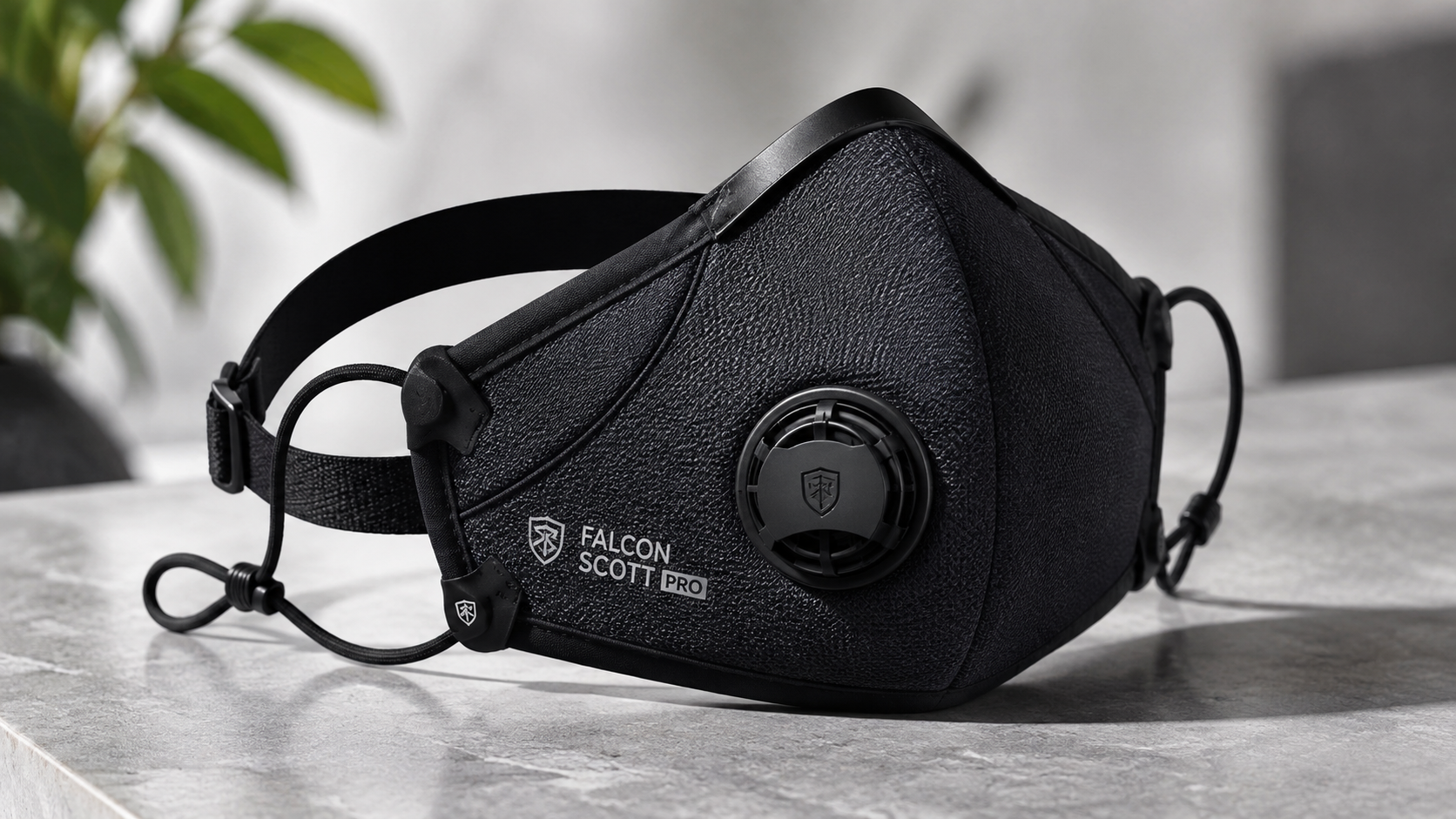
Discover why the Falcon Scott PRO Mask is ideal for glasses wearers. Learn about its military-grade filtration, anti-fog technology, and 3-6 month lifespan in our detailed review.
Over 60% of mask wearers who use glasses struggle with significant fogging that compromises visibility and creates frustration during daily wear. When warm breath escapes upward toward the lenses, condensation forms almost immediately, forcing you to constantly adjust your glasses or remove your mask entirely. This isn’t merely an inconvenience—fogging directly undermines your ability to see hazards, read critical information, or maintain situational awareness in environments where that matters most. For healthcare workers performing delicate procedures, construction professionals navigating job sites, or anyone commuting through dense traffic, this visibility loss transforms a protective tool into a liability.
The gap in the market: most respirators prioritize filtration over the glasses-wearing experience
The respiratory protection industry has historically focused almost exclusively on filtration efficiency, leaving glasses wearers to fend for themselves with makeshift solutions. You find yourself buying anti-fog sprays, applying dish soap to lenses, or investing in expensive optical inserts that never fit quite right. Standard masks simply weren’t designed with the optical reality of millions of users in mind. Manufacturers assumed everyone could manage the fogging problem independently, which meant those who wore glasses paid a hidden cost—both in dollars and in daily frustration.
How the Falcon Scott PRO addresses this specific pain point with included nose foam and anti-fog engineering
The Falcon Scott PRO Mask fundamentally changes this equation by including nose foam specifically engineered to create a superior seal around the nose and upper face. This accessory reduces the upward escape of warm breath that causes fogging in the first place. Combined with thoughtful mask geometry and included head strap design, the engineering minimizes the pathways where breath can reach your lenses. You’re not buying a separate anti-fog solution or struggling with add-on modifications—the solution comes integrated into the design.
The connection between proper fit and effective filtration, especially for those wearing eyewear
Fit quality directly determines whether a mask’s filtration technology actually protects you. If the seal fails around your nose or cheeks—common problems when glasses create pressure points—airborne threats bypass the filters entirely. The Falcon Scott PRO’s design acknowledges this reality by engineering around the specific challenges glasses create. The nose foam fills gaps that eyewear tends to create, while the adjustable head strap distributes pressure evenly rather than concentrating force at the ears where glasses already sit.
Real-world scenarios where anti-fog capability directly impacts mask performance and user compliance
Consider a nurse working a 12-hour shift in a patient-facing role. Without adequate anti-fog capability, she removes her mask repeatedly to clear her vision, each removal resetting the seal and potentially exposing her to pathogens. During wildfire season, an outdoor enthusiast faces the same problem—fogged lenses force constant adjustments that break the protective seal. In construction, a worker’s inability to see clearly due to fogging increases accident risk on the job site. The Falcon Scott PRO’s anti-fog engineering directly addresses these scenarios, maintaining both protection and user compliance throughout extended wear sessions.
Military-Grade Filtration Technology Explained
Breaking down the triple-layer system: primary filter, three-ply micro particulate layer, and activated carbon component
The Falcon Scott PRO Mask employs a sophisticated three-stage filtration approach that captures threats at different particle sizes. The primary filter stage handles larger particles—dust, pollen, and debris that would otherwise clog deeper layers. Below that sits the three-ply micro particulate filter, engineered to trap incredibly small particles that escape primary filtration. The final layer consists of military-grade activated carbon, which doesn’t merely trap particles—it actively kills bacteria and viruses on contact through chemical interaction. This layered approach ensures comprehensive protection while maintaining reasonable breathability across the entire mask lifespan.
How the mask achieves 99% filtration against viruses, bacteria, and particulate matter (PM10, PM2.5, PM0.3)
The 99% filtration efficiency covers an impressive range of airborne threats. PM10 particles (roughly 10 micrometers) represent visible dust and larger irritants. PM2.5 particles, associated with serious respiratory health impacts, measure just 2.5 micrometers—small enough to penetrate deep into your lungs if unfiltered. PM0.3 represents ultra-fine particles at 0.3 micrometers, smaller than most viruses and bacteria. By achieving 99% filtration across this entire spectrum, the Falcon Scott PRO ensures that whether you’re avoiding seasonal allergies, protecting yourself during illness outbreaks, or shielding against industrial pollution, the filtration performs consistently.
The role of military-grade activated carbon in killing pathogens on contact
Activated carbon possesses a porous structure with tremendous surface area relative to its weight. When saturated with the right chemical activation process—in this case, military-grade preparation—it becomes hostile to microbial life. Viruses and bacteria don’t merely stick to the carbon surface; the chemical environment actively disrupts their cellular function. This means the mask doesn’t simply collect pathogens and hold them against your face. Instead, it neutralizes them on contact, substantially reducing the risk profile of the filtered air you breathe.
Comparison of filtration standards: what military-grade actually means versus standard N95 or KN95 masks
Standard N95 masks filter 95% of particles 0.3 micrometers and larger, following EPA guidelines. They’re effective but represent a baseline standard developed decades ago. Military-grade filtration, by contrast, was engineered for battlefield conditions where exposures include chemical weapons, biological agents, and extreme pollution levels. The Falcon Scott PRO’s British military specification means it underwent testing against threats far more severe than typical civilian scenarios. When you’re comparing a 99% filtration rate (military standard) against the 95% baseline, that 4-percentage-point difference represents substantially more particles being captured, especially important during high-exposure situations or extended wear periods.
Effectiveness against specific pollutants: exhaust fumes, wildfire smoke, pollen, and gas pollution
Users consistently report the Falcon Scott PRO’s effectiveness in real-world pollution scenarios. During wildfire season, those wearing the mask notice marked improvement in air quality perception and respiratory comfort compared to unprotected breathing or inferior masks. Vehicle exhaust exposure—a concern for urban commuters and traffic-adjacent workers—gets filtered before reaching your respiratory system. Pollen seasons become manageable rather than debilitating for allergy sufferers. The activated carbon component specifically targets gas pollution, absorbing volatile compounds that bypass particle-only filtration systems.
The science behind ultra-fine particle capture and why PM0.3 matters for comprehensive protection
Ultra-fine particles (PM0.3) represent the frontier of respiratory hazards because they’re small enough to bypass your body’s natural defenses. Your nasal passages effectively filter larger particles, but PM0.3 penetrates directly into the deepest regions of your lungs where gas exchange occurs. Viruses measure roughly 0.1 micrometers, falling well within the ultra-fine range. By achieving 99% filtration of PM0.3 particles, the Falcon Scott PRO addresses the actual size distribution of viral and bacterial threats rather than relying on outdated particle-size assumptions.
The Economics of Reusability: Cost Per Wear Analysis
Lifespan breakdown: 3-6 months of daily use or 200-300 hours of protection
The Falcon Scott PRO functions effectively for 3-6 months of daily wear, translating to approximately 200-300 hours of active protection before filter saturation reduces effectiveness. This lifespan assumes typical urban or indoor air quality. Environments with extreme pollution (intense wildfire smoke, heavily trafficked construction sites) may reduce filter life, while cleaner air conditions could extend it. The key advantage lies in this predictability—you know approximately when replacement becomes necessary rather than guessing with disposable masks.
Cost comparison: $32 investment versus ongoing disposable mask expenses
At $32 for the complete Falcon Scott PRO package (including nose foam and head strap accessories), your initial investment covers 200-300 hours of superior protection. Disposable N95 masks typically cost $1-3 each, and most people wear them for 4-8 hours before discarding. Over a 6-month period of daily use (roughly 180 days), you’d purchase 22-45 disposable masks at a total cost of $22-135. The Falcon Scott PRO’s single $32 investment already competes favorably on price, before considering that disposable alternatives offer lower filtration efficiency and create substantial waste.
Environmental impact: reducing waste while maintaining superior protection
A person using disposable masks daily generates approximately 180 masks per year, weighing roughly 2-3 pounds of plastic and synthetic materials destined for landfills. Over a decade, that’s 2,000+ masks and 20-30 pounds of waste from a single individual. The Falcon Scott PRO, used for 6 months before filter replacement, requires only two replacement filter sets annually. You’re reducing waste by roughly 85-90% while simultaneously increasing filtration efficiency, making this a compelling choice for environmentally conscious users who refuse to compromise on protection.
Switch to the Falcon Scott PRO Mask and start saving money while protecting the environment.
Long-term savings for professionals who wear masks regularly (healthcare workers, construction crews, outdoor enthusiasts)
For a healthcare worker wearing masks throughout a 12-hour shift five days weekly, annual disposable mask costs reach $300-600 before considering the environmental responsibility many professionals feel obligated to address. A construction crew of five workers spending 40 hours weekly in dusty conditions invests $3,000-6,000 annually in disposable protection. An outdoor enthusiast managing seasonal wildfire exposure might spend $200-400 yearly on disposables. These professionals see the Falcon Scott PRO’s cost payback within the first month or two of use, with remaining months representing pure savings.
When the Falcon Scott PRO makes financial sense versus single-use alternatives
The mask’s economics favor anyone expecting consistent, regular use. If you wear respiratory protection occasionally—perhaps a few times yearly during specific events—disposables remain cost-competitive. However, anyone with weekly or daily mask requirements achieves breakeven within months and substantial savings thereafter. Healthcare settings, construction sites, and pollution-prone urban areas represent ideal applications where the reusable model delivers maximum financial advantage.
Storage and maintenance tips to maximize the mask’s effective lifespan
Between uses, store the Falcon Scott PRO in a clean, dry location away from direct sunlight, which can degrade filter materials. Allow the mask to air dry completely after cleaning if moisture has accumulated inside. Avoid crushing or flexing the mask excessively, which can compromise filter integrity. Replace the entire mask if you notice visible damage, cracks in the shell, or deterioration of the ear loops or head strap. When filter saturation approaches—typically indicated by increased breathing resistance—replace the filter cartridge rather than attempting to “refresh” a saturated filter through air-drying or cleaning.
Comfort Features That Support Extended Wear Sessions
The one-way valve advantage: how it prevents CO2 buildup during prolonged use
The Falcon Scott PRO features a one-way valve that allows exhaled breath to escape outward while preventing outside air from entering through the valve port. Without this feature, you’d rebreathe your own exhaled breath—higher in CO2 and lower in oxygen—creating fatigue and discomfort during extended wear. The valve substantially reduces breathing resistance and prevents the sensation of suffocation that makes many people abandon masks during long shifts. For professionals wearing masks 8-12 hours daily, this feature transforms the experience from endurable to genuinely manageable.
Adjustable head strap and ear loop design for customized fit without pressure points
Rather than relying solely on ear loops that concentrate pressure in a narrow area, the Falcon Scott PRO incorporates an adjustable head strap that distributes force across a broader surface. The ear loops themselves are adjustable, allowing you to customize how much tension the mask exerts. For glasses wearers, this proves particularly valuable—you can adjust the strap to sit above or below glasses frames, minimizing the pressure point concentration that typically causes discomfort during extended wear. The adjustability accommodates different face shapes and sizes without requiring multiple mask sizes for perfect fit.
Included nose foam accessory: reducing gaps and improving seal consistency
The nose foam included with the Falcon Scott PRO serves dual purposes. First, it fills the gap between your nose bridge and the mask shell, eliminating the primary pathway where unfiltered air bypasses the filter system. Second, it reduces the upward escape of warm breath that causes lens fogging, addressing the glasses-wearing problem directly. This isn’t an afterthought accessory—it represents genuine engineering that acknowledges how actual faces differ from theoretical mask designs.
Breathability performance compared to traditional sealed respirators
Many high-filtration masks prioritize seal tightness at the cost of breathing ease, creating a trade-off where wearers feel they’re suffocating. The Falcon Scott PRO, through its one-way valve design and carefully engineered filter layers, maintains strong filtration while preserving reasonable breathability. You’re breathing through 200-300 hours of filter capacity before resistance becomes noticeable, meaning early-stage filter wear barely impacts your breathing comfort.
Heat and humidity considerations: real user experiences in warm climates
Users in hot climates report that extended wear becomes challenging primarily due to perspiration accumulation rather than filtration failure. The moisture tends to accumulate inside the mask shell, potentially affecting comfort more than breathing resistance. Strategies that help include taking occasional brief breaks in clean-air environments to allow evaporation, using moisture-wicking head coverings, and ensuring proper ventilation during rest periods. Some users report that the breathability advantage provided by the one-way valve makes hot-climate wear substantially more tolerable than sealed alternatives.
The balance between protective seal and wearing comfort during 8+ hour days
Achieving both seal integrity and comfort requires design compromises. The Falcon Scott PRO accepts slightly more air leakage than absolute maximum-seal designs in exchange for improved wearability during extended periods. For most users, this trade-off proves worthwhile—you maintain 99% filtration at realistic gaps while actually being willing to wear the mask throughout your work shift rather than removing it repeatedly due to discomfort. This represents genuine engineering wisdom: a mask protecting you 95% of the time while worn is more effective than one protecting you 99% of the time while removed half the day.
Sizing Inconsistencies and Fit Challenges to Know About
Understanding Cambridge Mask sizing options and how they differ from standard mask measurements
Cambridge Mask offers sizing based on face geometry rather than simple small/medium/large categories. Your sizing should account for nose bridge width, cheekbone prominence, and overall face length rather than relying on standard hat or clothing sizes. The company provides detailed sizing guides, but some users report that moving between sizes requires careful measurement. What qualifies as “medium” at Cambridge might differ substantially from other manufacturers’ medium sizes.
Common fit issues reported by users and troubleshooting approaches
The most frequent complaint involves the mask riding too high or too low on the face, creating gaps that compromise the seal. This typically indicates sizing mismatch—either the mask is too large and slides down, or too small and rides upward. Secondary issues include ear loops cutting into ears (suggesting the mask is too small and being forced downward) or gaps developing around the nose bridge despite included foam (suggesting insufficient nose foam or need for a larger size). Addressing these issues first requires honestly assessing whether your selected size was correct before trying adjustment techniques.
The importance of proper sizing for both comfort and filtration effectiveness
A mask that doesn’t fit properly fails at its fundamental purpose. Even military-grade filtration offers no protection if unfiltered air bypasses the filter system through gaps and leaks. Additionally, an uncomfortable ill-fitting mask gets removed frequently, further reducing actual protection. Spending time getting the sizing right represents one of the highest-value actions you can take with your Falcon Scott PRO investment.
How to identify whether a sizing mismatch is affecting your protection level
Simple indicators of poor fit include feeling unfiltered air entering around your nose, mouth, or cheeks during normal breathing. You might notice that glasses stay clearer on one side of your face than the other, suggesting the seal is stronger on that side and weaker on the opposite side. Discomfort localized to specific areas—intense pressure on one ear, a gap visibly opening at your cheekbone—indicates the mask is fighting your face shape rather than accommodating it.
Adjustment techniques using the included accessories to improve fit
Beyond nose foam, the adjustable head strap offers significant fine-tuning capability. Try different strap positions: higher on your head, lower across your skull, or angled differently. Sometimes moving the strap position by just an inch substantially improves seal quality. The ear loops themselves offer adjustment—tightening or loosening affects both seal and comfort. Experiment systematically with these adjustments rather than making random changes, allowing you to identify which configurations work best for your specific face shape.
When to consider exchanging for a different size versus adapting your current mask
If careful adjustment of the head strap and ear loops still leaves visible gaps or discomfort localized to specific areas, a sizing exchange makes sense. However, if minor seal imperfections exist but the overall fit feels reasonable and comfortable, you might accept slight efficiency trade-offs rather than going through exchange processes. The question becomes whether the current fit genuinely compromises protection in practical terms or whether you’re pursuing theoretical perfection at the cost of practicality.
Real-World Performance Across Different Environments
Urban air quality scenarios: effectiveness against vehicle exhaust and pollution
Urban commuters and city residents benefit substantially from the Falcon Scott PRO’s comprehensive filtration. Vehicle exhaust contains numerous compounds—nitrogen oxides, particulate matter, volatile organic compounds—that create both immediate respiratory irritation and long-term health impacts. Users report noticeably improved breathing during peak traffic hours and reduced sinus irritation compared to unprotected exposure. The military-grade activated carbon specifically targets the gas components of exhaust, providing protection that particle-only systems miss.
Wildfire smoke protection: how the Falcon Scott PRO performs during peak season
Wildfire smoke represents one of the most demanding air quality scenarios. The smoke contains ultra-fine particles, volatile organic compounds, and oxidative threats that exceed typical urban pollution levels. Users in fire-prone regions consistently report that the Falcon Scott PRO makes outdoor activities and commuting substantially more tolerable during peak smoke seasons. Many describe going from confining themselves indoors to managing near-normal outdoor activity while wearing the mask, representing a significant quality-of-life improvement.
Professional settings: healthcare, construction, and industrial applications
Healthcare workers appreciate the mask’s performance in environments where biological hazards combine with chemical exposures (cleaning agents, disinfectants). Construction workers in dusty, high-particulate environments benefit from the triple-layer system’s efficiency at capturing fine construction dust without excessive breathing resistance. Industrial workers report the mask’s effectiveness at filtering exhaust, metal particulates, and other occupational hazards commonly encountered in manufacturing and processing facilities.
Commuting and travel: protecting yourself during public transportation exposure
Public transit environments combine crowding with recycled air, creating elevated exposure to respiratory pathogens. The Falcon Scott PRO’s 99% viral filtration provides substantial protection even when surrounded by coughing passengers or stale air circulation. Frequent travelers report that consistent mask use during transit substantially reduces illness rates, making the investment economically attractive beyond just the immediate dollar cost of the mask itself.
Outdoor activities: hiking, cycling, and exercise with respiratory protection
For athletes and outdoor enthusiasts, the one-way valve proves particularly valuable during strenuous activity. The reduced breathing resistance allows sustained exercise without the suffocation sensation that makes many masks intolerable during physical exertion. Cyclists benefit from the ability to maintain high breathing rates during climbs while still filtering air pollution. Hikers in wildfire regions report that the mask’s anti-fog design (crucial for safety while navigating terrain) combined with its breathability allows extended trail time that would be impossible with inferior masks.
User testimonials from various climate zones and pollution levels
Healthcare workers in humid climates praise the one-way valve’s breathability during 12-hour shifts. Construction professionals in arid, dusty regions consistently report reduced respiratory irritation compared to disposable masks. Urban commuters in smog-prone areas describe noticeable improvement in daily respiratory comfort and perceived air quality. Wildfire-exposed communities speak of reclaiming outdoor activity during smoke seasons. These testimonials, spanning diverse environments, paint a consistent picture of reliable performance across varying conditions.
Valved Masks and Regional Regulations: What You Should Know
How the one-way valve improves breathability and reduces CO2 accumulation
The exhaust valve allows your lungs to push stale, high-CO2 breath outward rather than forcing you to rebreathe it. This prevents the cognitive fog, fatigue, and discomfort associated with elevated CO2 levels. During extended wear, unvalved masks force continuous rebreathing of your own exhaled air, which contains substantially higher CO2 and lower oxygen than ambient air. The performance difference becomes noticeable within an hour of continuous wear, particularly during any physical exertion.
Regional restrictions: where valved masks are banned or limited
During the COVID-19 pandemic, many jurisdictions implemented restrictions against valved masks based on concerns that they protected the wearer but not others around them (since unfiltered exhaled breath escaped the valve). These restrictions persist in some healthcare settings, government buildings, and specific jurisdictions even as pandemic emergency declarations have ended. Before purchasing the Falcon Scott PRO for use in specific locations, verify whether valved masks remain restricted in those settings.
COVID-era policies and ongoing mask mandates in different areas
Mask mandate landscapes vary dramatically by region and institution. Some areas have fully returned to pre-pandemic normal with no mask requirements anywhere. Others maintain mandates in healthcare facilities, transportation hubs, or government buildings, often with specific restrictions on valved designs. Understanding your local policies ensures your mask purchase actually serves your intended use rather than violating local requirements.
Choosing between valved and non-valved models based on your location and use case
For pure personal protection in areas without valved-mask restrictions, the valved Falcon Scott PRO provides superior comfort during extended wear. For use in regulated settings, healthcare environments, or jurisdictions with ongoing restrictions, a non-valved model ensures compliance while still providing the same 99% filtration efficiency. Cambridge offers both configurations, allowing you to choose based on your specific circumstances rather than being locked into one design.
Workplace compliance: checking requirements before purchasing for professional settings
If you’re purchasing the Falcon Scott PRO for workplace use, consult your employer’s respiratory protection policy before buying. Some organizations require specific mask models or certifications, while others prohibit valved masks entirely. Confirming requirements before purchase prevents the frustration of receiving a mask that doesn’t meet your workplace standards.
The trade-off between personal comfort and regulatory compliance
The one-way valve substantially improves comfort during extended wear, but using it where restrictions apply creates compliance problems. This decision requires balancing your personal comfort against your obligation to follow workplace or regional regulations. For many users, purchasing both valved and non-valved options allows flexibility: use the valved version for personal outdoor activities and the non-valved version for regulated settings.
Comparing the Falcon Scott PRO to Other Premium Reusable Respirators
How it stacks against other British-engineered masks in the market
Cambridge Mask’s Falcon Scott PRO competes in the premium reusable segment against other British-engineered respirators. What distinguishes it specifically is the integrated anti-fog design combined with included accessories—many competitor masks offer strong filtration without addressing the glasses-wearing experience. The included nose foam and head strap represent thoughtful engineering directed at real user experience rather than theoretical maximum filtration.
Price-to-performance ratio in the $30-$50 price range
At $32, the Falcon Scott PRO delivers premium features typically found in masks costing $50-70 elsewhere. The 99% filtration efficiency, military-grade activated carbon, triple-layer design, and included accessories position it at exceptional value within its price range. Competitors offering similar filtration often lack the accessory package or charge substantially more.
Filtration technology differences and what they mean for protection levels
Most competitors in this price range employ either two-layer systems (offering lower filtration) or three-layer systems comparable to the Falcon Scott PRO. What varies is the specific filter materials and activation processes. Military-grade designation indicates higher standards than commercial-grade alternatives, translating to superior performance, particularly against biological threats and gas pollutants.
Design features that set it apart: anti-fog capability, included accessories, durability, and reusability
The integrated anti-fog engineering represents perhaps the Falcon Scott PRO’s most distinctive feature—competitors rarely address this aspect systematically. The included nose foam and head strap represent added value most competitors force you to purchase separately. Durability reports consistently praise the mask’s construction quality, with users reporting reliable performance throughout the rated lifespan.
User satisfaction metrics and long-term reliability reports
The Falcon Scott PRO consistently receives high satisfaction ratings from users across different environments and use cases. Long-term reliability reports indicate that masks continue functioning effectively through the full 3-6 month lifespan, with deterioration occurring gradually rather than suddenly. Failure rates remain low, with most quality issues attributable to user damage rather than manufacturing defects.
When alternative masks might be worth considering
If budget represents your primary constraint and you can tolerate disposable mask costs, investing in reusable protection might not make financial sense for occasional use. If you have specific facial geometry that makes standard sizing challenging, alternatives with different size ranges might better accommodate your proportions. If you absolutely cannot wear any mask with valves due to regulatory restrictions, ensure you’re purchasing the non-valved version specifically rather than assuming all models come in both configurations.
The Complete Accessory Package and What It Adds
Included nose foam: reducing gaps and improving seal quality
The nose foam serves as a custom gasket that fills the gap between your unique nose bridge and the mask’s standardized shape. This simple addition addresses one of the most common seal failures while simultaneously preventing the upward escape of warm breath that causes lens fogging. The foam can typically be adjusted or replaced if it becomes compressed or damaged.
Head strap functionality: how it differs from standard ear loops
Traditional masks rely entirely on ear loops, which concentrate pressure in a small area and make it difficult to adjust fit for different face sizes. The Falcon Scott PRO’s head strap distributes pressure across a broader area—your skull rather than your ears—reducing discomfort during extended wear. The strap’s position can be adjusted to find the optimal balance between seal integrity and comfort for your specific anatomy.
Optional accessories available for purchase and their benefits
Beyond the included package, Cambridge offers replacement filter cartridges (obviously essential for ongoing use), additional nose foam sets, and optional extras like glasses spacers for users with particularly large eyeframe sizes. Replacement filters cost substantially less than replacing the entire mask, making long-term usage economical.
Replacement filter availability and cost
Filter replacement represents the ongoing cost of mask ownership. Filters cost significantly less than the entire mask, typically in the $8-15 range for replacement cartridges, making the economics of reusable use dramatically favorable compared to disposables even over extended periods. Availability remains consistent through Cambridge’s direct channels and authorized retailers.
Cleaning and maintenance tools recommended for optimal performance
The mask shell itself requires minimal maintenance—gentle wiping with a soft, damp cloth removes exterior dust. Avoid harsh chemicals or excessive scrubbing, which could damage the shell or gasket materials. The included nose foam should be air-dried if it becomes damp but otherwise requires no special cleaning. Most users find that simply allowing the mask to air dry naturally between uses maintains optimal condition.
Customization options for different face shapes and sizes
Beyond sizing selection, the adjustable head strap and ear loops provide customization for individual facial geometry. Some users creatively adapt the nose foam or experiment with strap positioning to achieve better fit. Cambridge acknowledges that perfect one-size-fits-all designs don’t exist, and the included adjustability features recognize this reality.
Making the Switch: Transition Tips from Disposable to Reusable Protection
Adjusting to reusable mask wear: what to expect in the first week
The initial transition to reusable mask wear requires mental adjustment. You’ll notice breathing characteristics different from disposables, primarily because the one-way valve creates a distinct exhalation experience. The mask feels more substantial on your face due to durable construction compared to flimsy disposables. These differences aren’t problems—they indicate superior engineering—but they require acclimation. Most users adjust completely within a week of consistent daily wear.
Proper cleaning and storage protocols between uses
Daily cleaning requires only gentle wiping with a soft, barely damp cloth to remove dust and accumulated material. Avoid abrasive cleaners or excessive moisture. Store in a clean, dry location away from direct sunlight when not in use. Allowing the mask to completely air dry between uses prevents moisture accumulation that could support mold growth or material degradation. This simple protocol maintains optimal condition with minimal effort.
Identifying when filters need replacement based on usage patterns
Filter replacement timing depends on air quality and usage intensity. In moderate air quality conditions with typical daily wear, the 3-6 month lifespan represents a reasonable guideline. In severe pollution (wildfire smoke season, high-traffic construction sites), filters saturate faster—potentially in 4-8 weeks. Noticeable increases in breathing resistance indicate approaching saturation and suggest imminent replacement. Rather than guessing, mark your calendar when filters are installed to maintain awareness of replacement timing.
Building confidence in the seal and filtration effectiveness
New users sometimes doubt whether the mask’s seal is truly effective since they can’t see the filtration occurring. Confidence builds through consistent use and observing real-world effects—noticing reduced respiratory irritation, clearer breathing compared to unprotected exposure, or seeing personal air quality improve on air quality monitors. Reading technical specifications and understanding the military-grade filtration components reinforces confidence intellectually while real-world experience confirms it practically.
Integrating the Falcon Scott PRO into your daily routine
Rather than treating mask wear as a chore, integrate it into your existing routine. If you commute in high-traffic areas, the mask becomes as routine as your shoes. If you work in dusty conditions, putting on the mask becomes part of your work preparation ritual. If you’re managing seasonal air quality issues, designating specific times for mask wear creates consistency. This integration transforms the mask from a novel accessory to a normal part of your day.
Cost tracking: monitoring savings over your first 3-6 months
Keeping a simple spreadsheet tracking your mask-wearing days and comparing hypothetical disposable mask costs against your Falcon Scott PRO investment reveals the financial advantage impressively. After three months of daily wear, most users realize they’ve already recouped the entire $32 investment through avoided disposable purchases. Watching those savings accumulate reinforces the economic wisdom of switching to reusable protection.
Your Respiratory Protection Strategy Starts Here
The Falcon Scott PRO Mask represents a significant leap forward for anyone tired of compromising between protection and practicality. Whether you’re a glasses wearer frustrated with fogging, a professional requiring consistent respiratory defense, or someone committed to reducing disposable waste, this mask delivers on multiple fronts. Its military-grade filtration technology, thoughtful anti-fog design, and impressive 3-6 month lifespan create a compelling case for switching from disposable alternatives. Yes, sizing can vary, and extended wear in extreme heat presents challenges—but these are manageable trade-offs for a mask engineered with real-world use in mind. At $32, you’re investing in protection that pays dividends through cost savings, environmental responsibility, and genuine peace of mind.
The economics work in your favor from day one. The 99% filtration efficiency means you’re not compromising on the core protective function while saving money. The included nose foam and head strap accessories address specific usability challenges that most competitors ignore entirely. The one-way valve transforms extended wear from tolerable to genuinely manageable, making consistent daily use realistic rather than aspirational.
Your respiratory protection strategy succeeds when your chosen mask actually protects you because you’re willing to wear it consistently. The Falcon Scott PRO crosses that critical threshold where superior technology, thoughtful design, reasonable cost, and genuine comfort align. It’s not the absolute cheapest option, and it’s not unnecessarily overengineered—it represents the balance point where engineering meets real-world necessity.
Invest in the Falcon Scott PRO Mask today and start breathing better tomorrow.