
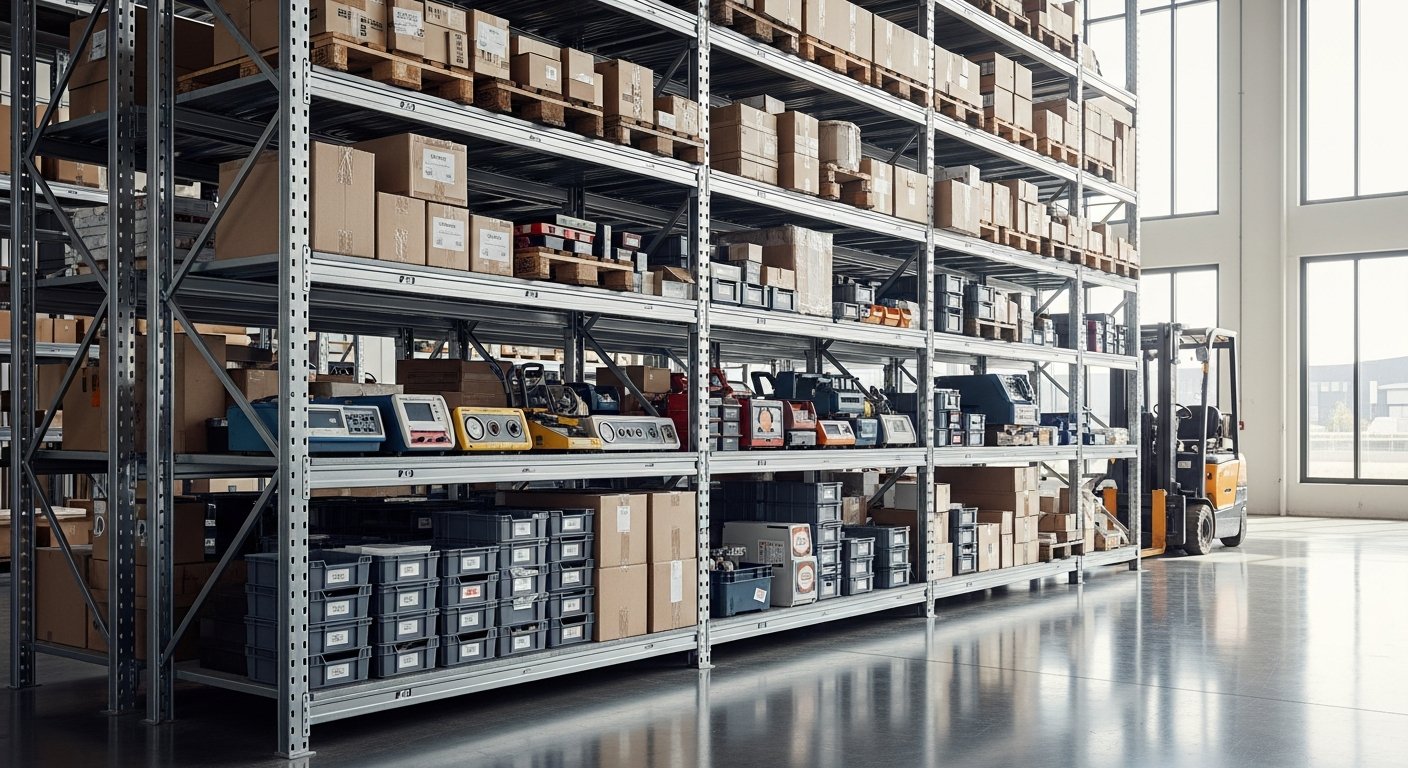
Discover how EUROKRAFTpro Heavy-Duty Industrial Shelving Units transform warehouse efficiency with 900 kg load capacity, galvanized steel construction, and a 10-year warranty. Learn which configuration suits your business needs.
Poor storage organization costs warehouses thousands of euros annually in lost productivity, with nearly 40% of warehouse inefficiencies traced directly to inadequate shelving systems. When inventory sits disorganized, workflows stall, employee time vanishes into searching and retrieving items, and safety risks multiply. The financial impact compounds quickly—a single inefficient warehouse layout can drain significant resources month after month.
The EUROKRAFTpro Heavy-Duty Industrial Shelving Unit, engineered by Kaiser Kraft ES, addresses these operational drains with precision engineering. Built from galvanized steel with a 900 kg load capacity and backed by an unparalleled 10-year warranty, this system transforms how businesses organize inventory and manage warehouse space. Explore Kaiser Kraft's complete shelving solutions to find your ideal storage system.
This guide walks through the technical specifications, real-world applications, cost-benefit analysis, and practical setup considerations for EUROKRAFTpro shelving. Whether you manage a bustling warehouse, manufacturing facility, or workshop, understanding whether this premium system aligns with your operational goals requires examining both its capabilities and your specific requirements.
Why Heavy-Duty Industrial Shelving Demands Premium Materials
Industrial environments test storage systems relentlessly. Temperature fluctuations, humidity exposure, chemical splash, and constant impact from forklifts and loading equipment create conditions that break down inferior materials quickly. Budget shelving painted with standard coatings rusts within months in these conditions, compromising structural integrity and creating safety hazards.
Galvanized Steel Construction and Corrosion Resistance in Demanding Environments
Galvanized steel provides protection through a zinc coating that acts as both a physical barrier and an electrochemical shield. When the zinc coating sustains minor scratches or damage, it actually sacrifices itself to protect the underlying steel—a process called cathodic protection. For industrial operations exposed to moisture, salt spray, or chemical residues, this self-healing property proves invaluable. EUROKRAFTpro's galvanized construction means your shelving resists rust and degradation across years of demanding use, maintaining structural reliability in harsh conditions where standard steel would deteriorate rapidly.
Load-Bearing Capacity Standards and How EUROKRAFTpro Exceeds Industry Minimums
Industrial shelving standards vary by region and application, but reliable systems must accommodate both static and dynamic loads. Static load refers to weight sitting stationary on shelves; dynamic load accounts for impact forces when items are placed or removed. EUROKRAFTpro's 900 kg distributed load capacity exceeds typical industry minimums for standard industrial applications. This generous capacity margin means the system handles unexpected overloads, shifting inventory patterns, and the wear-and-tear stresses of daily warehouse operations without flexing, bending, or failing.
Longevity Comparison: Budget Shelving Versus Premium Industrial Systems
A budget shelving unit costing 40-50% less than EUROKRAFTpro might seem economical until you calculate actual lifespan. Budget systems typically last 3-5 years before rust, bent shelves, or wobbly uprights force replacement. Replacement means disposing of the old unit, purchasing new inventory, and enduring downtime during installation. Over a 10-year period, a warehouse might cycle through 2-3 budget systems, accumulating 6,000-9,000 euros in total spending plus operational disruption. Premium systems like EUROKRAFTpro justify their higher upfront investment through superior longevity, minimal maintenance, and reliability that eliminates costly replacements.
Unpacking the Load Capacity: What 900 kg Actually Means
Load capacity numbers mean nothing without understanding how they translate to real warehouse operations. The difference between theoretical capacity and practical usability determines whether a shelving system truly serves your inventory needs or becomes a bottleneck.
Maximum Distributed Load Specifications and Safe Weight Distribution Practices
The 900 kg specification refers to the total weight that a shelving unit can safely hold when that weight distributes evenly across all shelves. If a unit has four shelves, this means approximately 225 kg per shelf under ideal conditions. However, actual safe weight per shelf is typically lower due to structural concentrations and uneven distribution patterns. Understanding your inventory patterns matters—if you consistently place heavier items on specific shelves rather than distributing weight evenly, you're working with lower practical capacity than the specification suggests. Safe warehousing practice means calculating your average item weight, multiplying by the number of items per shelf, and maintaining a safety margin of at least 20% below maximum rated capacity.
Individual Shelf Capacity (125 kg Per Shelf) and Practical Storage Scenarios
EUROKRAFTpro shelves are rated for approximately 125 kg individual shelf capacity when weight concentrates on a single shelf. This capacity accommodates numerous real-world scenarios: automotive parts storage where individual components weigh 5-15 kg each, allowing 8-25 items per shelf; small component bins where you might stack 30-40 containers; or heavy tools and equipment in workshop settings. For warehouses storing smaller, lighter items like packaging materials, textiles, or office supplies, the 125 kg per-shelf capacity provides substantial flexibility for organizing thousands of individual units across a single shelving system.
How Load Capacity Translates to Inventory Density and Space Optimization
Higher load capacity enables greater inventory density—storing more items in less floor space. A system with genuine 125 kg per-shelf rating allows warehouse managers to stack items to near-shelf capacity, maximizing vertical space utilization. This vertical stacking reduces floor space footprint, which directly lowers real estate costs, improves traffic flow, and makes aisle navigation safer. For a typical 50-square-meter warehouse, replacing budget shelving with premium high-capacity systems can increase usable storage by 30-40%, equivalent to renting an additional 15-20 square meters of warehouse space annually.
Customization & Modular Design: Building Your Perfect Configuration
Off-the-shelf shelving solutions rarely fit facilities perfectly. Standard dimensions work for textbook warehouses but create awkward gaps or wasted space in real buildings with irregular layouts, columns, or sloped areas. Modular shelving with genuine customization flexibility transforms unusable spaces into functional storage.
Browse Kaiser Kraft's customizable shelving options to maximize your facility layout.
Adjustable Shelf Heights and How Flexibility Adapts to Changing Inventory Needs
EUROKRAFTpro shelving features adjustable shelf positions, allowing you to modify spacing between shelves after installation. This flexibility proves invaluable as inventory needs shift—storage requirements for seasonal products differ from core year-round items. A warehouse stocking bulky seasonal goods might need wide shelf spacing in Q4, then reconfigure shelves closer together in Q1 when storing smaller components. Adjustability means you optimize configurations without purchasing new shelving, adapting to business cycles and inventory changes that inevitably occur across business operations.
Multiple Dimension Options (Heights, Depths, Widths) for Non-Standard Spaces
Standard shelving comes in fixed heights (typically 180-200 cm), depths (40-50 cm), and widths (100-150 cm). Facilities with ceiling height constraints, unusual alcoves, or specific workflow patterns require non-standard dimensions. EUROKRAFTpro offers configuration flexibility—shorter units for ceiling-restricted spaces, varying depths to fit narrow aisles, and width options matching your layout requirements. Rather than forcing square-peg items into round-hole standard dimensions, custom configurations maximize your actual usable space, eliminating dead zones and creating efficient storage footprints tailored to your facility's geometry.
Modular Expansion Capabilities for Growing Warehouses and Seasonal Demands
Business growth shouldn't force complete system replacement. EUROKRAFTpro's modular design allows you to purchase additional shelving units and connect them seamlessly to existing systems, expanding storage capacity incrementally as inventory grows. Manufacturing operations with seasonal demand swings can add temporary shelving units during peak periods, then remove them when demand normalizes. This scalability means your storage investment grows with your business rather than requiring expensive overhauls when operational needs change.
Assembly & Installation: From Unboxing to Full Operation
Shelving arrives in boxes, but transforming components into operational storage requires assembly. The difference between simple plug-together systems and complex bolt-and-weld constructions dramatically affects setup time, required skills, and total implementation costs.
Plug-in Assembly System and Why It Eliminates Specialized Tooling Requirements
EUROKRAFTpro's plug-in assembly design means shelf heights adjust by moving shelves up or down on pre-drilled uprights—no bolts, no welding, no specialized tools required. Standard setup involves unpacking components, connecting upright frames, and clicking shelves into position. This straightforward process eliminates the need for industrial welders, specialized fastening tools, or technical expertise. Warehouse staff with basic mechanical capability can handle assembly, or you can complete setup quickly with minimal assistance, avoiding expensive specialized labor costs that some industrial shelving systems demand.
Estimated Setup Time for Standard Versus Complex Configurations
A single standard EUROKRAFTpro unit (approximately 100 cm wide, 180 cm tall, 50 cm deep with four shelves) typically requires 20-30 minutes for one person to assemble. Large configurations or multiple interconnected units proportionally increase setup time—a warehouse-wide installation might require 4-6 hours with two people. However, the absence of specialized tools and complex fastening means setup remains feasible for warehouse staff, avoiding the need to contract external specialists. Time investment stays reasonable even for substantial installations, reducing both direct labor costs and operational disruption.
When Professional Installation Becomes Necessary and Associated Costs
Professional installation becomes valuable in specific scenarios: very large systems requiring precise leveling and alignment across multiple units, locations with electrical considerations or overhead constraints, or facilities wanting certified installation with guaranteed structural integrity verification. Kaiser Kraft ES and authorized installation partners offer professional setup services, typically costing 150-300 euros per unit depending on complexity and location. For straightforward implementations in standard warehouse spaces, DIY assembly with warehouse staff proves cost-effective; for complex configurations or facilities with specific safety requirements, professional installation provides peace of mind and eliminates assembly liability.
Industry Applications: Where EUROKRAFTpro Shelving Truly Excels
Different industries place distinct demands on storage systems. Understanding how EUROKRAFTpro performs across various applications reveals whether it matches your specific operational requirements.
Warehouse Management and High-Volume Inventory Storage Scenarios
Warehouses thrive on density and organization—storing maximum inventory in minimum floor space while maintaining quick access and accurate inventory tracking. EUROKRAFTpro's 900 kg capacity, adjustable configurations, and modular design make it ideal for warehouses managing diverse SKU (stock-keeping unit) counts. Whether storing e-commerce inventory, wholesale goods, or distribution center stock, the system accommodates varying item sizes and weights while supporting organized bin systems that enable efficient picking operations. The durability and 10-year warranty reduce replacement costs that would normally drain warehouse budgets focused on inventory and logistics expenses.
Manufacturing Facilities and Component Organization for Production Lines
Manufacturing operations require organized component storage that supports production line efficiency. Raw materials, subassemblies, and finished inventory need systematic organization enabling quick location and retrieval. EUROKRAFTpro's customizable dimensions accommodate component-specific storage needs—smaller shelves for precision parts, wider spacing for bulky subassemblies. The robust construction withstands the vibration, forklift traffic, and environmental conditions typical in manufacturing spaces. Load capacity supports inventory buffers that prevent production line stalls due to parts shortages, while organized storage reduces production floor clutter that creates safety hazards.
Automotive and Mechanical Workshops Requiring Organized Tool and Parts Storage
Workshop environments combine tool storage, parts inventory, and equipment organization in space-constrained facilities. EUROKRAFTpro's flexibility handles the diversity of workshop storage needs—shelves for small hand tools, deeper shelves for power tools, component bins for automotive parts and mechanical supplies. Galvanized steel construction resists the corrosive shop environment (oils, solvents, humidity) where standard shelving deteriorates quickly. Mechanics and technicians working in organized spaces reduce time searching for tools, lowering labor costs and improving job throughput. The safety improvements from organized storage reducing tripping hazards and falling tool risks contribute additional value beyond pure organizational benefits.
The 10-Year Warranty: What Protection Actually Covers
Warranty language often obscures what manufacturers actually guarantee versus what they exclude. Understanding coverage details prevents surprises when issues arise and reveals the manufacturer's confidence in product durability.
Extended Warranty Scope and What's Included Versus Excluded
EUROKRAFTpro's 10-year warranty covers manufacturing defects and structural failures stemming from material or workmanship deficiencies. This means if shelves bend under normal use despite proper load distribution, uprights crack from material weakness, or welds fail prematurely, Kaiser Kraft covers repair or replacement costs. The warranty specifically protects against defects within manufacturer control—using inferior steel, poor welds, or substandard fastening. Excluded from coverage are damage from misuse (overloading beyond specifications), environmental factors beyond normal industrial conditions (extreme heat exposure, chemical attack beyond corrosion resistance), or wear from normal use. Understanding these boundaries means realistic expectations—the warranty protects against manufacturing failures, not consequences of improper operation or extraordinary environmental exposure.
Manufacturing Defects and Structural Integrity Guarantees
The 10-year span demonstrates Kaiser Kraft's confidence in manufacturing quality. Most budget shelving failures occur within 3-5 years; the extended EUROKRAFTpro coverage suggests manufacturing processes and material standards that sustain functionality across a decade. Structural guarantees mean if uprights don't maintain vertical alignment, welds don't separate under specified loads, or shelves don't remain flat under proper distributed weight, the manufacturer provides replacement components or full system replacement. This protection eliminates the financial uncertainty surrounding shelf durability—you're purchasing not just shelving, but confidence that the system will perform reliably for 10 years.
Rust and Corrosion Coverage Under Normal Operational Conditions
Galvanized steel's corrosion resistance forms part of the structural guarantee. Under normal industrial operational conditions (standard temperature ranges, typical humidity, normal warehouse environments), EUROKRAFTpro shelving should resist rust formation that compromises structural integrity. The warranty covers rust failures stemming from manufacturing defects in galvanizing application rather than inevitable corrosion from extraordinary exposure. This distinction matters—a warehouse in a coastal location with salt-air exposure or an agricultural facility with chemical spray exposure faces conditions beyond "normal industrial," potentially voiding corrosion-specific coverage. Standard warehouse, workshop, and manufacturing environments typically fall within "normal operational conditions," providing genuine corrosion protection under warranty.
Cost Analysis: Is the Premium Price Justified?
Premium pricing demands justification. The EUROKRAFTpro system costs more initially than budget alternatives, but comparing upfront price alone ignores total cost of ownership across the product's lifespan.
Mid-to-High Price Positioning and Market Context
EUROKRAFTpro shelving units are priced around 961.01 euros for robust configurations, positioning them in the mid-to-high range for industrial shelving. Budget systems cost 500-600 euros, while entry-level commercial shelving starts around 300-400 euros. This 60-90% price premium reflects superior materials, engineering quality, galvanized construction, and extended warranty. The higher entry cost creates natural hesitation, but context reveals whether premium pricing aligns with actual value delivery.
Total Cost of Ownership Over 10 Years Versus Budget Alternatives
Calculate ownership cost spanning a decade. A warehouse purchasing three budget shelving units over 10 years (replacing them every 3-4 years) invests 1,500-1,800 euros plus replacement labor costs and downtime. A single EUROKRAFTpro unit costing 961.01 euros requires no replacement, minimal maintenance, and no setup disruption. Over 10 years, the premium system costs less per year (96 euros annually) than cycling through budget alternatives (150-180 euros annually when accounting for replacement and labor). The financial advantage grows as system count increases—warehouses purchasing 10 units see cost differences exceeding 5,000-8,000 euros over a decade, plus elimination of replacement disruption costs.
Downtime Reduction and Productivity Gains Offsetting Initial Investment
Beyond direct cost comparison, organized shelving improves warehouse productivity measurably. Studies indicate that efficient shelving reduces item-location time by 20-30% compared to disorganized storage. For a warehouse with 5 full-time personnel spending 2 hours daily locating items and managing inventory (10 person-hours daily), 25% efficiency improvement equals 2.5 hours recovered daily. At 15 euros per hour labor cost, that's 37.50 euros daily saved—approximately 9,000 euros annually assuming 240 working days. Over a decade, productivity improvements alone total 90,000 euros, making initial shelving investment negligible by comparison. The financial case for premium shelving becomes compelling when accounting for workflow improvements that typically far exceed the equipment cost.
Making Your Selection: Key Questions Before Purchasing
Proper purchasing preparation prevents costly mistakes. Before contacting Kaiser Kraft for quotes, assess your actual requirements against system capabilities.
Assessing Your Facility's Current Storage Challenges and Pain Points
Document existing problems before purchasing solutions. Do employees waste time searching for inventory? Are storage areas congested and disorganized? Does current shelving fail due to rust, bending, or structural issues? Are safety hazards present from falling items or unstable shelving? Identifying specific pain points prevents over-engineering solutions (purchasing overly large systems for modest needs) while ensuring adequate capacity for genuine requirements. Facility walkthroughs identifying problem areas guide sizing and configuration decisions. A warehouse struggling with component disorganization needs different shelving solutions than one primarily limited by storage density or capacity.
Calculating Required Load Capacity and Dimensional Specifications
Inventory audits reveal actual load requirements. Weigh sample batches of stored items, calculate average item weight, multiply by typical per-shelf quantities, and compare against rated capacity with a 20% safety margin. Measure facility dimensions—ceiling height, available floor space, aisle widths, obstacles like columns or equipment—to determine maximum shelving dimensions. Calculate the total cubic volume of inventory requiring storage, then determine shelving configurations meeting that volume while fitting facility constraints. Specifications emerging from this analysis guide configuration quotes and prevent purchasing systems that don't actually fit your facility or don't support your actual inventory loads.
Projecting Future Growth and Expansion Needs
Shelving purchased today should accommodate growth 3-5 years forward. If your business is growing 15% annually, shelving meeting today's capacity becomes undersized within two years. Modular systems like EUROKRAFTpro allow expansion through additional units, accommodating growth without complete replacement. Consider whether your facility has physical space for additional shelving units, or whether growth will require either expanded facilities or higher-density storage. Growth projections justify premium systems with expansion capabilities—inferior systems lacking modular flexibility force replacement rather than expansion as business grows, negating any initial cost savings.
Making the Right Storage Investment for Your Business
The EUROKRAFTpro Heavy-Duty Industrial Shelving Unit represents strategic investment directly impacting warehouse efficiency, operational safety, and financial performance. With genuine 900 kg load capacity, galvanized steel durability, and comprehensive 10-year warranty protection, this system directly addresses the productivity drains plaguing industrial operations lacking proper storage infrastructure.
The modular design means your shelving grows alongside your business—expand capacity through additional units rather than scrapping entire systems when inventory demands increase. When calculating total cost of ownership, factor in avoided replacement expenses (budget shelving cycles every 3-5 years), productivity gains from organized inventory, and labor savings from efficient item location. These benefits accumulate to thousands of euros annually, making the premium initial investment economically sensible compared to cheaper alternatives creating ongoing operational drag.
Begin implementation by auditing current storage challenges—document pain points, time wastage, and safety concerns. Calculate actual inventory load requirements based on item weights and storage density needs. Measure facility dimensions and identify space constraints. Project growth needs 3-5 years forward to ensure adequate capacity expansion room. With this analysis completed, contact Kaiser Kraft ES with your facility specifications and current inventory challenges to receive customized configuration recommendations and pricing. Start your warehouse transformation with Kaiser Kraft's premium industrial shelving systems today.