
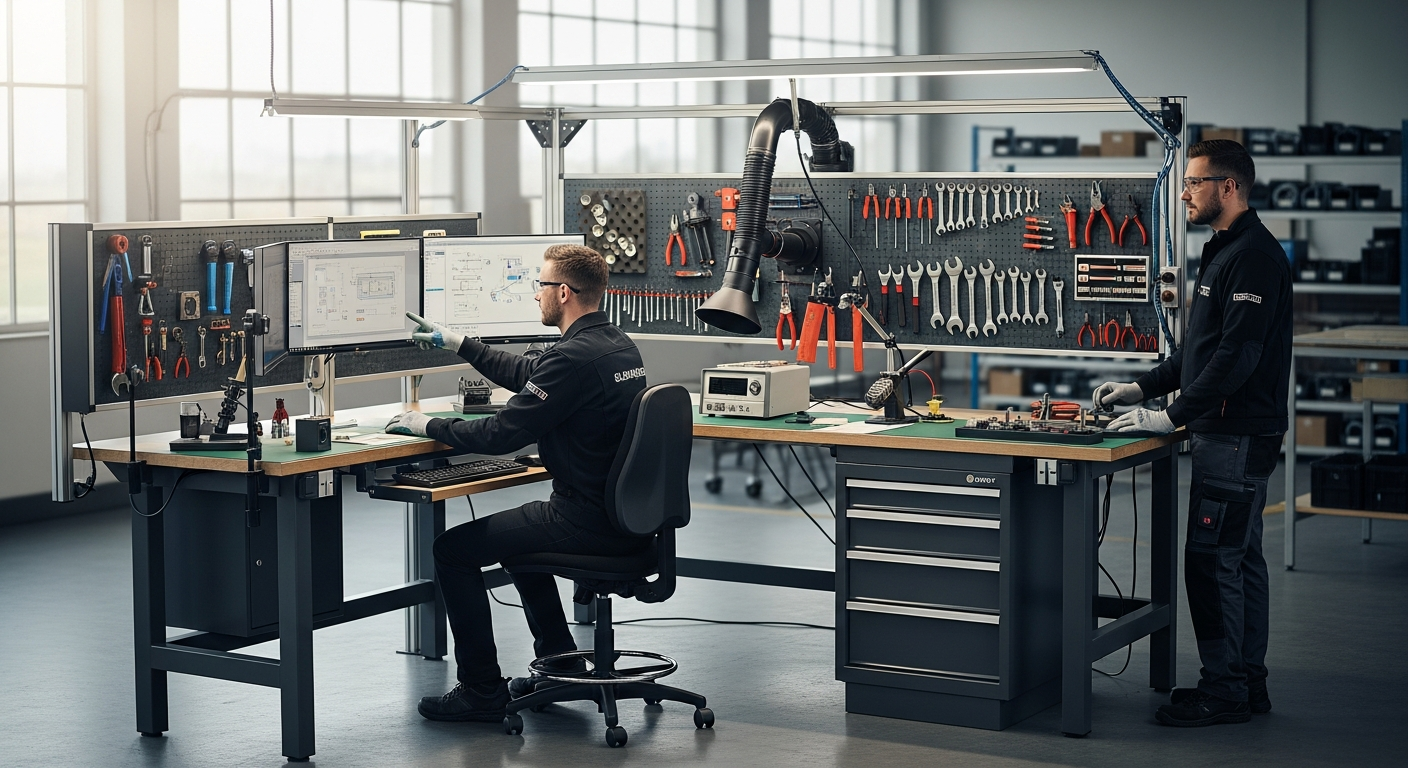
Discover how the Eurokraft Pro Industrial Workbench System powers collaborative manufacturing spaces with modular design, integrated power solutions, and ergonomic flexibility for team-based production workflows.
Manufacturing teams lose an estimated 15-20% of productivity when workstations lack proper organization, power access, and ergonomic support. This performance gap isn't inevitable—it's a direct consequence of workspace design decisions that fail to account for the realities of collaborative production environments. When workers struggle with tangled extension cords, shared tool zones, and poorly positioned equipment, the cumulative friction compounds across shifts.
The Eurokraft Pro Industrial Workbench System represents a fundamental shift in how modern manufacturers approach collaborative workspace design. Built by Kaiser Kraft ES, a leading B2B supplier of equipment for factories, warehouses, and offices, these workbenches combine heavy-duty construction with intelligent modularity. They're engineered specifically for environments where multiple team members work simultaneously, addressing the organizational and infrastructure challenges that drain productivity.
From Individual Workstations to Integrated Production Lines: The Group Workbench Advantage
Connecting Multiple Stations Into a Unified Workspace Ecosystem
Group workbench configurations fundamentally change how production teams interact with their physical environment. Rather than isolated stations scattered across a workshop floor, group workbenches create a connected ecosystem where adjacent work surfaces operate as a coordinated system. This architectural approach eliminates the "dead zones" between individual workstations where tools get lost, information gets misplaced, and communication breaks down.
When stations are integrated rather than separated, team members maintain visual contact with neighboring workers, reducing the need for verbal communication and enabling faster problem-solving. A machinist working at one end of a group workbench can immediately assist a colleague two meters away without leaving their station or calling across a cluttered floor.
Integrated Power Infrastructure: 400V and 230V Sockets Eliminate Extension Cord Chaos
One of the most underestimated sources of workplace inefficiency is the extension cord problem. A typical workshop littered with multiple power cables creates genuine hazards—tripping risks, electrical overloads, and equipment damage from overtaxed circuits. Advanced Eurokraft Pro group workbenches integrate power blocks directly into the structure, with 400V industrial sockets and 230V standard outlets positioned strategically across the work surface.
This integrated approach eliminates the need for daisy-chained extension cords running across floors and workstations. Every tool that requires power has immediate access through dedicated sockets, reducing setup time and creating a cleaner, safer working environment. The result is faster equipment changeover and fewer delays waiting for someone to reroute power connections.
Compressed Air Coupling Integration for Pneumatic Operations
Pneumatic tools remain essential across manufacturing, assembly, and maintenance operations. Traditional setups require compressed air lines running overhead or along baseboards, creating clutter and potential snag hazards. When workbenches integrate compressed air couplings directly into their structure, pneumatic tools connect instantly without requiring technicians to locate and attach hose adapters.
This integration means a team member operating a pneumatic nailer, grinder, or impact tool can switch between different pneumatic devices in seconds. The efficiency gain compounds across a full shift—reduced tool changeover time directly translates to more time actually producing work rather than managing logistics.
Synchronized Height Adjustment for Teams With Varying Physical Requirements
Workshop teams include individuals with different physical needs. A 1.95-meter tall assembly technician has different ergonomic requirements than a 1.60-meter colleague. Rather than accepting workbench heights that compromise comfort for some team members, Eurokraft Pro systems offer integrated height adjustment capabilities that synchronize across connected stations.
When multiple team members work adjacent to one another, synchronized height adjustment ensures the work surface accommodates everyone comfortably. This isn't a luxury feature—it's an injury prevention mechanism. Proper workbench height reduces back strain, shoulder fatigue, and repetitive stress injuries, directly impacting worker satisfaction and long-term retention.
Modular Expansion Strategies: Starting Small and Scaling as Demands Increase
Budget constraints often force manufacturers to build their workshop infrastructure incrementally. The Eurokraft Pro system accommodates this reality through genuine modular design. A small operation might begin with a single two-station workbench. As production volumes increase and the business adds staff, additional modules connect seamlessly to the existing setup.
This scalability means the initial investment doesn't lock you into a fixed configuration. Your workshop grows with your business, with each expansion adding integrated power, compressed air, and synchronized adjustment capabilities rather than bolting on incompatible aftermarket solutions.
Engineered Stability Under Pressure: Supporting Heavy-Duty Multi-User Operations
Steel Frame Architecture for Distributed Loads Across Multiple Workstations
The Eurokraft Pro system's structural foundation relies on heavy-duty steel frames engineered specifically for multi-user environments. Rather than featuring simple four-leg designs suitable for individual workstations, group configurations employ sophisticated bracing systems with upper and lower depth braces that distribute load across the entire structure.
These frames use high-quality steel tubing—typically 45 x 45 x 2 mm or C-profile steel 70 x 50 x 2 mm—designed to withstand static distributed loads reaching 4500 kg. This capacity means the workbench remains stable even when multiple team members place substantial pressure on different sections simultaneously. During an intensive assembly operation involving several workers pressing parts together, drilling, and applying force in different directions, the frame maintains structural integrity without deflection or wobbling.
Torsional Rigidity and Upper/Lower Depth Bracing
Torsional forces—the twisting stresses that develop when different parts of a workbench experience opposing pressures—represent a unique challenge in group configurations. When one team member applies downward pressure at one end of a long work surface while another applies lateral force at the opposite end, the structure experiences torsional stress that can cause subtle misalignment over time.
Upper and lower depth braces resist these twisting forces, maintaining precise alignment of the work surface. This engineering detail becomes critical when the workbench supports precision operations requiring consistent surface flatness. A workbench that twists or warps compromises accuracy across all simultaneous operations.
How Stability Directly Impacts Worker Confidence, Safety, and Precision
An unstable workbench creates persistent worker anxiety. Team members unconsciously compensate for movement by tightening their grip, adjusting their posture, and focusing attention on stability rather than the actual work task. This divided attention reduces precision, increases fatigue, and elevates injury risk.
Conversely, a rock-solid workbench allows workers to focus entirely on their operation. A machinist working with precision tolerances can concentrate on tool positioning rather than worrying about surface movement. An assembler can work with consistent pressure knowing the structure won't shift unexpectedly. This psychological confidence translates directly into better work quality and safer operations.
Long-Term Durability Advantages: Why Industrial-Grade Construction Justifies Initial Investment
The initial cost of an Eurokraft Pro group workbench exceeds basic commercial alternatives—significantly so. This price differential reflects engineering choices that extend the product's operational lifespan by years or decades compared to consumer-grade equipment.
Industrial-grade steel construction resists corrosion and fatigue-related failure. The 40 mm thick solid beech worktop, treated with environmentally friendly varnished linseed oil, withstands abrasion, impact, and the chemical exposure typical in manufacturing environments. A workbench that remains functional and accurate for 15-20 years costs substantially less per year of operation than a budget alternative requiring replacement every 5-7 years.
Organized Chaos Management: Storage and Tool Accessibility for Team Workflows
Perforated Panel Systems for Personalized Tool Zones
In a multi-user environment, tool organization presents a genuine challenge. Shared tool racks force workers to search for specific items, creating bottlenecks when multiple team members need the same equipment simultaneously. Perforated panel systems integrated into Eurokraft Pro workbenches solve this by allowing each team member to customize their immediate tool zone.
A welder might position their most-used electrodes, cleaning brushes, and angle grinders at arm's reach on their dedicated panel section. An adjacent technician might organize diagnostic equipment, testing probes, and measuring instruments in a completely different configuration on their portion of the same workbench. This personalization eliminates the "where's the saw?" delays that interrupt workflow.
Roller-Bearing Partial Extension Drawers With 100 kg Load Capacity
Storage beneath the work surface must accommodate heavy tools and materials without compromising access. Standard drawers with limited extension force workers into awkward reaching positions to access items at the back. Roller-bearing partial extension drawers featuring 90% extension and self-closing mechanisms solve this problem.
With 100 kg load capacity per drawer and anti-rollback devices preventing accidental full-extension collapse, these drawers accommodate substantive inventory without safety compromise. A team member can access a heavy power tool stored at the back of a drawer by simply pulling—the roller bearing system handles the weight while the self-closing mechanism ensures the drawer doesn't remain open, creating a tripping hazard during shift work.
Strategic Drawer Placement for Reducing Reach Time and Minimizing Worker Fatigue
Ergonomic efficiency depends on tool placement following the frequency-of-use principle: most-used items positioned closest to the work surface, less-frequent items stored further away. Strategic drawer placement implements this principle across group workbenches.
Daily-use hand tools occupy drawers immediately below the work surface at each station. Specialized equipment used weekly occupies lower drawers requiring more substantial reaching. Rarely-used items get stored in the least-accessible locations. This hierarchy reduces average reach distance across a full shift, measurably decreasing shoulder fatigue and repetitive stress injuries.
Modular Accessory Mounting Solutions That Evolve as Production Processes Change
Manufacturing processes evolve. A workbench designed for one production sequence often requires reconfiguration when processes change or new products enter the lineup. Modular accessory mounting systems on Eurokraft Pro workbenches accommodate this evolution without requiring structural modifications.
Tool holders, guide rails, clamps, and accessory supports attach and detach from perforated panels without permanent modification. When a production run ends and a new operation begins, the workbench reconfigures within hours rather than requiring expensive structural changes.
Moving Forward: Transforming Your Workshop Into a High-Performance Operation
The decision to upgrade your workshop infrastructure extends far beyond purchasing furniture—it's about creating an environment where your team can operate at peak efficiency. The Eurokraft Pro Industrial Workbench System addresses the specific challenges of multi-station manufacturing through integrated power infrastructure, modular scalability, ergonomic flexibility, and sustainable construction.
Whether managing a small assembly operation or coordinating a complex production line, the ability to customize and adapt your workstations directly impacts competitive positioning. Integrated 400V and 230V power eliminates safety hazards while reducing setup time. Synchronized height adjustment accommodates your entire team's physical requirements. Heavy-duty steel construction with 4500 kg load capacity ensures stability under the most demanding conditions. Strategic storage systems position tools where workers need them, reducing reach time and fatigue.
The initial investment pays dividends through reduced downtime, fewer accidents, improved worker satisfaction, and measurable productivity gains. Most critically, a well-designed group workbench creates the foundation for coordination and communication that transforms a collection of individual workers into a cohesive production team.
Your next step is straightforward: assess your current workspace constraints, identify which Eurokraft Pro configurations align with your production workflow, and determine where integrated power infrastructure and modular storage would eliminate your biggest operational friction points. Contact Kaiser Kraft ES today for a consultation on designing the group workbench configuration that transforms your workshop into a high-performance operation.