
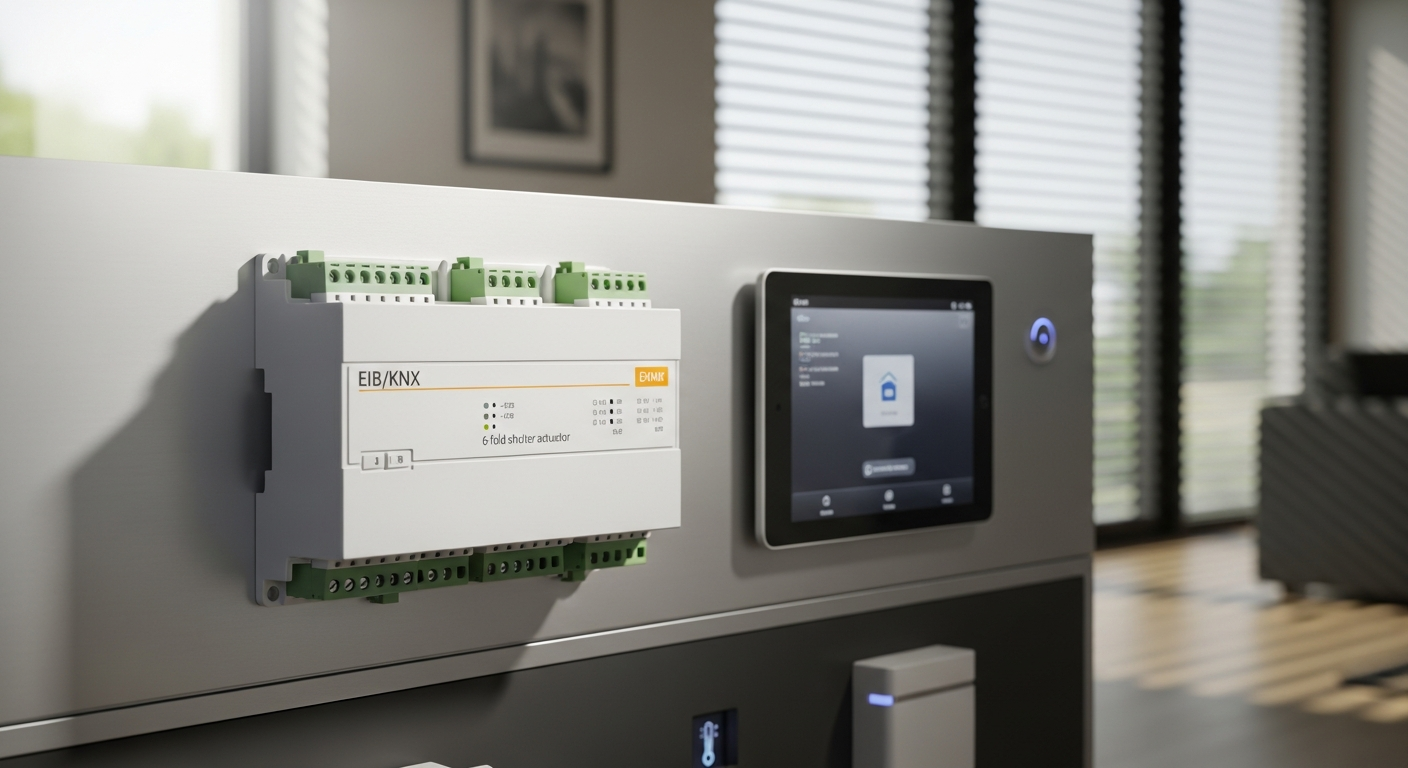
Discover how the EIB/KNX Shutter/Blind Actuator 6-fold delivers intelligent, automated shading control for commercial properties. Learn about weather-responsive automation, energy savings, and seamless KNX integration.
Commercial buildings waste an estimated 20-30% of their heating and cooling energy through poor window shading management. This efficiency gap represents a massive opportunity for property managers willing to modernize their approach. The EIB/KNX Shutter/Blind Actuator 6-fold addresses this challenge head-on, orchestrating up to six independent blinds or shutters with precision that manual control could never achieve.
The shift toward intelligent building automation isn't optional anymore—it's becoming essential for competitive facilities. Tenants expect responsive environments, regulators demand sustainability compliance, and operational budgets continue tightening. A single device capable of managing multiple shading zones efficiently can transform how a building performs.
This article examines the technical capabilities, commercial advantages, and real-world impact of the 6-fold actuator system. Discover how intelligent shutter automation can reduce your building's energy costs and improve occupant satisfaction.
Why Commercial Properties Are Switching to Intelligent Shutter Automation
Building operators face mounting pressure from multiple directions simultaneously. Energy efficiency regulations tighten each year, sustainability targets become mandatory rather than aspirational, and operational budgets face constant scrutiny. Manual shading management no longer cuts it.
The competitive real estate market amplifies these pressures. Tenants in modern office spaces expect responsive building systems that adapt automatically to changing conditions. A facility that can't maintain comfort without constant manual intervention loses appeal against properties featuring intelligent automation. This tenant preference translates directly into lease rates and occupancy levels.
The integration advantage matters significantly. Modern buildings rarely operate with isolated systems. A shutter actuator that communicates seamlessly with existing building management systems, HVAC controls, and occupancy monitoring creates a unified ecosystem rather than a collection of disconnected devices. This integration reduces operational complexity and unlocks efficiency gains impossible with standalone equipment.
The financial case strengthens further when considering risk mitigation. Automated response to extreme weather events—sudden wind gusts, intense solar radiation, or unexpected storms—protects both building integrity and occupant safety while reducing reactive maintenance costs. The ROI potential becomes apparent when energy consumption drops measurably and HVAC systems operate with reduced strain.
Understanding the 6-Fold Architecture and Its Commercial Advantages
The architecture of the 6-fold actuator reflects practical engineering focused on commercial realities. Managing six independent shutter circuits from a single device eliminates the need for multiple actuators, each requiring separate installation, configuration, and maintenance. This consolidation reduces overall system complexity significantly.
The compact DIN rail installation deserves specific attention. Electrical cabinets in commercial buildings represent expensive real estate. A device occupying only six modular spacings versus multiple single-channel actuators each taking separate space streamlines installation and reduces cabinet overcrowding. Facility managers appreciate solutions that work within existing infrastructure constraints.
Scalability becomes straightforward with this modular approach. Large buildings with multiple facade orientations can deploy multiple 6-fold units as needed, maintaining configuration consistency while avoiding unnecessary complexity. A retail complex with north, south, east, and west-facing sections can organize shutter control logically without system sprawl.
The cost-effectiveness argument proves compelling. Consolidating six control functions into one certified unit costs substantially less than purchasing, installing, and configuring six individual actuators. This financial advantage applies not only to equipment costs but also to labor, testing, and ongoing maintenance.
Weather-Responsive Automation That Protects and Saves
Six integrated weather alarm functions represent the intelligence layer that transforms a basic actuator into a strategic building asset. These functions process real-time environmental data continuously, triggering blind adjustments before problems develop.
Consider summer heat management. As solar radiation intensity increases, the system automatically adjusts blinds to minimize heat gain, reducing cooling loads significantly. During winter months, the same system can open blinds to capture passive solar warmth when outdoor temperatures are low but solar radiation is available. This seasonal responsiveness generates measurable energy savings year-round.
Wind speed monitoring provides critical protection. Excessive wind speeds can damage blinds or shutters, create noise, or compromise building security. The system responds automatically to high-wind conditions, closing shutters to protect equipment and occupants. This automated response occurs faster than manual intervention could achieve and eliminates dependency on staff awareness.
Integration with external sensors creates a comprehensive environmental awareness system. Temperature sensors, humidity monitors, and solar radiation detectors feed data continuously into the actuator's processing capability. Facility managers can configure threshold settings specific to each building zone and facade orientation, recognizing that a south-facing wall has fundamentally different shading requirements than a north-facing section.
Storm and high-wind protocols ensure enhanced occupant safety. When weather monitoring detects dangerous conditions, the system can execute coordinated blind closure across affected zones automatically, protecting windows and reducing internal damage risk from flying debris impact.
Advanced Parameterization for Precision Control
The parameterization capabilities distinguish this actuator from basic alternatives. Different shutter types require different control approaches—roller shutters, venetian blinds, and awnings each have unique runtime characteristics and speed requirements. The extensive runtime configuration allows facility managers to tailor control parameters precisely to the equipment in place.
Slat positioning control adds another dimension of sophistication. Beyond simple open/closed operation, the system can optimize daylighting while maintaining privacy. During morning hours, blinds might position at angles that admit sunlight while blocking direct sightlines into office spaces. This precision reduces artificial lighting requirements while preserving occupant comfort.
Scene creation enables coordinated multi-zone operations. A "morning scene" might gradually open blinds on southern exposures while maintaining partial closure on western walls. A "noon scene" could adjust all blinds for optimal solar heat gain or minimization depending on season. An "evening scene" might close blinds systematically as occupancy patterns wind down. These coordinated sequences execute automatically according to schedules or sensor triggers.
Lock functions prevent unauthorized manual overrides during automated operations. When the system is executing weather-responsive adjustments or scheduled scenes, staff cannot accidentally interfere by manually operating blind controls. This protection maintains system integrity and prevents conflicts between automated and manual commands.
Position feedback mechanisms provide continuous system verification. Whether configured in 1-bit format (simple position confirmation) or 1-byte format (detailed position reporting), the actuator confirms that blinds have reached commanded positions and alerts operators to any discrepancies indicating mechanical issues.
The six independent measurement functions process sensor data in multiple formats, from basic 1-bit signals up to 2-byte exponential calculations. This flexibility allows integration of diverse sensor types throughout the building, creating a rich data environment for intelligent decision-making.
KNX Integration and ETS Commissioning Simplified
KNX certification ensures compatibility with the most established building automation standard in Europe and increasingly worldwide. This standardization matters because it guarantees that the actuator will function reliably within existing infrastructures and remain supported as standards evolve.
The actuator's compatibility with ETS3, ETS4, ETS5, and newer engineering platforms spans multiple technology generations. Building managers implementing new systems don't need to worry about rapid obsolescence. Teams that have invested in specific ETS platforms can configure this device immediately without software upgrades.
Freely available product databases eliminate commissioning barriers. Rather than hunting for proprietary configuration files or depending on vendor technical support, facility managers can import device profiles directly into their engineering platform. This transparency accelerates deployment and empowers in-house teams to manage configurations.
The seamless communication within existing KNX infrastructure means this actuator functions as part of a unified ecosystem. Building management systems, HVAC controls, lighting systems, and security networks can all exchange information through KNX protocols. A fire alarm trigger can automatically close shutters. An occupancy sensor can adjust blinds. A time-of-use tariff signal from the electrical grid can optimize shutter positioning for energy cost reduction.
Support for complex automation scenarios and cross-building coordination addresses the needs of large commercial operations. Multi-building facilities, retail chains, or corporate campuses can implement consistent shutter management strategies across properties while maintaining local flexibility for site-specific conditions.
Real-World Performance in Commercial Environments
European commercial installations provide substantial performance evidence. Office buildings deploying 6-fold actuators across multiple facades report measurable reductions in HVAC energy consumption—typically in the range that justifies the initial investment within 3-5 years depending on climate and existing baseline efficiency.
Mixed-use developments with diverse shading requirements showcase the actuator's versatility. Buildings combining office spaces, retail sections, and residential units need shading systems that respect different operational requirements and occupant preferences. The 6-fold architecture handles these variations efficiently, managing retail storefronts that need specific lighting for merchandise display alongside office areas requiring different lighting and privacy balance.
Facilities managing 50+ shutter zones demonstrate that scalability works as designed. Large properties deploying multiple 6-fold units maintain consistent performance and reliability without system stability issues. Configuration management remains straightforward even with dozens of coordinated devices.
Tenant feedback emphasizes comfort improvements. Building occupants appreciate responsive shading systems that maintain comfortable light levels and temperatures without requiring manual adjustments. This responsiveness reduces complaints to facility management and improves perceived building quality.
Reliability data from established installations confirms long-term durability. KNX components engineered and certified to industry standards demonstrate service lifespans exceeding 10-15 years in typical commercial environments. This longevity supports strong ROI calculations.
Installation Considerations for Facility Managers
The actuator operates on standard 230V power, a voltage available in virtually all commercial electrical systems. This compatibility simplifies installation logistics—no specialized electrical work is required to supply power.
Space planning within distribution boards requires attention but remains straightforward. The six modular spacing requirement fits standard DIN rail configurations. Facility managers should verify cabinet capacity before committing to installation, but most modern commercial buildings accommodate the requirement without difficulty.
Professional commissioning versus in-house configuration options provide flexibility. Organizations with experienced KNX technicians can handle configuration internally once equipment is installed. Smaller organizations or those new to KNX systems benefit from partnering with certified installers who handle commissioning efficiently.
Training requirements for building operations staff matter for long-term success. While the actuator operates autonomously once configured, staff managing the building need to understand basic operational concepts. Training typically requires a few hours for operations personnel to grasp scene management, sensor integration, and emergency override procedures.
Installation timeline depends on existing infrastructure conditions. New buildings being commissioned benefit from planned integration. Retrofit installations in existing buildings may require coordination with ongoing operations. Typical downtime during installation remains minimal—the system doesn't require building-wide shutdown.
Maintenance protocols prove straightforward. The actuator itself requires no regular maintenance beyond occasional inspection. The mechanical blinds and shutters require the same maintenance they would need regardless of control method. System monitoring consists primarily of monitoring performance feedback to confirm continued operation.
Comparing Costs Against Long-Term Energy Savings
The actuator occupies a mid-to-high price positioning within the KNX component market. This pricing reflects the advanced technology, reliability engineering, and certification investments required for commercial-grade building automation equipment. While specific pricing wasn't provided in available information, comparable KNX components suggest this 6-fold actuator represents a significant but justified investment.
Comparison against single-channel actuators and legacy systems clarifies the value proposition. Deploying six single-channel actuators costs more in both equipment and installation labor than implementing one 6-fold unit managing the same zones. Legacy manual systems or simple timer-based controls generate no equipment cost but incur substantial labor costs and energy waste that overshadow the initial savings.
Annual energy cost reductions in typical commercial scenarios range from 10-20% of baseline HVAC consumption when shading automation is implemented comprehensively. For a mid-sized office building, this translates to thousands of dollars annually. Multiplied across a five-year payback period, the accumulated savings substantially exceed the initial equipment investment.
Payback period calculations for different building types yield consistent results. Office buildings with consistent occupancy patterns and significant east/west exposures see faster payback. Retail properties with lower heating/cooling intensity see longer payback periods but still achieve positive ROI within acceptable timeframes.
Hidden costs of manual management compound over years. Staff time spent adjusting blinds, responding to occupant complaints, and managing reactive maintenance adds up quickly. Automated systems eliminate these hidden labor costs while improving outcomes.
Premium pricing justified by automation capabilities and reliability becomes evident when total cost of ownership is calculated rather than focusing on initial purchase price. The equipment likely still operates effectively 15 years after installation, whereas single-channel alternatives and legacy systems typically require replacement within 10 years.
Security and Alarm Integration for Enhanced Building Protection
Coordination with fire alarm and emergency response systems ensures that shutter automation supports rather than complicates emergency procedures. When fire alarm systems activate, they can trigger coordinated blind closure to contain smoke and limit fire spread. This integration happens automatically, requiring no additional manual intervention during crisis situations.
Automated blind closure during security events or after-hours operates through integration with access control and security monitoring systems. When unauthorized access attempts are detected or when facilities transition to after-hours mode, shutters can close automatically to secure the building envelope and deter opportunistic criminal activity.
Integration with occupancy sensors creates adaptive shading that responds to actual building usage patterns. When occupancy sensors detect that office spaces are empty, the system can optimize blinds for energy efficiency rather than occupant comfort. When occupancy increases, the system returns to comfort-oriented settings automatically.
Tamper detection and unauthorized operation alerts identify when mechanical blind systems malfunction or when someone attempts manual override during automated operation. These alerts enable rapid response to mechanical problems before they escalate into safety issues or create operational disruptions.
Compliance with building codes and safety regulations becomes simpler with documented automated response protocols. Fire safety officials, building inspectors, and insurance underwriters appreciate systems with clear, documented behavioral characteristics that support rather than complicate emergency procedures.
Making the Transition: Implementation Strategy for Your Facility
Assessing current shading infrastructure and control gaps forms the foundation for any implementation project. Facility managers should document which zones currently lack automated control, which areas experience frequent comfort complaints, and where manual operations create operational burden. This assessment identifies priorities for initial deployment.
Determining optimal zones for initial automation rollout focuses investment where impact will be greatest. High-occupancy areas with significant solar exposure and documented occupant complaints become obvious candidates. These zones generate both energy savings and comfort improvements that justify initial investment and build organizational confidence in the technology.
Phased implementation approach minimizes disruption while allowing operations teams to develop expertise gradually. Rather than automating the entire facility simultaneously, rolling out control systems zone by zone enables staff training, system optimization, and performance verification without overwhelming operational capacity.
Vendor selection and partnership with certified KNX installers ensures professional execution. Organizations lacking internal KNX expertise should prioritize partners with established track records in commercial installations and clear references from comparable projects.
Staff training and change management considerations prepare operations teams for new responsibilities. Training should cover emergency override procedures, scene management concepts, and basic troubleshooting so that facilities staff can manage the system confidently.
Monitoring and optimization post-installation allows fine-tuning of parameters as actual performance data emerges. Initial configurations represent educated estimates based on standard practices. Real building performance may suggest adjustments to weather alarm thresholds, scene timing, or zone groupings that improve results further.
Your Building's Competitive Edge Starts Here
The EIB/KNX Shutter/Blind Actuator 6-fold isn't simply another piece of building automation equipment—it's a strategic investment in operational efficiency and market competitiveness. Its weather-responsive intelligence, multi-zone control, and seamless KNX integration create tangible energy savings while enhancing occupant comfort and safety. The ability to transform reactive building management into proactive, intelligent systems working continuously represents its true value.
Whether managing a sprawling office complex, a mixed-use development, or a retail property, the six-fold architecture delivers the precision control that modern commercial spaces demand. Energy bills decrease, occupant satisfaction improves, and building systems operate with minimal manual oversight. The technology exists today and has proven itself across hundreds of European installations.
The investment pays dividends through reduced utility costs, minimized maintenance demands, improved building appeal to quality tenants, and enhanced safety during emergencies. These benefits compound over the 15+ year service life of the equipment, creating compelling financial performance alongside tangible operational improvements.
Connect with a certified KNX installer today to assess your facility's shutter automation potential.