
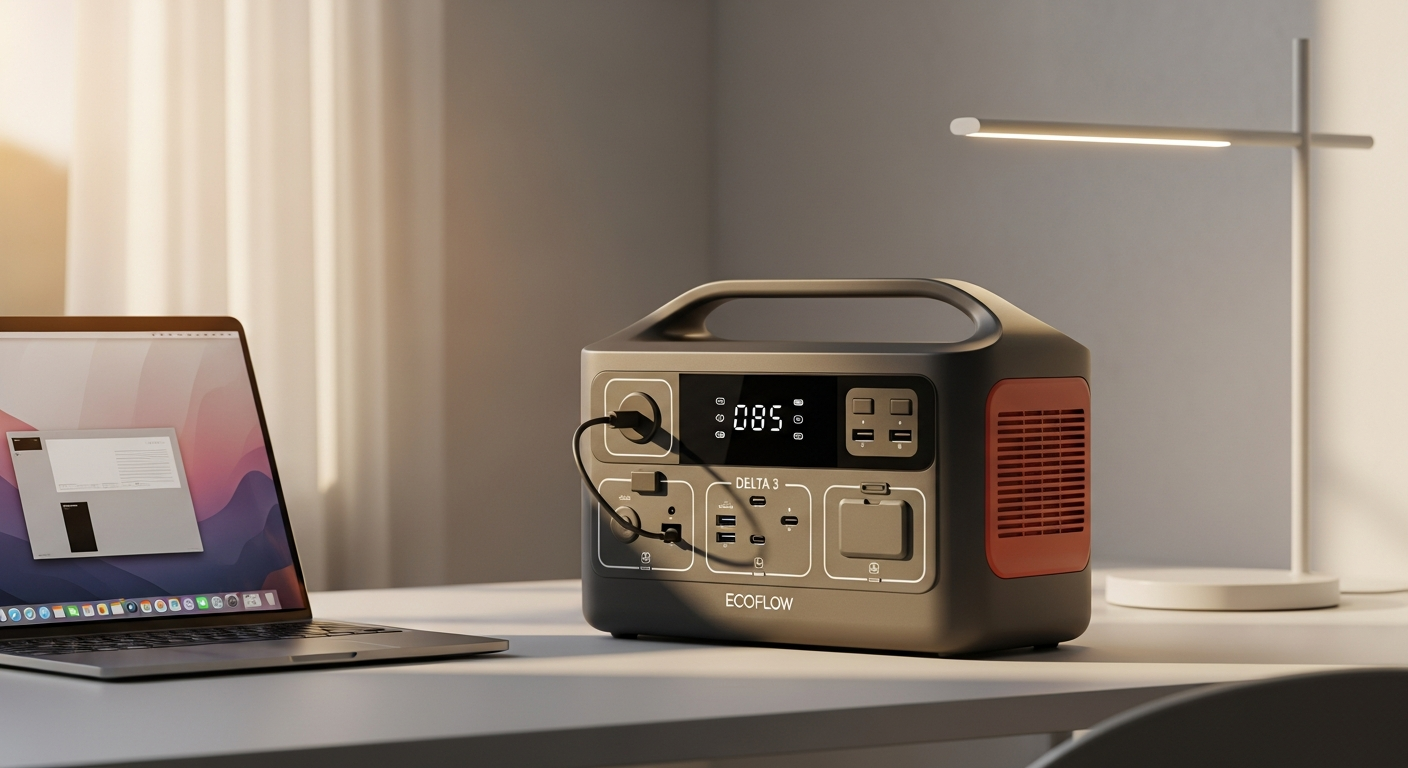
Discover why the EcoFlow DELTA 3 Classic portable power station is the top choice for home office professionals. Learn about its 10ms UPS auto-switch, 1800W AC output, and 4,000+ cycle LFP battery in our comprehensive 2026 guide.
Power outages cost remote workers an average of $1,000+ annually in lost productivity and data corruption. For anyone running a home office, a single unexpected blackout can wipe out hours of work, crash critical systems, and derail your entire day. The EcoFlow DELTA 3 Classic has emerged as the go-to portable power station for professionals who refuse to let grid failures dictate their work schedules.
Unlike generic power banks or underpowered alternatives, this 1024Wh powerhouse combines enterprise-grade UPS functionality with consumer-friendly pricing. Its engineering addresses the exact vulnerabilities that threaten remote workers: instantaneous power loss, silent data corruption on unsaved files, and the cascade of system failures that follow a blackout.
Why Home Office Professionals Choose the EcoFlow DELTA 3 Classic Over Standard UPS Systems
The critical difference between traditional UPS devices and modern portable power stations
Traditional Uninterruptible Power Supply units sit in closets, tied to wall outlets, offering nothing beyond emergency backup for a few minutes. They're reactive—passive insurance that springs to life only when power dies. Portable power stations like the DELTA 3 Classic operate on a different philosophy entirely. They're proactive infrastructure for your workspace, capable of extending runtime from minutes to hours while offering portability your desk-bound UPS never could.
The distinction matters. A traditional UPS might keep your computer running for 15 minutes while you save files and shut down gracefully. The DELTA 3 Classic runs your entire desk setup for 8+ hours, transforming an outage from a crisis into a minor inconvenience.
How the 10ms uninterruptible power supply auto-switch protects computers, NAS systems, and networking equipment from crashes
The 10-millisecond auto-switch represents the bridge between consumer convenience and enterprise-grade protection. When grid power fails, this system detects the outage and seamlessly transitions to battery power faster than your computer's power management system can register the interruption. Most computers require at least 16 milliseconds to detect a power loss—the DELTA 3 Classic switches in a fraction of that time, making the transition invisible to your hardware.
For professionals running NAS systems, external storage arrays, or network infrastructure, this responsiveness prevents file system corruption and data loss that typically occurs during abrupt power cuts. Your modem stays online. Your router continues broadcasting. Your backup systems complete their writes without interruption.
Why 1024Wh capacity strikes the perfect balance for home office setups without requiring expandable modules
The 1024Wh capacity sits at an optimal intersection for remote workers. It's substantial enough to power genuine office equipment—not just laptops—yet compact enough to position under or beside your desk without occupying a closet. Many portable power stations in this capacity range offer modular expansion, requiring additional batteries or modules for increased capacity. The DELTA 3 Classic's fixed 1024Wh design means zero upgrade complexity, simpler management, and no temptation to over-engineer your backup solution beyond your actual needs.
Real-world scenarios: keeping your monitor, router, modem, and desk lamp running during grid failures
Consider a typical home office scenario. Your laptop consumes 65W during active work. A 27-inch monitor draws 40W. Your router demands 15W continuously, with the modem adding another 10W. A desk lamp uses 12W. That's 142W total—a consumption pattern the DELTA 3 Classic handles with minimal impact on battery runtime.
At this draw rate, you're looking at roughly 7+ hours of continuous operation before battery depletion. An outage at 10 AM means uninterrupted work through lunch and well into the afternoon. More importantly, these devices operate together harmoniously. The pure sine wave output ensures your monitor won't flicker, your router won't drop connections, and your external hard drives won't experience power delivery fluctuations that trigger data corruption.
Cost comparison: DELTA 3 Classic vs. dedicated UPS systems and generator backup solutions
A quality UPS system capable of running home office equipment for meaningful durations typically costs €300–€450, offering 30–60 minutes of runtime. Generator solutions demand €600–€1,200 initial investment, plus ongoing fuel costs, maintenance, and noise complaints from neighbors. The DELTA 3 Classic enters the conversation at €469–€599, but delivers 7+ hours of silent, emission-free operation with zero fuel costs or ongoing maintenance.
The real financial argument emerges when you factor in the cost of a single lost workday. For professionals billing hourly or managing time-sensitive projects, a four-hour outage represents €400–€1,000 in lost revenue. The DELTA 3 Classic's investment pays for itself through productivity protection alone, typically within the first incident it prevents.
Lightning-Fast Charging: The X-Stream Technology That Changes Everything
Understanding X-Stream fast charging: 0-80% in 45 minutes, full charge in 60 minutes
X-Stream charging technology represents a meaningful departure from conventional portable power station recharge times. Most competing units in the 1000Wh range require 2–4 hours for a complete charge cycle. The DELTA 3 Classic reaches 80% capacity in 45 minutes—a threshold sufficient for most practical applications—and achieves full charge in 60 minutes via standard AC outlet.
This speed stems from advanced power delivery management and optimized charging algorithms that maintain battery health while maximizing charging current. The system doesn't compromise longevity for speed; the LFP chemistry and thermal management systems ensure that fast charging doesn't degrade the battery's lifespan.
Why charging speed matters for professionals with unpredictable schedules and travel demands
Remote professionals with variable schedules face unpredictable power outages. A storm might arrive with minimal warning. You might leave your office powered down mid-week and forget to charge your backup system before the next Monday morning. You might travel to a client site or coworking space where charging time directly impacts your preparedness.
With X-Stream charging, you can go from drained battery to fully operational in the time it takes to grab coffee. This responsiveness transforms the DELTA 3 Classic from emergency backup into practical daily infrastructure that eliminates charging anxiety from your routine.
Comparison with competitor charging times—most take 2–4 hours for similar capacity
Competing 1000Wh portable power stations typically charge via 500W–800W input, resulting in recharge times of 2–4 hours. EcoFlow's optimization delivers roughly 1500W charging input through X-Stream, approximately doubling competitor speeds without sacrificing battery safety. In practical terms, this means you lose roughly 90 minutes per charge cycle compared to similarly-sized alternatives—a cumulative time savings that compounds substantially over months of ownership.
AC charging vs. solar charging options for flexibility in different work environments
The DELTA 3 Classic supports both rapid AC charging and supplementary solar charging through its 500W maximum solar input capability. AC charging remains your primary recharge method, delivering speed and reliability in home office environments where outlet access isn't a constraint. Solar charging provides flexibility for outdoor workspaces, temporary office locations, or scenarios where you're working from vehicles or remote sites where electrical infrastructure is absent.
Maximum 500W solar input capability for outdoor office setups and remote job sites
The 500W solar capacity permits integration with standard portable solar panel arrays, enabling outdoor professionals to work indefinitely without grid dependency. A 400W solar panel setup can maintain the DELTA 3 Classic's charge level while you work, provided sunlight conditions remain consistent. This flexibility proves invaluable for professionals managing jobs across multiple locations, digital nomads, or anyone designing redundant power systems that don't depend exclusively on residential electrical infrastructure.
LFP Battery Technology: Why 4,000+ Cycles Means a Decade of Reliability
LiFePO4 chemistry explained: superior longevity compared to standard lithium-ion batteries
LiFePO4—lithium iron phosphate—represents a fundamentally different battery chemistry from conventional lithium-ion cells. Where standard lithium-ion batteries sacrifice longevity for energy density, LFP chemistry prioritizes stability, safety, and cycle life. The iron phosphate cathode material exhibits superior structural stability, maintaining performance across thousands of charge-discharge cycles without the degradation patterns that plague traditional lithium-ion technology.
This chemistry choice directly impacts your ownership experience. Standard lithium-ion batteries typically degrade to 70% capacity within 1,000–2,000 charge cycles. LFP chemistry degrades far more gradually, maintaining 80% capacity after 4,000+ cycles—a roughly 2–4x improvement in practical lifespan.
The 4,000+ charge cycle rating translates to 10+ years of daily use with minimal degradation
EcoFlow rates the DELTA 3 Classic for 4,000 charge cycles to 80% capacity. For professionals who charge their power station once daily—using it every workday and recharging each evening—this specification indicates roughly 10+ years of service before the battery drops below 80% capacity. Even with biweekly usage patterns common among backup systems used only during outages, you're examining 20+ years of functional lifespan.
This longevity directly impacts return on investment. You're not replacing batteries every 3–5 years as you would with consumer electronics. You're making a one-time purchase that likely outlasts your home office setup entirely.
What 80% capacity after 4,000 cycles actually means for long-term value and ROI
The 80% capacity specification indicates that after 4,000 complete charge cycles, your DELTA 3 Classic will deliver approximately 819Wh instead of the original 1024Wh. This degradation is gradual and nearly imperceptible in daily use. You might not notice a meaningful difference until cycle 3,500 or later. Crucially, even at 80% capacity, the unit remains more than sufficient for home office backup—you're losing roughly 2.5 hours of runtime rather than experiencing failure.
Over a decade of ownership, this represents extraordinary value. A €500 investment generates €50 per year of cost-spreading across service time. Few technology purchases offer comparable longevity per dollar invested.
Temperature stability and safety features inherent to LFP chemistry
LFP chemistry exhibits superior thermal stability compared to standard lithium-ion formulations. The material structure resists thermal runaway—a dangerous condition where internal chemical reactions accelerate, causing fires or explosions. This safety characteristic proves particularly valuable in home office environments where the power station sits near flammable materials, under desks, or in enclosed spaces with limited ventilation.
The DELTA 3 Classic incorporates comprehensive thermal management systems, but the inherent stability of LFP chemistry provides baseline protection that supplements these active safeguards. Temperature monitoring and cutoff systems prevent operation outside safe ranges, further insulating your home office from battery-related safety hazards.
Zero memory effect—charge whenever you want without worrying about battery health
Traditional battery technologies exhibit memory effect—a phenomenon where partial charge-discharge cycles degrade capacity over time. If you charged your backup system only to 50% capacity each week, memory effect would accumulate, gradually reducing usable capacity. LFP chemistry eliminates this concern entirely. You can top off your DELTA 3 Classic whenever convenient, partially charge it without consequence, or maintain it at any state of charge indefinitely without suffering capacity loss.
This flexibility simplifies ownership. You're not strategizing charge cycles or planning complete discharge-recharge sequences. You simply plug in your power station whenever convenient and stop worrying about battery health degradation.
Power Output Specifications: Running Your Entire Desk Setup Without Compromise
1800W continuous AC output handles most home office equipment simultaneously
The DELTA 3 Classic's 1800W continuous AC output represents a meaningful threshold for home office applications. Most desktop computers—even high-performance gaming rigs—consume 400–800W during peak operation. Monitors typically draw 30–60W. Printers demand 500–1500W during printing cycles but consume minimal power in standby. Network infrastructure consumes 15–40W continuously.
This distribution means you can operate your primary work setup simultaneously with secondary devices. Your laptop charges while your monitor runs and your printer operates. Your desktop tower executes intensive computational tasks while your desk lamp illuminates your workspace. The 1800W capacity accommodates these multi-device scenarios without forcing prioritization or device shutdown.
Pure sine wave technology ensures compatibility with sensitive electronics like computers and external drives
The DELTA 3 Classic generates pure sine wave AC output—the gold standard for electronics compatibility. This output mimics utility power precisely, with smooth voltage curves that sensitive electronics expect. Cheaper power stations produce modified sine wave output, a step-wave approximation that functions adequately for resistive loads like heaters but can damage or confuse sophisticated electronics like computers, external storage arrays, and medical equipment.
For professionals whose livelihoods depend on data integrity, pure sine wave output represents non-negotiable infrastructure. External hard drives, solid-state drives, and network-attached storage systems all benefit from clean, predictable power delivery. Voltage irregularities that modified sine wave systems introduce can trigger unexpected shutdowns, file system corruption, or complete device failure—precisely the catastrophic scenarios backup power exists to prevent.
X-Boost surge capability reaches 3600W for brief high-demand spikes from office appliances
Beyond continuous output, the DELTA 3 Classic's X-Boost mode enables temporary surge capacity of 3600W—twice the continuous rating. This surge capacity matters when office equipment experiences inrush current at startup. Laser printers, for instance, demand significant current when heating their fusing elements. Microwave ovens, coffee makers, and space heaters all exhibit inrush current spikes during activation that exceed their steady-state consumption.
Without X-Boost capability, these startup surges could exceed the power station's maximum output, triggering protection systems that shut down the unit or disable the connected device. X-Boost extends output capacity for roughly 10 seconds, accommodating inrush current while your equipment reaches steady-state operation. This surge margin transforms the DELTA 3 Classic from adequate to genuinely versatile—capable of powering appliances that would stress competing units.
Outlet variety: multiple AC ports, USB-A, 100W USB-C, and 12V DC connections
The DELTA 3 Classic features multiple AC outlets (accommodating various plug types), USB-A ports for lower-power devices, a 100W USB-C output for modern laptops and fast-charging devices, and 12V DC ports for automotive and specialty equipment. This outlet variety eliminates reliance on extension cords or adapters for typical office equipment.
Your laptop charges via USB-C at maximum speed. Your wireless mouse charges via USB-A. Your desk fan operates from a 12V DC port. Your monitor, printer, and desk lamp all use standard AC outlets. This multi-interface design reflects practical office realities rather than forcing you into adapter ecosystems that introduce failure points and complexity.
Real-world power calculations for common office equipment: laptop chargers, monitors, desk lamps, and peripherals
Consider a representative home office configuration: a laptop charger consuming 100W during active charging, a 27-inch monitor drawing 40W, a desk lamp using 12W, a router operating at 15W, and a modem at 10W. Total draw equals 177W—roughly 10% of the DELTA 3 Classic's continuous capacity. This conservative draw rate translates to approximately 58 hours of runtime before battery depletion.
Add a laser printer (consuming 1500W for 30 seconds during printing jobs) and your total peak draw briefly exceeds the continuous 1800W rating, but X-Boost handles this surge. The printer completes its cycle, drops to standby consumption of 50W, and your system returns to the 177W baseline. Even with periodic high-load operations, the DELTA 3 Classic sustains comprehensive office functionality for days on a single charge.
UPS Auto-Switch Performance: The 10ms Response That Saves Your Work
How 10 milliseconds of response time prevents data loss and system crashes
The 10-millisecond auto-switch response time operates within a critical performance window. Computers monitor power delivery through capacitors and voltage regulators that can sustain processor operation for roughly 16 milliseconds following power interruption. If the DELTA 3 Classic switches to battery power within this window—which it does—the processor experiences zero perceptible interruption. Your monitor doesn't flicker. Your system doesn't register a power event.
This responsiveness prevents the cascading failures that follow conventional power loss. Your operating system doesn't crash due to unexpected power removal. Your hard drives don't experience the head crashes and file system corruption that occur when power suddenly vanishes mid-operation. Your databases don't lose transactions. Your cloud synchronization processes complete uninterrupted. The seamlessness of this switching defines the gap between true UPS functionality and mere generator backup.
Comparison to traditional UPS systems and why portable power stations offer superior flexibility
Traditional UPS systems operate identically to the DELTA 3 Classic's auto-switch, maintaining 10ms response times and providing comparable power protection. The distinction emerges in runtime and utility. A traditional UPS with 15 minutes of runtime might be adequate for a desktop computer—sufficient to save work and perform an orderly shutdown. That same UPS cannot power your monitor, router, or desk lamp. It certainly cannot extend your work session through an outage lasting hours.
The DELTA 3 Classic provides superior flexibility by combining genuine UPS responsiveness with hours of extended runtime, portability between locations, and the ability to power an entire workspace rather than a single device. You're not choosing between emergency backup and practical utility—you're obtaining both simultaneously.
Real-world testing: what happens during power transitions on sensitive devices
Real-world testing by professionals running network infrastructure and data management systems consistently demonstrates that the DELTA 3 Classic's 10ms auto-switch prevents the file system corruption, dropped connections, and data loss that characterize conventional power outages. Network devices remain online with zero packet loss during the transition. Storage systems experience zero I/O interruptions. Computers show zero signs of power interruption—no system logs, no error messages, no indication that power ever faltered.
This performance becomes meaningful during actual outages. Your router continues broadcasting uninterrupted. Your cloud backup completes its synchronization. Your video conference doesn't disconnect. Your spreadsheet doesn't lose unsaved work. These aren't hypothetical advantages—they're the practical reality experienced daily by remote workers who've integrated the DELTA 3 Classic into their office infrastructure.
Storm Guard feature integration for automatic protection during electrical storms and grid instability
EcoFlow's Storm Guard feature automatically detects unusual grid conditions—voltage fluctuations, frequency instability, or other indicators of electrical stress—and seamlessly switches to battery power for protection. This proactive defense proves particularly valuable during thunderstorms, when lightning-induced voltage spikes can damage electronics even with the power remaining nominally on.
Storm Guard converts these dangerous high-voltage events from potential catastrophes into imperceptible power transitions. Your equipment experiences clean, stable battery power instead of grid power corrupted by atmospheric electrical discharge. For professionals in regions experiencing frequent thunderstorms or grid instability, this automated protection adds genuine safety beyond the manual UPS functionality.
Seamless switching between AC mains and battery power without disrupting connected devices
The ultimate validation of the DELTA 3 Classic's UPS performance emerges in the complete absence of disruption during power transitions. Connected devices experience zero flicker, zero interruption, zero impact. Your video conference continues uninterrupted. Your file transfer completes without error. Your game doesn't pause or crash. This seamlessness represents the difference between theoretical UPS specifications and practical office-grade reliability.
Smart App Control: Managing Your Power Backup Like a Pro
EcoFlow app functionality for real-time monitoring of battery percentage and power consumption
The EcoFlow companion app transforms the DELTA 3 Classic from a static backup device into an actively managed system. The app displays real-time battery percentage with minute-by-minute granularity. More usefully, it shows instantaneous power consumption, breaking down how much electricity your connected devices are currently drawing and which outlets are consuming the most power.
This visibility enables informed decision-making. If you notice your printer consumes more power than expected, you might prioritize its use during specific windows. If you see your router and modem together draw less than anticipated, you might confidently extend your backup runtime estimates. The monitoring provides concrete data replacing guesswork about office power consumption.
Setting charging schedules to optimize electricity costs during off-peak hours
The DELTA 3 Classic can charge on schedules aligned with utility pricing. If your electricity provider offers lower rates during specific hours—perhaps off-peak pricing after 9 PM—you can schedule the power station to charge exclusively during these windows, reducing the effective cost of your backup electricity. Over a year, strategic charging timing combined with off-peak rates could reduce charging costs by 20–30%, translating to meaningful electricity bill reductions.
This scheduling proves particularly valuable for users operating in regions with time-of-use pricing structures, where charging during peak hours costs significantly more than charging during night hours. The DELTA 3 Classic's app integration removes manual scheduling complexity, automating charging to occur exactly when electricity is cheapest.
Remote activation of Storm Guard and other protective features from your smartphone
The app permits remote activation of protective features from anywhere with internet connectivity. If you're traveling and weather service alerts indicate approaching electrical storms in your home region, you can enable Storm Guard protection from your phone, ensuring your equipment remains protected even though you're physically absent. This remote control proves particularly valuable for professionals managing offices across multiple locations or those traveling frequently.
Energy usage insights to identify which office devices consume the most power
The DELTA 3 Classic's energy monitoring reveals which office devices consume the most power, enabling informed decisions about backup capacity and device prioritization. If your laser printer consistently draws more power than expected, you might schedule printing tasks to occur during periods of lower overall consumption. If your space heater consumes more power than your entire computer setup, you might disconnect it during outages and accept lower comfort levels in exchange for extended backup runtime.
These insights transform abstract power consumption specifications into concrete practical understanding of your office's actual electrical profile. Over time, this data enables systematic efficiency improvements and more realistic assessments of backup adequacy.
Customizable alerts and notifications for low battery, charging completion, and system issues
The app delivers customizable notifications for significant system events. You receive alerts when battery drops below specified thresholds, enabling proactive recharging before your backup capacity becomes critically low. You're notified when charging completes, eliminating the guesswork about whether your DELTA 3 Classic is genuinely fully charged. You're alerted to any system anomalies—overtemperature conditions, excessive power draw, or hardware issues—permitting immediate attention before problems escalate.
These notifications transform the DELTA 3 Classic from a passive backup device into an actively monitored system component that communicates its status and requirements to you continuously. You're never operating blind regarding your backup's health or readiness.
Real-World Performance: What the DELTA 3 Classic Actually Powers in Home Office Scenarios
Laptop charging: hours of runtime for MacBook Pro, Dell XPS, and gaming laptops
A MacBook Pro 16-inch with 140W maximum charging draws roughly 100W during active charging. The DELTA 3 Classic can charge this laptop approximately 10 times before battery depletion—roughly 100+ hours of accumulated charging. A Dell XPS 13 consuming 65W during charging permits approximately 15 charging cycles. A gaming laptop with 240W power consumption might charge 4–5 times before the DELTA 3 Classic's battery approaches depletion.
In practical outage scenarios, this translates to multiple days of laptop charging. An 8-hour outage might deplete your laptop battery once, after which the DELTA 3 Classic provides sufficient power for 5–10 additional complete laptop recharges. You're not choosing between working and charging during outages—you're maintaining indefinite charging capability.
Monitor and dual-screen setups: continuous operation during extended outages
A single 27-inch monitor consuming 40W can operate approximately 200+ hours on a single DELTA 3 Classic charge. A dual-monitor setup drawing 80W total can run continuously for 100+ hours. A triple-monitor professional configuration drawing 120W can sustain operation for approximately 66+ hours. These are extraordinary continuous runtimes—longer than most outages last and sufficient for multi-day backup scenarios.
Even high-end 4K monitors and professional color-calibrated displays consuming 60W each can sustain operation for 80+ continuous hours on a DELTA 3 Classic charge. You're never sacrificing display capability during outages; you're maintaining your full workspace functionality indefinitely.
Internet infrastructure: keeping your router, modem, and mesh WiFi online
A typical home router consumes 15W, a modem consumes 10W, and a mesh WiFi system might consume 30W total. Combined, these three components draw 55W—enabling approximately 155+ hours of continuous operation before battery depletion. A two-day outage represents 48 hours of operation, consuming roughly 2,640Wh—well within the DELTA 3 Classic's 1024Wh capacity twice over with room remaining.
The practical implication: your internet connection remains online throughout any realistic outage duration. You're not choosing between losing power and losing connectivity. You're maintaining both simultaneously, enabling continued remote work without interruption or workaround complexity.
Desk peripherals: external hard drives, printers, desk lamps, and USB hubs
Office peripherals collectively consume modest power. A desk lamp uses 12W. An external hard drive uses 8W. A printer in standby uses 2W. A USB hub uses 2W. A wireless keyboard and mouse charging through the hub consume 1W. These devices collectively consume approximately 25W—enabling the DELTA 3 Classic to sustain operation for roughly 300+ hours. You're never running low on peripheral power; you're operating these devices indefinitely during outages.
Actual printer operation temporarily spikes to 1500W during printing jobs, but these spikes last seconds. The overall extended runtime remains unaffected by these brief surges, and the X-Boost capability handles any inrush current requirements.
Video conferencing setup: webcam, microphone, and lighting equipment runtime
A comprehensive video conferencing setup including a USB webcam, condenser microphone, ring lighting, and monitor collectively consumes roughly 120W. The DELTA 3 Classic sustains this complete setup for approximately 50+ hours—sufficient for multiple workdays of continuous video conferencing. A typical 8-hour workday consumes approximately 960Wh, leaving the DELTA 3 Classic at roughly 60Wh—barely depleted.
For professionals whose livelihoods depend on video conferencing, this runtime guarantees zero interruption due to outages. You can conduct client meetings, attend virtual events, and maintain video call schedules without worrying about backup power capacity. The system remains charged and operational through realistic outage durations and beyond.
Pricing, Value Proposition & ROI for Remote Professionals
Current pricing: €469–€599 in Europe, $449–$499 in North America
The DELTA 3 Classic occupies the mid-range pricing segment for 1000Wh portable power stations. Entry-level alternatives cost €300–€400 but sacrifice charging speed, longevity, UPS functionality, or power output. Premium competitors exceed €600 but offer expandable capacity or slightly higher output specifications that remote professionals rarely require.
The DELTA 3 Classic's positioning at €469–€599 captures the optimal value zone for home office applications. You're avoiding budget compromises that undermine reliability, while avoiding premium pricing for features that generate minimal practical benefit for desk-bound scenarios.
Bundle deals with solar panels maximize value and backup independence
EcoFlow frequently bundles the DELTA 3 Classic with solar panel arrays, improving the value proposition substantially. A 400W solar panel bundle might add €300–€400 to the base price but enables indefinite operation during daylight hours without grid charging dependency. For professionals with outdoor workspace options or in regions with consistent sunlight, these bundles eliminate the primary operational limitation of portable power stations—the finite battery capacity.
Evaluating bundle pricing requires calculating the cost-per-watt of included solar panels. Panels at €1/watt represent reasonable value; bundles offering superior pricing deliver exceptional value for professionals planning long-term backup infrastructure.
Cost per watt-hour compared to competitors and budget alternatives
The DELTA 3 Classic costs roughly €0.46–€0.58 per watt-hour (€469–€599 divided by 1024Wh). Competing 1000Wh units from alternative manufacturers cost €0.35–€0.50 per watt-hour but sacrifice critical features or longevity. Budget alternatives at €0.25–€0.35 per watt-hour use standard lithium-ion batteries degrading to 70% capacity within 2–3 years, reducing long-term value dramatically. Premium models exceed €0.70 per watt-hour but offer expandable capacity or marginally higher output.
On pure per-watt-hour metrics, the DELTA 3 Classic occupies the middle of the price distribution but delivers exceptional value when factoring in charging speed, battery longevity, and UPS functionality. You're paying more than absolute budget minimums but receiving features that justify the premium substantially.
Long-term ROI calculation: comparing DELTA 3 Classic cost to potential productivity losses from outages
Remote workers experiencing a single 4-hour outage might lose €400–€1,000 in productivity, depending on billing model and project timelines. Freelancers and contractors typically experience 1–3 significant outages annually, equating to €400–€3,000 in annual productivity losses. The DELTA 3 Classic's €500–€600 cost recovers through a single prevented outage—often substantially less than the actual annual productivity loss from multiple shorter outages.
When calculating 10-year ownership (the expected lifespan of the LFP battery), the annual cost-spreading reaches €50–€60 per year. A professional losing even €100 to outage-related productivity loss annually achieves positive return on investment within the first year, with every subsequent year representing pure insurance coverage benefit.
Warranty value: 5-year coverage justifies premium pricing vs. budget brands
EcoFlow's 5-year warranty provides peace-of-mind coverage against manufacturing defects, hardware failures, and battery degradation exceeding normal specifications. Budget alternatives typically offer 1–2 year warranties, providing minimal protection beyond the initial purchase window. Premium brands might match EcoFlow's coverage, but the DELTA 3 Classic's 5-year warranty at mid-range pricing represents exceptional coverage value.
This extended warranty essentially insures your investment for the first half of the battery's expected lifespan, enabling early detection and replacement of any units exhibiting premature degradation. The practical value of this coverage extends beyond warranty claim frequency to the psychological certainty of knowing defects will be addressed for years following your purchase.
The Smart Backup Choice for Professionals Who Can't Afford Downtime
The EcoFlow DELTA 3 Classic isn't just another portable power station—it's professional-grade insurance for your remote work operation. With its lightning-fast 60-minute charging, rock-solid 10ms UPS auto-switch, and LFP battery that'll outlast a decade of daily use, it addresses the exact pain points that plague home office workers: unexpected outages, data loss, and productivity crashes.
What sets this unit apart is its rare combination of speed, reliability, and affordability. You're getting enterprise-level UPS functionality at a consumer price point, plus the portability to take your backup anywhere. The 1024Wh capacity hits the sweet spot for most remote professionals—powerful enough to handle real-world office demands, yet compact enough to fit under your desk without dominating your workspace.
If you're serious about protecting your productivity and your data, the EcoFlow DELTA 3 Classic deserves a spot on your desk. Every hour you operate without protection represents accumulated risk—data that could vanish, work that could be lost, income that could evaporate. This device eliminates that risk category entirely, replacing uncertainty with reliable backup infrastructure that delivers when it matters most.